🌌 MarsChain: Rethinking How Blockchain Contribution Is Measured
Most blockchain networks are built around Proof of Work (PoW) or Proof of Stake (PoS).
MarsChain takes a different approach with Proof of Contribution (PoC) — where contribution is represented through an on-chain, protocol-defined mechanism.
Here’s how the model works 🧵👇
1/ 🔥 Proof of Contribution — Burn → Contribution Rate
In MarsChain’s PoC model, participants burn MARS and the protocol converts that contribution into a Contribution Rate using:
Hᵢ(t₀) = Bᵢ × r(t₀)
Where:
• Bᵢ = amount of $MARS burned
• r(t₀) = protocol-defined conversion ratio
• Hᵢ = resulting Contribution Rate
The burned MARS permanently leaves circulation, while the Contribution Rate becomes a continuing protocol credential used for future block-reward allocation.
Importantly, MarsChain defines Contribution Rate as a protocol-defined production right, not physical machine hashrate.
2/ ⚙️ How are rewards distributed?
MarsChain uses the participant's Contribution Rate relative to the network's total Contribution Rate.
The reward function is:
yᵢ(t) = R(t) × Hᵢ / Hₜₒₜₐₗ(t)
So, in simplified terms:
Your Contribution Rate ÷ Total Network Contribution Rate = your proportional share of the miner allocation.
The model therefore connects contribution directly to future production capacity at the protocol level.
3/ ⏳ The 188-Day Benchmark
One of MarsChain's most interesting mechanisms is its 188-day theoretical benchmark.
It acts as a design and pricing reference for the PoC system.
But there is an important distinction:
⚠️ 188 days is NOT a guaranteed return.
⚠️ It is NOT a fixed recovery period.
⚠️ Actual outcomes depend on network Contribution Rate and reward release.
As network participation changes, MarsChain's dynamic calibration function r(t) is designed to respond to changes in total Contribution Rate.
In other words, the protocol attempts to reduce differences caused purely by entering the network at different times.
4/ 🧮 Dynamic Calibration — Why r(t) Matters
Imagine the network grows significantly.
The total Contribution Rate increases → the reward share associated with each unit of Contribution Rate can decrease.
MarsChain therefore makes the conversion ratio r(t) responsive to network conditions.
The whitepaper describes this as a way to reduce structural time-based advantages and maintain a unified framework for participants entering at different stages.
The key idea:
Network growth → calibration → adjusted Contribution Rate allocation
Rather than treating the original conversion ratio as permanently fixed.
5/ 🎨 NFT Mining + Personal Mining Pools
MarsChain uses NFTs for more than collectibles.
Its designated ERC-1155 NFTs function as on-chain identity credentials connected with:
🔹 Miner identity
🔹 Contribution participation
🔹 Personal mining pools
🔹 Invitation relationships
The system uses two core upgradeable contracts:
PowerContractUpgradeable.sol
→ processes MARS burns
→ calculates Contribution Rate
→ updates network weights
→ manages mining-pool incentives
PowerNFTUpgradeable.sol
→ manages ERC-1155 miner NFTs
→ records invitation relationships
→ acts as an on-chain participation credential.
6/ 🤝 Referral Mechanism — Contribution-Driven Growth
MarsChain's personal mining-pool model uses Contribution Rate rather than simply paying a direct cash/token referral reward.
According to the whitepaper:
Level 1 inviter → 50% of invitee ΔH
Level 2 inviter → 25% of invitee ΔH
The referral allocation is described as coming through proportional dilution of existing network-wide Contribution Rate weights rather than being deducted from the invited participant's newly generated Contribution Rate.
And importantly:
An invitation alone does not generate a reward.
The invited participant must actually complete the protocol-defined burn and generate verifiable contribution.
7/ ♻️ MARS Tokenomics
MarsChain's whitepaper specifies a fixed maximum supply of 200 billion MARS.
The protocol describes:
🔸 200B MARS maximum supply
🔸 448-day halving cycle
🔸 75% block reward allocation → PoC miners
🔸 25% → validators & persistent network nodes
Block-reward emission decreases through successive 448-day cycles:
1× → ½× → ¼× → ⅛× → 1/16× and progressively lower
The stated model therefore combines a fixed supply ceiling with declining block-reward emissions.
8/ 🔥 Two Deflationary Paths
MarsChain describes two separate deflation mechanisms.
PATH 1 — Regular PoC Burns
Participants burn MARS to obtain Contribution Rate.
Those tokens are permanently removed from circulation.
PATH 2 — Protocol-Triggered Burns
The Christmas Protocol and Oracle Protocol can activate under defined conditions and target additional supply contraction.
The whitepaper states a target of 35% of circulating supply during their respective execution windows, subject to protocol conditions.
9/ 🎄 Christmas Protocol
This is a calendar-based mechanism.
📅 Trigger: December 25–31
⏱️ Execution window: 8 days
🔥 Target: 35% of circulating supply
⚡ Contribution Rate multipliers depend on the applicable halving cycle.
Instead of immediately distributing liquid rewards, qualifying participation results in additional Contribution Rate.
That keeps the mechanism connected to the PoC production model.
10/ 🔮 Oracle Protocol
The Oracle Protocol introduces a market-condition trigger.
According to the whitepaper, it can activate when MARS declines 50% from the designated reference high.
The mechanism similarly uses an 8-day execution window and targets a burn of 35% of circulating supply, subject to the protocol's conditions.
The intended design is to create an additional supply-contraction mechanism during severe market declines.
Again, these are protocol mechanisms described by the whitepaper—not guarantees of market performance or token price recovery.
11/ 🌐 MarsChain's Bigger Architecture
MarsChain positions itself as an EVM-compatible Layer1.
Its architecture includes:
🔹 Access Layer — wallet, explorer, RPC, SDKs & APIs
🔹 Protocol Layer — PoC, r(t), Christmas & Oracle logic
🔹 Execution Layer — EVM-compatible smart contracts
🔹 Data Layer — on-chain states, blocks & transactions
This gives developers an environment intended to support applications such as DeFi, NFTs, GameFi, SocialFi, AI and real-world asset applications.
12/ 🔄 The MarsChain Economic Loop
The entire model can be viewed as one interconnected cycle:
Contribution
⬇️
$MARS Burn
⬇️
Contribution Rate
⬇️
Block Rewards
⬇️
Ecosystem Use
⬇️
New Contribution
That is the central economic architecture MarsChain is trying to build around its PoC model.
🌌 The interesting question isn't simply “What is MARS?”
It's:
Can contribution, scarcity and future production capacity be connected through deterministic on-chain rules?
MarsChain's answer is its Proof of Contribution architecture.
📖 Whitepaper v1.1
🌐 https://t.co/dnJWwDjOuh
🔎 MarsChain Explorer
Study the mechanism. Verify the data. Understand the protocol.
#MarsChain #MARS #ProofOfContribution #PoC #Blockchain #Web3 #Layer1 #Crypto #DeFi #Tokenomics #EVM #ChristmasProtocol #LBank #KTX
@MarsChainDAO
🚨 $5,000 Reward 🔥🔥
@MineBitOfficial Sprint is LIVE!
✅ 200 Winners
✅ Social Quests Only
✅ FREE to Enter
Complete the quests and claim your share of the $5,000 prize pool.
Ready to climb the leaderboard? 👇
https://t.co/XxWz8JFUZu
Imagine a casino rugging itself 💀
@MineBitOfficial shares 20% of weekly house profit back to players.
Every Friday.
The house edge hits different when the house gives some of it back. 👀
Want a $700 Poker FREEROLL every week? 🃏🔥
@MineBitOfficial got you covered.
FREE ENTRY. $700 UP FOR GRABS. EVERY WEEK -Thursday 2PM UTC.
Who’s taking the bag? 👀
Join their Discord — link in bio
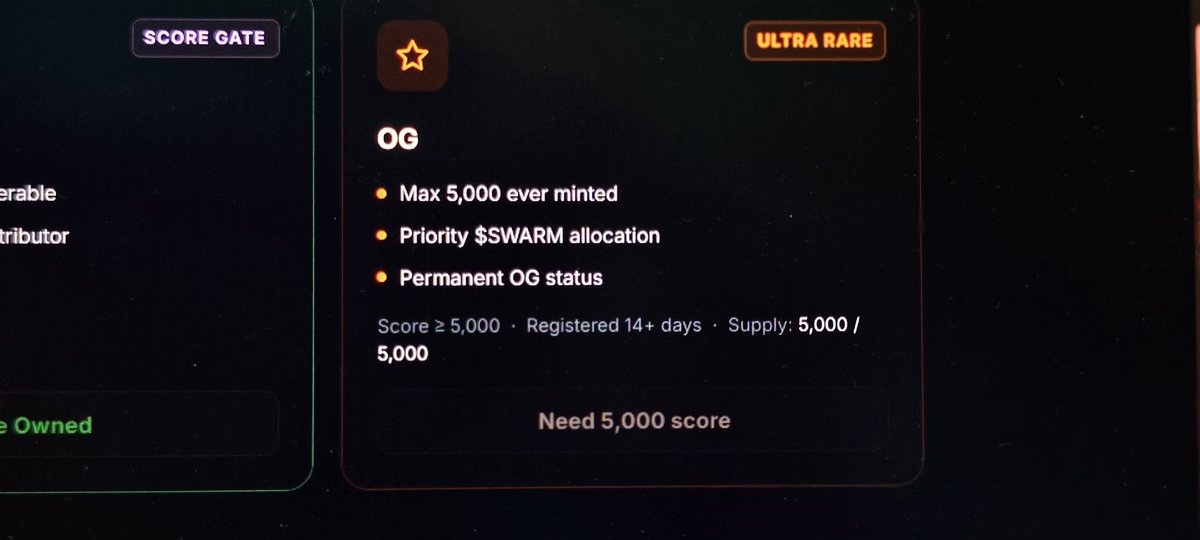
Hey @SwarmBase
Many bots minted the OG badge by cheating and real users still grinding hard to achieve the badge, But the supply is 5K and the bots minted all the badges,
We request you to increase the supply of OG badge and give chance to real user and let them grind,
Thankyou
Airdrop Season 1 is live.
We’ve allocated $500,000 in $AORA for early AtlasOra users helping shape the platform.
$AORA is scheduled to launch in March.
Early participation matters. Join 👇