Today we’re launching the Mental Health Parity Index.
For the first time, health insurance companies’ own data is helping pinpoint where access to mental health and substance use care falls short, and where payment disparities exist in real time.
Most people assume their health insurance equitably covers mental health care — only to find out when they’re in need that it doesn't. A new index is now showing users exactly where and why those gaps exist. Last month, The Kennedy Forum, in collaboration with the American Medical Association, Third Horizon, the American Psychological Foundation and Ballmer Group, launched the Mental Health Parity Index. The first-of-its-kind, open-access tool measures how well commercial insurers are actually delivering mental health coverage compared with physical health coverage. https://t.co/co5HYq0tBo
Today, The Kennedy Forum honors the men and women who made the ultimate sacrifice in service to our country and freedoms, including Lieutenant Joseph Patrick Kennedy Jr. (1915–1944), a U.S. Naval aviator who gave his life in service to the United States. https://t.co/rhzOHD6TEr
A growing number of teens are engaging in gambling, often without parents knowing. A survey found 36% of boys ages 11–17 reported gambling in the past year. It’s a shift that raises new questions about visibility, access, and early exposure: https://t.co/3PTmeKXW4w.
May is #MentalHealthAwarenessMonth! This year, we’re focusing on what it takes to move from awareness to action.
We're taking a closer look at early intervention, emerging risks for teens, the economic impact of mental health, and how schools can play a stronger role in support.
48 million Americans struggle with addiction, and too many still navigate a fragmented health system that fails to communicate. HHS is fixing this—ensuring technology enables the secure, appropriate exchange and use of health information to improve outcomes for Americans facing mental health and addiction challenges.
Grateful to be joined by @PJK4brainhealth, National Coordinator for @ONC_HealthIT Tom Keane, and @KathrynBurgum in this effort to ensure no American is left behind.
NEW from LAC + @kennedyforum: our Network Adequacy Parity Gold Standard brief! Coverage on paper isn’t enough—ppl need to actually be able to find in‑network mental health & addiction care! Info re: how states can measure & achieve real access here: https://t.co/vP5q9lyuxx
Today we’re launching the Mental Health Parity Index.
For the first time, health insurance companies’ own data is helping pinpoint where access to mental health and substance use care falls short, and where payment disparities exist in real time.
Developed by The Kennedy Forum in collaboration with Third Horizon, the @AmerMedicalAssn, the @AmPsychFdn, and @BallmerGroup, this tool brings new transparency to where parity breaks down, and where action is needed.
A new $110M investment from @BallmerGroup targets one of the most urgent challenges in youth mental health: access to care. The funding will expand programs at UCLA and CSU campuses to train the next generation of providers.
As this landscape continues to shift, policymakers, regulators, and public health leaders face a narrowing window to address the risks before they become further entrenched.
Medicaid is the largest payer of behavioral health services in the United States and covers a significant share of children and adolescents. Access to care and the ability to scale new approaches can differ widely across the country. Read more: https://t.co/yMSfZaBfjM.
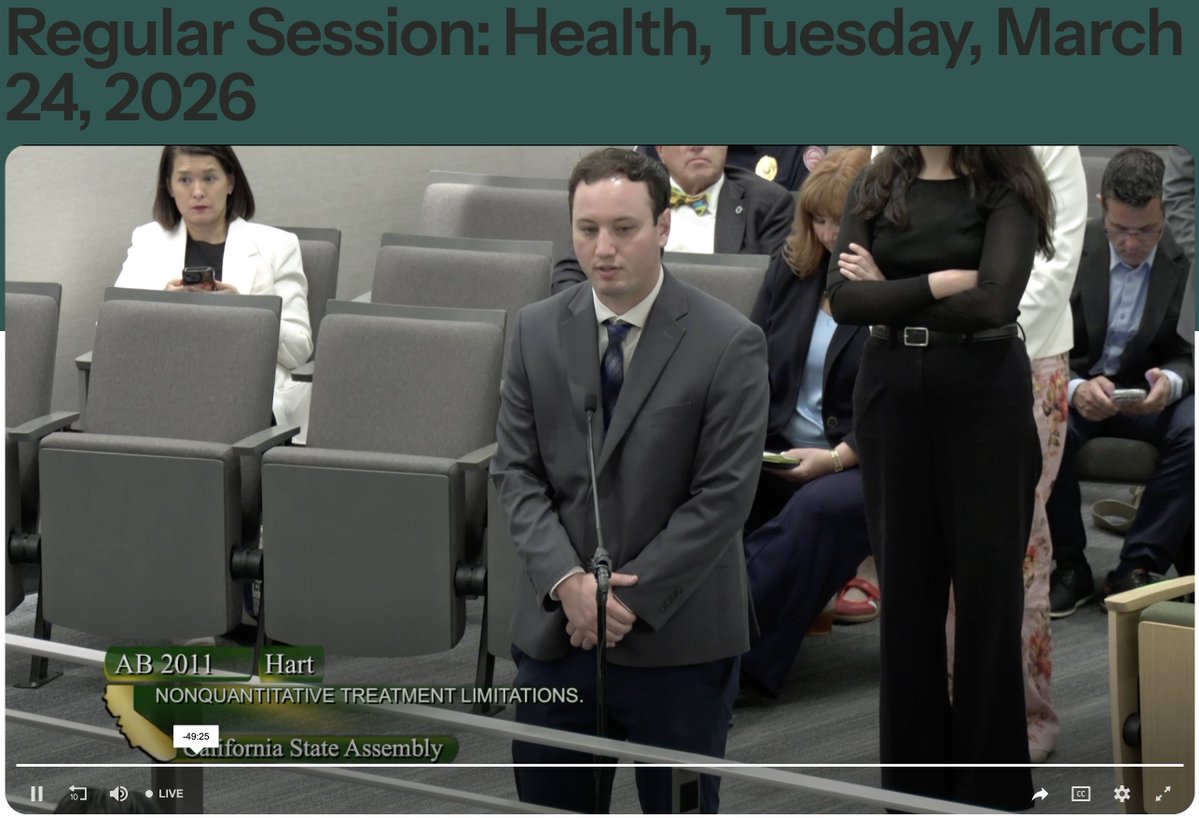
CAADPE's Trent Murphy showed support for AB 2011 today at the Assembly Health Committee.
This bill locks federal mental health parity protections into California state law — ensuring insurers treat MH/SUD care equally to physical health care, regardless of what happens at the federal level.
We proud to support @AsmGreggHart, @Steinberg_Inst, and @kennedyforum, as they aim to protect access to substance use disorder treatment for all Californians.
#AB2011 #MentalHealthParity #SUD #CaliforniaHealth
What’s shaping youth mental health in 2026?
According to the @jedfoundation, it’s not just one thing. It’s everything happening at once. Technology is evolving faster than the protections meant to keep young people safe. Read more: https://t.co/KYZCuv5mGR.
At the @LNImpactForum, @PJK4brainhealth joined @NBCNews’ @tvkatesnow for a conversation on the most consequential issues facing mental health today and why leaders across business, technology, health care, and public policy must work together to move the field forward.
At the same time, adoption varies dramatically across states. Proven models exist to expand access to mental health care, but implementation and reimbursement policies play a critical role in determining who actually benefits.
Read more: https://t.co/swfOa9S3df.
A new study highlights both progress and persistent gaps in mental health care delivery. Use of the Psychiatric Collaborative Care Model (CoCM), which integrates behavioral health services into primary care, has expanded rapidly in recent years.
States need to keep their eye on gold—parity standards, that is! To offer states guidance on implementing mental health & substance use disorder parity concepts, LAC has partnered w/ @kennedyforum—check out our series of briefs here: https://t.co/TbCVV9pYB2