TO PARAMEDICS
INTRODUCE YOURSELF FIRST.
Before we talk about what is inside the ambulance, let’s first explain who we are, what we are trained to do, and the level of care we are qualified to provide.
An ambulance does not define a paramedic.
The paramedic’s education, clinical training, competence and scope of practice define the level of care.
The ambulance is equipped to support that level of clinical practice , which is why we have different levels of ambulance capability, including Advanced Life Support (ALS).
So, before saying,
“This is what we carry in our ambulance…”
Start with,
“This is who we are. This is what we are trained to do. This is the care we are qualified to provide.”
Equipment supports clinical practice.
It does not create the clinician.
#Paramedic #Paramedicine #PrehospitalCare #ALS #EmergencyCare #ParamedicEducation #ProfessionalIdentity #ClinicalPractice
PARAMEDICINE
It represents knowledge, skill, compassion, courage and responsibility.
Behind every paramedic is a commitment to stand between life and death when seconds matter, bringing clinical care, critical thinking and humanity to the patient when they need it most.
#Paramedic #Paramedicine #PrehospitalCare #EmergencyCare #PatientCare #ClinicalExcellence #ParamedicPride #TPAK
This is a very important question.
Paramedics and EMTs are two different cadres, with different levels of education, training, and clinical scope.
EMTs are primarily trained to provide Basic Life Support (BLS) and can operate BLS ambulances. They can also work alongside paramedics as ambulance operators/drivers and assist with patient care within their scope.
Paramedics are trained to provide Advanced Life Support (ALS) and advanced prehospital clinical care, and therefore should be appropriately deployed within ALS-capable ambulance teams and other clinical response models.
The issue is not about one cadre replacing another. Both have an important role in a properly structured EMS system. The problem arises when the roles, scopes of practice, career pathways and deployment models are not clearly defined.
This is exactly why TPAK has been advocating for the recognition and integration of the prehospital clinical workforce within Kenya's healthcare system, including through @_shakenya
With proper workforce planning, Kenya can have BLS resources for appropriate calls, ALS resources for patients requiring advanced care, and appropriately trained paramedics and EMTs deployed according to clinical need.
The ambulance should not determine the profession; the patient's clinical needs should determine the response.
We have a lot of work to do, but with continued engagement with government, regulators, counties, SHA and other stakeholders, we can progressively help Kenyans and the wider health sector understand the distinction between EMT and paramedic practice.
This is what meaningful digital integration of paramedicine should look like. @MOH_Kenya@_shakenya@fnoluga@psmuthoni@Senate_KE@KmpdcOfficial@KenyaGovernors
This video demonstrates something that Kenya's healthcare system needs to think about more seriously, the ambulance is not simply a vehicle for transporting a patient. It is part of the healthcare system.
The paramedic is a clinical professional operating at the first point of contact. Therefore, the systems designed around emergency healthcare financing and service delivery should also recognise the paramedic as part of the digital clinical pathway.
Imagine a Kenyan system where, from the moment an emergency call is received:
📞 Dispatch → 🚑 Paramedic response → 📋 Digital patient record → 🩺 Point-of-care assessment → 💊 Treatment → 🏥 Hospital notification → 🔄 Continuity of care
The information generated by the paramedic should not disappear when the patient reaches the hospital. It should become part of the patient's healthcare record.
This is where we believe paramedicine should have been much more deliberately incorporated into the design of SHA and Kenya's broader digital health architecture.
The issue is not simply about having more ambulances.
It is about asking:
Who is responding?
What clinical capability do they have?
What information do they receive before reaching the patient?
What can they do at the scene?
How is the patient electronically handed over to the receiving facility?
And how does the system learn from every emergency encounter?
This is also why Kenya needs to differentiate its emergency response resources according to clinical capability and patient need.
For example:
🚑 ALS Paramedic Ambulance
For emergencies requiring advanced prehospital assessment, resuscitation, airway management, cardiovascular care, medication administration and other ALS interventions.
🚗 Critical Care Paramedic Response Car
For selected high-acuity cases where an advanced/critical-care clinician can rapidly reach the patient, provide specialist interventions and either stabilise the patient or support an existing ambulance crew.
🚑 Basic/EMT Response
For cases appropriate to that level of clinical need.
The important principle is that dispatch should be clinically driven,not simply vehicle driven.
Kenya should not build a system where an ambulance is dispatched merely because someone requested transport.
We should build a system where the right clinical resource is dispatched to the right patient, at the right time, with the right information.
That is how we begin to move from an ambulance service to an integrated Emergency Medical Services system.
Paramedics should not be an afterthought in digital healthcare transformation. They should be designed into it from the beginning.
#ParamedicineKenya #EmergencyMedicalServices #SHA #DigitalHealth #PrehospitalCare #Paramedics #EMS #EmergencyCare #HealthcareTransformation
@Genesismwanzo1
A good example of why Prehospital Paramedicine is much more than transportation.Scope of practice,clinical governance,education and appropriate paramedic staffing of ambulances matter. An ambulance capable of transporting someone is very different from a properly equipped and clinically staffed prehospital response system.
Paramedics are highly trained healthcare professionals.
@MOH_Kenya@_shakenya@KmpdcOfficial@fnoluga
Every emergency is a reminder that time matters.
Investing in paramedicine means investing in the ability to bring clinical care to the patient, rapidly, not merely transporting patients to hospital.
@_shakenya@MOH_Kenya@Senate_KE
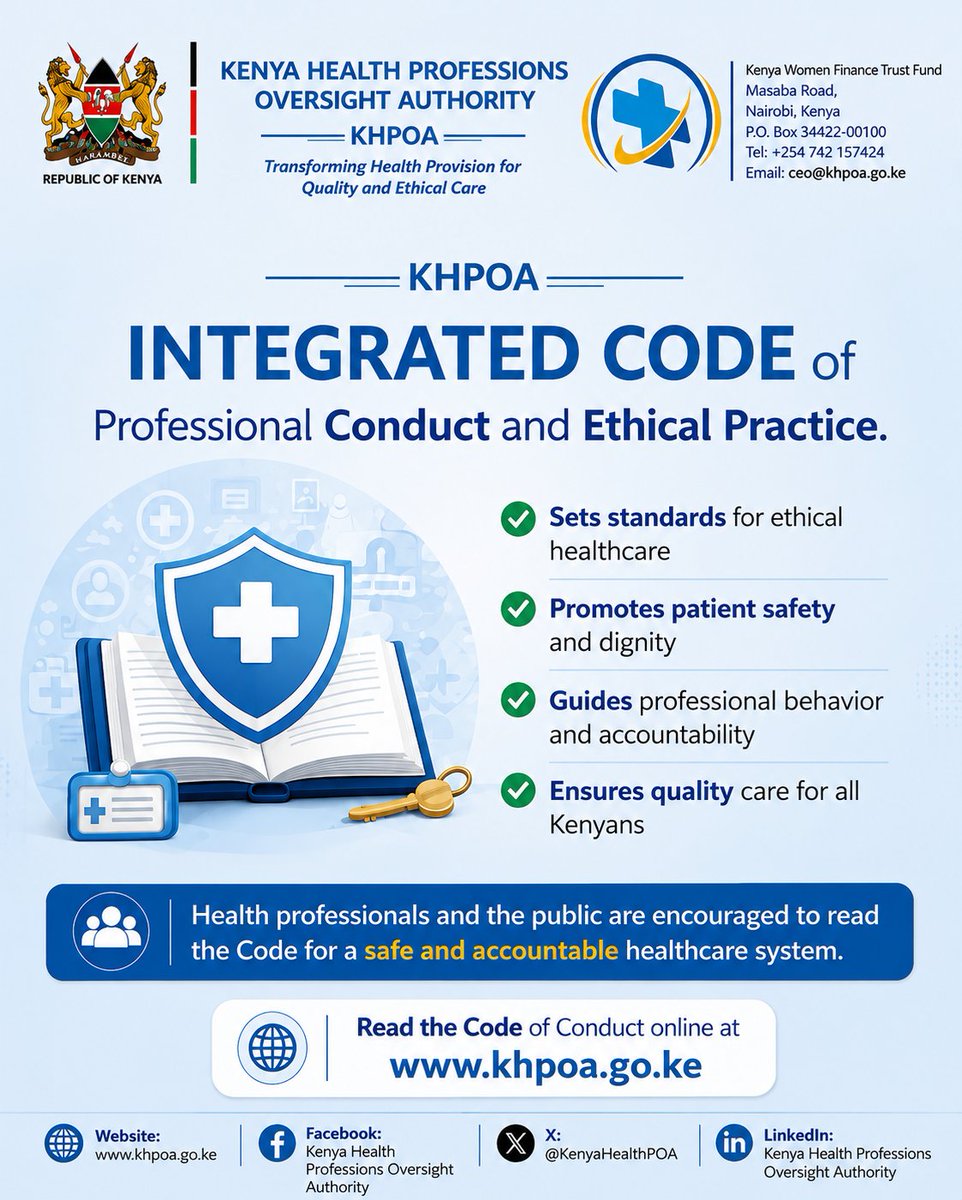
The KHPOA Integrated Code of Professional Conduct and Ethical Practice provides standards to guide health professionals in promoting ethical practice, accountability, patient safety, dignity and quality healthcare.
📖 Read the full Code:
https://t.co/iaB5ewZqM6 @KenyaHealthPOA
The KHPOA Integrated Code of Professional Conduct and Ethical Practice provides standards to guide health professionals in promoting ethical practice, accountability, patient safety, dignity and quality healthcare.
📖 Read the full Code:
https://t.co/J5xj8uVDKp
Internationally, paramedicine is a well-established, degree-level regulated health profession.
Paramedics are trained through accredited university programmes, registered with statutory regulatory bodies, and practise autonomously within a defined scope of practice in the pre-hospital environment.
The entry qualification is a Bachelor's degree in Paramedic Science or Paramedicine, typically three to four years in duration, combining academic study with mandatory supervised clinical placements in ambulance and hospital settings.
Upon graduation, paramedics are registered as regulated health professionals, in the same framework as doctors, nurses, and other clinical practitioners. They are not support staff. They are not an extension of another profession. They are an independent clinical cadre with their own scope of practice, professional standards, and regulatory framework.
The career pathway does not stop at registration. Paramedics can pursue postgraduate study and specialise in areas of professional interest, including critical care, community paramedicine, disaster medicine, education, research, and public health, progressing to Master's level and Doctorate level. In some countries, including the United Kingdom, there are established pathways for experienced paramedics to transition into medicine and qualify as doctors. This reflects the depth of clinical knowledge and competence that the paramedic profession carries.
Paramedicine is therefore not a dead-end career. It is a profession with a full academic and clinical pathway, from undergraduate entry to the highest levels of professional and academic achievement.
This is the standard that Kenya is working towards. The BSc in Paramedic Science is already being offered in Kenya. What remains is formal recognition, a defined and approved scope of practice, statutory regulation, and an established career structure in the public service.
That is exactly what @KenyaParamedics is building.
The Paramedic Association of Kenya (TPAK)
@MOH_Kenya
@EmmanuelKi43789@DrGithiria@Genesismwanzo1 Paramedics are highly trained, and when the system is well designed as you can see from this video Paramedics make everyone safe.
This is actually part of the challenge we face in developing prehospital care. Not everyone has had sufficient exposure to how modern EMS and prehospital clinical care function.
An ambulance is not simply a vehicle for transporting a patient to hospital. It is part of a prehospital clinical system, and the professionals working in it are there to assess, stabilise, treat and continuously monitor patients while determining the most appropriate destination and pathway of care.
Unfortunately, because many people have historically experienced EMS primarily as transportation, the ambulance has become synonymous with transport rather than clinical care. This is precisely why we need greater public and professional education about what paramedics and modern prehospital systems actually do.
The goal should not simply be to get the patient to the hospital faster, it should be to make a clinical difference before the patient reaches the hospital. That is the direction Kenya's EMS system should continue moving towards.