Hyperliquid is a target for what exactly western regulators are spinning up. They extract trading fees, decide which synthetic TradFi markets to list, and coordinate the protocol, European regulators view them as an unauthorized financial intermediary, not a "purecode" protocol.
@BSCNews@cz_binance@HyperliquidX Hyperliquid’s combination of no-KYC + enormous volume + direct competition with traditional derivatives markets makes it a big target. Even if the protocol is on-chain and non-custodial, regulators can target the team, front-ends, or foundation.
CZ Admits Binance Cannot Compete With Hyperliquid
Binance founder CZ (@cz_binance) says Hyperliquid (@HyperliquidX) $HYPE occupies a niche that Binance cannot compete in, according to remarks made on the Galaxy Brains podcast.
Speaking on the Galaxy Brains podcast, CZ described Hyperliquid's innovation as "awesome."
He added that Binance would not pursue the same model given its regulatory experience.
@HYPERDailyTK Hyperliquid’s combination of no-KYC + enormous volume + direct competition with traditional derivatives markets makes it a big target. Even if the protocol is on-chain and non-custodial, regulators can target the team, front-ends, or foundation. Just thoughts 💭
Many people know @solayer_labs only as a restaking project, but looking at their ecosystem expansion in the last few months, it is clear that they do not want to be just an infrastructure layer.
Today I learned about Solayer's new product Margin Trade. At first I thought it might be another simple perpetual trading platform, but after looking at the details, it seems they are trying to do something a little different.
Margin Trade is planned to bring a 24/7 orderbook-based perpetual market, where not only crypto, but also equities, commodities and indices will be traded. Crypto market never closes, so I find the idea of removing some limitations of traditional market very interesting.
Another issue is cross-margin support. Generally, if you want to trade different assets, you have to manage capital separately. Solayer is here trying to increase capital efficiency across all asset types, which can be quite beneficial for active traders.
They have brought a new approach with the liquidation system. ADL engine will use pro-rata model, so that no particular trader is fully stressed during market stress. Time will tell how effective it will be in practice.
What is most interesting is that Solayer is not limited to creating a chain infrastructure or liquidity layer. They are gradually building products that end users can use directly. Many projects on Web3 talk about roadmaps, but very few projects reach actual product launch.
Top traders have already participated in beta testing and now the platform has entered the public beta phase. So user feedback and trading activity will be watched in the next few weeks.
Personally, I think this move by Solayer shows that they not only want to power the backend of the ecosystem, but are also moving towards building a complete financial ecosystem on Solana.
Let's see how big a milestone Margin Trade can become for the Solayer ecosystem in the future.
@solayer_labs
@margin_trade@prlnet I can say the volumes on the testnet are quite impressive. Many billions and it keeps working with little latency. Yes, I definitely like it.
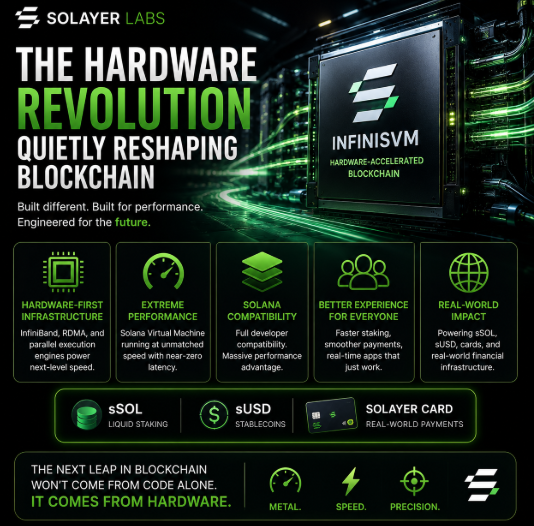
Solayer Labs: The Hardware Revolution Quietly Reshaping Blockchain
While most projects compete on software upgrades and marketing, Solayer Labs took a bolder route, they brought specialized hardware into the heart of blockchain infrastructure.
InfiniSVM isn’t just another Layer-1. It’s a high-performance network that uses real computing power, InfiniBand networking, RDMA, and parallel execution engines, to run the Solana Virtual Machine at speeds most chains can only dream about. This hardware-first design removes the usual bottlenecks, letting transactions fly through with near-zero delays even under heavy load.
The result feels different. Developers get Solana compatibility plus dramatically better performance. Users get faster staking, smoother payments, and tools that actually respond in real time. Everything from liquid staking (sSOL) to spendable stablecoins (sUSD) and real-world cards benefits from this foundation.
@solayer_labs is proving that the next leap in blockchain won’t come from clever code alone, it will come from treating infrastructure like the high-performance systems that power today’s internet and finance.
They’re not promising the future. They’re engineering it with metal, speed, and precision.
This is what happens when blockchain grows up.