Biscuit taster. SQL DBA & Developer. F1 & motorsports fan. Linux wrangler. Data Privacy advocate. Web botherer. Takes too many pictures.
Say no to digital ID!
Over 300,000 people die of drowning each year. In order to protect society, it is now illegal to consume or possess water.
Your government is also considering banning solid food, as it presents a needless choking hazard.
You are not an adult.
You are a baby.
Eat the baby food.
David Lammy’s proposals to restrict the right to jury trial have been examined by the Justice Committee of the House of Commons.
And. Well. Um.
It’s *quite* the report.
I think it’s actually worse than politely scathing.
It’s embarrassing 👇🏼🪡🧵
Our statement on the UK government’s demand that all content on all devices sold or used in the country be scanned, on the presumption of nudity, using a dystopian combination of age verification and content scanning. This proposal will not safeguard children. It endangers us all.
https://t.co/VdWe9uhi8p
Some politicians in the UK think it is a good idea to introduce identity verification for using VPN services.
It could be that these politicians do not understand what they are proposing. The alternative, that they do understand, would be even worse.
Whistleblowers, activists, and journalists depend on anonymous VPN services. Requiring identity verification for VPN services would put them at risk. It would also have a chilling effect on online debate (VPNs can help people post anonymously on social media).
In authoritarian countries, VPN services are crucial forcriticizing the government. That is precisely why such governments seek to ban or restrict them. Hopefully, the UK will not join that list.
So-called age verification for social media is spreading across the world, framed as an effort to create a safer internet for children. In reality, age verification lays the foundation for a fully controlled internet.
The age verification rush must be slowed down, and politicians need to recognize the consequences of different types of legislation and systems.
Age verification is the wrong approach to fix “the social media problem”
The big tech social media companies are bad. Their business model is bad; it is based on mass surveillance and manipulation, and they cooperate with governments in mapping entire populations. But age verification is fundamentally the wrong approach to preventing children from using big tech social media platforms. Introducing age verification is based on coercion; the state forces social media companies to verify their users’ identities. But the big tech social media platforms already know which of their users are children. Their business model depends on knowing this. They know how old users are, and they know exactly what type of person they are. As age verification is based on coercion, politicians could instead force platforms to stop doing the things politicians consider harmful to children, or force them to block children (again, they know who they are) from using their services. But instead, politicians seek to massively invade everyone’s privacy and undermine democratic rights on a global scale. In other words, the latter is the real objective – they do not want to protect children; they want to impose control.
Slippery slope of age verification
It is undeniable that age verification threatens freedom of expression, risks increasing mass surveillance, and is likely to lead to censorship. It will not only shrink the online world and reduce young people’s right to privacy (for example, if VPN services were to be restricted); but also risks becoming a significant step toward a controlled internet for everyone.
Most age verification is identity verification
Most countries are now considering introducing age verification systems, meaning that everyone would have to identify themselves either to the service/website they want to use or to a third party capable of linking them to their activity on that service or website. This is not age verification but identity verification, and the consequence is therefore that freedom of information is restricted (you can no longer visit regulated websites anonymously) and that you can no longer post anonymously on social media. This is a major problem in countries like the UK and Germany where the police conduct raids on people’s homes for posting content on social media that the authorities dislike. Or in the United States, where authorities are trying to pressure tech companies into revealing the identities behind accounts protesting ICE. Social media identity verification removes important tools for activists in countries where criticizing those in power is dangerous.
Restrictions on app store or operating system level
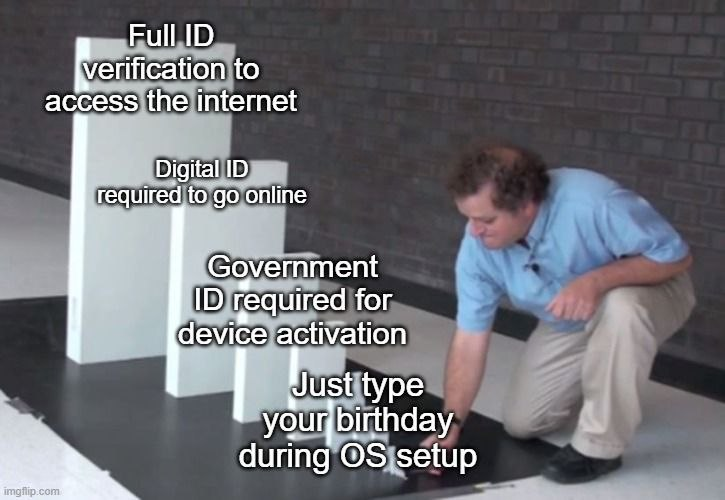
Some countries are looking to impose identity verification at the app store level or even within the operating system itself. This is an exciting experiment, since this is possible to circumvent using open-source operating systems. Some countries are already looking to include open-source systems. Since open-source systems cannot be controlled, politicians would ultimately need to ban devices that are not controlled by the state. The end point: telescreens like those in Orwell’s 1984, devices that both monitor you and broadcast only the information approved by the state.
The Zero-Knowledge Proof (ZKP) alternative and the EU
The EU has presented its own age verification app as “completely anonymous”. The idea is to use Zero-Knowledge Proof (ZKP) cryptography to break the link between the age credential issuer (EU governments) and the regulated services/sites. Currently, the EU app does not have ZKP functionality, contrasting Ursula von der Leyen’s claim that the app ”is technically ready to be used”. But more importantly, the app is currently designed to always function without ZKP technology; if ZKP is unavailable, the app falls back to a non-ZKP model. Even if fully developed ZKP technology could be implemented in the future, it would remain an optional extra feature that countries may choose to disable and that the EU could remove at any time.
Read more on our site.
https://t.co/wTVKHMS1zg
I can't properly describe to anyone under the age of 30 just how cool the Internet was before Amazon, Google, Meta, and Apple turned it all into a walled garden of garbage and commerce.
Cadbury was founded in Birmingham in 1824.
In 2010, it was acquired by an American company.
Today, much of the profit from one of England's best-known chocolate brands flows to overseas shareholders.
The UK chocolate market is worth over £8 billion a year. If just 10% shifted to English-made producers, that's £800 million supporting businesses, jobs and investment here.
We're building https://t.co/eWD8weWXHH to make it easy to find them.
"But you clicked consent"
Consent isn't meaningful in a 60 page document written in legalese only for liability protection and not for actually informing people about what's going on.
This!. This!!. This!!!. A thousand times this.
Digital ID for social media does not make anyone safer. It creates a searchable, linkable record of everything you say, connected to your real identity. It is meant to discourage people from speaking freely.
When governments restrict VPNs, they are deciding which parts of the internet you can access, even though you pay for that access.
You do not need privacy because you have something to hide. You need it because those in power are always tempted to misuse what they can observe.
Once surveillance systems are in place, the real question is not if they will be misused, but when and by whom.
If your country requires digital ID verification to use social media, then you don't live in a free country anymore.
If your country want to regulate or ban VPNs, you don't live in a free country anymore.
Using the internet in 2026, a vignette:
> go to website, enter username and password
"Please confirm your phone number so we can send it a verification code".
> enter phone number
> receive code
> enter code
"We've sent a code to your account's email address. Please enter that code to continue."
> go to email
> get code
> enter code
"Welcome to SomeWebsite! Our experience is better on the app. Would you like to download the app?"
> X out
> scroll down a ways to the thing you are looking for
"SomeWebsite is better on the app. Please download the app to continue."
> press X
The website scrolls you back to the top
> scroll down again
Same message. You realize that accessing this, and most other functionality, is gated behind the app for you even though the website itself has this functionality too.
> go to app store
> search SomeWebsite
> download app
> open app
"Welcome to SomeWebsite's app! To properly operate, this app needs permissions for your location, contacts, bodily fluids, and firstborn son. Please click below to go to settings and enable these permissions."
> click button, go to settings
> enable all sorts of permissions
> go back to app
> enter username and password
"We've sent a code to your account's phone number. Please enter that code to continue."
> get code
> enter code
"Thank you for logging in! Would you like to use passkeys instead? You can use Touch ID, facial recognition, or a retina scan."
> no, I'm not gonna do biometrics
"SomeWebsite would like to send you push notifications. Do you accept?"
> no
And now you can FINALLY do the thing you wanted to do.
3/ They could have empowered parents with the tools that already exist on every smartphone, every router, every computer.
They could have implemented device-side age verification — proposed by Apple — that flags a child's device without surveilling every adult.
They could have used cryptographic age proofs that verify age without identity disclosure.
They rejected all of it.
1/ "Online Child Safety Acts" are being passed in every state, every country, every legislature on Earth — all at the same time, all using the same language, all promising to protect your children.
These laws are NOT what you think they are.
This is an incredibly worrying story by @Williamrt for @ComputerWeekly.
It appears that Europol, the EU police force, has been operating a shadow IT system that processes vast quantities of sensitive information, including information about innocent individuals, without proper scrutiny.
The Home Office must now say whether any personal data of entirely innocent British citizens is being stored in Europol’s systems and, if so, why it is being stored and why the UK government is allowing it to be stored.
https://t.co/zjx6WtDlqL
Dear Microsoft, when I hit the Windows Start menu key and start typing a word to autocomplete a search, I never, ever, EVER want it to return results of something not on my computer. Ever. Like, ever, ever, never.
🚨DIGITAL ID "CONSULTATION" ENDS TOMORROW!
Let's stick it to them
Were you one of the 3m people who signed the petition against Digital ID?
They haven't stopped - their "consultation" is about to close
Do respond - otherwise it’s even easier for them to pretend there’s no opposition 👇
https://t.co/ukds6QFdMF
Britain has taken a serious step backwards under Labour when it comes to free expression.
Social media restrictions for children.
Adults being arrested over posts on Facebook and X.
You can criticise the Conservatives all day long, but we didn’t see this level of government overreach before Labour took power.
This isn’t progress.
It’s authoritarianism creeping in.