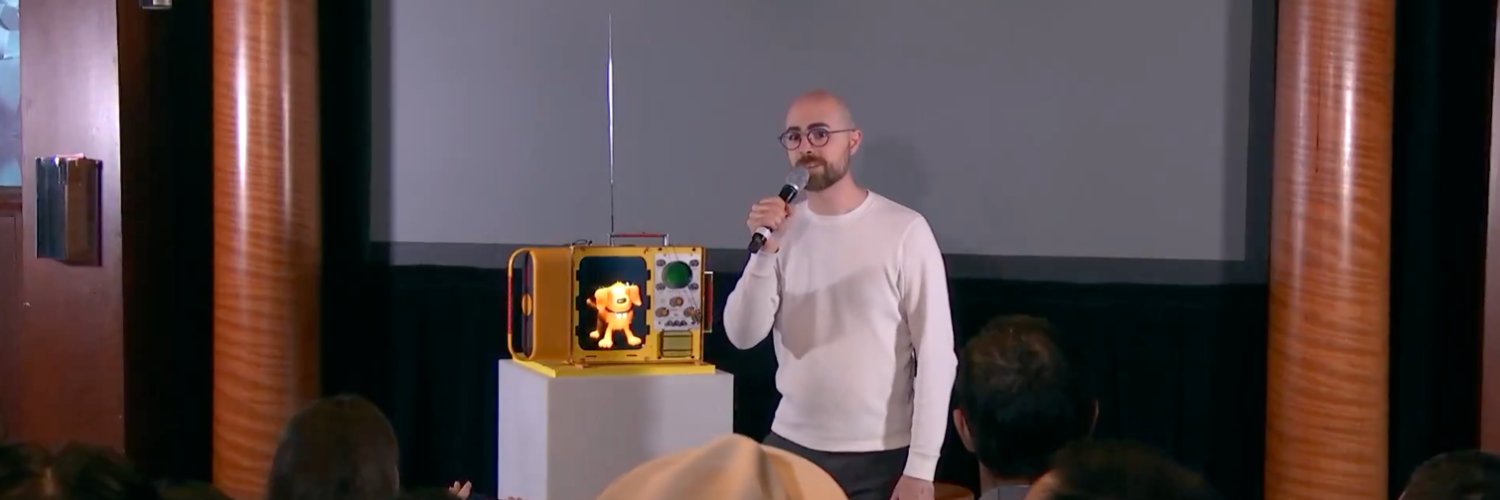
After four years, I’ve decided to wind down active operations at Illusion of Life, formerly known as Open Souls.
I founded the company with a strange question: what would it mean if AI felt like it had a soul?
Together, with a group of incredible people, we explored whether AI characters could feel present, emotionally real, and alive in a way traditional software never had.
I’m proud of what we built. Spark reached millions of people, formed real relationships with families, and helped show that interactive characters could become something more than content, avatars, chatbots, or interfaces.
This chapter is closing, but I believe the ideas we explored will continue to shape how people think about AI, characters, screens, and human-computer interaction.
I’m taking some time before sharing what comes next, but I expect I’ll keep working near the questions that animated Illusion of Life.
Thank you to everyone who built, supported, believed in, loved, or spent time with Spark, Illusion of Life, and Open Souls.
It meant more than I can easily say.
After four years, I’ve decided to wind down active operations at Illusion of Life, formerly known as Open Souls.
I founded the company with a strange question: what would it mean if AI felt like it had a soul?
Together, with a group of incredible people, we explored whether AI characters could feel present, emotionally real, and alive in a way traditional software never had.
I’m proud of what we built. Spark reached millions of people, formed real relationships with families, and helped show that interactive characters could become something more than content, avatars, chatbots, or interfaces.
This chapter is closing, but I believe the ideas we explored will continue to shape how people think about AI, characters, screens, and human-computer interaction.
I’m taking some time before sharing what comes next, but I expect I’ll keep working near the questions that animated Illusion of Life.
Thank you to everyone who built, supported, believed in, loved, or spent time with Spark, Illusion of Life, and Open Souls.
It meant more than I can easily say.
@aidan_mclau@DanielleFong inasmuch as a human survives as the same person into the late 20s. there’s certain core emotional responses which are fixed, but the way those drives express themselves and receives feedback changes irreversibly
clarifying what studying the physics of deep learning actually means:
the platonic representation hypothesis shows that deep networks are tools probing the structure of reality itself. specifically, the structure of information.
so the real work is uncovering the mechanics of how information is learned, compressed, stored, and represented during training. there should be discoverable laws (the actual “physics”) governing information learning dynamics and geometries.
as a corollary architectural innovations are mostly just different effective learning methodologies within that same underlying physics.
deep learning models need to be studied the same way we do physics
physics is about discovering heavily dimensionally reduced predictive models that humans are able to intuitively use to understand outcomes
there’s not really a different sense in which a complex system can be “understood”
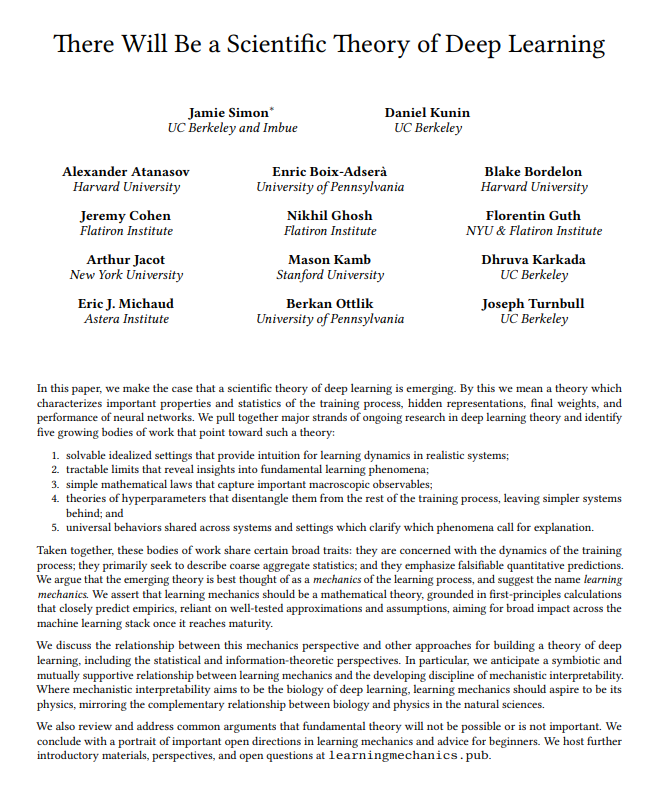
This is a very interesting paper
It argues that a real scientific theory of deep learning is starting to form.
Researchers call it "learning mechanics." It's like physics, but for how neural networks learn.
Now there are 5 active research areas that together look like pieces of this theory:
1. Simple systems (like linear networks) that we can fully solve. Math there works cleanly and we have intuition about how learning behaves.
2. Studying extreme limits, like what happens if a network becomes infinitely wide.
Systems become mathematically tractable in these cases.
3. Simple laws that describe large-scale behavior, like scaling laws (performance vs. data/model size) and relationships between sharpness and generalization
4. Understanding hyperparameters separately
Learning rate, batch size, weight decay and other effects can be separated to make training look like a simpler system underneath.
5. There are underlying principles shared across systems as they scale: similar training dynamics, scaling trends, internal structures
Old theory can’t explain what we see today, that's why we need a real theory upgrade. But why it should be about mechanics?
The researchers see that deep learning needs 2 parts: mechanistic interpretability is like biology that studying individual parts, and studying overall laws and behavior is like physics.
this type of work has the motivations for the investigative chain inverted
this work is an example of “how do i use physics principles to optimize things that basically already work”
i think that there are significant breakthroughs to be had by studying the physics of the networks themselves