“ITS CALLED ‘POLICY LAUNDERING’ AND ITS WHEN YOU GET A FOREIGN GOVERNMENT TO ADOPT YOUR PLAN AND THEN RUN A PR OP BACK AT YOUR WASHINGTON OPPONENTS SAYING ITS AN ‘INTERNATIONALLY RECOGNIZED STANDARD’.”
1. Never happens.
2. If it happens, the paedophile isn't trans.
3. The real crime here is the deadnaming.
4. TERFs love it when this stuff happens.
5. OMG why do you even care?
They are changing what it means to be America, one district, one city, one state at a time. And if you listen to the people leading this political conquest, they say that over & over. You don’t have to wonder or make it up. You just have to pay attention to what they are telling you. Do you want sharia law or the constitution? Women’s rights of subjugation of women? This is not a game or a show. This is not political theatre. It is real. It is right here. And it is an unholy alliance between the left, political Islam, internal actors/traitors and the globalist puppet masters who’re directing it.
This is why mass Indian infiltration via illegal border entry, visa and employment fraud isn't a simple economic problem. Deeply rooted in their culture is an amoral ruthlessness Americans have never experienced before, and will only face it when they have reached critical mass.
Our country is so demented it no longer knows its own insanity.
Like your Uncle with advanced Alzheimer’s naked in Lidl threatening staff with a carrot
Never forget when LeBron James tried to doxx and threaten the life of a white police officer for killing a black woman before he had any facts about what actually happened. Then the bodycam footage came out and showed that the officer heroically SAVED the other black woman’s life that was about to be stabbed to death.
After this, LeBron deleted the post in shame after MILLIONS of people had already seen it… many of them still believe it was a racially-motivated police shooting to this day. He STILL has never apologized to the officer for doing this… just moved on like it never happened.
Thales Storytime. My father owned a McDonalds franchise back in the 90s, and build a playplace in it. It was fun, all the kids loved it, business went up.
Then a black kid had to take a dump. And his mother told him to just do it in the ball pit because I dunno, dumbass ghetto trash. All the balls had to be thrown away, the playplace had to be closed, professionally disinfected at enormous expense per regulation, and basically all the revenue increase for that year was eaten up by one dumbass and the playplace had to be blocked off, which irritated customers who saw it and then couldn't bring their kids inside. Many complained. about false advertising, etc.
A cool thing became a drag and a negative.
I get why these went away. It sucks, it really fucking sucks, but we can't have nice things when welfare queens tell their kids to take a shit in the playground.
If you read Jefferson's Notes on Virginia and Hamilton's Discourse on Manufacturing, you learn that they both agreed that our nation would not survive being swamped by foreigners with no allegiance to our government.
Cato now considers this to be "right wing socialism."
Die Linke won the Berlin election. They want to provide public spaces for smoking crack, replace the police with social workers, legalise fare evasion and grant squatters ownership rights.
Good luck everybody!
https://t.co/PbV0K3uinT
Macron's former Prime Minister, who is candidate at France's next presidential elections, proposes to "build the United States of Europe" 👇
I've been hearing this discourse ever since I was a child, that we cannot compete with the US and China without a strong Europe.
Which, granted, makes a lot of sense on paper: if you're to compete against giants, you've got to be a giant yourself. Logical, right?
Except, in practice, the exact opposite occurred. Just look at the evolution of relative share of global GDP (https://t.co/X0iTKx9hcy): in 1992, the year of the Maastricht treaty (which officially created the EU), the countries making up the EU used to have 28.8% of global GDP which was actually more than the US (25.7%) and China (1.9%) combined!
Fast forward to today and both the US and China's shares have grown - in the case of China it's grown considerably - but Europe's share has shrunk to around 17%, the same share as China, losing about 40% of its economic weight in a mere 3 decades.
Which means that, very concretely, more Europe - and there has been, treaty after treaty, more and more Europe - has so far meant more and more economic irrelevance. The more we built Europe - this supposed economic giant on paper - the smaller we got economically.
And it's not a China story, it's not that simple: if it were, the US's global share of GDP would have shrunk alongside Europe, but it just didn't. Which means it's really a Europe problem.
And, unfortunately, it's not just the economy. More Europe has meant more irrelevance and weakness in just about all fields that matter.
Take foreign affairs for instance. There used to be a time when Europe's voice mattered in the world - or at least that of the countries making up Europe.
When, say, De Gaulle could, in the space of a single year, pull France out of NATO (https://t.co/asl494VdaU), ask American troops to leave French soil (https://t.co/7IM0R10bGi), and then fly to Phnom Penh to tell a packed stadium that the US had no business waging war in Vietnam (https://t.co/LMipIYWaKa). Try to picture a single European leader doing even one of those three things today.
Heck, in 2009 France got **back** in NATO, a sad illustration that the "strong Europe" we were promised as a counterweight to the US has in practice meant ever deeper subordination to it.
It's even written in black and white in the Lisbon Treaty itself (https://t.co/PRy91R7Dip), which states that NATO "remains the foundation" of its members' collective defence. So much for the independent giant...
Or take another critical dimension of power: technology. The countries of Europe used to sit at the technological frontier: Concorde, Ariane, the TGV, the World Wide Web invented at CERN, etc. A reminder that as late as 2007 a single European company, namely Nokia, sold 4 out of every 10 mobile phones on the planet.
Today look at the ASPI Critical Technology Tracker (https://t.co/JkfQboeBFn): out of the 74 critical technologies of the future, in how many is any European country in the lead? Answer: not a single one of them.
And I'm not even speaking about energy, culture, and a dozen other fields where the story is identical.
On energy alone: European companies now pay 2 to 3 times more for their electricity than their American and Chinese competitors, and just last year Brussels pledged to buy $750 billion worth of American energy as part of a trade "deal" for which it received, in exchange, 15% tariffs on its exports. Some giant...
Long story short, there is the logic on paper and then there is the logic in practice: when you see that the patient has been getting steadily sicker for 3 decades, and that the doctor's only answer, year after year, is to increase the dose of the very same medicine, at some point you have to question the medicine. Or the doctor.
De Gaulle, coming back to him because he was in my view one of the most prescient statesmen we ever produced, saw it coming clear as day: as early as 1962 he warned that a supranational Europe, having dissolved the only entities capable of having a will and a policy of their own - nations - would have no policy at all, and would end up following someone else's. He warned that "there would perhaps be a federator, but he would not be European" (https://t.co/hrhtRKUDd9).
In the same 1962 press conference he also beautifully said that "Dante, Goethe, Chateaubriand belong to all of Europe to the very extent that they were respectively and eminently Italian, German and French. They would not have served Europe much had they been stateless men and had they thought, written in some integrated Esperanto or Volapük."
That was his conviction: that Europe's genius is really the sum of its singular geniuses, and that you cannot add them up by melting them down.
If you make some sort of soup out of French, Italian, Greek, and Spanish cuisine, all thrown in the same pot, you don't get all the flavors at once. Instead, you've destroyed four of the world's great culinary traditions to produce something no one wants to eat.
I'm not anti-European, by the way, and neither was De Gaulle. I do believe - and so did he - that Europe should be a power in its own right. What De Gaulle called a "European Europe": independent of Washington, speaking with its own voice, master of its own destiny.
He simply understood that only nations can carry such an ambition, because only nations have a will. Which is the great irony of this whole story: those who claim to want a strong Europe are busy dismantling the only thing that could ever make it one - the sovereignty of nations.
On this topic, I just stumbled upon an extraordinary number released by China's National Radio and Television Administration (NRTA): 430,000 micro-dramas (short TV series) went online in China in the first 8 months of 2026, and over 90% of them were AI-made (https://t.co/sZcxNq5RA6) 🤯
And micro-dramas aren't a micro-phenomenon in China: still according to the NRTA, they're watched by 800 million people - a good majority of the population - and the market passed 100 billion yuan last year, about twice China's cinema box office (https://t.co/Xo8QN9aWFg).
Which means that, that's it, we're there: the majority of new TV-style series in the world's largest market are made by AI.
I knew anecdotally that AI entertainment content was big in China (hence my casual take last night 👇) but I'm genuinely awed by the scale and speed of it: AI dramas were virtually non-existent at the beginning of last year and, fast forward a year, it's now human-made dramas that are the exception!
To be clear, this is about what gets made: many of these AI dramas are - like YouTube videos - made by everyday folks and don't that much viewership. But that's how every creator economy works: a long tail few people watch, and a handful of hits that reach hundreds of millions.
This might possibly become China's answer to Hollywood. We're talking immense production cost advantages: the cost per minute of footage for AI micro-dramas is roughly 1,000 yuan ($140, https://t.co/gElTrHJJ7Q) while your typical Netflix drama costs $5M to $10M per hour-long episode, so $85,000 to $170,000 a minute. In other words, it's roughly a thousand times cheaper to produce.
And there are other advantages too: with AI, it's ridiculously easy to re-render the footage with local faces, languages and other local cultural characteristics for every single international market at near-zero cost. Which would be something Hollywood never had: a culture-neutral fiction factory.
All the more because we're also starting to see full-length AI dramas appear.
In fact, just 3 weeks ago, Hunan TV, one of China's biggest channels, began airing in prime time "Hou Xiyou Ji" ("The Later Journey to the West"): a 30-episode series of 40 minutes each, entirely AI-generated, without a single human actor. You can watch the first episode here in full: https://t.co/DHsqIxsGX2 and see for yourself that it looks remarkably well made.
It went from approval to broadcast in just under 4 months and, according to the series' director Li Dongshen, costs about 900,000 yuan per episode to make ($135,000), or 50 times less than your typical Netflix series (https://t.co/om4UQsE3HJ).
And it did very well: it topped its time slot among provincial satellite channels five nights running, passed 150 million plays on Mango TV in its first five days, and sent Mango Excellent Media's stock up 44% in two days, adding over 11 billion yuan to its market value (https://t.co/JVvpGD0B9H).
Bear in mind that at the beginning of 2025 the technology could not do this at all (back then, no-one could produce more than a few seconds of coherent AI video, let alone a 40-minute episode with consistent characters) so it's an understatement to say that things are moving fast. Imagine where this will be in another 18 months: today is the worst AI dramas will ever look.
Interestingly, this technology is overwhelmingly Chinese. Where China is roughly on par vs the West for frontier LLMs, it is clearly ahead in AI video: on the main blind-test leaderboards (https://t.co/Io4rdccaYZ), out of the 10 top spots, 9 are held by Chinese models (ByteDance's Seedance, Alibaba's Wan, https://t.co/QKbcemwQkO's MAGI-2, Minimax), with Google the only Western lab still in the race.
And they've clearly unlocked some sort of flywheel which gives them a considerable advantage: the companies building the models are the same ones that own the platforms where the content gets watched.
ByteDance makes Seedance and owns Douyin and Hongguo, China's biggest micro-drama app. Alibaba makes Wan and owns Youku. Kuaishou makes Kling and owns, well, Kuaishou. So hundreds of thousands of AI dramas get made with their models, then watched by 800 million people on their app. Better models make better dramas, better dramas bring more viewers and more creators, and round it goes.
No Western lab has anything like it: OpenAI had a model - Sora, being discontinued this very week (https://t.co/c1PeqrXRRz) - but no audience, and Netflix has an audience but no model.
Only Google has Youtube but, so far, it strangely doesn't seem to have connected the pieces: it has the best video model in the West and the biggest video audience in the world, but no serialized drama format built on top. If anyone in the West can replicate the Chinese flywheel, it's them. But for now, they haven't.
In any case, long story short, what this all means is that the entertainment industry, in Hollywood and elsewhere, is on the cusp of being seriously disrupted, and its epicenter is China.
Humans won't disappear from the process - even in China, the regulator's line is that "AI is a tool, humans are the creators" (https://t.co/ewv3PuZ9uk) - but it matters a great deal which humans, and whose tools, and it looks increasingly like the next generation of storytellers will either be Chinese or using Chinese tools.
Putting Canada and France in there is like when leader of Albania once said: "Remember, together with the Chinese, we comprise a quarter of the world's population"
This blew my mind: between 1403 and 1407, the Ming Dynasty emperor commissioned an encyclopedia - now called the Yongle encyclopedia, after the emperor - that was so vast in scale (around 400 million Chinese characters) that the only other encyclopedia that finally exceeded it was Wikipedia in 2007, 6 years after its launch!
This is yet another example of West-centric our sense of intellectual history is: in French education we're taught that encyclopedias as a concept started with Diderot and d'Alembert's "Encyclopédie" in the mid-18th century, which we're told was the first attempt in history to gather all of human knowledge in one place.
Not only was the Yongle encyclopedia completed 350 years earlier, and not only is it 20 times larger than L'Encyclopédie, but it was itself a very late entry in a Chinese tradition of encyclopedias which started with the Huanglan - more than 8 million characters in length - compiled around 220 AD (https://t.co/jlWoDrDzwa).
Unfortunately much of the encyclopedia has been lost: out of the original 11,095 volumes, only around 400 are known to have survived (300-ish of which are in China). But we sometimes find new ones, like two volumes that surfaced in 2020 in the attic of a French family, descendants of a naval officer who had received them as a gift from corrupt Chinese officials in the 1870s.
They went to auction in Paris with a starting price of 5,000 euros and sold for 8.12 million to a Chinese textile entrepreneur, Jin Liang, who donated them to China's National Archives of Publications this summer (https://t.co/2bRD4or98r).
Ok, we now have the actual text of the Greenland deal (https://t.co/VxZ1Q47jsh), so we can say how it compares to the existing 1951 arrangement and who, between Trump and Denmark, lied the most in their framing of it.
Long story short - which may surprise some - the Danes lied the most: Trump is pretty much correct in saying that this new deal grants the US control of Greenland.
Let's look into what changed compared to the 1951 deal.
1) This is now a permanent arrangement: whereas the existing 1951 deal only lasted as long as NATO existed, this one "does not have an end date and may only be amended by mutual consent."
It even survives a hypothetical future independence of Greenland: in that event, Denmark and Greenland must ensure that the independent Greenlandic state "affirmatively assume[s] all of the rights and obligations of the Kingdom of Denmark specified in this Agreement."
2) In the 1951 agreement, the US could set up bases only where both governments agreed, and only on the basis of NATO planning. The new deal locks in three bases: the US can "modernize and expand its activities" at Pituffik, its only base in Greenland until now, and "shall be allowed to establish an additional Defense Area at Narsarsuaq and Mestersvig." Further bases beyond these 3 can be justified by the defense of "the American continent," a US interest rather than a NATO one.
Also, quite subtle but this is interesting: Article IV(iii) says that "the United States may establish additional defense areas in Greenland" and that consultations are then held "to decide implementation details based on mutual agreement." What this means is that the principle of a new base is automatically granted and only the implementation details require agreement.
Article VII also gives the US "the right to raise concerns regarding construction, or change of use" of any building near a US base, after which the parties decide together what to do. Which means that the US has a say over civilian planning around its bases.
3) On US military movement across Greenland, the wording change between the 1951 agreement and this new one is quite funny.
The 1951 text said (Art. V(3)): the US "may enjoy... the right of free access to and movement between the defense areas through Greenland, including territorial waters, by land, air and sea," but only "in accordance with general rules mutually agreed upon and issued by the appropriate Danish authority in Greenland."
The new one says: "the United States of America shall enjoy... the right of free access to and movement between the Defense Areas through Greenland, including the Territorial Waters, by land, air and sea."
That's it: "May" becomes "shall," and the US military movement no longer has to follow rules "issued by the appropriate Danish authority in Greenland." The US also gets something new on top: "undersea access to and movement within the Territorial Waters," i.e. submarines.
4) Non-NATO exclusion: non-NATO states are barred from military installations or a persistent presence in Greenland unless all three parties approve, giving the US an effective permanent veto. The 1951 deal had no equivalent clause.
5) Investment screening: this is entirely new. "States or investors from a state that is not a member of NATO, a NATO partner, or an EU member state" (i.e. Russia, China, India, the Gulf States, etc.), "shall not be allowed to have (i) control, (ii) significant influence, or (iii) access to non-public information...within Particularly Sensitive Sectors or Activities in the territory of Greenland (including the Territorial Waters), unless agreed between the Parties."
Again, it basically means that the US has a permanent veto over who can invest in strategic sectors in Greenland, as far as non-NATO or EU states are concerned.
6) Lastly, in stark contrast with the 1951 deal, the framing of the deal changes significantly: this new deal is largely framed around the US.
The 1951 agreement existed only "for the benefit of the North Atlantic Treaty Organization." The new one lists the defense of "the American continent" as an objective, celebrates "the irreplaceable role" of the United States military as well as "the United States' indispensable historical and ongoing contributions to the security and defense of Greenland," and names the establishment of Trump's "Golden Dome" missile defense system as a key goal.
So, to sum up:
- The US secured a permanent military foothold that even an independent Greenland would inherit whether it likes it or not
- The US now has veto power over any non-NATO military presence in Greenland, and over who can invest in its strategic infrastructure and resources (beyond NATO and the EU)
- Denmark signed away its say over the principle of new US bases, with only the right to discuss the "implementation details"
- Danish authorities no longer set the rules for US military movement across the island
- And all of it is now justified by the defense of "the American continent"
I don't know in which universe this even remotely "recognizes the sovereignty and territorial integrity of the Kingdom and the Greenlandic people's right to self-determination," as Danish PM Mette Frederiksen put it (https://t.co/dHOavrPB3r).
Yes, the preamble of the text cynically "reaffirms" Danish sovereignty but, in my book, when you let a foreign country put bases on your soil, move its troops without following your rules and veto who else can come in, in perpetuity, after it spent two years threatening to take you by force, the word for that is anything but "recognized sovereignty" 🤷
Fun fact: investors are so enthusiastic about France that its borrowing costs are now the highest in the Eurozone.
Macron, the so-called "Mozart of finance", has somehow achieved the feat of making France so toxic that investors now treat Greece as the safer bet.
Whenever you hear about student loans and student loan forgiveness, remember that leftist activists already get their loans forgiven, courtesy of US taxpayers, for a decade of activism work:
https://t.co/Ufo8hmSqj0
This was true of plantations, even before the Revolution, and the difference with Northern industrialism is that it used slave labor instead of immigrant labor and was on a more distributed scale, as is recorded in Robert Carter of Nomini Hall:
"It has been seen that among the laborers on Carter's estates were skilled white workers, including weavers, carpenters, millers, blacksmiths, coopers, and sailors. The existence of such a white artisan class on the Virginia plantation has not often been observed. It would be interesting to know the extent to which this class participated in the economic life of the colony, and whether or not the rôle of Negro labor has been overemphasized."
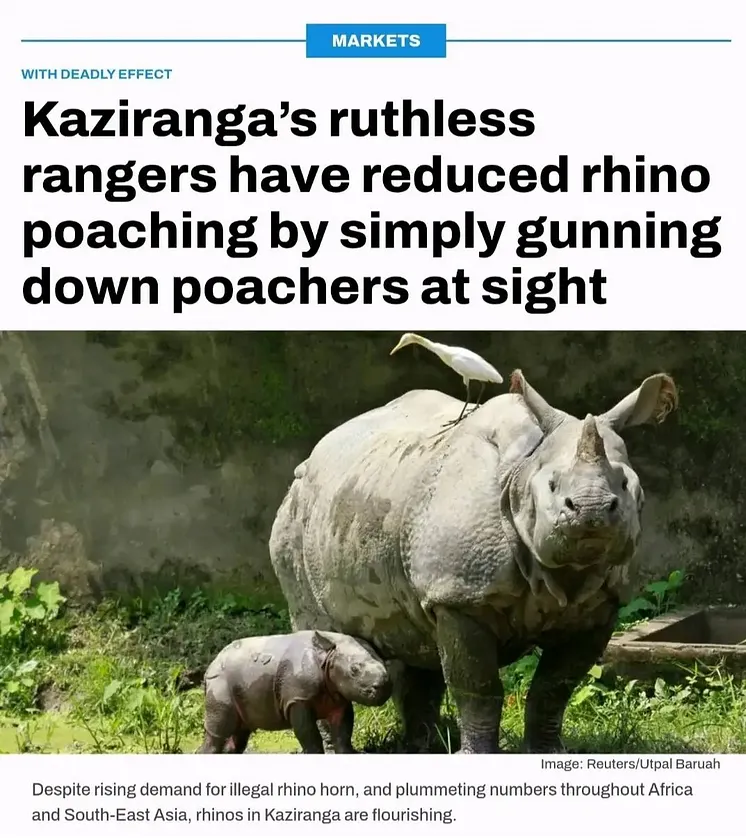
Most supposed predicaments are really just problems that can be solved by being harsh to the guilty
For example, the rhinos are going extinct, and have been since decolonization removed good governance from Africa
Is the extinction of megafauna inexorable? No. Death squads targeting poachers solve it, and protect God's grandest creatures
That same sort of "fix everything easily switch" solution applies to everything, from pitbulls to property crime, as our ancestors knew
It just requires summoning the proper amount of will