A lot of enterprises are reading the latest EU AI Act and Colorado AI law updates as a reason to slow down governance efforts.
I think the opposite is true.
This is an opportunity window for enterprises to get governance infrastructure in place before operational and regulatory pressure intensifies later.
https://t.co/qV6KxE6ktZ
https://t.co/rF9iHD0ONU
AI governance is moving closer to the infrastructure layer itself.
The challenge is no longer just governing models. It’s governing MCP servers, agent frameworks, orchestration layers, and third-party AI dependencies.
Visibility, runtime enforcement, and auditability will matter more than static policy docs.
https://t.co/NBl5WEtZZt
Race weekend in Miami!
Great to be here with John Marshall supporting the Atlassian @WilliamsF1 Team. Always fun to see @Airia_AI's partnership with Williams come to life trackside.
We spend a lot of time thinking about control and visibility in AI. You see a version of that play out here in real time.
#F1 #MiamiGP #EnterpriseAI
AI adoption isn’t the problem. Control is.
Most teams still can’t answer what’s actually running, who has access, or what’s enforced at runtime.
At @Airia_AI, we’re building the control layer that makes that possible: https://t.co/YGRIwoDUxK
AI adoption isn’t the issue. Control is.
AI is spreading faster than most organizations can track, creating gaps in visibility, security, and audit readiness.
That’s what we built @Airia_AI to solve.
One place to see what’s running and enforce policies at runtime.
Can you answer this with confidence:
What AI is running across your enterprise?
Airia gives you visibility, runtime control, and audit-ready oversight so you can scale faster with less risk.
Watch → https://t.co/XyjjWT6sL3
I met with a group of CIOs and AI leaders last week. Different industries, different stacks, same conclusion:
There's a widening gap between what AI promises and what it actually delivers inside the enterprise.
Building a demo agent? Easy. Deploying it across a Fortune 500 without breaking everything? That's where the fun begins.
Enterprises are sitting on decades of tech debt, data scattered across hundreds of systems, and workflows designed when flip phones were cutting edge.
Startups can build for AI from scratch. Enterprises have to transform mid-flight while hitting quarterly targets. It's like performing surgery on yourself while running a marathon.
This execution gap is creating a massive market opportunity.
Systems integrators, forward-deployed teams, and specialized consultancies are stepping in to bridge the gap from PowerPoint to production. Every platform shift spawns its own services layer. AI is no different.
At @Airia_AI, we're building the orchestration layer that lets enterprises run AI at scale with security and governance baked in from the start. Not bolted on when someone asks "wait, should this agent have access to payroll?"
Two things are clear:
Implementation is the new differentiator. Enterprises expect vendors to drive transformation, not just drop tools and run.
This is a decade-long buildout, not a sprint. The AI deployment economy is just getting started.
Despite the doom posting, this isn't about jobs disappearing. It's about entirely new categories of work emerging.
The companies investing in operational discipline now, not just shiny models, will capture the value.
Everyone else will still be stuck in "pilot purgatory" in 2027, wondering why their 47th proof-of-concept hasn't moved to production.
Tomorrow.
If your AI systems were audited, what would you show?
AI inventories are quickly becoming evidence.
Join Andrew Clearwater, Chief Trust Officer at Airia, to learn what yours needs to capture to hold up under NIST AI Risk Management Framework, ISO/IEC 42001, and the EU AI Act.
📅 April 28, 1 PM ET
🎟️ https://t.co/BIkbdQ6UMI
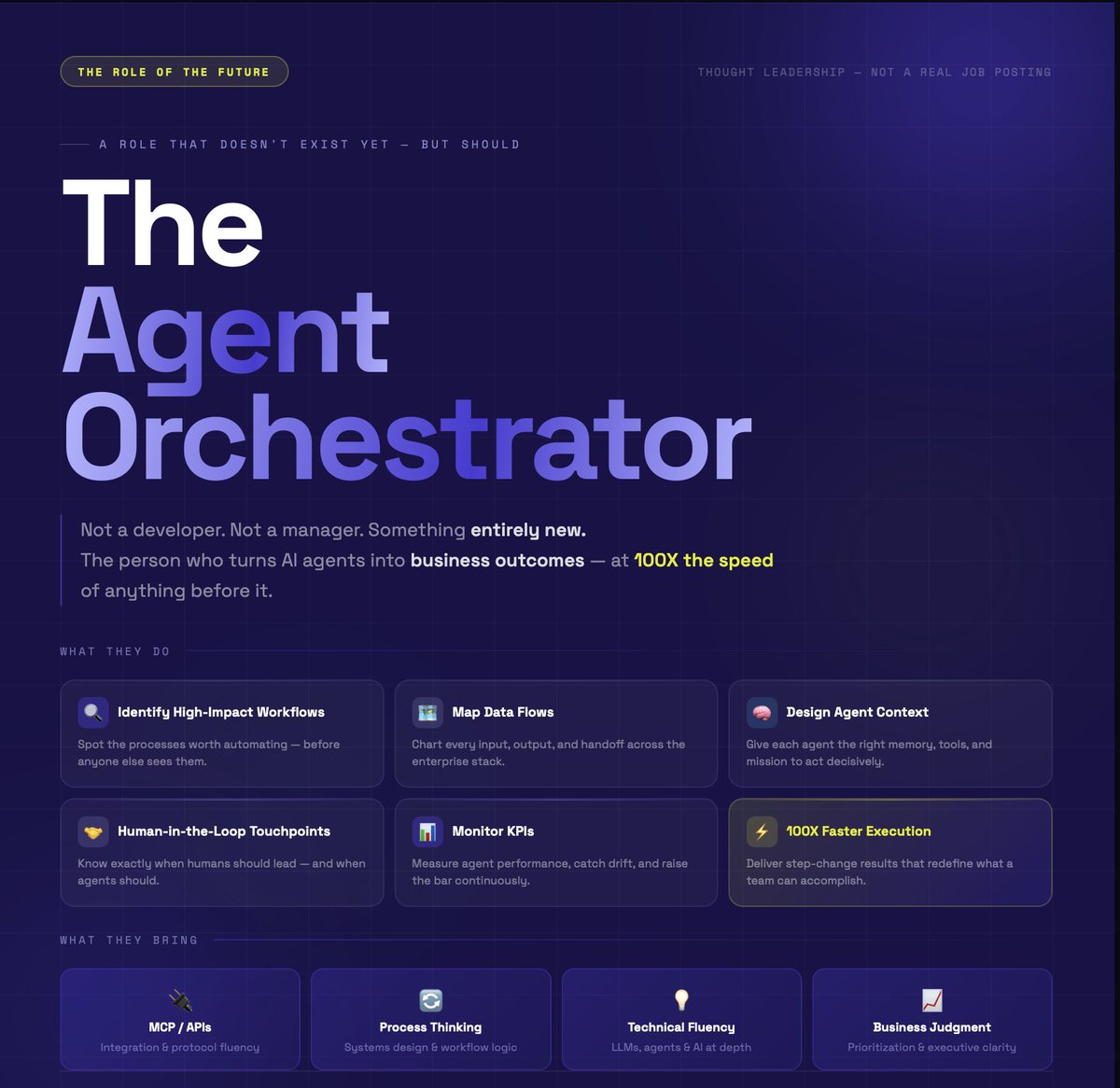
If you've been wondering where technical skills matter in an AI-driven world, here's one answer:
The bottleneck isn't building agents. It's building the trust infrastructure that lets enterprises run them at speeds that unlock value.
This isn't a centralized role. It lives embedded where agents create value: sales ops, legal ops, customer success, finance.
Usually with governance accountability to a central function, but close enough to understand what breakthrough performance looks like.