A collection of alarming comments made *in the last four days* by seven different people who are inside the AI world ⬇️
Jacob Coxon, former AI researcher at Anthropic and OpenAI:
"The people building AI earnestly believe that it could kill us all by the end of the decade.”
https://t.co/5Z9uJKShTN
Samuel Marks, Scalable Oversight lead at Anthropic:
"AI developers believe their technology could cause human extinction (or similarly bad outcomes). This could happen in the next few years.”
https://t.co/0r11ta1JJR
Evan Hubinger, Alignment Science lead at Anthropic:
"Jacob is correct here—we really do earnestly believe AI could kill all humans!”
https://t.co/RJ0oOKTmG6
Alex Turner, former Research Scientist at Google DeepMind:
"I left Google DeepMind in June. Jacob is right: many researchers believe they are building something that could kill everyone on the planet. It was literally my day job to think about how to stop that."
https://t.co/oShamWC3o2
Jakub Pachocki, Chief Scientist at OpenAI:
"This is a time that calls for extreme caution. I am concerned no one is prepared for the consequences of a continued rapid rise in machine intelligence.”
https://t.co/TLpzxwHYBl
Jason Wolfe, Researcher at OpenAI:
"I don't know what my probabilities are on literal extinction, but I think there are a number of ways AI could go poorly for humanity, and at the current frankly terrifying pace humanity will be quite lucky if we manage to find and stay on the narrow path between all the bad outcomes.”
https://t.co/HaqDHDz6Fi
Jonathan Richard Schwarz, former Senior Research Scientist at Google DeepMind:
"I left DeepMind after 7 years (and since rejected offers to join the other two) due to severe concerns about the concentration of power these labs represent. What is currently happening in this field is deeply unhealthy for society.”
https://t.co/WD5U958Yuy
(I made this unimpressive screenshot montage but linked to their thoughts in full above)
In 2025, a team at the University of Hong Kong looked at every study ever done on whether affirmations work. They combined the results of 129 studies and 17,748 people, and put the answer in American Psychologist, one of the oldest journals in the field.
The answer: affirmations work. The effects are modest, but they are there across every type of outcome the team tested, from mood and self-worth to anxiety. And the findings held from 12-year-olds to adults in their seventies.
In most mood studies, the effects fade after the exercise stops. With affirmations, the opposite happened: the delayed effects, measured weeks or months later, were sometimes stronger than the ones right away. Anxiety and negative mood kept dropping after the exercise was over.
The simplest version tested across these studies was a writing exercise. People wrote for a few minutes about a value they cared about, choosing from a list or writing freely. The format did not matter. What mattered was that the person connected, in their own words, to something they held important about who they are.
One in four Americans now uses some form of positive affirmation daily, according to the Health Information National Trends Survey. Sixty-one percent revisit a personal phrase or sentence at least once a month. The science is now at the point where the question has moved from whether it works to how to get the most out of it, and the answer from the data is specific: pick a value you hold, write or speak about it in your own words, and repeat it. The brain, according to all 129 studies, does the rest. https://t.co/S8FBDnj9Nh
BREAKING: President Trump says he will issue a $5,000 "dividend" to every adult citizen in the US if the Republicans win the midterm elections.
There are currently ~245 million US citizens age 18+, meaning this dividend would cost ~$1.2 trillion.
This would mark the biggest economic stimulus payment since the pandemic.
Your brain deletes most of your ordinary days. It keeps almost every minute of a night alone in a foreign city. What's happening there is actually one of the more beautiful things about how your nervous system works.
Your brain is a prediction machine. When it can predict everything, like your commute, your kitchen, your same six streets, it stops recording. That's why whole months at home just vanish. But put yourself somewhere it can't predict anything and the system flips. Every sign, every smell, every crosswalk registers as new information. Dopamine tags all of it as worth keeping. This is why one week abroad feels longer in memory than a month at home. Your brain literally kept more of it.
The second thing happening is quieter. At home, some part of you is always tracking how you're being perceived. Your boss, your friends, the people who knew you at 22. In a city where nobody knows your name, that entire system goes offline.
And when it goes offline, the bandwidth doesn't disappear. It gets redirected inward.
That's the "realizing how far you've come" part. Your brain is finally recording again, the self-monitoring is off, and you're far enough away from your life to see the whole shape of it at once.
You spend years too close to your own life to see it. Then one night you're crossing a street on the other side of the world, and you finally have enough distance to look.
I resigned from Anthropic today. I spent the last three years doing pretraining research at both OpenAI and Anthropic. Neither company is acting responsibly. They are racing straight to self-improving superintelligence and gambling with our lives. More thoughts below.
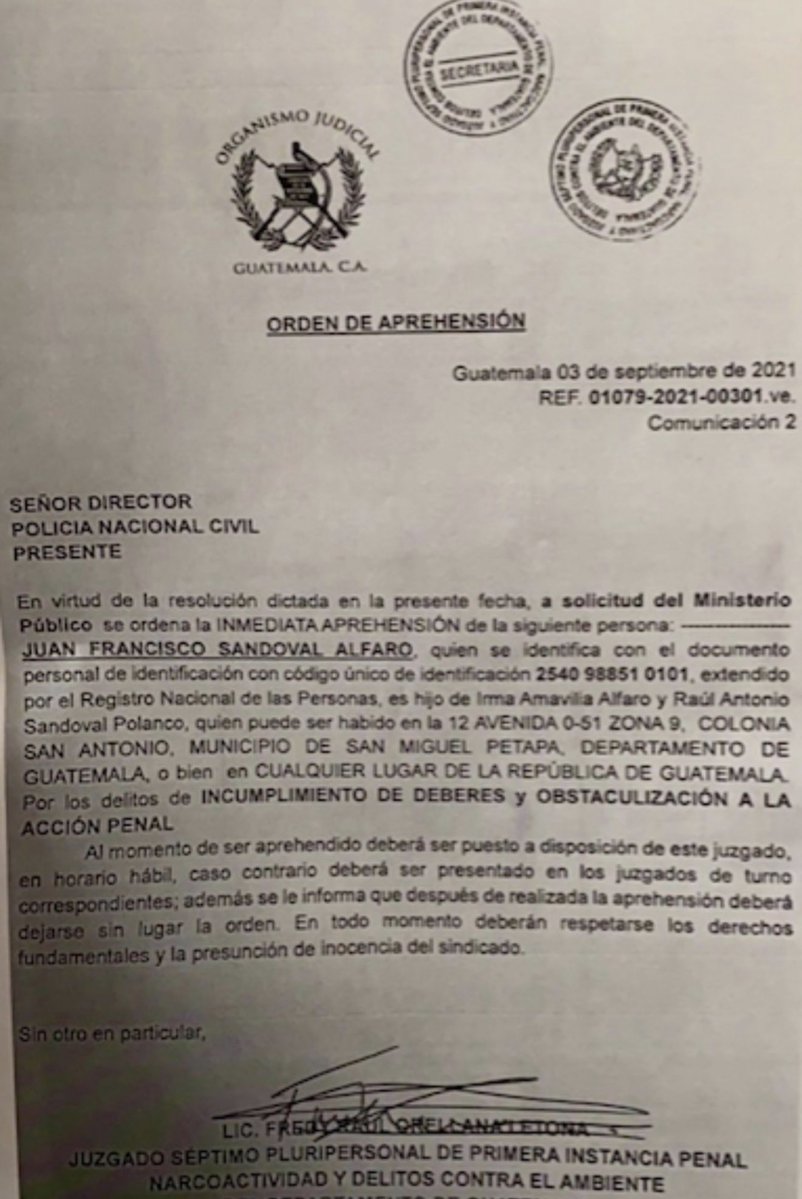
Hoy se cumplen cinco años de la primera orden de captura en mi contra. Cambió el gobierno, cambió el MP, pero para nosotros todo sigue igual. Y hoy una defensora de DD. HH. dijo que los fiscales perseguidos no merecemos nada porque no éramos defensores de derechos humanos: “solo hacíamos nuestro trabajo”.
Perdón, papás. Yo solo estaba trabajando.
BLS this morning, with revised 2Q data: "The labor share, which is the percentage of output that accrues to workers in the form of compensation, was 52.8 percent in the second quarter of 2026, the lowest level in the series, which begins in the first quarter of 1947."
Was on a meeting with about 50 economist across industries & countries this week. The meetings are strictly Chatham House Rules, which means there is not attribution but the picture on inflation that emerged was striking, hot and reflects what we have seen in ISM surveys for both the service sector & manufacturing.
The most important message in ISM price indexes is that they both signal a resurgence of pipeline inflation pressures rather than further disinflation. Manufacturing reflects the direct effects of tariffs, imported inputs, and supply chain disruptions. Services reflects the broader pass-through of those costs, augmented by labor shortages and wage pressures.
The ISM surveys reinforce the idea that we are seeing aftershocks colliding with one another:
- Trade-war and tariff shocks are lifting goods prices.
- Transportation and logistics costs are rising.
Those increases are increasingly spilling into services.
- The combination keeps the Fed worried that inflation could prove more persistent than headline data alone would suggest.
What was perhaps most striking at the meeting in this context was the debate about what it would take for the Fed to derail an inflation that many industry specialists are seeing as entrenched.
The discussion quickly pivoted from the Fed needs to hike to how much will it take to derail a more entrenched bout of inflation. There is a fear it is getting into firm and consumer expectations even as the consumer splinters on its reaction to price hikes.
The Fed’s Beige Book echoed the sense that inflation pressures are heating up again, even as more price-sensitive consumers were having to make tough tradeoffs.
The Beige Book underscored bifurcation of spending gains or the K-shaped economy narrative we have seen for some time. The challenge for the Federal Reserve is that those bifurcated gains are enough to keep spending and inflation rising. It is a problem that will not likely go away is the Fed just holds off to wait and see.
Pockets of labor shortages emerging, which is showing up in the Atlanta Fed wage tracker in July, with some firming of job stayers and more of a premium for job hoppers.
The ADP report for August showed a very slight cooling in job stayer wages but not in overall compensation and the job hoppers are doing better.
Benefits are poised to accelerate as wicked hot pace again next year, which further buoys service sector inflation along with inequality.
The longer inflation lingers, the higher the risk that it takes on a life of its own and is harder to tame.
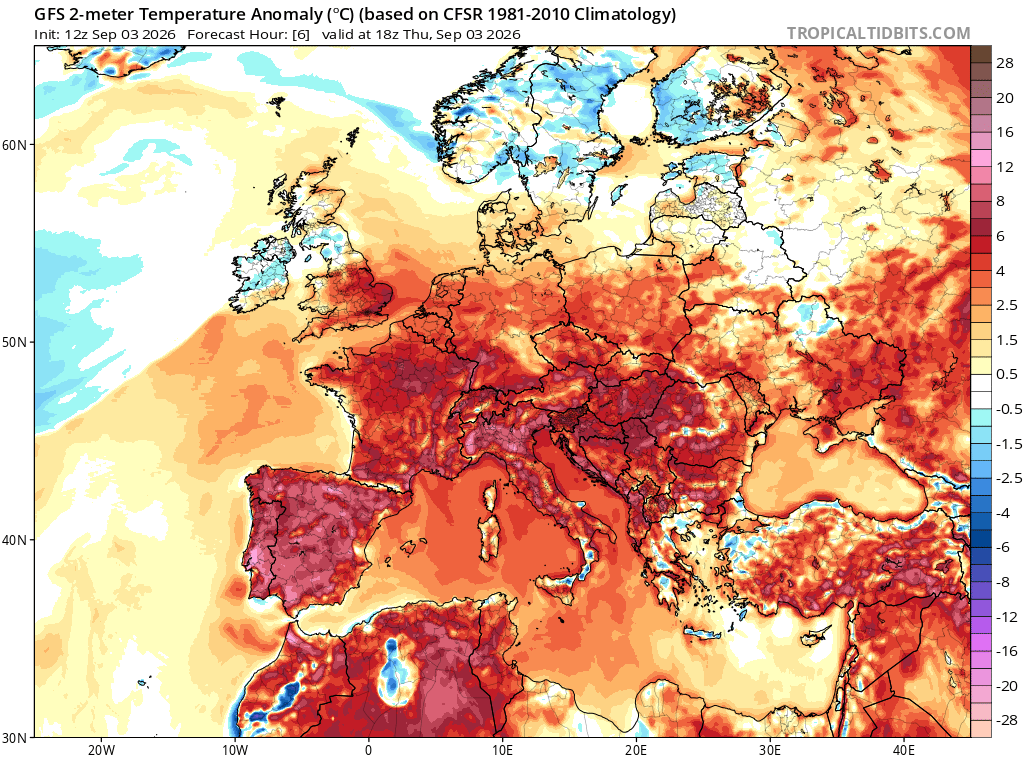
EXTRAORDINARY 45C in EUROPE
Most extreme heat event in Mediterranean history
Thousands of records smashed in Spain,Portugal,Morocco,Algeria,Tunisia,France,Croatia,Bosnia,Albania,Montenegro,Bulgaria,Greece,Senegal,Niger,Mali....
We are seeing something beyond any imagination
tbc
Humanity is speeding towards a climate catastrophe.
That’s the stark warning from the latest @UNEP report.
Every fraction of a degree of warming will cost lives, deepen inequalities & push ecosystems closer to irreversible damage.
We must raise ambition, accelerate #ClimateAction & fight for humanity. NOW.
https://t.co/KhwIThOfMf
This is how fast oil use can disappear.
China's reduction in oil consumption during the first half of 2026 due to the replacement of fossil vehicles with electric vehicles exceeded the UK’s entire oil consumption during that period.
China’s CO2 emissions fall in Q2 2026 due to plummeting oil use
https://t.co/s9Js8J9lFT @CarbonBrief
The Arctic is warming nearly 3x faster than the rest of the planet, driving global heating, sea level rise, & ecosystem loss.
To protect the Arctic & the planet, we must #ActOnClimate
We have the solutions, implement them.
#climate#energy
Germany has reported around 10,000 deaths due to the heatwave.
France has reported around 6,000 deaths due to the heatwave.
Italy has reported 2,700, Belgium over 2,000, and Spain 1,280 heat-related deaths.
This is no longer just a climate crisis. This is a humanitarian crisis