PE alone isn't a great barometer. Two better ways to look at it.
One: PEG - price to earnings per unit of growth. A company growing at 40% with a PE of 80 has a PEG of 2. Another company at 60 PE looks cheaper, but if it's only growing at 10%, its PEG is actually 6, making it more expensive.
Two: compare a business to itself. Like a child's school results, it's not about how they scored against classmates who keep changing. It's about how they scored against their own past performance. That tells you if there's real progress.
#PERatio #PEG #StockMarket #InvestingIndia
“If you feel very uncertain about IT services , it probably means it is the best time to enter the sector.
The more uncertain you get about something , the greater is your profit opportunity. I learnt this phrase from a book by seminal economist Frank Knight titled Risk , Uncertainty and profit. You must read it” says Ridham Desai of Morgan Stanley.
Full conversation with @rndx1 of @MorganStanley drops tomorrow ⭐️
“It is necessary for me to come and give an optimistic view on TV because I don’t want investors to panic because of issues like oil rising and the Middle Eastern crisis .
These are transient things and they will pass.
This sideways market is nothing compared to what we saw in the late 90s” says @rndx1 of @MorganStanley India
I asked him why he needs to keep giving Sensex targets and how he responds to being called a perma bull 😅
Full chat with Ridham Desai out now ✨
BREAKING: President Trump says the deal with Iran is “now complete.”
“I hereby fully authorize the toll free opening of the Strait of Hormuz… let the oil flow,” Trump says.
Follow what Nvidia is doing. Just check their track record
1. NVIDIA completed a $5 billion investment in Intel in December 2025, acquiring roughly 4% of the company for $23.28 per share. Trades at $82+ today.
2. NVIDIA has invested $2 billion in Synopsys common stock, acquiring a ~2.6% stake at $414.79 per share to accelerate AI-driven, GPU-accelerated chip design. This multi-year partnership focuses on integrating NVIDIA’s CUDA-X and Omniverse technologies into Synopsys' EDA software to drastically boost design simulation speeds from weeks to hours. Stock trades at $500+.
3. Nvidia announced a $2 billion investment in AI infrastructure provider CoreWeave in January 2026 AT $87, becoming its second-largest shareholder to accelerate AI data center expansion.
Stock trades at $110+ today.
4. Nvidia is investing $1 billion (EUR 0.86 billion) in Nokia, acquiring a 2.9% stake through a directed share issuance to accelerate the development of AI-powered radio access networks (AI-RAN) and 6G technologies. Investment is being done at € 6 a share and stock trades at €9 today.
5. NVIDIA is acquiring roughly 8.3% of Nebius at
$94.94 per share as part of a $2 billion investment to accelerate AI cloud development. Stock trades at $147
today.
6. NVIDIA has recently committed to invest $2 Billion in both Lumentum and Coherent to accelerate phonics development.
"Only two people can buy at the bottom and sell at the top - one is God and the other is a liar." - @VijayKedia1
Credit: A clip taken from @Money9Live YouTube channel
Only three companies in the world make gas turbines for Data Centers
Siemens
GE
Innio
There is a four year waiting list for these gas turbines
TD Power Systems is a supplier to all three
ROCE explained with a simple story 👇
Imagine a tea stall that uses ₹10 lakh (owner’s money + bank loan) to run its business.
At the end of the year, it makes ₹2 lakh as operating profit (EBIT=Earnings Before Interest and Taxes)
That’s a 20% ROCE meaning for every ₹100 invested, the business earned ₹20.
Now, compare it with another stall using the same ₹10 lakh but earning only ₹1 lakh (10% ROCE).
Same size, same capital but one uses money far better.
This is why ROCE matters in stocks too
1. It tells you how efficiently a company converts invested capital into profits.
2. Growth with high ROCE creates wealth
3. Growth with low ROCE leads to stagnation as cost of capital in a country like ours is 10%. Looking for businesses with ROCE>COC over a period of time is a bare minimum before investing.
The day you stop worrying about the market and start focusing on:
✅ Entry & Exit system
✅ Business Valuation
✅ Relative Strength & Stage Analysis
✅ Fundamental Catalysts
…is the day you become an Atmanirbhar Investor. 💡
Also remember that...
“Far more money has been lost by investors trying to anticipate corrections, than lost in the corrections themselves.” – Peter Lynch
Mark Minervini Setup
How to find stocks
Screen stocks that are within 25% of their 52-week high
Eliminate the following stocks
Eliminate stocks trading below 30
200 MA is rising for at least 3 months
50 MA is above 200 MA
Current price is above 200 SMA and preferably above 50 too
Current price is at least above 100% from 52-week low
The stock should have made a 52-week high at least once every 4 to 6 months
Buying Pattern
Make stock list every week after weekly closing
Use weekly charts
Use Volatility Contraction Pattern (VCP)
Use only Price and Volume
Stocks moving up with good volume and then falling with lower volume (consolidating) is good
Use weekly charts
AMO daily charts are good for seeing setting of the stock
Look for volatility contraction in daily charts (just for looking entry)
You don’t need to find new candidates every day, try to add to existing position
Breakouts should happen between 4–8 weeks
Win rate is only 50%, so be prepared
Post Buying Monitoring
Follow up buying
Green days vs Red days
Up Volume vs Down Volume
Tennis Ball Action
Shallow Pullback
VCP Pattern
Volatility Contraction Pattern (VCP)
To calculate volatility contraction, divide swing low by swing high then -1 gives the % drop in volatility
There should be ideally 3 VCP
Each time volatility should decrease by ideally 50% (not a hard rule)
Buy when the previous swing high is taken out
With volatility, there is also time contraction which is very similar to price contraction
Take a stock for 2 VCP only if the second contraction is more than 70%
Stop Loss Calculation
Plot 20-period ATR on daily chart
Calculate 2× of the above value
Use this value as your stop loss
Use maximum of 10% as stop loss
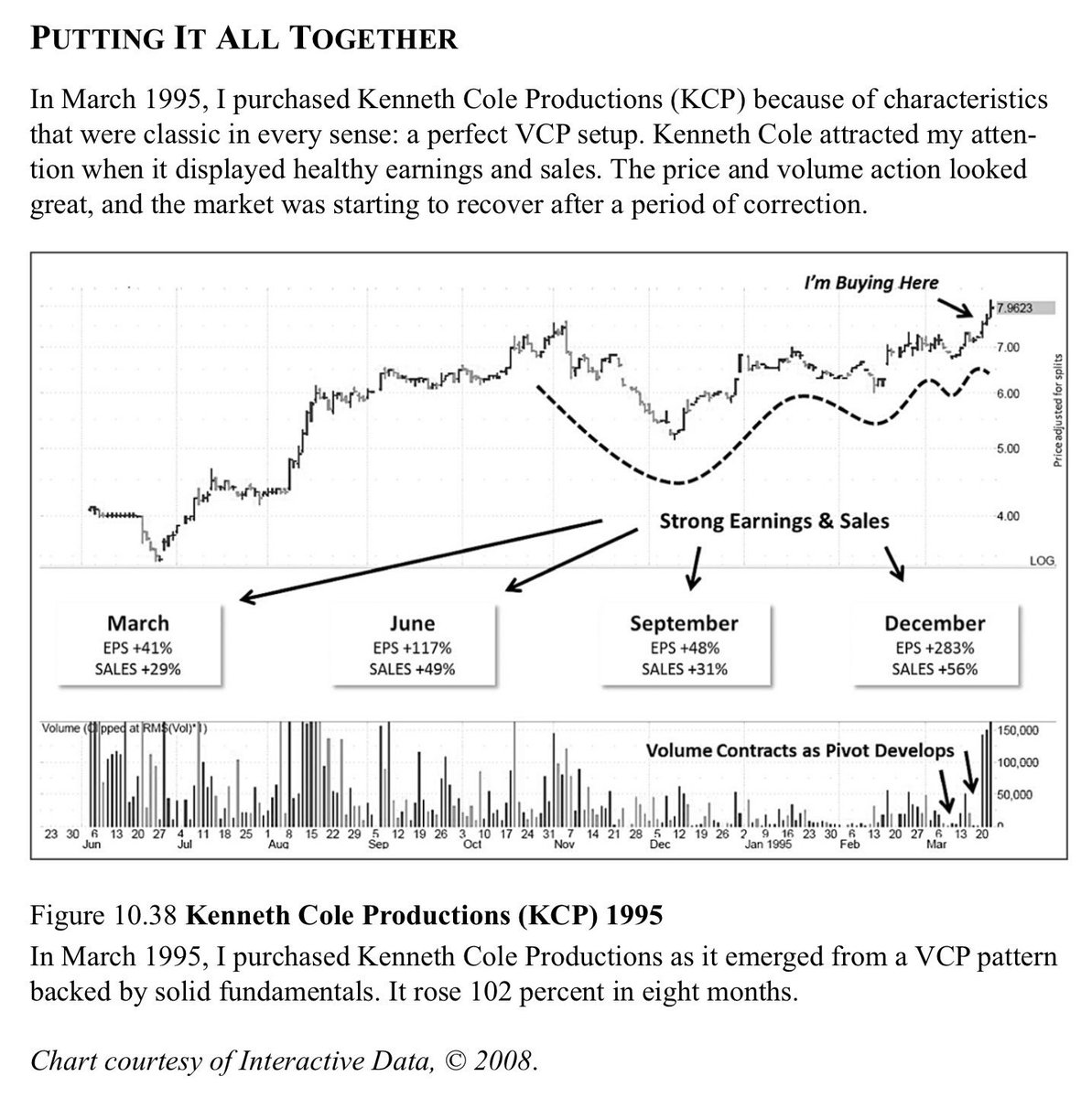
Here’s Mark Minervini coming into the ‘95 uptrend based on what stocks met his criteria. He didn’t get really aggressive until April ‘95 - had an incredible 413% return that year! From ‘Trade Like A Stock Market Wizard’ - Minervini 2013
A lot of questions on How to Invest in International & US Markets
Did a deep dive for TheWrap🌯members a while back
Making the video public ⤵️
If you like this, please consider supporting us via subscribing to TheWrap🌯
https://t.co/a84pkcbEsD
10 Vital Things To Check Before Investing In Any Business Or Stock
Here’s a practical checklist to level up your stock selection process-
1) Past Revenue Growth
Check revenue growth over the last 3–5 years. Double-digit CAGR is preferred.
For cyclical companies — study how they perform in upcycles and downcycles. Studying old cycles can give you a clue about how future ones might play out.
2) Competitive Intensity
How many players are there in the industry? The lesser the better. If there are a lot of players, check if everyone makes money or not? Competitive intensity matters a lot. Also check if the business you are studying has something unique like — cost advantage, brand, distribution, etc.
3) Consistency Of Margins
Are the margins volatile or consistent? Check the margins of the last 10 years. If current margins are unusually high, don’t overpay. Margins eventually revert. Buy when they’re expanding — not peaking.
4) Operating Leverage
Look for companies where fixed costs are done & sales are now scaling. Capex cycles and management commentary will help you to spot this. Getting this right can lead to powerful re-ratings.
5) Check The Cash Flows
Is the company able to convert its EBITDA into cash flows? Some companies have epic income statements and profits. However, when you look at their cash flows, everything is stuck in the working capital. This is an important question to ask when looking at stocks.
6) Market Penetration
How much headroom is left to grow? If a product has >90% market penetration, growth might be limited. But companies creating new categories can grow exponentially.
7) Focus On Volume Growth
Revenue = Price × Volume
The best quality of growth is when the number of units sold or volumes sold keeps going up. Double digit volume growth over an extended period of time can lead to big winners in the stock market.
8) B2C > B2B > B2G
Generally B2C valuations are > B2B Valuations > B2G Valuations. Thus, if you see consumption businesses growing at double digits, do not ignore them!
9) Margin Of Safety
Have a Margin Of Safety or be cautious of the valuations you are paying for a stock. You can be right on all the things but one can forget that sometimes accidents happen. At high prices, small mistakes might lead to derating of PE Ratio. A great business bought at the wrong price may prove to be a bad investment.
10) Learn Stage Analysis
Learning Stage Analysis is a blessing for fundamental investors who are good at valuing companies. It will help you to understand where the stock is in its cycle.
Few books which can help you to understand the cycle of a stock from fundamental and technical perspective- 1) Understanding Michael Porter by Joan Magretta, 2) Capital Returns by Edward Chancellor and 3) Secrets For Profiting In Bull and Bear Markets from Stan Weinstein.
Hope this post gave you a rough checklist to evaluate stocks better!