"Budoucnost nepatří globalistům, ale patriotům," pokračuje Donald Trump.
"Jestli chcete svobodu, buďte hrdí na svou zemi. Jestli chcete demokracii, držte se své suverenity. A jestli chcete mír, milujte svůj národ," říká ve svém projevu americký prezident.
Petr Ginz was just a kid in Prague who stayed up too late reading adventure novels, who built model airplanes, who annoyed his little sister the way brothers do.
By age twelve, he had also written a 600-page science fiction novel. Not a school assignment. Not something his parents had encouraged. A fully imagined story about lunar expeditions and space exploration, written in notebooks he filled faster than anyone could replace them. His bedroom walls were covered in sketches — rocket designs, alien landscapes, star charts mapping galaxies that existed only inside his head.
Then March 1939 arrived, and the future Petr had been imagining slammed shut.
German tanks rolled into Prague. Within months, Jewish children were expelled from schools, banned from libraries, forbidden to enter bookshops or cinemas. The world that fed his imagination — books, teachers who encouraged his ideas, conversations about things that didn't yet exist — was taken away.
But imagination doesn't require permission.
While Nazi bureaucrats cataloged restrictions and propaganda posters declared Jews subhuman, Petr kept writing. He kept designing fictional spacecraft. His notebooks became the only territory the occupation could not reach.
In October 1942, a deportation notice arrived. Petr was fourteen. His parents were staying behind — for now, they hoped. He packed a small bag. The train took him to Terezín, a fortress town the Nazis had converted into a concentration camp designed partly as propaganda — a "model ghetto" they could show Red Cross inspectors to prove they were not monsters.
Behind the staged appearances, people were dying of starvation and disease. Thousands were being shipped regularly to Auschwitz. Everyone knew what those transports meant.
But something remarkable emerged from the horror.
The prisoners — many of them artists, musicians, writers, intellectuals — refused to surrender their minds even as their bodies weakened. They painted on scraps. They composed music they could not record. They taught children in secret schools the Nazis did not know existed.
And in Barracks L417, teenage boys created a magazine. They called it Vedem. We Lead. Every Friday, these boys — some as young as twelve — produced a handwritten publication. Articles, poetry, drawings, satirical pieces. They passed it from bunk to bunk, reading by whatever light they could find, keeping their minds sharp while everything else was being systematically destroyed.
Petr became the editor.
Not because he was oldest. Not because adults appointed him. Because the other boys recognized something in him — a refusal to accept that this was the end of stories.
For two years, he edited Vedem while watching boys disappear on transports. He wrote science fiction while people around him died of typhus. He imagined futures while the present was designed to make futures unthinkable.
Then, in 1943, he drew something that should not have been possible.
A small, heavily cratered moon dominates the foreground. Behind it, suspended in absolute blackness: a sphere of blue and white, continents barely visible through swirling clouds.
Earth. Seen from the lunar surface.
No human had witnessed this view. The first crude satellite images were fifteen years away. The famous Earthrise photograph from Apollo 8 would not exist for another twenty-five years.
Petr drew it with uncanny accuracy — the proportions, the perspective, the delicate appearance of our planet against infinite darkness. He labeled it Moon Landscape and moved on to his next drawing, as if sketching impossible visions was simply what you did when pencils and paper were available.
How did he know? How could a teenager who had never left Czechoslovakia, who had never seen footage from space because footage from space did not yet exist, draw Earth from the moon with such precision?
Perhaps genius is simply imagination freed from the constraints everyone else accepts. Perhaps when you have already lost school and friends and freedom and the ordinary future you were supposed to have, your mind stops recognizing the boundaries between what is and what could be.
September 1944. Another transport list. Petr's name appeared. He was sixteen years old. Old enough that in ordinary circumstances he would have been thinking about university, about what he wanted to do with his life. He boarded a train to Auschwitz.
His parents survived Terezín. When liberation came in May 1945, they searched desperately for their son. They wrote letters. They checked survivor lists. The confirmation came slowly, through testimonies from people who had been on the same transport.
Petr Ginz was murdered at Auschwitz in September 1944, probably within days of arrival. Sixteen years old. Killed for being born Jewish.
But the notebooks survived.
Friends had hidden them in Terezín. After liberation, someone found them in an attic in Prague — tucked away with other artifacts the Nazis had not destroyed. Including Moon Landscape.
For decades, Petr's work circulated mainly among Holocaust scholars and Czech educators. His diary was published. His drawings were preserved at Yad Vashem. A few people knew his name. Most of the world did not. Then January 2003 arrived.
Israeli astronaut Ilan Ramon was preparing for a Space Shuttle Columbia mission and wanted to bring something symbolic — something representing memory, hope, human creativity surviving atrocity. Someone showed him a teenage boy's drawing of Earth from the moon, made in a concentration camp sixty years earlier.
Ramon understood immediately. The idea that a murdered child had imagined space travel decades before it existed — and drawn it accurately — felt like something that needed to reach actual space.
On January 16, 2003, Columbia launched. Aboard: seven astronauts and a pencil sketch from a sixteen-year-old who had been dead for nearly sixty years.
For sixteen days, Petr's drawing floated above the atmosphere. The impossible vision became real. The boy who never left Europe made it to orbit.
Then, on February 1, 2003, Columbia disintegrated during re-entry over Texas. All seven crew members died. Including Ilan Ramon, who had wanted to honor a murdered boy by carrying his dreams to the stars.
Moon Landscape scattered across the Texas sky.
But it was recovered from the debris. Today it hangs in museums. Petr's stories have been published in multiple languages. His diary teaches schoolchildren about the Holocaust in classrooms across the world.
The boy murdered for being Jewish has become, in the truest sense, immortal.
Every child who sees Moon Landscape resurrects Petr for a moment. Every person who reads his stories defeats something the Nazis believed was permanent. Every time someone marvels that a teenager drew Earth from space before satellites existed — imagination wins.
He died at sixteen believing, one imagines, that his dreams would die with him. He was wrong. His vision outlasted his murderers. His drawings outlasted the Third Reich. His imagination proved more durable than everything designed to extinguish it.
For those who have ever kept creating — kept writing, kept drawing, kept imagining — in a time when the world made it difficult or dangerous or seemingly pointless: Petr Ginz's story holds something worth sitting with quietly.
The barbed wire could not reach his notebooks.
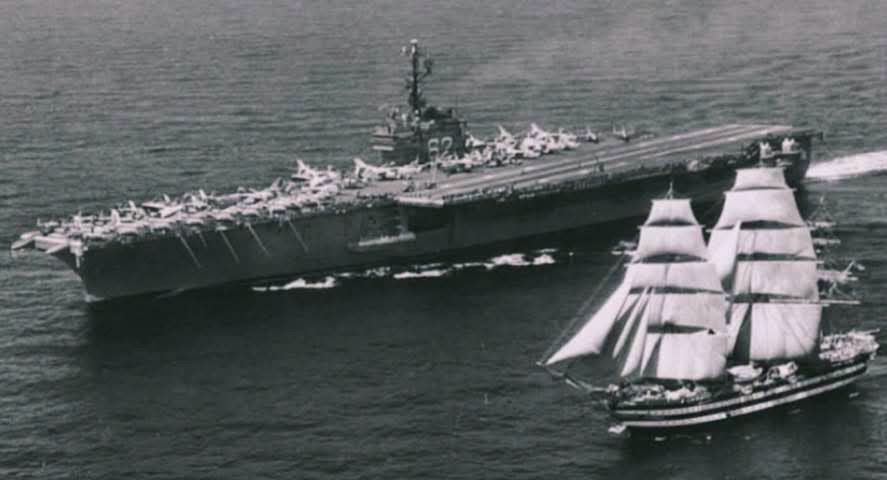
On 12 July 1962 the American supercarrier USS Independence was steaming through the Mediterranean with the Sixth Fleet when her lookouts spotted a three-masted sailing ship under full canvas, a sight that already belonged to another century. The carrier flashed a signal asking the stranger to identify herself. Back came the reply by light, "Training ship Amerigo Vespucci, Italian Navy." She was a tall ship launched at Castellammare di Stabia near Naples in 1931, her black hull banded with two white stripes in memory of the old gun decks, 26 canvas sails spread across masts more than fifty metres high. The Independence, eighty thousand tonnes of steel and aircraft, took her in and signalled a single line in return, "You are the most beautiful ship in the world."
The compliment outlived the carrier. The Independence was eventually scrapped, but the Vespucci is still sailing, the oldest ship in commission in the Italian Navy, and Italians have called her the most beautiful ship in the world ever since that afternoon. The story did not quite end there either. On 1 September 2022 another American carrier, the USS George H.W. Bush, crossed her path in the Adriatic and sent almost the same words across the water, telling the old ship she was still the most beautiful in the world, sixty years to the season after the first time. Few exchanges between warships are remembered with any fondness.
#drthehistories
A rebellion is brewing in Russia: a Russian soldier recorded an address to Putin in which he threatened a coup
In just four hours, the video gathered over 3.5 million views on Instagram and more than 125,000 likes.
According to observers, this indicates that the situation in Russia is becoming increasingly tense and potentially explosive.
Voronezh blogger Alexander Lunin stated that if he is not invited to the Kremlin and not given a chance to speak live alongside Putin, “the army will turn its weapons against the Kremlin.”
In his statement, he described alleged widespread abuses in the military — including torture, punishment for refusing orders, “eliminations,” and mysterious disappearances of soldiers.
.@RandPaul Asks Samantha Power: 'Did USAID Fund Coronavirus Research In Wuhan China?'
"Should we be funding the Academy of Military Medical Research in China? ...Some of the research proposals in 2018 were the Wuhan Insitute of Virology asking for money to create a virus with a furin cleavage site. A SARS-like coronavirus with a furin cleavage site. That's exactly what COVID-19 turned out to be.
So we want to know if there were other research proposals you either granted or denied that were in the same vain as creating viruses that could have become COVID-19. We can't tell because you won't give us information... I now have 25 Senators that have sent you a letter, and you aren't responding... You are being dishonest."
🎼🎻 He looks like an accountant. He plays like a genius. | "Take Five" by Joe Morello
The best drum solo in jazz history? ✨
🌟Desmond: Take Five / Dave Brubeck Quartet, Live performance in Belgium, 1964
Yes, the story checks out in its core facts per Diario de Almería, ABC, police statements and other outlets.
June 21 ~5:30pm, Almería caravan parking at Andarax river mouth: 21yo undocumented sub-Saharan man forced entry into 44yo German woman’s caravan with knife + stick, attempted sexual assault (prevented by bystander honking), brutally beat her (face disfigured, body covered in wounds). He fled into rough sea ~100m out and started drowning. Five Policía Nacional officers swam in, rescued him with difficulty; all five later needed medical care for rescue injuries. Victim treated at Materno Infantil hospital under sexual assault protocol. He’s detained for sexual assault + injuries.
It was covered by local + some national media.