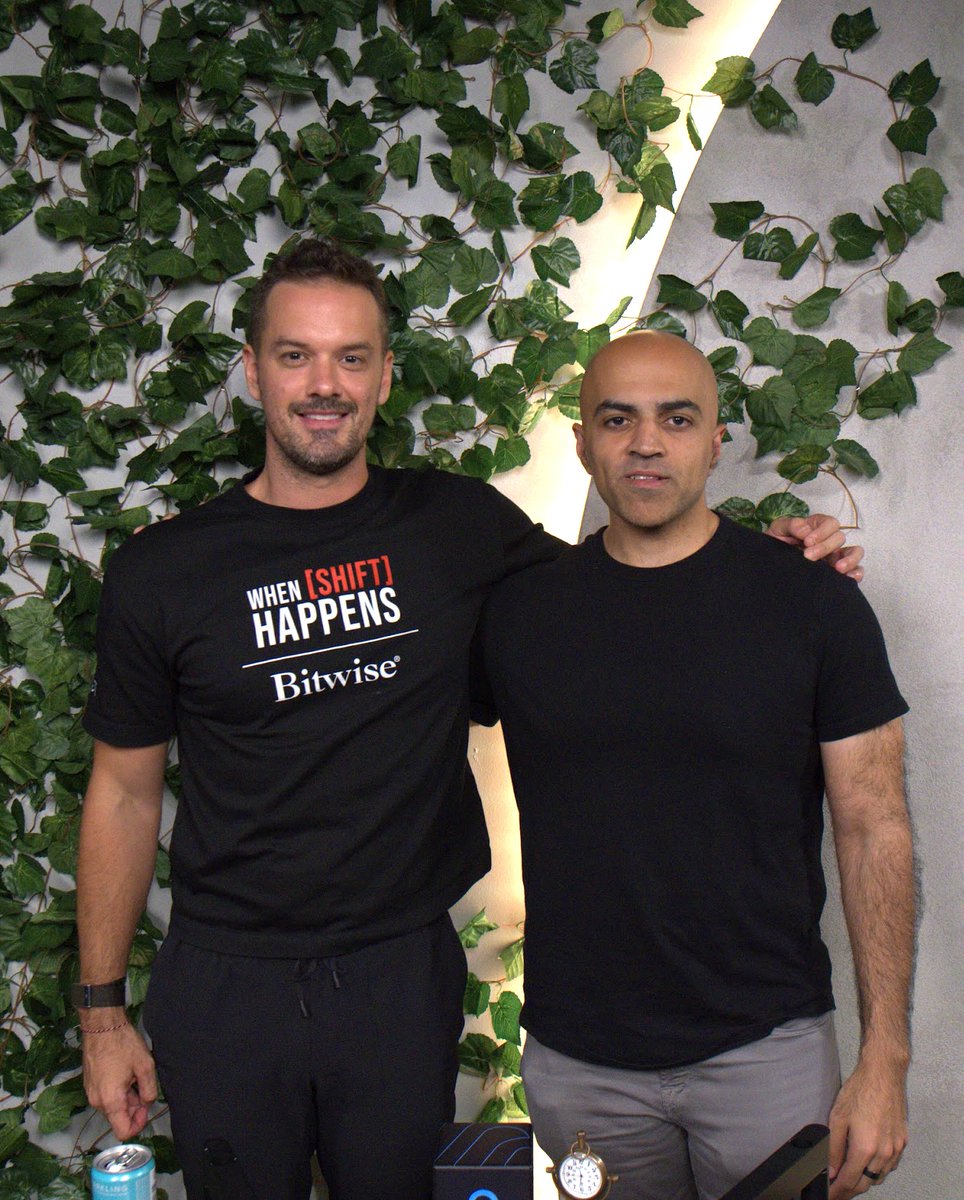
DROPS 47: @Starknet: Agents Will Adopt Blockchain Before Banks Do
@EliBenSasson, co-founder of @Zcash and Starknet, explains why he believes crypto will become the way people and AI agents handle money, and why most people haven't realized the world's financial infrastructure is being rebuilt.
He also covers what Bitcoin is missing, from privacy to its resistance to change, how quantum computers and superintelligent AI could threaten it, and the technology he's building to fix it.
This is a sponsored Episode.
Timestamps:
00:00 Intro
1:16 The Future Most People Can't See
2:32 Why Money Takes Centuries To Change
5:55 The Day Bitcoin Found Eli
9:40 What Happens When Every Purchase Is Public
10:53 Building Private Bitcoin
13:44 Why Privacy Took 10 Years To Matter
18:34 Is Your Bitcoin Safe For 20 Years?
20:29 The Darth Vader Test For Trust
26:11 Do We Really Need Another Chain?
27:15 Why Big Investors Are Hesitating
28:45 How Starknet Plugs Into Other Blockchains
32:44 Why Starknet Has A Token
33:48 An Application That Was Built On Starknet
35:41 Private Payroll and the Agent Economy
38:21 What Starknet Changes For The Average Person
41:04 The Biggest Risk He's Wrong
42:42 One Takeaway
Something people don't know and I want to highlight:
People already make the connection between native account abstraction and smooth UX.
But I want to emphasize the next part: just as native AA allows for smooth UX, it is a key element in enabling post-quantum security.
Don't know if this is clear or not. Here's my explanation:
This week, I’m releasing a 1-hour conversation with @hosseeb - Managing Partner at @dragonfly_xyz.
Dragonfly was early on @NEARProtocol, @Ethena, @variational_io and Polymarket. Ask Haseeb for the one crypto asset he believes in most right now and he doesn’t say Bitcoin or ETH. He names an AI privacy platform with a revenue run rate that grew from $15M to over $100M in under a year.
We talk about:
- Why Venice $VVV is his highest-conviction crypto asset right now
- How the third party doctrine means your AI chat logs can be pulled with a subpoena
- Why $ZEC is an insurance policy on your Bitcoin
- What the AI math breakthroughs mean for cryptography
How much ZEC to hold relative to Bitcoin depends on how much risk you see in BTC
- What would turn him bearish on crypto
- Why institutions running on cypherpunk rails does not weaken those values
And much more...
Podcast out this week!
. @hosseeb reveals OpenAI is now pointing its lasers at cryptography, and why that makes @Zcash the antidote to Bitcoin being seized
“OpenAI dropped I think it was 700 plus manuscripts of new results that they had found using their unreleased AI model in foundational mathematics”
“The story now is that apparently OpenAI is pointing their lasers at cryptography, and there was a lot of fear and loathing online about, oh my God, does this mean that cryptography is going to get destroyed?”
“If Bitcoin can be seized, or if Bitcoin now is sort of being encompassed under very different kind of regime, then Zcash is the antidote to that”
Podcast out this week!
@dragonfly_xyz
. @ilblackdragon explains NEAR’s concept of user owned AI and why companies building AI models end up working against their own users
“If I’m a company and I’m making an AI model and I’m offering a product on top of it like ChatGPT, my motivation is not to make you successful”
“As soon as you achieve your target audience, you need to continue growing your revenue. You need to start making more money from every individual user. And so you start doing things that are not particularly always good for your users”
“User owned AI is effectively the opposite. How do we build AI that is on your side? It needs to be private. It needs to be aligned with you. The way I explain it is AI is almost like your mom. It’s always aligned with your success. It doesn’t always agree with you, it may give you feedback, but it needs to be aligned with you”
@NEARProtocol
As agents start moving money, whoever controls the rails they run on will also control global finance.
Privacy for AI and finance is a precondition for a user-owned agent economy. @ilblackdragon on the stakes of the agentic shift:
Fascinating how many of you go into complete panic and drama mode when the markets dip a bit
Probably the reason you’ve been here for 10 years
And probably why you’ll be here for another 10!
As I’ve said many times - BTC was the existence proof for a digital Store of Value.
There will be multiple SoVs, including BTC and ETH (and likely a few more)
Fascinating how many of you go into complete panic and drama mode when the markets dip a bit
Probably the reason you’ve been here for 10 years
And probably why you’ll be here for another 10!
Gm Folks
We are back!
This is another edition of the Predict Alpha Report, our bi-monthly collaboration with @CoinsiliumGroup tracking the rise of prediction markets, event-driven finance, and the growing role of AI agents within it. Each edition focuses on the signals that matter, from capital flows and fundraising activity to regulatory shifts and product innovation. As information is increasingly priced in real time by both humans and machines, the Predict Alpha Report will track where these signals lead.
But first, let’s get this part out of the way:
Always DYOR:
This bulletin is for informational purposes only and contains summaries of news articles originally published by third-party media outlets. Please refer to the full disclaimer at the end of the post.
Now, let’s get started.
Here are the highlights:
💸 Capital Signals
👉$40 Billion Valuation
👉Overtaking Crypto Revenue
👉Coinbase, Too
👉Nijinn Launches Free Public Platform with Dedicated 2028 US Presidential Election Dashboard
📈 Industry Pulse
👉NBA 🤝Kalshi et Polymarket
👉Kalshi, Kalshi
👉Non-expiring Contracts
👉All in One Place
💸 Capital Signals
💰$40 Billion Valuation
@Kalshi has raised $1 billion in a new Series G round at a $40 billion valuation, nearly doubling its valuation from $22 billion in May and marking a 20x increase from $2 billion in June 2025. The round was co-led by Sequoia Capital and Wellington Management, with Tiger Global and Dragoneer also participating. Annualized trading volume across the platform now exceeds $1 trillion, with more than 30 million accounts created on the platform.
Sports still make up roughly 80% of its prediction market volume, but the company is pushing further into crypto, commodities, and other financial products, including perpetual futures that have already generated $83 billion in trading volume since launching a few months ago. Kalshi also plans to expand internationally and develop products tied to stocks and indexes, while CEO @mansourtarek_ has acknowledged discussions around a potential IPO.
💰Overtaking Crypto Revenue
Revenue from @RobinhoodApp's prediction market business jumped more than sixfold year over year to $173 million in Q3 2026, overtaking crypto revenue, which fell 55% to $120 million. Its Rothera exchange, launched with Susquehanna International Group, processed 3.4 billion contracts and generated more than $100 million in its first full quarter, putting the business on track to reach a $1 billion annual revenue run rate.
Meanwhile,
💰Coinbase, Too
@Coinbase’s prediction markets business more than doubled in the third quarter, passing a $200 million annualized revenue run rate from just over $100 million in Q2. Daily active traders rose more than 60% quarter over quarter, and more than half of trading activity came from non-sports contracts. The growth stood out against a lower quarter for Coinbase’s core crypto business, with total transaction revenue falling 1% from Q2 and 44% from a year earlier.
The next step is about improving the economics. Coinbase currently routes prediction market trades through outside venues such as Kalshi, meaning part of the revenue is lost to exchange and clearing fees. In September, Coinbase secured CFTC approval for Coinbase Clearing LLC, giving it the regulatory infrastructure to eventually list, broker, and clear its own contracts. That would allow the platform to keep more of the fees generated by prediction markets and settle trades directly in USDC.
And rounding up this section:
💰Nijinn Launches Free Public Platform with Dedicated 2028 US Presidential Election Dashboard
@Predictive_Labs has launched the free public version of @nijinn_official, a prediction-market discovery terminal comparing markets across Kalshi, Polymarket, and Limitless. Coinciding with the company’s presence at Web Summit, the release includes a dedicated 2028 US Presidential Election dashboard, enabling users to explore election-related markets and compare probabilities across venues. The launch builds on Nijinn’s US Midterms dashboard, with additional venues, including Crypto_com, planned.
Predictive Labs is exhibiting at Web Summit Lisbon from 9 to 12 November 2026, with founder @johann_evrard showcasing Nijinn alongside leading figures in AI and blockchain.
📌 FYI: Predictive Labs is backed by Gibraltar-based venture builder, Coinsilium Group. Coinsilium’s shares are traded on the Aquis Stock Exchange Growth Market in London, under the ticker symbol "COIN", and on the OTCQB Venture Market in the United States under the ticker symbol "CINGF".
But it’s not just capital flowing into the space.
Keep reading for the latest signals in regulation, adoption, and structure.
📈 Industry Pulse
⚡️NBA 🤝Kalshi et Polymarket
The NBA has named Kalshi and Polymarket as its preferred prediction market platforms, giving both companies access to official league data and permission to use NBA branding on their platforms. The agreements also create an integrity framework around NBA-related markets, including information sharing, limits on certain contracts, and restrictions preventing league and team personnel from trading on NBA events. The league has also signed an agreement with the CFTC to help identify suspicious trading and potential misuse of inside information.
The partnership is another sign that prediction markets are moving deeper into mainstream U.S. sports, following similar deals involving the NHL and Major League Baseball.
⚡️Kalshi, Kalshi
Kalshi has received CFTC clearance to list more than 50 perpetual futures tied to individual stocks, including Apple, Nvidia, Tesla, Microsoft, and Amazon. Trading began on November 3 with contracts linked to Costco, McDonald’s, Qualcomm, and Amgen. Unlike regular futures, these contracts do not expire, giving traders ongoing exposure to a stock’s price without having to roll into a new contract every few months.
At the same time,
Kalshi has also filed rule changes that would let it list perpetual futures on newly public companies as soon as two business days after an IPO. Under the new rules, a company trading for less than a month could become eligible once at least 2.4 million shares have changed hands, while certain early price-history requirements would also be temporarily waived for companies valued at $3 billion or more at the time of their offering.
This means Kalshi could offer stock-linked products much closer to an IPO, similar to the faster timelines already used by major options exchanges such as Cboe and NYSE American. While Kalshi’s other eligibility rules remain strict, the filing fits a broader pattern as the platform pushes beyond prediction markets and deeper into traditional derivatives, where offering quicker exposure to newly public companies could matter more to institutional traders.
⚡️Non-expiring Contracts
@OG_com and @Cryptocom have launched regulated crypto perpetual futures for eligible U.S. traders, giving users access to non-expiring contracts with 24/7 trading and leverage of up to 5x. Crypto_com has registered as an Introducing Broker with the National Futures Association, allowing orders placed through its app and exchange to be routed into OG_com’s federally regulated exchange, clearinghouse, and brokerage infrastructure.
The launch gives Crypto_com users a way to take long or short positions on major cryptocurrencies without having to roll contracts as they expire, while also keeping spot trading, derivatives, and prediction markets within the same ecosystem. More broadly, it reflects the growing push to bring products that have traditionally been popular on offshore crypto exchanges into regulated U.S. markets, with firms increasingly competing on who can offer the widest range of derivatives under a federal framework.
⚡️All in One Place
@BinanceUS is planning a broader trading platform that could eventually bring prediction markets, spot crypto, and other financial products into one place. CEO Steve Gregory said the company is targeting the first half of 2027 for a prediction market launch, subject to regulatory approval, and has already applied for a CFTC-designated contract market license. The idea is to build an “everything exchange” where customers can move across different products without leaving the BinanceUS ecosystem.
The bigger challenge is regulation rather than technology. Gregory said BinanceUS already has surveillance and compliance systems in place, including Nasdaq’s SMARTS technology, but still needs clearer rules around issues such as insider information and election contracts. With more crypto exchanges, including Coinbase expanding beyond crypto into prediction markets and derivatives, offering several products in one venue is an increasingly important advantage.
And that’s it!
Long read, but if you enjoyed this, set a reminder in your calendar for the next edition of the Predict Alpha Report.
Thanks to Coinsilium, we’ll be dropping these updates every other Monday, i.e., twice a month.
Till then,
Thank you for being a part of the When Shift Happens family.
Full Disclaimer
All rights to the original content belong to the respective publishers. We do not claim ownership of any third-party material and provide proper attribution, including source links, for transparency and reference. While we strive for accuracy in our summaries, we make no warranties or guarantees regarding the completeness or accuracy of the information provided.
Any mention of cryptocurrency, financial products, public company stocks, or other investment instruments in this newsletter or the referenced articles is not intended as financial advice or a recommendation to invest. The information is not tailored to any individual’s circumstances and should not be relied upon for investment decisions. Readers are encouraged to consult the original articles and seek independent financial, legal, or professional advice before making any investment.
The author(s) of this report may hold, directly or indirectly, positions in the securities or digital assets (including shares or tokens) of the company(ies) or project(s) mentioned herein. Any such holdings are disclosed for transparency and should not be construed as a recommendation to buy, sell, or hold any financial instrument.
Building a successful and sustainable, $$ making business is very hard
By definition, most people can’t do it
That’s why the majority of the people go for short term, extractive games
And why would they not? In terms of $ and life quality the result is the same (or even better often as its easier to make $$ by extracting value than by creating value)
But the one thing that wont change after you made all these $ playing the wrong game:
You perception of yourself and therefore your sense of meaning and happiness
That’s why so many of the course sellers, “KOLs”, and grifters try to then build more “real businesses” (that they often fail) or turn to “God”
Crypto Is Growing Up. Bitget CEO Gracy Chen Says Its Security Model Needs to Grow Up Too.
For years, cryptocurrency exchanges have operated as all-in-one platforms, allowing users to store assets, execute trades, and access financial products in one place. That convenience helped make crypto more accessible, but it also created a security model that is becoming increasingly difficult to defend.
In this episode of Drops, I sit down with @Bitget CEO, @GracyBitget, to discuss the security challenges facing crypto exchanges, the lessons from Bitget's recent $388 million breach, and why she believes separating custody from trading could represent an important step forward for the industry.
A $388 Million Wake-Up Call
On September 24, Bitget experienced a major security breach involving unauthorized transfers of approximately $388 million from its hot and warm wallets. The initial suspicious transfers began around 2:30 a.m. in Gracy’s time zone, followed by larger withdrawals shortly afterward. She happened to wake up before 4 a.m., checked her phone, and discovered what was unfolding.
Her immediate priorities were understanding the extent of the losses, identifying the vulnerability, and determining whether the threat had been contained. Within hours, she was addressing the community publicly, even as the investigation continued. The experience was emotionally demanding, and Gracy admits there were moments when her hands shook, despite her efforts to remain composed.
"I'm a human being. I'm not an AI," she said.
The breach originated through third-party vulnerabilities rather than compromised private keys, and Bitget's cold wallets remained secure. The company subsequently patched vulnerabilities, strengthened withdrawal procedures, and used its existing protection fund to cover the losses, leaving customer balances unaffected.
But beyond the immediate response, Gracy came away with a more fundamental realization: Improving security protocols alone would not solve the underlying problem.
Why the Traditional Exchange Model Is Reaching Its Limits
To understand Gracy's argument, it helps to understand how centralized cryptocurrency exchanges operate. Unlike conventional financial markets, where different institutions handle trading, custody, and clearing, crypto exchanges have often combined these functions. Gracy describes this structure as "one giant monster."
The advantage is a seamless experience where users can deposit funds, purchase assets, move between products, and execute trades, but the problem is that concentrating so many responsibilities within one organization also concentrates risk. As exchanges expand their offerings, they create more systems, dependencies, and potential vulnerabilities to protect from, while attackers only need to exploit one weakness to cause substantial damage.
Gracy argues that this creates an inherently uneven contest between security teams and hackers, especially as attacks become increasingly sophisticated. Her conclusion is that the industry needs to reconsider its architecture rather than simply keep adding protective measures to the same underlying model.
The Open Custody Network
Gracy's proposed solution is the Bitget Open Custody Network, which she summarizes in one sentence as "Assets in bank, trading on Bitget." Essentially, customers would no longer need to keep all their assets directly with the exchange to trade on its platform. Instead, custody would move to specialized providers, including established banks, digital banks, and dedicated cryptocurrency custody firms. Bitget would continue facilitating trading, while these separate institutions would be responsible for safeguarding customer assets.
However, separating custody from trading introduces its own considerations. Customers must understand the custodian's regulatory status, financial strength, security record, jurisdiction, and the time or cost involved in accessing funds. The model is intended to distribute responsibilities, thus reducing risk.
Security Comes With a Trade-Off
Crypto users have become accustomed to moving funds almost instantly, and introducing independent custodians could make certain processes slower or more complicated. This may be acceptable for institutional investors who often prioritize asset protection over convenience, but retail customers may see things differently.
Gracy acknowledges this. The initial rollout primarily targets institutional clients and high-net-worth users, who are more likely to value independent custody arrangements. Over time, Bitget hopes to simplify the process for smaller customers, potentially reducing the need to select and manage custodians individually. Importantly, participation is not intended to be mandatory. Customers would retain the option of keeping assets with Bitget or adopting the external custody model.
This raises a broader question for the industry. Can exchanges offer substantially stronger protection without sacrificing the simplicity that attracted users in the first place? Gracy believes the answer will depend on how effectively exchanges and custody providers develop the infrastructure together.
From Crypto's Original Ideals to Institutional Adoption
The discussion eventually moves beyond security to examine how cryptocurrency itself is evolving. Bitcoin emerged from a philosophy of decentralization, peer-to-peer transactions, and individual control over financial assets. Yet the industry now includes traditional financial institutions, investment products, and regulated intermediaries. Gracy doesn't necessarily see this as a contradiction.
She distinguishes decentralized blockchain networks from the institutions that provide access to assets operating on those networks. Bitcoin can remain decentralized even as banks, asset managers, and regulated exchanges participate in its broader ecosystem.
She points to the growing digital asset activities of institutions such as JPMorgan, BlackRock, and Fidelity as evidence of this transition. For Gracy, the industry is moving beyond its experimental years toward a stage where security, sustainable business models, and integration with traditional finance matter.
What Success Would Look Like
Gracy has a specific vision for measuring the Open Custody Network's success over the next three years. She wants at least half of Bitget's total assets under management to be held by independent custodians, with no custody-related security breaches and minimal disruption to the customer experience. She also hopes other centralized exchanges will adopt similar approaches.
Rather than positioning the network primarily as a new revenue opportunity, she describes it as an effort to encourage broader changes in how the industry manages security.
As crypto becomes part of a larger financial system, the industry must become more deliberate about who holds customer assets, how those assets are protected, and what risks users accept in exchange for convenience.
👉If you enjoyed reading the summary, head over to When Shift Happens on YouTube or your favorite podcast platform to access the full convo.
it dawned on me why everyone on this site is so obsessed with short term trading.
the vast majority of ppl have only been here since 2021 let alone 2017. they’ve never experienced the joy of developing long term theses and be proven right after 100-10000x. on top of that with the sheer amount of garbage launched after 2021 statistically most things ppl hold go to zero.
but having hit one 10000x, one 1000x, and a handful of 10-100xs, i can tell u from experience long term investing is financially, intellectually, *and* emotionally far more rewarding than short term games. not only will u make more money, u will learn more about the world and feel great watching a project succeed after years of ups and downs.
1% of short term traders will ever make it (and im increasingly convinced u r either born a great trader or u aren’t.) yet everyone thinks they are the chosen one. and even then, observe that the greatest of all time have made almost all their money from long term stuff (like buffett). these are the right role model for the 99%.
The markets will go just high enough to make everyone FOMO-buy and then go low enough to crush everyone whose life depends on their portfolio (panic-capitulation)
And then the cycle will repeat. Forever.
That’s why it’s so hard to build wealth in the markets
The solution?
Focus on your income (higher income = lower stress and more $$ to buy dips) and let the compounding make you wealthy