Sebuah metode bodoh.
Cara melihat sebuah tanda tanpa harus ada info A1.
"Tak ada orang bodoh membeli barang banyak pada harga bawah tanpa ada suatu tujuan"
Sebuah Utas!
klarifikasi bos kopdes soal lokasi yang nyeleneh:
- lahan 1000 m² harus hibah gratis dari desa
- kepala desa yang tentukan,
- biasanya kasih tanah yang tidak terpakai
- beda logika dari retail biasa yang butuh lokasi strategis
- kdmp tidak berorientasi profit
- tidak semata mata mencari keuntungan
- kdmp fungsinya gudang distribusi & pendamping petani, bukan toko komersial
- tidak jualan hasil pabrikan
Tau ga kenapa ada orang yg kalo diajak ngobrol topiknya beneran ga abis2?
Karena isi kepala mereka bener2 diisi terus. Jadi mau kenal 5, 10, 20thn, ya ga akan bosen. Karena mereka selalu meng-update topik di kepala dgn buku baru, film baru, fenomena baru, dll.
Makanya ga abis2.
Semakin bertambahnya usia, semakin merasa harus ramah ke setiap orng yg ditemui.
Karena kita ga tau beban apa yg mreka pendam.
Ada orng yg mengubur mimpinya dalam2, karena dia tau mimpinya sulit diwujudkan.
Gue beli saham cuma nanya ke Claude AI doang dan hasilnya hijau semua.
Tapi bukan berarti kalian bisa asal tanya. Ada cara yang benar untuk minta Claude bantu pilih saham yang layak dibeli.
Ini 8 prompt yang gue pakai, dari screening sampai keputusan final.
Jangan lupa di-save 🧵
Ijin.......
Cuma mau share ilmu dan pengetahuan yang saya dapat dari pak @_dika7 - beliau adalah salah satu trader sukses dengan pengalaman 28thn 3 bulan 4 hari 2 jam....
Kalau sebut nama pak Dika, orang akan ingat saham $IKAN
Cerita beliau "Tentang 1% Risk Rule"
Apa Itu 1% Risk Rule? Ini yg pak Dika bilang ke saya :
Kamu tidak boleh merisikokan lebih dari 1% dari total modal trading dalam satu trade saja.
Artinya: kalau trade itu kena stop loss, kerugian maksimal hanya 1% dari modal keseluruhan. Ini bukan berarti kamu hanya boleh pakai 1% modal untuk beli saham, tapi kerugian yang diizinkan dibatasi 1%.
Rumus Utama
Risiko Maksimal per Trade = Modal Total × 1%
Jumlah Lot Maksimal = Risiko Maksimal per Trade ÷ (Risiko per Lot)
Di mana:
Risiko per Lot = (Entry Price – Stop Loss Price) × 100 lembar
Contoh 1: Modal Sedang (Rp100.000.000) - Saham Blue Chip (BBCA)... hmm modal sedang aja 100 jt
Asumsi:
Modal trading kamu: Rp100.000.000
Risiko per trade: 1% = Rp1.000.000
Saham: BBCA
Harga entry: Rp10.000 per lembar
Stop loss: Rp9.500 (risiko Rp500 per lembar atau 5%)
Perhitungan:
Risiko per lot = Rp500 × 100 lembar = Rp50.000
Jumlah lot maksimal = Rp1.000.000 ÷ Rp50.000 = 20 lot
Hasil:
Kamu boleh beli maksimal 20 lot BBCA.
Nilai transaksi = 20 lot × 100 lembar × Rp10.000 = Rp20.000.000 (20% dari modal).
Kalau kena stop loss - >rugi tepat Rp1.000.000 (1% modal).
Kalau saham naik 10% (ke Rp11.000) - >§profit kotor ± Rp2.000.000 (sebelum fee).
Contoh 2: Modal Kecil (Rp10.000.000) - Saham Harga Murah
Asumsi:
Modal: Rp10.000.000
Risiko 1% = Rp100.000
Saham: contoh saham Rp2.000 per lembar
Stop loss: Rp1.900 (risiko Rp100 per lembar atau 5%)
Perhitungan:
Risiko per lot = Rp100 × 100 = Rp10.000
Jumlah lot maksimal = Rp100.000 ÷ Rp10.000 = 10 lot
Hasil:
Beli maksimal 10 lot (nilai Rp2.000.000 atau 20% dari modal).
Kalau kena stop loss - > rugi tepat Rp100.000 (1% modal).
Contoh 3: Stop Loss Lebih Ketat (Modal Rp50.000.000)
Asumsi:
Modal: Rp50.000.000
Risiko 1% = Rp500.000
Saham: Rp5.000
Stop loss hanya Rp4.900 (risiko Rp100 per lembar atau 2%)
Perhitungan:
Risiko per lot = Rp100 × 100 = Rp10.000
Jumlah lot = Rp500.000 ÷ Rp10.000 = 50 lot
Kesimpulan dari contoh ini:
Semakin ketat (kecil) stop loss kamu, semakin banyak lot yang boleh dibeli - asal risiko total tetap 1%.
Kenapa Contoh Ini Penting?
Kalau kamu mengalami 10 kali rugi berturut-turut pakai 1% rule - >×total rugi hanya 10% modal (masih tersisa 90%).
Kalau kamu abaikan aturan ini dan pakai 5–10% risiko per trade - >10 kali rugi bisa habiskan 50–100% modal (mati gaya loe sementara teman teman di grup heboh).... cring jadi gembel
Tolong buat yang mau nanya nanya, silahkan dm bapak @_dika7, jangan sungkan, beliau banyak waktu senggang.. trader sukses itu waktu bukan lagi masalah, dan ke'dermawan'an beliau dalam membagi ilmu tidak di ragukan lagi
ttd
Murid dia yang masih belajar
( masih belajar jadi percuma nanya gw)
WRONG IS PART OF THE GAME.
Lately, a lot of portfolios are getting absolutely wrecked. Down 20%, 50%, even 75%. If we could learn a thing or two from why is that happening? Simple.. humans are wired to avoid being wrong. Nobody wants to be wrong in this world, hate it or love it, that’s just nature or by design..
"Siapa sih yang mau salah?"
You see someone down 30–40% in a "safe" name like ICBP or even BBCA. Low volatility type of stock, cash generating, ok growth is not as usual but.. hey.. low expected return too tho, daily movement average is at 1-2%, how come someone is down nearly half their money there? Not the stocks that are bad, just how they react to the market that is wrong.
Instead of cutting, people start justifying:
"Businessnya masih ada kok"
"Kata si ini mau dikerek ke xxxx"
"Bottom lah udah max fear"
"Dividend ada kok"
Technically, not wrong. But in the public market, there are two axes. Just look at the formula for Total Shareholder Return or TSR:
((P1 – P0) + D) / P0
P1 is latest price.
P0 is average price you paid.
D is dividend.
The company pays you a dividend. But the deviation between price movement and dividend is apples to oranges. Price can swing ±30%, while the dividend gives you just 5-10%. If the stock hit -30% drawdown, that dividend becomes irrelevant.
-
No matter how good your strategy, how solid your thesis, how impressive your RMSE, CI, or IR… eventually, you will be wrong. And.. you can be wrong all the time and still make life changing money. The only condition? You admit when you're wrong. Admit it that humans are DOGSHIT at investing. Dogshit at predicting where the market goes tomorrow. We're all stupid. Not just you and me, all of us. The longer you're in this market, the more you realize that "The market is RANDOM".
-
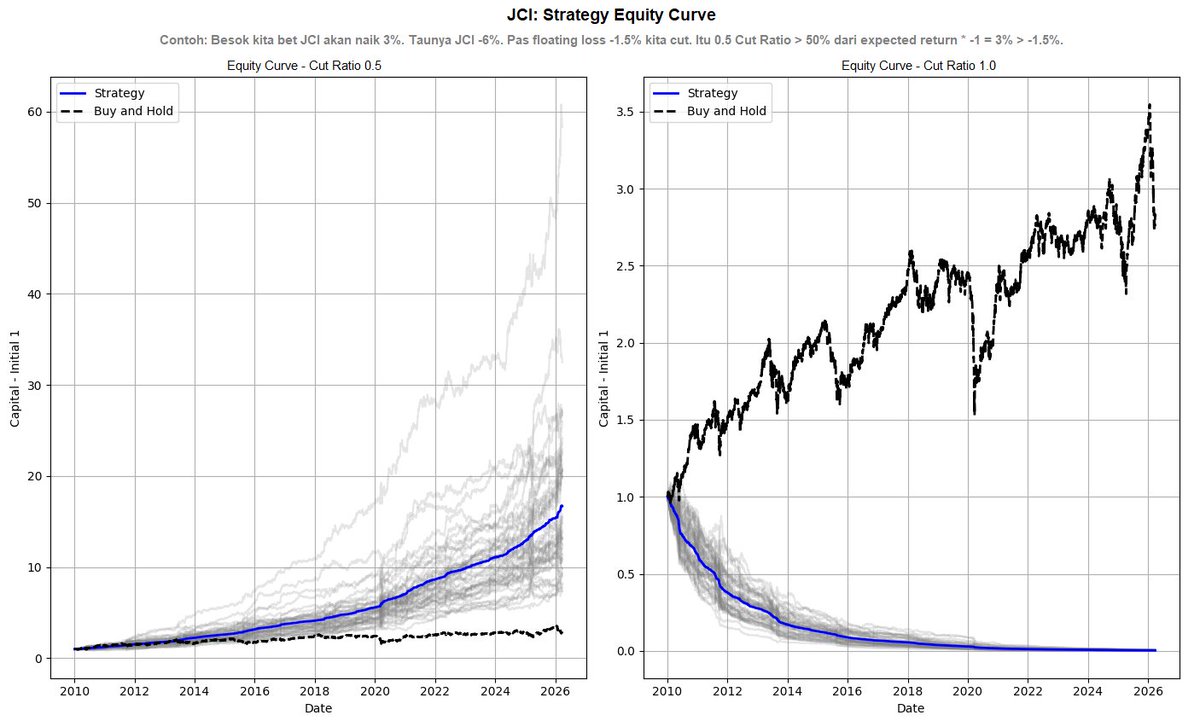
We ran a simulation, just on the JCI. Assumed we're betting on the index. Wrong 60% of the time, right 40%. In one scenario, when we were wrong, we did nothing. In the other, still wrong 60%, right 40%, but when we were wrong, we cut at 50% of the forecasted move.
*Example: you bet JCI will go up 5%. It goes down 5%. So when the loss hits -2.5%, you get out.*
The "stubborn and feeling like the smartest person in the room" strategy.. ofc smoked.
The "Okay, I'm wrong, move on, we're all dogshit at predicting price” strategy.. generated ridiculous CAGR. 19.89% from a single ticker… JCI.
So what's the catch? You can be wrong most of the time and still make life changing money. Your performance beats 99.99% of investors out there. Your alpha is unmatched. You make index returns look like SHIT.. all if you... admit when you're wrong.
Admitting you're wrong is just as important as picking the right company to buy. You take all these classes, paying 5 to 50 million for this or that, but when it's time to execute, you act like it's your first day in the market. "I'm right, the market is wrong" Stop attending expensive classes if you think you'll be right all the time. Useless.
-
And drawdown management *the thing most people take lightly* ends up destroying long term CAGR. Think of the market as binary: predictable vs unpredictable. When it's predictable, you play, fine, you make billions, maybe trillions, whatever. But when it's in the unpredictable phase, you still bet. And when you're wrong, you don't admit it. That's the crucial part. Why?? Because when the market becomes predictable again.. you're no longer playing with the same capital.
-
"Jangan cut loss"
"Kalau company-nya bagus, akan balik kok"
Not wrong... But we all know what it does to the CAGR.
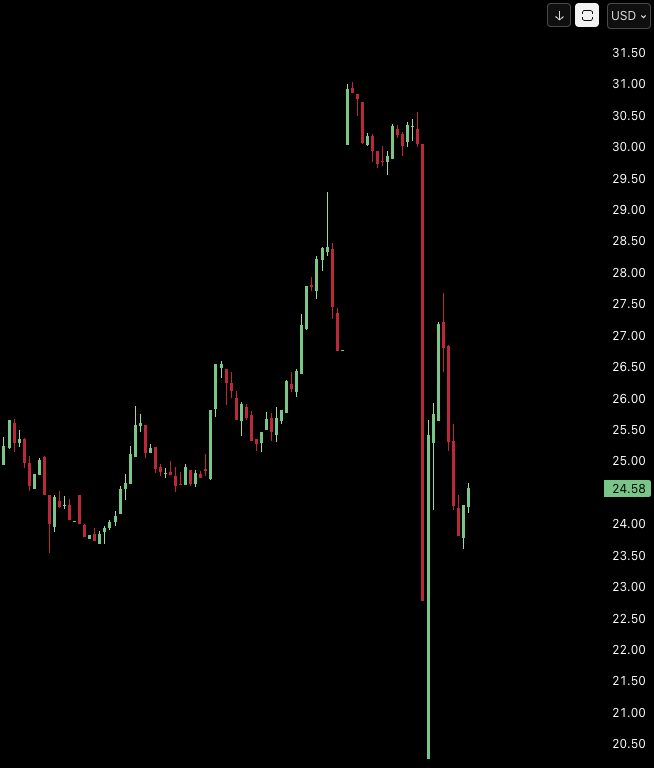
VIX is at 24.58. If you don't know what that means, stop whatever you're doing and read this. This is the one number that tells you whether to stay in the game or get the fuck out and go spend time with your family.
What is VIX?
It's the fear meter. That's it. It looks at S&P 500 options prices and tells you how freaked out the market is about the next 30 days. Not yesterday. Not last week. What people think is COMING.
Every hedge fund, every bank, every options trader on earth, all their panic boiled down into one damn number.
When VIX is at 25, the market expects the S&P 500 to swing about 1.6% every single day. When it hits 30, we're talking 1.9% daily swings. That's not normal. That's "oh shit" territory.
The cheat sheet you need tattooed on your arm:
Below 15 = Nobody gives a shit. Everyone's partying. No one's buying protection. This is when you should be worried because nobody else is.
15 to 20 = Normal. Chill. Nothing to see here.
20 to 25 = Hmm. The smart guys are quietly buying hedges. Something smells off. Pay attention.
25 to 30 = Shit is getting real. Money is flying out of stocks. Protection costs are going through the roof. If you don't have a plan, you're the plan.
Above 30 = Oh fuck. Full panic mode. Everyone is selling everything. Liquidity gone. This is where accounts blow up or fortunes get made. No in between.
We're at 24.58 right now. Read that again.
Why should you give a damn?
1. VIX is the price of fear
Imagine fire insurance. VIX at 15? Insurance is basically free. Nobody thinks the building is burning. VIX at 30? Every fund manager on the planet is SPRINTING to the same counter screaming "GIVE ME PROTECTION." The price goes nuts.
You want to know what fear costs? Look at VIX. That's the bill.
2. VIX up = stocks down. Almost every time.
These two move opposite about 70 to 80% of the time. Stocks take the stairs up. But when they fall? They take the goddamn elevator. VIX shows you that freefall happening live.
When S&P is dropping and VIX is spiking at the same time, that is not a dip to buy. That is the market screaming at you that the rules just changed. When S&P breaks below its 200-day moving average and VIX is above 25? Brother, that is a regime change. The "buy every dip" playbook? Throw it in the trash.
3. VIX always comes back down
Here's the thing nobody tells you. VIX can't stay insane forever. It always drifts back to around 19.5 over time. Always.
COVID March 2020? VIX hit 82.69. Came back down. April 2025 tariff meltdown? VIX hit 52.33. Came back down. Every. Single. Spike. In. History. Came back down.
And here's the beautiful part. Looking at the last 10 times VIX jumped 50% or more in a single month, the S&P 500 was HIGHER 12 months later in 7 out of 10 cases. That means when everyone is losing their minds, selling everything, calling their wife crying, THAT is when the deals show up.
The guys who got rich didn't buy when things were comfortable. They bought when it felt like the world was ending.
4. The market is always too scared
This one is hilarious. The options market almost always overestimates how bad things will be. What they think will happen is almost always worse than what actually happens. This gap is called the volatility risk premium and it has been around for decades.
The market is basically a nervous wreck by design. It's always pricing in more disaster than reality delivers. Smart money knows this and prints money off it.
5. Low VIX is NOT "all clear"
This is the trap that blows people up. VIX at 12, 13, 14? Everyone's relaxed. "Market is great bro, keep buying." Nobody has hedges. Nobody has protection. Everyone's balls deep in growth stocks with no stop loss.
Then BOOM. VIX goes from 14 to 30 in a week and those same people are staring at a 15% drawdown wondering what happened. Long periods of low VIX almost always end ugly. The cheapest time to buy an umbrella is when the sun is out. By the time it's raining, umbrellas cost 10x.
bottom line: the difference between making money and losing money in this market is not about which stock you pick.
It's about knowing when the weather is about to turn. VIX tells you the weather. Learn to read it or get rained on.
Stay sharp. Stay humble. And if VIX is above 30, maybe just close the app and go have dinner with your family. The market will be there tomorrow.
Pink Bourbon | Study Room.
Duh gmn ya ni akun gede kok telen mentah2 sambil cuci tangan ucapan Bennix yg udh terkenal "hadeh" kaya gini 😂😂😂
1. Loans yield 13% dikurang CoF 3-4% itu ranahnya Net Interest Income (NII). Kalo lo cuma ambil dr sini doang, lo lupa sama Opex dan Cost of Credit (CoC). Spread segitu ga bisa lo terjemahin mentah2 bank itu jadi vampir. Apalagi microlending itu NPL nya gede, bisa 3-5% di satu segmen nya, makanya ada namanya loans premium.
2. Data ttg Vietnam dilebih2 in dan sok iye, charge 2.58% bahkan 1.2% itu apa? per annum apa monthly rate? Cek lagi kalo emg annual itu karena subsidi government atau mungkin misleading karena ternyata USD loan? atau rate interbank overnight (ini aja di angka 4.5%).
Kenapa NIM emerging markets itu gede? ya karena risiko premium nya gede. Indo yg lebih investable aja NIM di range 4-7%.
3. Izin bank asing susah? Kayanya LambeSaham ama Bennix bener2 perlu macet2 an lewat Sudirman, Thamrin ama Rasuna Said buat liat bank2 Asia yg belakangan justru agresif ekspansi secara inorganik belakangan ini. Kalau ga ada kendaraan, buka dulu laporan publikasi nya coba jembrengin 5Y CAGR Assets Growth nya kaya gimana.
4. Saham Bank turun karena ada sistem yg diperbaiki 😂😂😂😂😂😂
Boleh lah sy ngakak banyak. Diketawain HoR sama Funds2 lah.
5. Korporat susah terbitin obligasi? Sering2 mampir dah ke keterbukaan informasi. Iya sih ga ada emiten yg terbitin obligasi (ini nyindir seriusan).