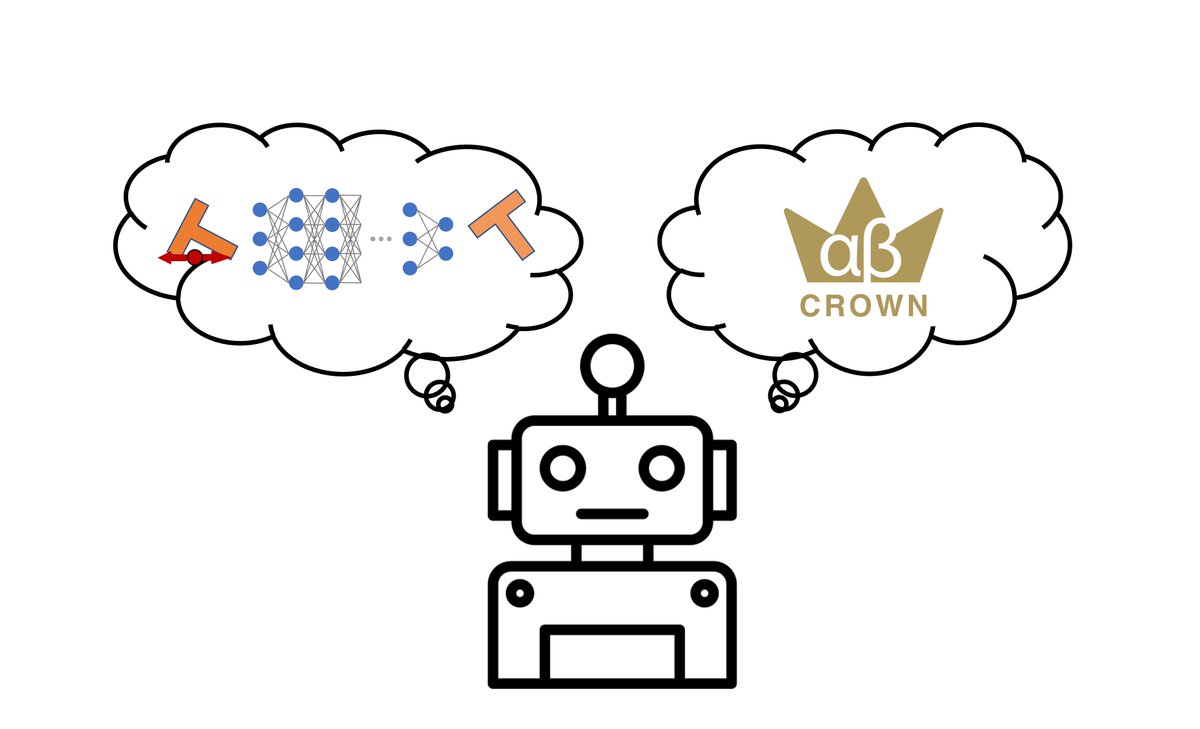
🎯Can robots do better on planning involving neural dynamics?
Introducing our recent work, BaB-ND: https://t.co/gQnPOypyOm.
Existing sampling- and gradient-based methods may fail short on complex planning problems over non-convex neural dynamics with long planning horizons.
Inspired by neural network verification techniques, robots can now strategically explore and reduce the search space and tackle challenging tasks like non-prehensile planar pushing with obstacles.
(1/6)
This project is led by @Keyi_Shen_ and made possible through the incredible contributions of co-authors: Jiangwei Yu, Jose Barreiros, @huan_zhang12, and @YunzhuLiYZ.
(6/6)
🎯Can robots do better on planning involving neural dynamics?
Introducing our recent work, BaB-ND: https://t.co/gQnPOypyOm.
Existing sampling- and gradient-based methods may fail short on complex planning problems over non-convex neural dynamics with long planning horizons.
Inspired by neural network verification techniques, robots can now strategically explore and reduce the search space and tackle challenging tasks like non-prehensile planar pushing with obstacles.
(1/6)
BaB-ND is an effective, applicable, and scalable framework, excelling in a wide range of real-world complex planning problems.
These include contact-rich manipulation, deformable object handling, and object pile management, all while supporting diverse model architectures such as multilayer perceptrons (MLPs) and graph neural networks (GNNs).
(5/6)
BaB-ND draws inspiration from the successful neural network verifier α,β-CROWN (🔗 https://t.co/pmqArEyJi1).
We present a novel adaptation of neural network verification techniques to address planning problems involving neural dynamics models in robotic manipulation.
Our work bridges the efforts in both the robotics and verification communities.
(4/6)