Politically Claimed Areas of Kashmir by 3 Countries ( China 🇨🇳, India 🇮🇳 and Pakistan 🇵🇰)
The Kashmir region is one of the most complex and disputed territories in the world, claimed by three nuclear-armed countries: India, Pakistan, and China.
After the partition of British India in 1947, the region became the center of several conflicts between India and Pakistan, with both countries controlling different parts of the territory while continuing to claim the whole area.
🤍🏳🤍
جمال مخفي لا يراه الكثيرون…
نورستان… كأنها قطعة من حلم
جبال خضراء تعانق السحب، ومياه عذبة تنساب بين الصخور كأنها موسيقى هادئة.
من كان يتوقع أن يوجد هذا السحر في أفغانستان؟
ویدیو: در بسیاری از منطقههای نورستان، هنوز هم شمار زیادی از مردم در منارههای چند صدساله زندگی میکنند.
منارههای قدیمی روستای دیوه در پارون، نمونههایی از فرهنگ غنی، تاریخ کهن و معماری بهشمار میروند.
#طلوعنیوز
Call for Collaboration (Mundigak Historical Research Foundation):
The Mundigak Historical Research Foundation is ready to cooperate academically and in the field on the documentation of these ancient Buddhist stupas. Based on available field data, historical sources, and visual documentation, we can contribute to organizing and strengthening the process of recording and studying these sites in a more systematic and scientific manner.
With the cooperation of relevant academic institutions, research organizations, and international cultural partners, it is possible to properly document, digitally record, and preserve this important heritage for future generations.
For the Mundigak Foundation, this is not only an academic project, but also a serious commitment to safeguarding our shared historical heritage.
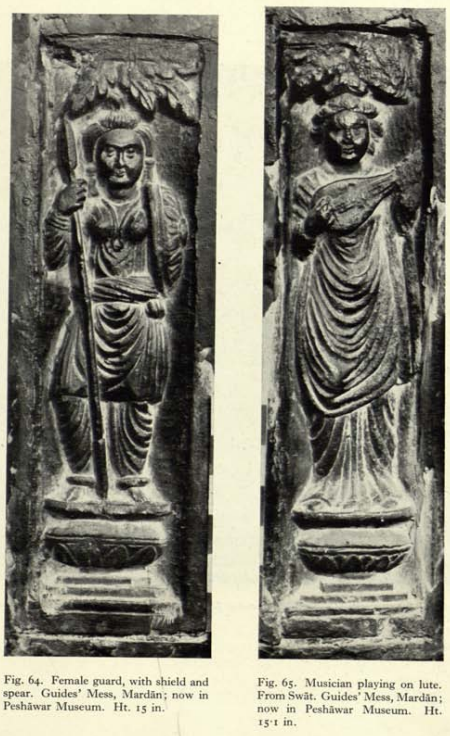
At the edges of a Gandharan Buddhist relief stand two beautiful figures: a female guard in native dress, armed with shield and spear, and a musician in Greek attire playing a lute.
In these small details, the cosmopolitan world of ancient Gandhara comes vividly to life.
1730s.
The decade a merchant family settled in Peshawar and began building one of the most extraordinary private architectural legacies in South Asian history.
The Sethi family. Traders. Not kings. Not governors. Traders.
They ran a commercial empire that reached Russia, China, Iran, Afghanistan and the Indian plains from a single neighbourhood in the old city of Peshawar.
They issued hundis, traditional financial instruments, for British officers operating in Afghanistan.
They moved caravans through the Khyber Pass when the Khyber Pass connected continents.
And they built seven havelis in one lane to show the world what Peshawar's merchant class looked like at its peak.
Sethi House is the one that survived completely. Construction began in 1835. Completed in 1882 by Sethi Karim Bakhsh.
The exterior is almost entirely hand-carved wood from ground to rooftop. Inside: 12 rooms layered with woodwork, frescoes, coloured glasswork and mirror work.
Every room carries a different geography.
The layout echoes old Baghdad.
The carved wooden screens trace to Samarkand and Bukhara.
Persian arches sit next to Mughal detail.
Local Peshawari craft ties it all together.
You are not looking at a house. You are looking at every city the Sethi family ever walked through.
The Bolshevik Revolution ended their Russian trade in the early 20th century. The family sold the properties. The havelis waited.
In 2006 the KP Government purchased Sethi House. Restored it. Converted it into a museum.
The same building where caravans stopped, deals were struck and tea was poured over trade routes spanning continents is now open to every Pakistani for PKR 200.
Peshawar does not just have history.
Peshawar carved it into its walls. 🇵🇰
Have you been to Sethi House?
📍 Sethi Mohallah, near Ghanta Ghar, Peshawar
Ethnic Identity in China: The Making of a Muslim Minority Nationality
Dru C. Gladney , Harcourt Brace College Pub, 1998
https://t.co/K3moXG03s1
PDF 🎯
https://t.co/0Q8etgCBTi
DG Archaeology & Museums KP visited Tokar Dara, Swat, to inspect ongoing excavations & recovered artifacts. Emphasizing the site’s significance, he directed the expansion of excavations to uncover more Buddhist heritage structures & deepen understanding of region’s rich past. 1/
#NewPublication
The Race for Universal Monarchy
Apocalypticism and the Ottoman–Habsburg Rivalry in the Sixteenth-Century Mediterranean
Ebru Turan, Columbia University Press, 2026
https://t.co/zsm0d9izf9
https://t.co/p3BDXmcArt
https://t.co/3uPupr7mj1
#NewPublication
The Book of China
A Persian Merchant’s Description of the Ming State for the Ottoman Court
ʿAli Akbar Khatayi, ed. Transl. Kaveh Hemmat et al. Columbia University Press, 2026
https://t.co/vP9wecIaMy