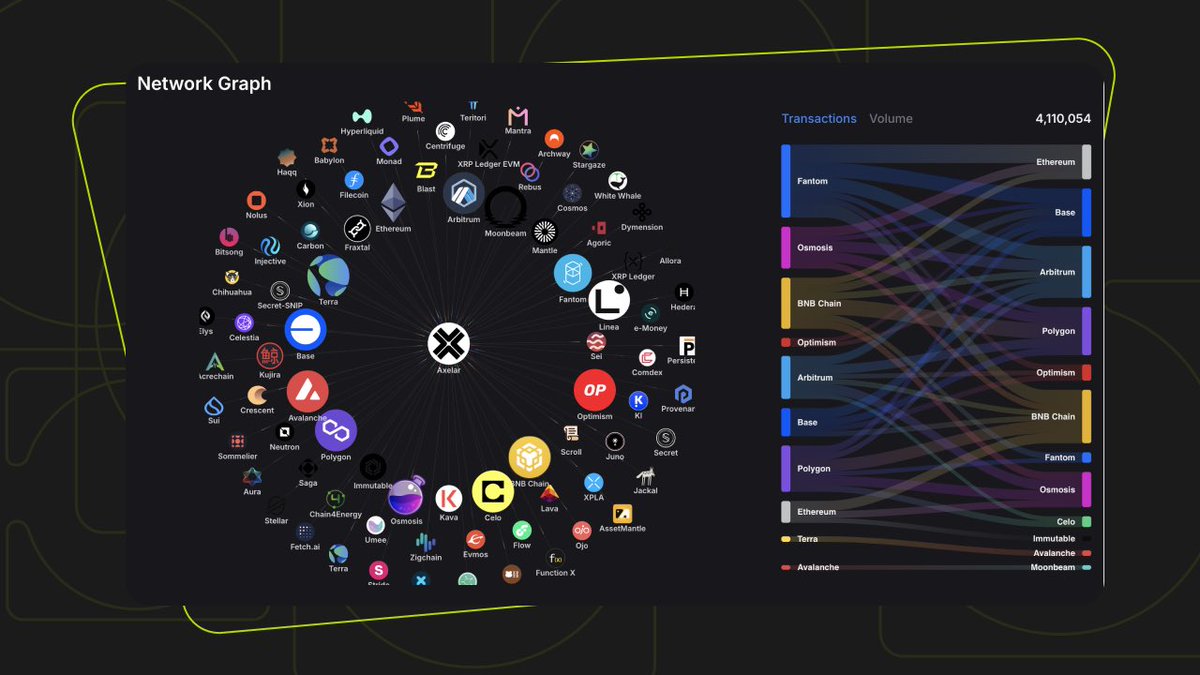
Axelar Network — I think it’s much better than LayerZero or Wormhole.
Let me start with the risks and drawbacks.
1/
Axelar connects dozens of blockchains — but that also means dozens of ways things can go wrong.
Here are the biggest red flags 👇
2/ TSS = single point of total failure
If Axelar’s threshold signatures break → the entire cross-chain system collapses.
This is the #1 existential risk.
3/ Validator centralization
A few validators + early investors hold too much power.
66% takeover = forged cross-chain messages.
Game over.
4/ Off-chain relayers
If relayers get DDoSed or go offline, Axelar stops moving messages.
This layer is fragile.
5/ Any chain can break the whole route
If one connected chain halts or lags → transactions freeze across the route.
Users stuck. Liquidity stuck.
6/ GMP risk: one bug spreads everywhere
A single dApp misusing Axelar’s messaging can trigger multi-chain damage.
Cross-chain amplifies mistakes.
7/ $AXL token economics = security risk
Low price → weak staking → easier attacks.
Tokenomics directly affect safety.
8/ Domino effect
If Axelar gets hacked, it’s not one chain that suffers.
It’s many at once.
The blast radius is massive.
9/
Axelar is powerful tech — but the risks are real.
The more chains you connect, the more catastrophic the failures can be.
@axelar@AxelarFDN
#AXL #crosschain #analysis #Web3 #DEX
@xeyalhuseynovx Small funds, however, match the country’s economic scale — they are flexible, adopt new technologies quickly, correct mistakes faster, and specialize more effectively.
A system of multiple small funds is also more resilient: if one fails, the rest continue operating.
@xeyalhuseynovx Small pension funds are a more practical model for Azerbaijan. The domestic market is not large enough for big funds to deploy massive capital without distorting the economy or becoming passive...
Why Small Pension Funds Are a More Rational Model for the Future
1.Small funds can operate in “thin” opportunity zones that large institutions simply cannot see.
Large funds require massive-scale deals — otherwise there’s nowhere to deploy their capital.
Small funds, however, can enter local projects, smaller tickets, and fast-moving opportunities.
They spot potential long before it becomes “scalable.”
2.Small funds experience far less informational noise.
In large institutions, decisions get buried under layers of reporting and hierarchy.
Small funds work with clean signals — no bureaucracy, no political noise — which leads to sharper, more accurate investment decisions.
3.Small funds correct mistakes faster.
When a strategy stops working, a small fund can adjust course in weeks.
A large fund may need months or even years.
This ability to self-correct quickly is one of the strongest forms of resilience.
4.They naturally create diversification at the national level.
Dozens of different strategies, markets, and approaches = a system that is resistant to shocks.
If one fund missteps, the rest continue operating.
The opposite of a “single-giant” model.
5.Small funds can build deep specialization.
One may focus on agritech, another on technology, another on regional development.
This creates analytical depth that large universal structures simply cannot achieve.
Universality in big funds = superficiality.
6.Small funds can adopt modern technologies much faster.
Transitions to advanced reporting, fintech tools, automated analytics — all of this happens quicker and more efficiently in compact structures.
Small funds become technologically advanced by default.
7.They are less vulnerable to herd behavior.
Large institutions tend to move “as the market moves.”
Small funds can pursue original, non-obvious strategies — the kind that often generate unexpected sources of national growth.
8. In small funds, managerial responsibility is visible and personal.
Contributors know who makes the decisions.
There is no “anonymous committee” to hide behind.
Responsibility drives quality.
9.Small funds are easier to scale in quantity, not size.
A country can grow 10–20 small players much more easily than one oversized institution.
This builds an ecosystem, not a monolith.
⸻
10. The key argument for Azerbaijan: large funds simply have nowhere to deploy massive capital domestically.
This is a critical issue that often gets overlooked.
Azerbaijan’s economy is dynamic, but not enormous in terms of internal investment capacity.
There are not dozens of projects capable of absorbing hundreds of millions or billions of manat at once.
A large fund inevitably faces one structural problem:
too much money, too few places to invest without distorting the market.
As a result, a large fund must either:
• invest abroad,
• over-concentrate capital in a few assets, or
• sit in passive instruments with minimal impact on the real economy.
All three options are inefficient — and none support long-term domestic growth.
Small funds, however, fit the structure of Azerbaijan’s economy perfectly:
• they can work with small and mid-sized projects,
• support regional initiatives,
• back local tech teams,
• strengthen the real sector without overheating the market.
A small fund can always find productive places to deploy capital.
A giant fund cannot.
And this is the fundamental reason why a distributed, compact, multi-fund pension system is far more rational for countries with economic structures similar to Azerbaijan.
@dsmfsosialgovaz
#Pension #Reform #Azerbaijan #DSMF #ECONOMY
Private Pension Funds in Azerbaijan — Structural Rationale & Lessons from the Netherlands
1.Azerbaijan’s transition toward private pension funds is not a cosmetic reform — it’s a structural necessity.
Demographics, fiscal pressure and rising life expectancy require a shift from a pure pay-as-you-go model to a capital-accumulation system.
2.The benchmark case is the Netherlands — consistently ranked among the world’s strongest pension systems.
Its framework is built on three coordinated pillars:
• State pension
• Mandatory occupational funds
• Voluntary private savings
3.The core insight: resilience comes from diversification of responsibility.
No single institution — not the state, not employers, not individuals — carries the entire risk.
Azerbaijan’s current model relies heavily on the state; private funds redistribute that load.
4.Dutch occupational funds (ABP, PFZW) illustrate scale and efficiency:
• Joint employer–employee contributions
• Large diversified portfolios
• Long-term investment horizons
• Professionalized governance
These factors produce stable returns and lower systemic vulnerability.
5.For Azerbaijan, the introduction of private funds provides a similar opportunity:
✔ Stabilize long-term pension obligations
✔ Reduce fiscal dependency
✔ Build domestic capital pools for investment
✔ Strengthen financial markets through predictable, long-horizon liquidity
6.The critical success factors are not theoretical — they are operational:
• Independent regulation and strict oversight
• Transparent reporting standards
• Clear investment risk boundaries
• Freedom to transfer, inherit or adjust accounts
Without these, participation and trust remain limited.
7.Private pension funds can become a strategic economic driver.
In the Netherlands, pension assets exceed national GDP.
Azerbaijan can replicate the logic at a smaller scale: create long-term capital that supports infrastructure, real estate, corporate finance and innovation.
8.The main risk is designing funds that are nominally private but operationally weak.
Governance, investment competence and regulatory independence will determine outcomes more than the legislation itself.
9.If executed correctly, this reform shifts Azerbaijan toward a multi-pillar, market-integrated, risk-balanced pension architecture — the same structure that allowed the Netherlands to achieve long-term sustainability.
10.The takeaway:
Private pension funds are not a financial product — they are a macro-economic institution.
Their design will influence capital markets, household savings behavior, and fiscal stability for decades.
This is my first modest post ; I'm very glad that progress is being made in this direction.
@dsmfsosialgovaz
#Azerbaijan #Pensions #Netherlands #Reform #Economics #Finance