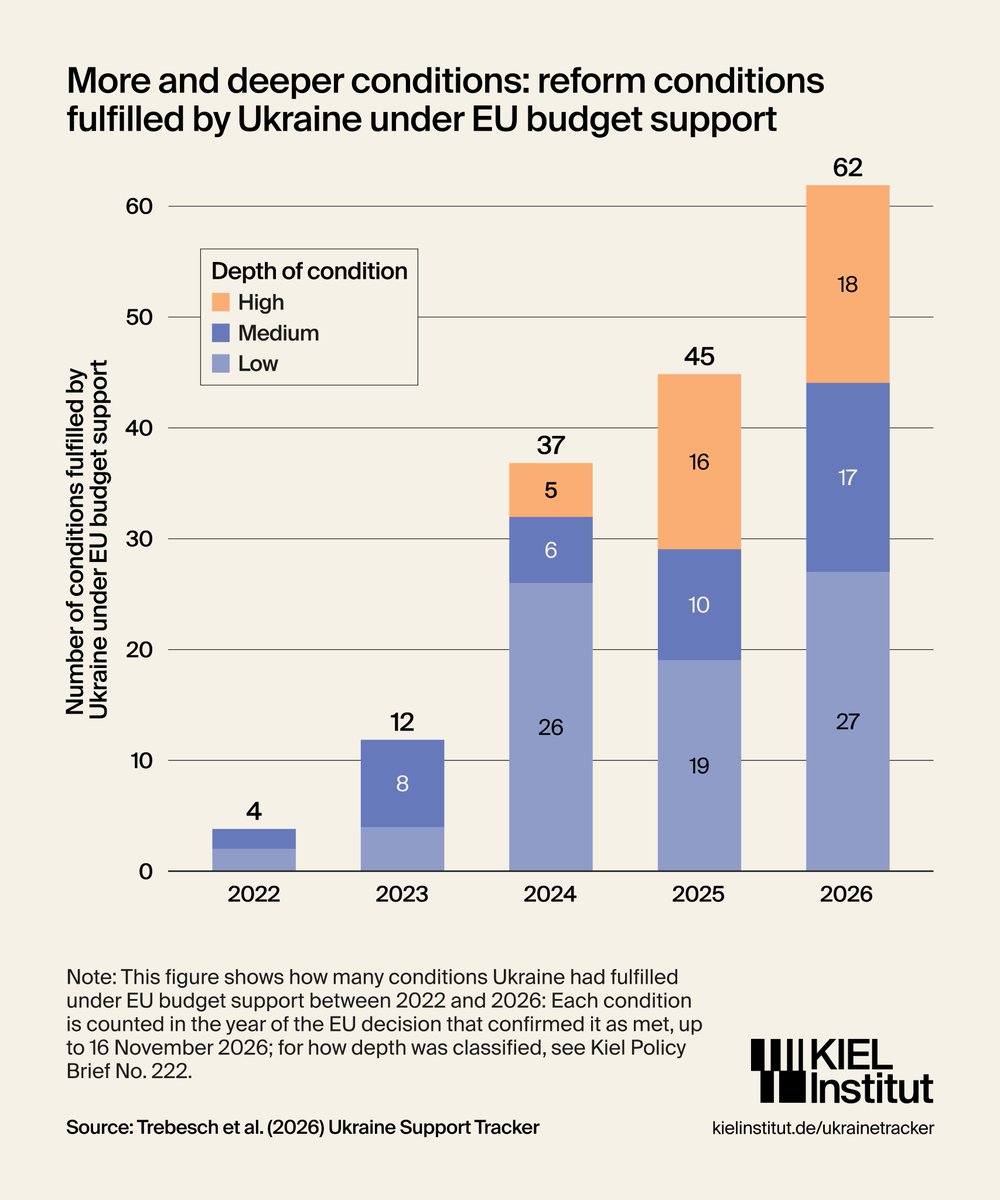
🇺🇦 Budget support for Ukraine is set to fall ~25% in 2026 while needs grow, & the EU Commission sees a ~€70bn gap for 2027. The EU is now the main donor, but payouts are €10bn+ behind schedule. New Kiel Brief warns of a severe squeeze, even with a new €45bn loan 👉 https://t.co/ePyxtwVkzX
<2 weeks: 2nd #IndustrialPolicy Lab Annual Conference, Nov 30–Dec 1, Berlin.
Keynotes: Felix Tintelnot (Duke) on green industrial policy, Chiara Criscuolo (OECD) on spending smarter.
By invitation. Interested? Write to [email protected]
https://t.co/o8pDgJEfg7
📢 Postdocs in international economics: join our 2027 cohort, starting Sept 1, 2027. We especially welcome research on geoeconomics, security & conflict. Own research budget, mentoring, job-market support. Apply via #EconJobMarket 👉 https://t.co/4x6wMfV5n9
6/ Marvin Amann studies the economic costs of war – his first paper with @YGorodnichenko and Oleksandr Talavera is out as Working Paper 👉 https://t.co/ALGEeBRRgv. He first came across the Kiel Institute through our Ukraine Support Tracker.
🎓Two months in, our new ASP PhD cohort attended its first major Kiel Institute conference: the 5th Kiel-CEPR Conference on Geoeconomics in Berlin. Meet Finn, Jonathan, Aleksejs, Klara and Marvin – working on war and defence, climate policy, trade and finance 🧵
What can the social sciences contribute? Central panel with Nicole Deitelhoff (PRIF), Sabine Kurtenbach (GIGA), Maren Röger (GWZO), and Moritz Schularick (Kiel Institute), moderated by Jörg Rocholl (ESMT Berlin).
By invitation – interested? Write to [email protected]
Defending Europe takes more than military strength. On Dec 7 at ESMT Berlin, Joschka Fischer & Sauli Niinistö @niinisto give the keynotes at “How to Defend Europe?”, a joint event of the Kiel Institute, ESMT Berlin, & the Leibniz Research Network Security and Resilience Research
🎉 Congratulations to Thomas Drechsel, Alexey Makarin, Isabela Manelici and Marco Tabellini on the Kiel Institute’s Excellence Awards 2026, presented at the Kiel-CEPR Conference on Geoeconomics at the Federal Foreign Office in Berlin.
We look forward to following your work!
Best of all, a group of early-career researchers from across Europe became a real community. That network will stay with them throughout their careers. A special thank you to Stiftung Mercator for funding Next-Geo and our partners at @OxfordEconDept, IEP@Bocconi & @cepr_org
🎉 It’s a wrap: the first year of our #NextGeo Program came to a close at the Kiel-CEPR Conference on Geoeconomics, where some of our fellows presented their research.
Applications for the 2027 cohort close tomorrow 👉 https://t.co/foUxlCfbSi
What a year: an online kick-off in winter, “Best of Geoeconomics @ Kiel Institute” at our Kiel headquarters around Easter, the Oxford Summer School in summer, and a policy module right before the conference. Plus mentoring all along the way.
Bis 2038, wenn das Infrastruktur-Sondervermögen ausläuft, wären jährlich Maßnahmen von über 0,5 % des BIP nötig, um die Schuldenbremse einzuhalten. Die Aufgaben sind deutlich größer als in den 2000ern. Neuer Kiel Policy Brief von @HogrefeJens 👇 https://t.co/y44aBtAU83