Kenya’s government, through Treasury CS John Mbadi and AG Dorcas Oduor, says the Sh204.3 billion received from the sale of its 15% stake in Safaricom is non-refundable.
The government says the shares have already been transferred to Vodacom and are traded on the NSE.
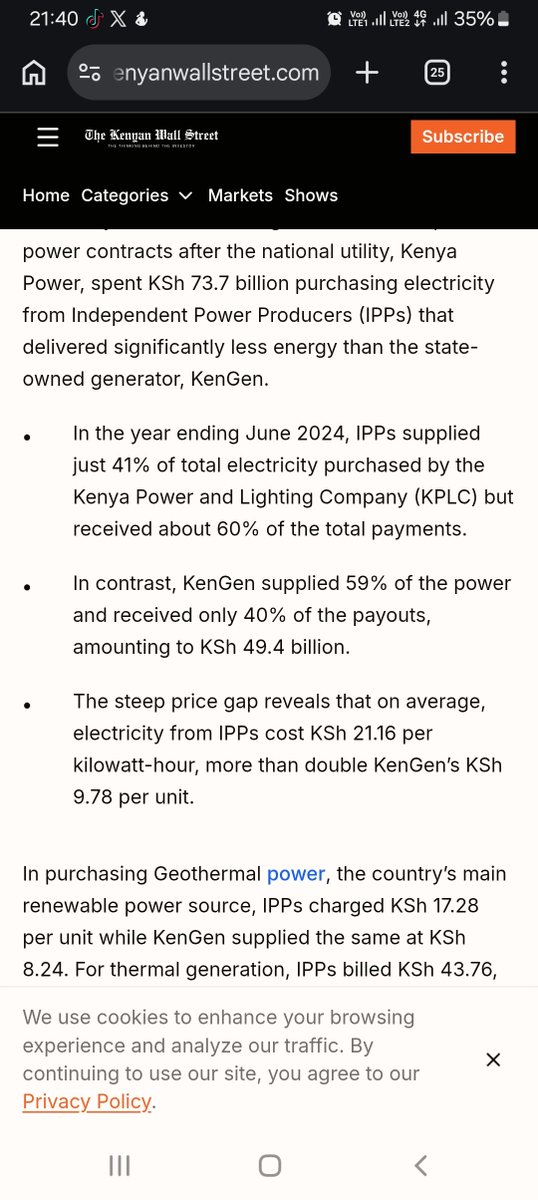
@__theo254@swamukonya@NdindiNyoro Do you see the selling price here, the costing of Kengen is mostly from natural renewable energy. Tell me how the production becomes expensive as compared to fossil fuel power then...
Hon. Ndindi Nyoro, please confirm or deny the following:
Whether President William Ruto called you three days ago at exactly 8:05 a.m.
Whether, during that conversation, he instructed you to mention Rigathi Gachagua by name and portray or insinuate that he is a bully.
Whether he directed you to mobilise 3,000 young people from the Mt. Kenya region residing in Nairobi and organise a People’s Party rally in Nairobi.
Finally, whether the President instructed you to identify and recruit a suitable gubernatorial candidate to contest the Nairobi governorship on your party’s ticket.
These are specific and verifiable questions. A simple “Yes” or “No” to each would suffice.
Tunakuona 18.
Mejja’s “Hustler” Is Not a Celebration. It Is the Soundtrack After the Jobs Were Sold.
Mejja, born Major Nameye Khadija, has a new hit called Hustler. On the surface it praises hard work and the micro-entrepreneurial spirit of Kenya’s middle class - not the slum romance usually sold as “hustle,” but the clerk, the side-hustle graduate, the person who still believes effort should convert into a wage.
Listen again and it sounds less like celebration than conditioning: a generation being told to clap for the wreckage of the original contract.
That contract was sung into children. Mejja’s age-set grew up inside 8-4-4 with a song on daily rotation at the Voice of Kenya, later KBC: Someni vijana, muongeze pia bidii, mwisho wa kusoma, mtapata kazi nzuri sana.
Study. Add effort. At the end of school you will get a very good job.
Parents sold land and animals on that promise. Children sat exams under anxiety. They survived colonial-style boarding schools and corporal punishment from stressed, violent and psychotic Kilimambogo/Kagumo College teachers.
The deal was simple: endure the system, collect the certificate, collect the white-collar job. 8-4-4 was built to manufacture that belief, then failed on its own terms.
Moi launched 8-4-4 in 1985 after the Mackay Commission, replacing the inherited 7-4-2-3 structure. The official pitch was practical: more years in primary school, vocational subjects, self-employment for those who dropped off the ladder.
What arrived was an overloaded exam machine. Primary pupils faced a pile of examinable subjects. Secondary students crammed for papers. Teachers taught to the test. Students memorized, sat, forgot. Critical thinking and workshop skill were sacrificed to ranking.
The cruelty was structural. 8-4-4 trained a mass of credentialed youth for a formal labour market that was already shrinking. It produced anxiety as pedagogy: land, animals sold for fees, years of boarding-school colonial concentration camp brutality, then a certificate that no longer opened an office door.
Structural Adjustment did not arrive as a rescue. It arrived as a lever.
Kenya signed early World Bank structural adjustment lending around 1980 and spent the next two decades under IMF and Bank programs.
The package was consistent. Liberalize imports. Realign the exchange rate. Cut subsidies. Cap the deficit. Restructure and sell public enterprises.
Of more than two hundred parastatals earmarked for divestiture, the programme’s purpose was not mystery: shrink the state’s productive footprint, open the market, and use debt service as the enforcement tool.
The impacts were not abstract. Import liberalization flooded shelves with goods that domestic plants could not match on price once protection was stripped. Agro-industrial and manufacturing parastatals that had already been looted and mismanaged were then declared inefficient and prepared for sale.
Debt that had been advanced into a patronage state - much of it looted with donor’s knowledge - was then waved as destiny: pay, privatise, or starve of foreign exchange.
That is the sequence the KBC song never mentioned. The same generation drilled to expect a job after Form Four and university walked into an economy whose industrial floor had been pulled out.
White-collar intake collapsed with the firms that used to absorb clerks, technicians, accountants and managers. What has remained is informal survival dressed up as virtue.
So the hymn has to change.
With the original promise broken, new songs are required to glorify the demeaning craft of “hustle.”
Kenyans are encouraged to forgo the expensive education their parents funded by selling land and animals; to shelve the skills; to forget the man-hours and the exam nights; to forget the suffering under brutal colonial boarding schools.
They are told to embrace a totally new way of earning a living, praised as a Hustler.
That is what Mejja’s song is doing, whether he intends the history or not.
" Safaricom does not nyef nyef nyef."
This was wakili Ian Mutiso and Wakili Danstan Omari interrogating a Safaricom officer who had testified in court that he was asked to track the location of David Mokaya.
He even accepted that he did not have the court order to do that.
Alafu mnataka kuanza kutufunza kuhusu Katiba?
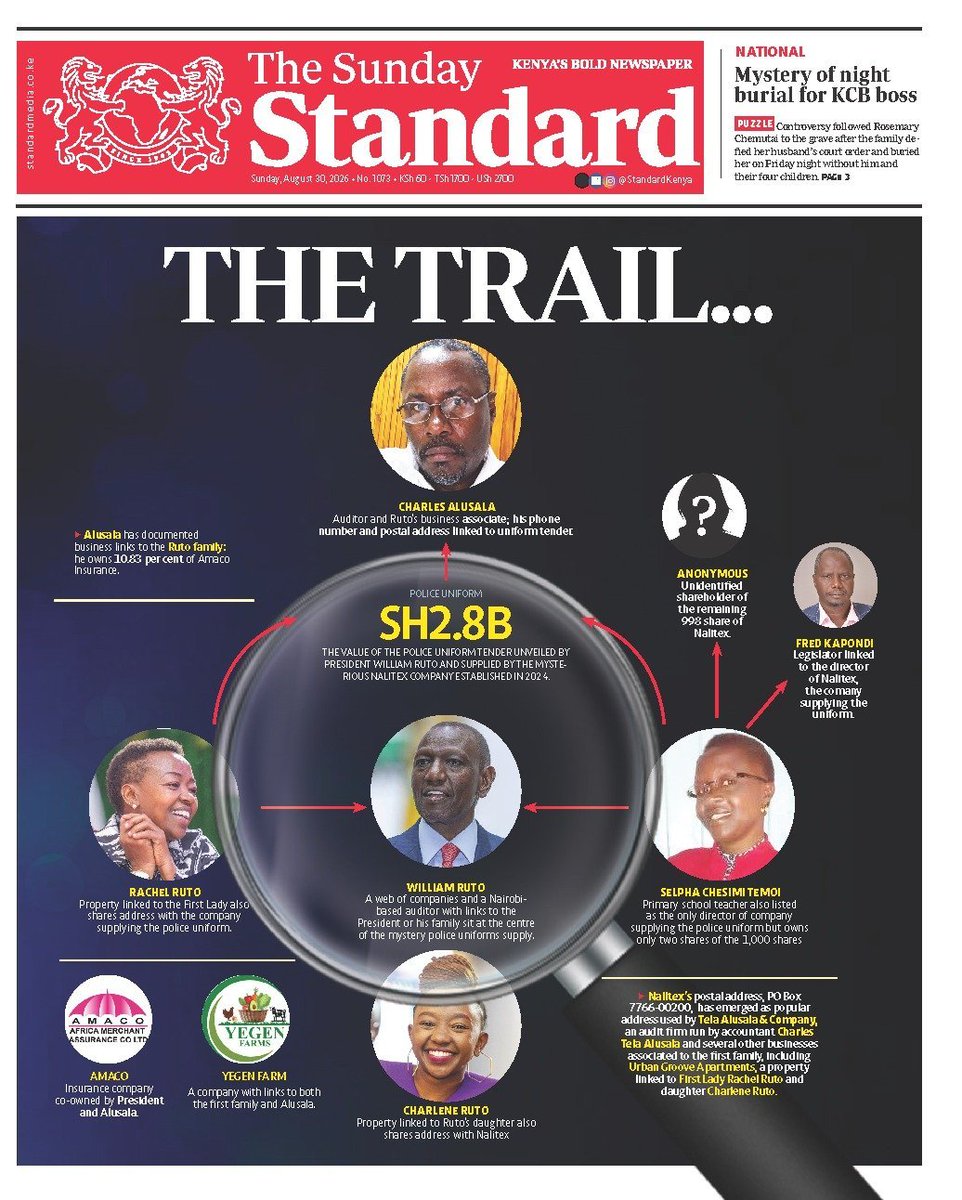
The 'Charles Alusala' in the police uniforms tender is the same ' Charles Alusala' in the NTSA deal who is William Ruto's accountant.
And he has the audacity to lie to you that after signing the conflicts of interests Bill he lost so many friends.
Which friends? He's the one shamelessly doing business with our taxes.
This is not hustling. This is a crime.
@Cjamehk If it indeed happened ,then this must have been a government psychological operation to show the public that goonism isn't a problem harboured &natured by the government of the day and therefore give them a plausible deniability of involvement.
I promised we wouldn’t let them bury this. Today, I keep that promise.
The complete, unredacted NHIF payment data (2018-2024) is OFFICIALLY LIVE.
Scan the QR code below for the full database + official SHA response letter.
It contains the full raw dataset of 272,000+ NHIF payment records (2018–2024) totalling KES 340.4 Billion across 5,790 facilities.
Some of these numbers will make your jaw drop. They tried to stall, but transparency won.
Massive gratitude to Saddam, CAJ, our legal supporters, and every single one of you who kept the pressure on.
The truth is finally in your hands. ✊ Let’s make sure everyone sees it. Public data belongs to the public. God willing we will have a good website.
The United Opposition is calling on the ICC to monitor political violence in Kenya and, where there is evidence, take action against President William Ruto, whom they describe in their statement as a former indictee.
They have also urged ICC to revisit President Ruto’s file relating to the 2007 post-election violence.
As the Founding Chairman, UDA (Emeritus), I request Hon. Ndindi Nyoro to either confirm or deny the following:
1. Whether, over the last four months, you have had five telephone conversations and two physical meetings with President William Ruto.
2. Whether your team initially presented a KSh72 million budget to Felix Koskei for the launch of your presidential bid, which was subsequently revised upwards to KSh86 million.
3. Whether you have held secret meetings with prospective defectors from UDA, particularly Members of Parliament from the Mt Kenya region.
4. Whether you were instructed not to use the political slogan “WANTAM” in your public engagements.
These are specific and verifiable questions. Given the growing public speculation surrounding your political ambitions, a simple confirmation or denial would put the matter to rest.
The Kenyan public deserves clarity—not political whispers, coded messages or plausible deniability
The law is the law. It does not matter for how long the law has been violated. Article 138(1) & (2) of the Constitution, on the Procedure at presidential election, categorically provides:
(1) If only one candidate for President is nominated, that candidate shall be declared elected.
(2) If two or more candidates for President are nominated, an election shall be held in each constituency.
Voting at elections is conducted as provided under Article 86, which provides:
86. At every election, the Independent Electoral and Boundaries
Commission shall ensure that-
(a) whatever voting method is used, the system is simple, accurate, verifiable, secure, accountable and transparent;
(b) the votes cast are counted, tabulated and the results announced promptly by the presiding officer at each polling station;
(c) the results from the polling stations are openly and accurately collated and promptly announced by the returning officer; and (d) appropriate structures and mechanisms to eliminate electoral malpractice are put in place, including the safekeeping of election materials.
From the law above, there is no way the results for the Presidential elections cannot be announced at the Constituency as required by the Constitution. #ReKe #GetitDone #KnowYourConstitution
"Here is brijin Aaron Cheruyot speaking in Kericho. He states, "There are a few people in Kericho who are hiding and saying wantam." He tells the governor that some individuals, not even from Kericho and joking too much, are claiming wantam. He warns that those people will be sent amway to stay with their grandmothers. He also added, "kuna mtu atatolewa chini ya kitanda ya nyanya yake akiwa amekatalia hapo," meaning someone will be taken out from under their grandmother's bed.
DCI cannot understand the Kalenjin language Aron Cheruyot is speaking, but can understand the Kikuyu language that Kaguchia is speaking".