The legal dispute worth noting. On one side, the parties had agreed that fees would be settled before release, and an auctioneer who has done lawful work is entitled to be paid, so releasing the vehicle at once risks leaving genuine charges unrecovered. On the other side, attachment is a public power granted for a single purpose, and once the decree is paid that purpose is spent, so holding the property to force payment of an untaxed and disputed sum turns the process into leverage. The court resolved it by ordering release now and taxation of the fees separately, with the owners also awarded damages for the loss of use of the vehicle while it was wrongly held.
Key takeaway: payment of the decretal sum ends the attachment. An auctioneer recovers disputed fees by taxation, not by detaining the property, and not even a consent can license detention beyond what the law allows
The respondents raised a consent recorded on 14 November 2024, under which fees and storage were to be paid before release. The court accepted that a consent has contractual force and is not lightly disturbed. But it held that a consent must be read together with the law, and cannot authorise fees above the scale or permit the indefinite detention of property. Private agreement cannot override a statutory process.
Auctioneers' fees are not open-ended. They are fixed by the Auctioneers Act, which sets a scale. Any charge beyond the scale must be sanctioned by law or determined through taxation. An auctioneer who is owed fees files a bill of costs and has it taxed. He does not hold the owner's property until a figure of his own choosing is met.
The principle is settled. Attachment places property in the custody of the law for one purpose only, to satisfy the decretal sum. Once that sum is paid, the property ceases to be in the custody of the law, and the auctioneer cannot keep detaining it to recover his own costs. The court applied National Industrial Credit Bank Ltd v S.K. Ndegwa Auctioneer, where the Court of Appeal held exactly that.
A motor vehicle was attached in execution of a decree for KES 213,319. Before the auction, the owners paid the decretal sum in full and redeemed the vehicle. It was still not released. The auctioneers held on to it over a dispute about their fees, demanding KES 174,016 against a scale figure of KES 17,371. The Small Claims Court allowed the car to be held until the fees were taxed and paid. On appeal, the High Court disagreed.
The decree was paid in full. The auctioneers still refused to release the car, demanding KES 174,016 in fees when the lawful scale came to KES 17,371. The High Court has now held that the detention could not stand.
This is Mburu & another v Kengere & 3 others, [2026] KEHC 15055 (KLR). Here is what it means.
.
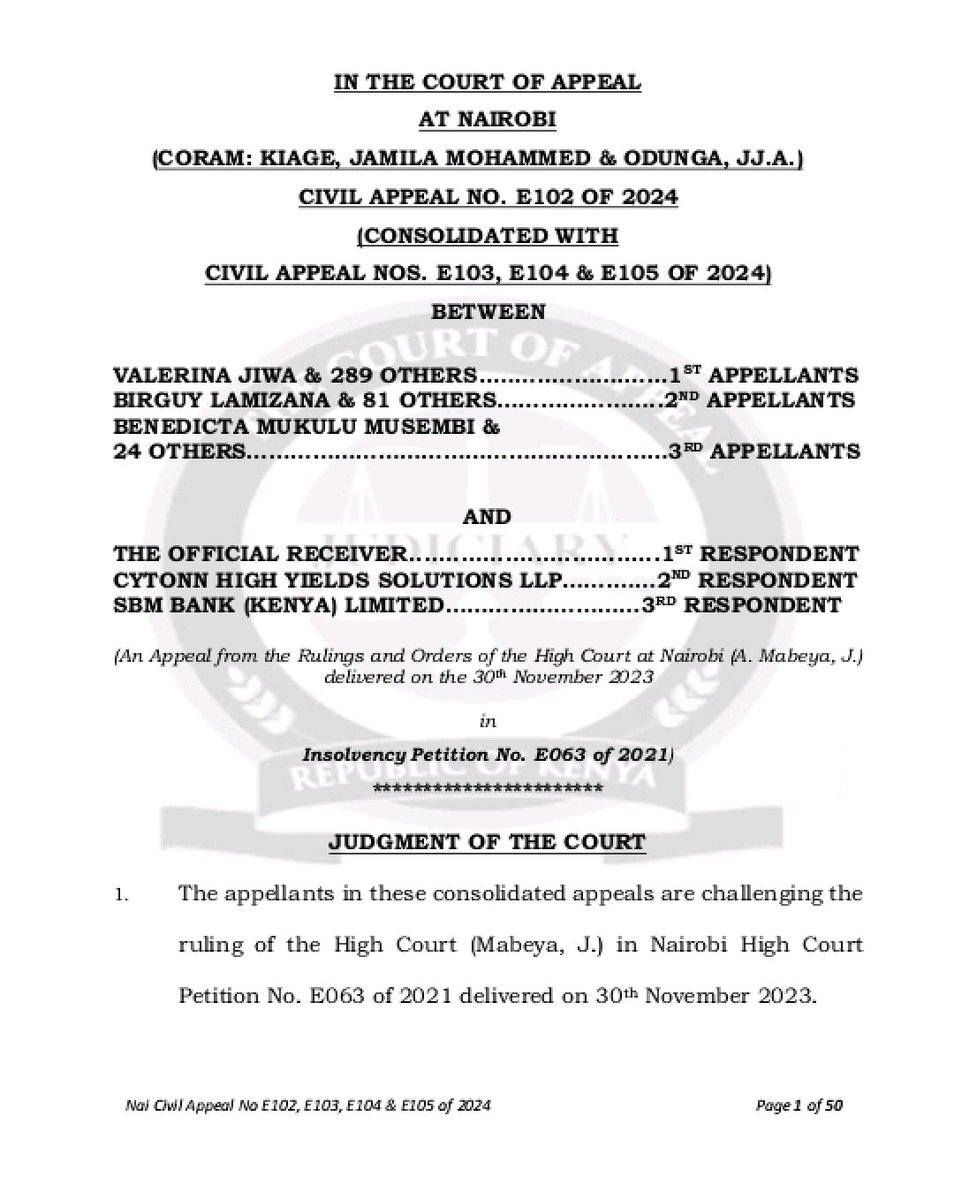
Cytonn’s multi-billion shilling appeals have been DISMISSED and the liquidation train is officially unstoppable. Over 3,000 investors and Ksh 11B on the line, and the so-called ‘Special Purpose Vehicles’ have been told: you’re not walking away with the bag. Investors argued those properties shouldn’t be touched, but the Court wasn’t convinced.
The SCOK in the case of MNK v POM; significantly clarified the law on cohabitation and the presumption of marriage. The key finding was that long-term cohabitation alone is not sufficient to automatically constitute a marriage; it is the exception rather than the rule.
@ahmednasirlaw@Wakabando@MachariaNjeru Because he said during campaigns that he's the real bulldozer to Kenya's problems and he's happy the problems and troubles found him.Let him face it head on.