The AI space moves too fast. 99% of tools are just noise.
I spent the last 30 days testing 100+ AI tools to find the ones actually worth your time.
Here are 7 game-changing AI tools that will save you 10+ hours every week:
1. Claude 3.5 Sonnet: The best LLM for nuanced writing and clean coding logic.
2. Perplexity AI: Replaces Google for research with real-time, cited answers.
3. Midjourney v6: Studio-grade image generation for visual storytelling.
4. Notion AI: Automates meeting notes, drafting, and project organization.
5. ElevenLabs: Hyper-realistic voice synthesis for videos and podcasts.
6. Cursor: The AI-first code editor that speeds up development by 3x.
7. Make / Zapier: Connects these AI tools into automated background workflows.
I share practical AI workflows, curated tools, and actionable prompts every day.
Follow me @Kim1Trung so you don't miss out on what's next.
The dirty secret of frontier AI:
Training models is expensive, but inference is what bankrupts you.
As models shift to long-horizon reasoning and autonomous agents, serving tokens 24/7 on generic Nvidia GPUs is no longer economically sustainable.
Now, the silicon rebellion has begun: 🧵👇
1. The Big Moves:
• Anthropic is in advanced talks with Samsung to co-develop dedicated inference silicon.
• OpenAI has partnered with Broadcom and TSMC to design custom in-house accelerators.
The software pure-plays are officially becoming chip designers.
2. Why Nvidia’s Moat is Fracturing at the Inference Layer:
Nvidia’s CUDA and general-purpose GPUs dominate training because research architectures change every month.
Inference is completely different:
• Workloads are predictable and standardized.
• Memory bandwidth and power efficiency matter 10x more than raw compute.
• Paying Nvidia’s 75%+ gross margins on every single user prompt is an existential threat to AI margins.
3. The Custom ASIC Advantage:
By stripping away unused GPU graphics pipelines and hardcoding specific matrix multiplication architectures:
• Inference latency drops by 3x–5x.
• Power consumption is cut in half.
• API token costs for end-users can drop by an order of magnitude.
The Endgame:
Google pioneered this decade ago with TPUs. Apple did it with Apple Silicon.
Now, every frontier AI lab must vertically integrate down to the transistor level or surrender their profit margins to Jensen Huang.
Software eats the world. Hardware eats the software.
Will custom AI chips democratize API pricing, or will the fabrication choke point stay with TSMC?
Bookmark this breakdown, and follow @Kim1Trung for daily insights on practical AI workflows.
ByteDance just secured a massive $30B credit facility to finance its AI infrastructure expansion.
Most people think ByteDance is just a social media company.
They miss the bigger picture:
This is a direct assault on the digital advertising pipeline. 🧵👇
Here is the strategic breakdown of what this $30B CapEx war chest actually builds:
1. The Data Advantage Nobody Talks About:
OpenAI and Google scraped the public web.
ByteDance owns Douyin and TikTok: hundreds of millions of short-form vertical videos uploaded every month, complete with second-by-second user retention data. They don’t just have video tokens—they know exactly which frames make humans buy.
2. Powering the Seedance Video Pipeline:
Training commercial-grade video models (like Seedance 2.0 / 2.5) requires unfathomable compute.
Rendering believable fluid physics, character consistency, and 3D spatial alignment demands clusters of tens of thousands of high-performance GPUs running around the clock.
3. The Autonomous Ad Flywheel:
ByteDance's endgame isn't competing for subscription fees.
It is closing the loop on TikTok Shop:
• Merchant uploads a product URL.
• Agent analyzes top-converting competitor creatives.
• Generative engine renders 50 custom video ads automatically.
• Algorithm tests them across targeted feeds and scales the winners.
Production costs collapse from thousands of dollars to pennies per creative.
The Takeaway:
The AI video wars won't be won by whoever generates the prettiest cinematic landscape.
It will be won by whoever connects generative video directly to transaction volume.
ByteDance isn't building a cool demo. They are building an automated commerce factory.
Will automated generative video replace traditional creative agencies within 24 months?
Bookmark this perspective, and follow @Kim1Trung for daily insights on practical AI workflows.
The "PRODUCT LOCK — CRITICAL" section is textbook commercial direction.
Most FMCG AI ads fail because the packaging branding melts or the mascot changes face between cuts. Explicitly enforcing package geometry, reflection physics, and zero-redesign constraints while breaking the 15s into an 8-panel storyboard is the only way to deliver client-ready advertising.
Precision parameters beat vague aesthetic buzzwords every single time.
Pro-tip for ad testing: The winning workflow right now is rendering 3 different 3D blockouts in Blender (different product angles), then using Seedance to generate 3 distinct hook variations for TikTok/Reels in under 10 minutes."
The generative video race just shifted from "making cool 5-second GIFs" to actual ad production.
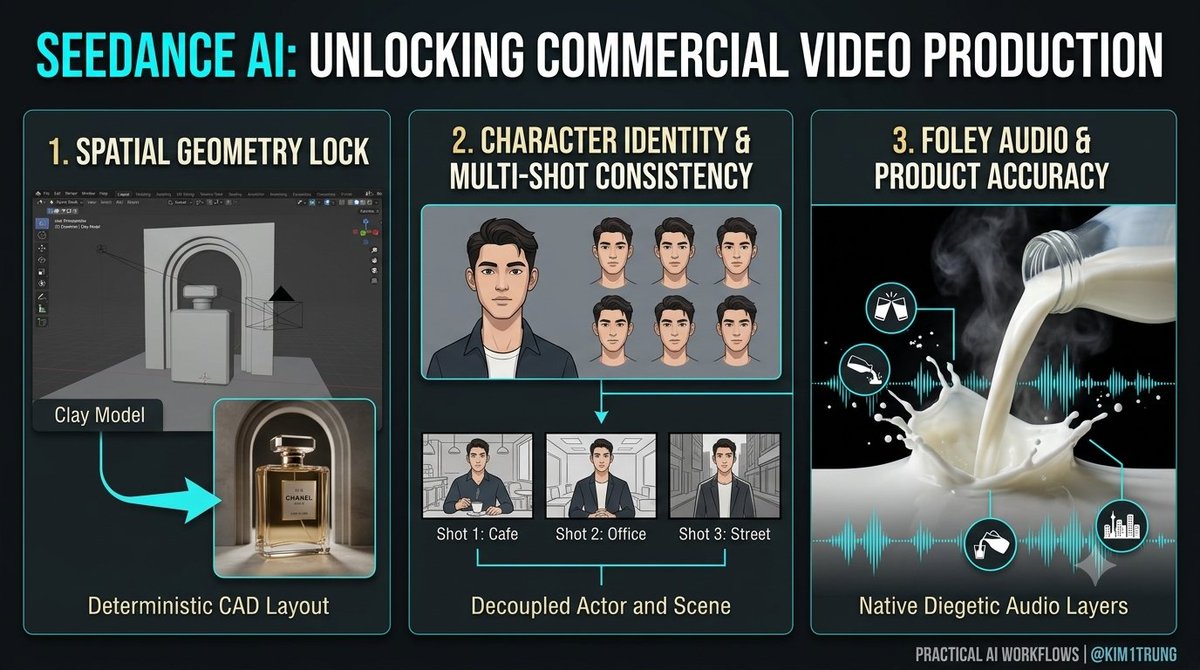
ByteDance's Seedance (v2.0 / 2.5) is quietly outperforming traditional AI video generators in commercial workflows.
Here is why performance marketers and motion designers are paying attention: 🧵👇
1. Native Spatial Geometry Conditioning:
The fatal flaw of Gen-3 or Sora for commercial ads was random camera drift. Seedance integrates directly with 3D depth/clay models (via Blender plugins).
You set the camera angle and packaging geometry in 3D $\rightarrow$ Seedance paints the realistic lighting and materials. Zero spatial hallucination.
2. True Multi-Shot Identity Lock:
In standard video models, your actor's face morphs between cut 1 and cut 2.
Seedance allows decoupling the "Master Character Set" from the "Storyboard Panel." You can run a character through 5 distinct environments (café, street, office) without the face melting or wardrobe shifting.
3. Commercial Fluid Dynamics:
Food and beverage ads are the ultimate stress test. While most models turn liquids into floating gelatin, Seedance handles micro-splashes, milk pours, and vapor with believable physical momentum.
4. Built-in Diegetic Foley Audio:
Instead of forcing creators into third-party sound libraries, the native pipeline synthesizes environment-accurate acoustic layers (footsteps, ambient wind, glass clinks) timed directly to the visual frame rate.
The takeaway:
Generative video is no longer about novelty prompts. It is about controllable, reproducible production assets that lower client acquisition costs.
Have you integrated AI video into your paid creative pipeline yet?
Bookmark this breakdown, and follow @Kim1Trung for daily practical AI workflows.
The Teal & Orange color contrast cuts through the volumetric fog really well here.
The classic diffusion quirk is noticeable though: despite prompting for a "female warrior", the model defaulted to a school sweater/collar look. When a video prompt packs too many environmental descriptors (smoke, rain, metallic debris), diffusion models often simplify character wardrobe tokens.
Negative prompting for modern casual clothing or locking the costume in a Midjourney/Flux keyframe first solves that wardrobe drift.
Fixing camera focal length and perspective via Blender blockouts is the only way to make generative diffusion viable for real commercial pipelines.
Pure text prompting always drifts spatial coordinates across iterations. Passing a direct clay/depth buffer into Seedance 2.5 lets the 3D artist control composition and framing while offloading texture synthesis and global illumination to the neural net.
Deterministic camera layout + latent style pass is the right architecture.
The most critical line in this entire prompt is: "Do not copy any pose from the Master Character Set. The storyboard controls the layout."
Most creators fail at character consistency because the model latches onto the reference image's pose and camera angle rather than extracting pure facial weights.
Decoupling character identity vectors from shot-by-shot spatial composition across a 7-panel sequence is the only way to produce coherent long-form AI storytelling.
OpenAI CEO, Sam Altman:
"I just tell the model what I want come back in 30 minutes and it's all ready.
Astra is the first model where I could tell someone just give it a try and it will work."
In 20 minutes he explains how AI went from a tool you operate to an agent that operates your computer for you, and where that goes next.
Worth more than any $500 AI course you'll find.
Watch it, then read the guide below on the easiest way to run your own agent team for free.
Treating Blender clay renders as geometric control inputs is the only reliable way to eliminate structural hallucinations in AI architectural visualization.
Instead of fighting with prompt seeds to keep window placements or wall curvature consistent, passing a raw depth/normal pass into Dreamina lets the diffusion model handle surface materials and ray-traced bounces while keeping exact CAD tolerances.
Python bpy scripting \rightarrow Clay pass \rightarrow Latent styling is becoming the standard studio pipeline.
It only feels like a generic uptime tick until you look at the energy minimization logs in your console.
The real value of classical validator nodes in quantum networks isn't compute throughput—it’s proving "quantum supremacy" honestly. Without verifiable benchmarks, any compute provider can run classical simulated annealing and pocket the rewards.
Notice your RPC to port 9944 dropped to "Degraded" though—restarting Caddy or checking local WebSocket bindings usually fixes that header sync hang.
The miniature diorama angle is a brilliant aesthetic choice, but the hardest part for video diffusion models here is maintaining scale physics:
To sell the "tiny village" illusion, the fire, smoke, and dust particles must be simulated at high speed with low volume, matching a tilt-shift 50mm f/1.4 lens profile.
If the model defaults to real-world dragon scale, the diorama depth-of-field collapses immediately into standard CGI.
Prompting specific camera focal lengths and aperture parameters is key to locking that macro perspective.
The two hardest stress tests for generative video in one prompt: human fingers twisting an object and dynamic liquid splash.
Prompting "realistic milk physics" usually yields gelatinous white paint unless you feed a solid start/end frame reference. Packaging consistency across cuts is where 90% of AI commercial workflows still break.
Great showcase for rapid prototyping, but claiming these are "production-ready without greyboxing" skips a massive chunk of the game dev pipeline:
Generative 3D meshes usually require heavy manual retopology to fix non-manifold geometry and reduce excessive polycounts.
Physics colliders, draw-call batching, and proper UV islands still dictate actual runtime performance on client hardware.
Tripo P2 is incredible for visual blocking and indie vertical slices, but the engineering polish after the prompt is where the real game gets built.
Pro-tip for ad creatives: Always append --style raw in Midjourney v6 when generating e-commerce assets. It strips away the default hyper-stylized AI sheen and gives products a clean, believable editorial texture.
90% of AI ad creatives look generic because people prompt like poets instead of creative directors.
Writing "cinematic, hyper-realistic, 8k product photo" does nothing.
The secret weapon top performance marketers use to generate commercial-grade assets: Midjourney Prompt Generator tools powered by Claude / GPT-4 Vision (or prompt frameworks like PromptBase / Midlibrary).
Here is the exact framework to turn a messy 5-word concept into a multi-million-dollar ad visual in seconds: 🧵👇
1. The Missing Link: Visual Anatomy
A commercial prompt requires 5 non-negotiable parameters:
• Subject Anchor: Exact material finish (matte frosted glass, brushed titanium).
• Lighting Rig: Specific commercial lighting (rim light, softbox diffuser, golden hour backlight).
• Camera Rig: Focal length & lens type (85mm prime lens, f/1.8 aperture for creamy bokeh).
• Context/Background: Clean architectural interior, studio cyclorama, or textured stone.
• Commercial Ratio: Specifying aspect ratios for paid placement (--ar 9:16 for Reels/TikTok, --ar 1:1 for Feeds).
2. The Meta-Prompt to Generate Perfect Image Prompts:
Feed this into Claude 3.5 Sonnet to create your visual prompt engine:
"Act as an Award-Winning Commercial Art Director.
I will give you a product and a campaign goal.
Generate 3 detailed Midjourney v6 prompts with:
- Concrete studio lighting setup (key, fill, rim lights).
- Camera lens, shutter angle, and depth-of-field specs.
- Precise color grade and negative prompts to avoid synthetic plastic skin/textures.
- Zero fluffy buzzwords (ban 'photorealistic', 'hyper-detailed')."
3. The Workflow:
• Input: "A luxury minimalist serum bottle on wet stone."
• Engine Output: "Commercial product photography of a frosted amber glass dropper bottle resting on wet basalt stone, water droplets, soft dramatic rim lighting from top-left, 90mm macro lens, shallow depth of field, neutral slate grey studio backdrop --ar 4:5 --style raw --v 6.1"
Stop guessing camera parameters. Let structured prompt engines do the heavy lifting.
What product are you running ads for this month? Drop it below and I’ll generate a high-converting visual prompt for you.
Bookmark this framework to streamline your creative pipeline, and follow @Kim1Trung for daily practical AI workflows.
"Will AI replace humans in the workforce?" is the wrong question.
The real shift is much simpler:
AI will not replace humans. A human using AI will replace those who don't.
Here is the breakdown of what is actually getting automated vs. what remains irreplaceable: 🧵👇
1. What AI Has Already Commoditized:
• First-draft creation (copywriting, boilerplate code, email outlines).
• Information retrieval (scouring documentation and synthesizing 50-page PDFs).
• Repetitive data reformatting and routine admin schedules.
If your core value was simply being a faster typist or a human search engine, your margin is collapsing to zero.
2. The 3 Things AI Cannot Replicate:
• Taste & Curation: AI can generate 100 variations in 10 seconds. Knowing which 1 variation actually resonates with real people requires human intuition.
• Contextual Judgment: Models hallucinate and optimize purely for patterns. Knowing when NOT to follow the standard playbook requires real-world experience.
• Accountability & Trust: When high-stakes decisions fail, a business cannot fire an algorithm. Clients pay for someone to own the outcome.
3. The New Career Moat:
Stop competing with LLMs on speed or memory.
Become an Orchestrator:
• Define the strategic goal.
• Direct AI agents to execute the low-level grunt work.
• Apply your editorial cut and taste to the final output.
AI commoditizes execution. It amplifies judgment.
Where do you see the biggest resistance to AI adoption in your industry today?
Bookmark this perspective, and follow @Kim1Trung for daily insights on practical AI workflows.
The "$10K/month faceless channel" dream sounds great on paper, but YouTube's algorithm has evolved past raw AI generation.
Three hard truths for anyone testing this:
Raw ChatGPT scripts lack dynamic pacing and structural hooks, leading to sub-30% retention.
Monotone AI voiceovers combined with generic stock overlays get flagged under YouTube's "Repetitious / Reused Content" monetization policy.
Tools can speed up the outline, but high CTR thumbnails, sound design, and human editorial pacing are still mandatory to survive the 90-day mark.
AI is the assistant, not the creator.
Step 6 (Self-critique) and Step 7 (Sequential workflows) are the only two that actually bridge the gap to agentic execution.
However, instead of asking the same LLM instance to critique its own work in one go (which often leads to confirmation bias), the better pattern is running a separate evaluator call with a strictly adversarial system prompt.
The biggest mistake retail traders make with Candle Range Theory is treating every candle range as a mean-reverting setup.
CRT only works reliably when framed inside Higher Timeframe Order Flow:
If the macro market is in aggressive trend expansion, looking for sweeps on the HTF range high/low just turns you into exit liquidity.
CRT sweeps are high-probability only when price taps into an unmitigated HTF Point of Interest (POI) or Fair Value Gap first.
Context always dictates whether a range breaks or sweeps.