Today the Church celebrates the great Solemnity of Corpus Christi, the Real Presence of the Body, Blood, Soul and Divinity of Our Lord Jesus Christ in the Most Blessed Sacrament.
Pope Leo XIV on Sacred Polyphony: "Polyphony itself, moreover, is a musical form full of meaning, for prayer and for Christian life. First of all, in fact, it is inspired by the Sacred Text, which it aims to "clothe with appropriate melody" (Inter sollicitudines, 1) so that it can better reach "the intelligence of the faithful" (ibid.). Furthermore, it achieves this goal by entrusting the words to several voices, each of which repeats them in its own and original way, with varied and complementary melodic and harmonic movements. Finally, it harmonizes everything thanks to the skill with which the composer develops and intertwines the melodies, respecting the rules of counterpoint, making them echo each other, sometimes even creating dissonances, which then find resolution in new chords. The effect of this dynamic unity in diversity - a metaphor for our common journey of faith under the guidance of the Holy Spirit - is to help the listener to enter ever more deeply into the mystery expressed by the words, responding, where appropriate, with responsories or in alternatim.
Precisely thanks to this richness of form and content, the Roman polyphonic tradition, in addition to having left us an immense heritage of art and spirituality, continues to be even today, in the musical field, a point of reference to look to, albeit with the necessary adaptations, in sacred and liturgical composition, so that through singing "the faithful participate fully, consciously and actively in the liturgy" (Sacrosanctum Concilium, 14), with profound involvement of voice, mind and heart. Of all this, the Missa Papae Marcelli, in its genre, is an example par excellence, as is the precious repertoire of compositions left to us by the unforgettable Domenico Cardinal Bartolucci, illustrious composer and director of the Sistine Chapel Choir for almost fifty years."
Pope Leo: “Polyphony is not merely a musical technique; it is a form imbued with theological meaning. It takes the sacred text and clothes it with fitting melody so that it may better reach the understanding of the faithful…. Sometimes [voices] clash, sometimes they resolve, but always in pursuit of unity. This dynamic, unity in diversity, is a metaphor for our shared journey of faith under the guidance of the Holy Spirit.”
As Rome celebrates the Jubilee of Hope, attention turns to 2033—the 2000th anniversary of Christ’s resurrection. Global leaders unite to renew evangelization worldwide.
https://t.co/eZhCHH6a4W
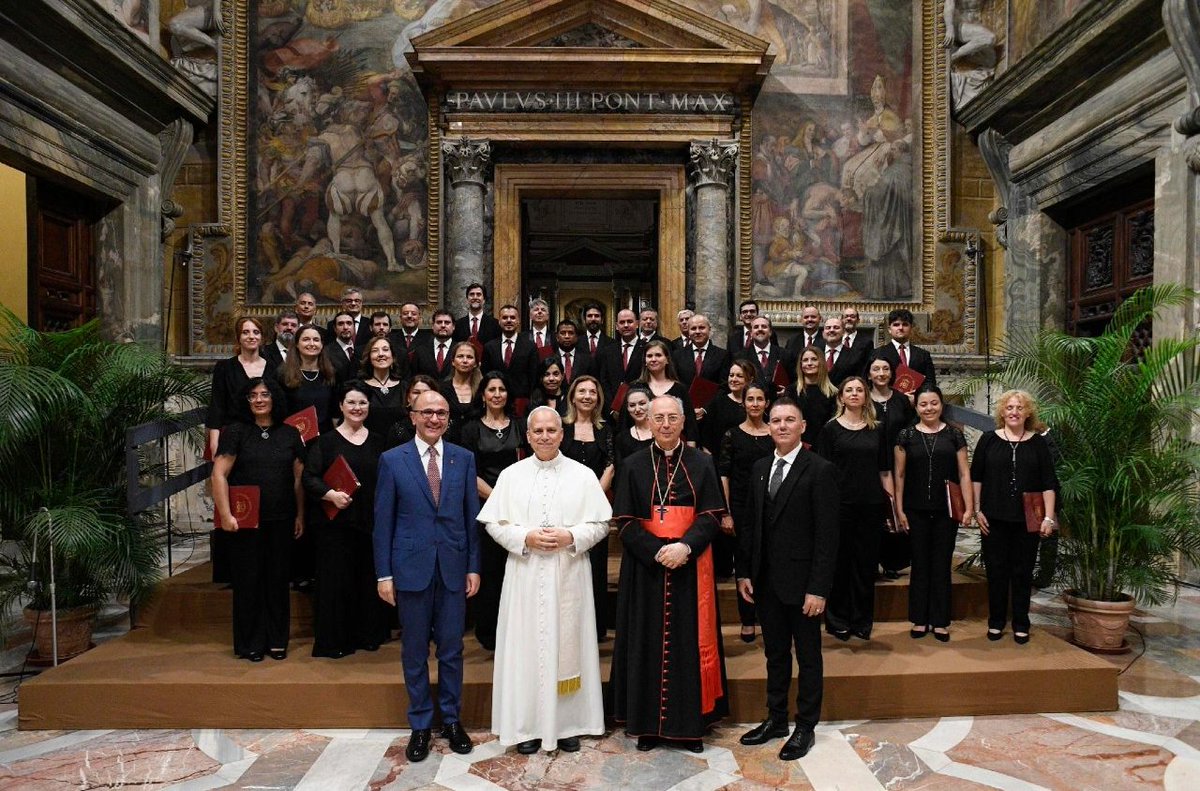
Pope Leo XIV received members of the Domenico Bartolucci foundation and choir on the occasion of the 500th anniversary of the birth of the great composer and organist Giovanni Pierluigi da Palestrina, whose music continues to enrich the Church and the liturgy to this day.
Pope Leo @pontifex shares a beautiful message of hope for young people - "St Augustine speaks so often of our restless hearts ... that restlessness is not a bad thing and we shouldn't look for ways to put out the fire ..."
https://t.co/XC5gJmj8nP
#Peace is built in the heart and from the heart, by eliminating pride and vindictiveness. Let us carefully choose our words, for words too, not only weapons, can wound and even kill.
Pope Leo XIV appeals for peace in Gaza and Ukraine, and between India and Pakistan.
"I carry in my heart the sufferings of the beloved Ukrainian people. Let everything possible be done to achieve an authentic, just and lasting peace as soon as possible. May all the prisoners be freed and may the children return to their families.
I am deeply saddened by what is happening in the Gaza Strip. Cease fire immediately! Let humanitarian aid be provided to the exhausted civilian population and let all hostages be freed.
On the other hand, I am pleased by the announcement of the ceasefire between India and Pakistan, and I hope that through the forthcoming negotiations a lasting agreement will soon be reached."
Pope Leo XIV explains his choice of name:
"... I chose to take the name Leo XIV. There are different reasons for this, but mainly because Pope Leo XIII in his historic Encyclical Rerum Novarum addressed the social question in the context of the first great industrial revolution. In our own day, the Church offers to everyone the treasury of her social teaching in response to another industrial revolution and to developments in the field of artificial intelligence that pose new challenges for the defence of human dignity, justice and labour."


![RichRaho's tweet photo. Pope Leo: “Polyphony is not merely a musical technique; it is a form imbued with theological meaning. It takes the sacred text and clothes it with fitting melody so that it may better reach the understanding of the faithful…. Sometimes [voices] clash, sometimes they resolve, but always in pursuit of unity. This dynamic, unity in diversity, is a metaphor for our shared journey of faith under the guidance of the Holy Spirit.”](https://pbs.twimg.com/media/GtwVuSBWsAAYijA.jpg)


