@PattyMurray So, now it's "dystopian" for people to get married and have children. I'd say that pretty well sums things up for your sick/twisted party.
THE EVIDENCE™ — AN OPEN LETTER TO THE PRO FOOTBALL HALL OF FAME
MACARTHUR LANE AND GEORGE WEBSTER — HALL OF FAME?
And the Larger Question Canton Should Answer: What Is the Hall of Fame Supposed to Honor?
━━━━━━━━━━━━━━━━━━━━
To the Pro Football Hall of Fame (@ProFootballHOF), its Selection Committee, and the members of its Seniors Committee:
I am writing to ask for a direct reply about two players whose careers raise the same larger question. The first is George Webster, one of the most decorated young linebackers of the AFL era: a unanimous Rookie of the Year and three-time first-team All-AFL selection whom the Hall named to the All-Time AFL Team before his fourth professional season. The second is MacArthur Lane, a running back who led the NFL in rushing touchdowns and total touchdowns in 1970, later led the league in receptions, and still holds the record as the oldest player to rush for 100 yards in an NFL game.
Measured only by career totals, both cases can be outright dismissed. Measured by what each man accomplished, how highly he was regarded while playing, what distinguished his career, and the conditions under which it unfolded, the question is harder. That distinction goes directly to what “Hall of Fame” is supposed to mean.
━━━━━━━━━━━━━━━━━━━━
GEORGE WEBSTER
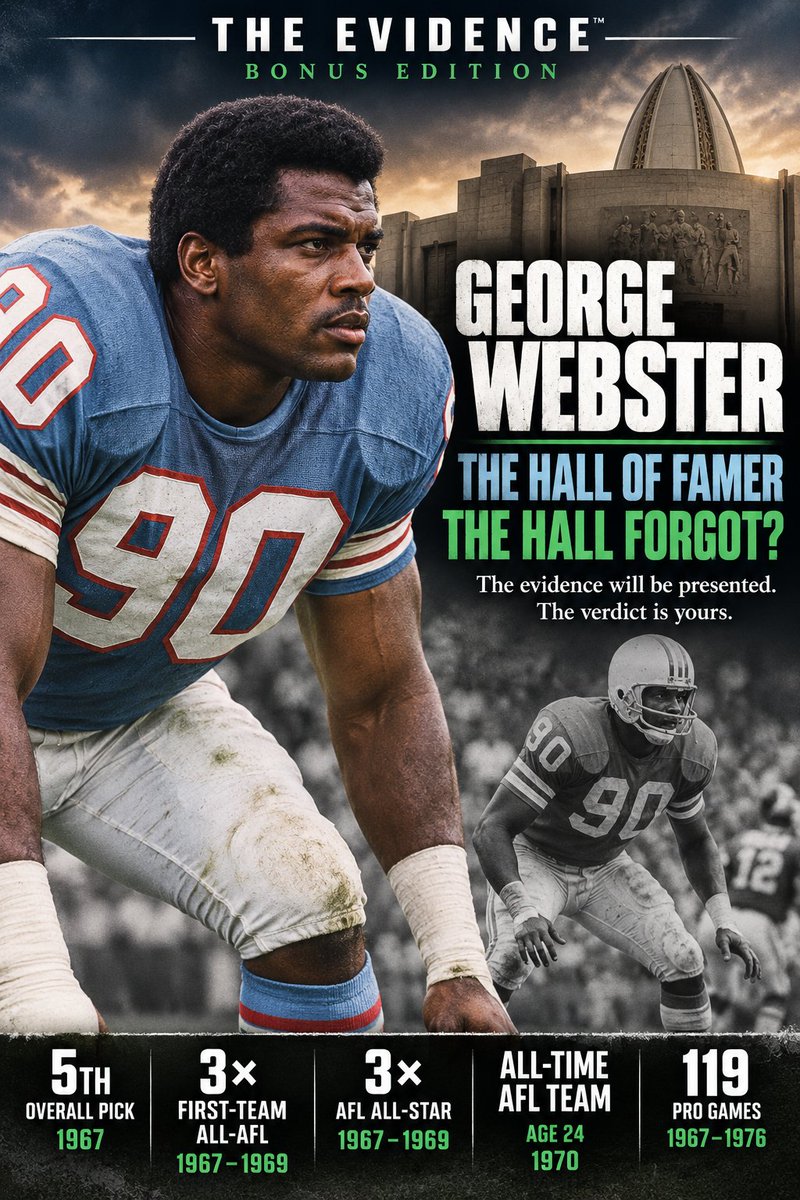
Houston selected Webster fifth overall in the 1967 draft, and he became an immediate force. The Associated Press named him AFL Rookie of the Year unanimously. He earned first-team All-AFL honors and an AFL All-Star selection in each of his first three seasons, 1967 through 1969. That standing did not depend on one newspaper or a case assembled decades later. People watching the game at the time consistently regarded him as one of its finest defensive players.
In January 1970 the Hall named Webster to the All-Time AFL Team; he was its youngest member. The Hall itself, evaluating the league while it was still fresh in memory, identified him as one of the finest players it had produced.
Ten months later, in November 1970 against St. Louis, Webster suffered cartilage and ligament damage in his left knee. He underwent surgery, missed the rest of the season, strained the same knee early in 1971, and continued with Houston, Pittsburgh, and New England through 1976. The player who had dominated his first three seasons was never the same. The question is not whether he accumulated enough statistics afterward. It is whether a player who reached that level, was recognized at that level by the Hall itself, and then had his career altered by a major injury should be judged mainly by what he could no longer accumulate.
A fuller examination is here:
https://t.co/DU15obKdSF
━━━━━━━━━━━━━━━━━━━━
MACARTHUR LANE
In 1970 with St. Louis, Lane led the NFL with 11 rushing and 13 total touchdowns, finished third with 977 rushing yards, averaged 4.7 yards per carry, and went to the Pro Bowl. The Newspaper Enterprise Association named him first-team All-Pro. On October 18 against Philadelphia, with St. Louis trailing 10–0, they turned the game over to Lane. The result: he rushed for 125 yards on 15 carries, scored three rushing touchdowns, and added a 26-yard touchdown reception in a 35–20 win. The highlights of that game have been indelibly etched in my mind for the past 50+ years.
That season did not stand alone. After a trade to Green Bay he produced 1,106 yards from scrimmage in 1972 for a 10–4 team that won the NFC Central, Green Bay’s first division title since 1967. In 1976, at 34 with Kansas City, he led the NFL with 66 receptions and produced 1,228 yards from scrimmage. On October 1, 1978, at 36 years and 199 days, he rushed for 144 yards against Buffalo. No older player in NFL history has had a 100-yard rushing game.
Lane’s case does not depend on rushing totals comparable to Walter Payton or Emmitt Smith. At one stage he led the NFL in rushing touchdowns; at another he led it in receptions. He produced more than 1,000 yards from scrimmage for three franchises under three coaching staffs, and he remained productive at an age when running backs are ordinarily long gone. Those facts may or may not be enough for Canton, but they should be weighed for what they were rather than dismissed because one conventional benchmark was never reached.
A fuller examination is here:
https://t.co/99A0NsOvAK
━━━━━━━━━━━━━━━━━━━━
THE CASE AGAINST THEM, AND WHY IT IS NOT ENOUGH
The arguments against both men should be stated plainly. Webster’s dominant period lasted only a few seasons. His statistical record is hard to compare with modern linebackers because sacks were not official until 1982 and tackle totals from his era are incomplete and inconsistent. Lane made one Pro Bowl, never rushed for 1,000 yards in a season, was not a first-team Associated Press All-Pro, averaged 3.9 yards per carry for his career, and finished well below the rushing totals normally associated with Hall of Fame running backs.
Those facts belong in the evaluation. If they automatically end it, Canton faces a larger question about why a Selection Committee is needed. If career totals decide membership, the process can be reduced to thresholds: 10,000 rushing yards and 50 touchdowns for running backs, corresponding cutoffs for every other position, and the arithmetic does the rest. A committee exists because careers occurred in different eras, under different rules, in different systems, across different schedule lengths, and under medical conditions that could alter a career in ways a statistics page cannot recover.
The Hall’s own history supports that principle. Gale Sayers played only 68 games before knee injuries ended one of the most extraordinary careers the game has seen. He was elected on his first ballot. That was the correct result, and it establishes a principle Canton cannot ignore: career length and accumulated totals cannot be absolute measures of greatness. Webster presents the question through an extraordinary peak shortened by injury. Lane presents it through an unusual combination of rushing, receiving, adaptability, and longevity that conventional rushing totals do not fully describe.
━━━━━━━━━━━━━━━━━━━━
THE WORLD THEY PLAYED IN
Football in the 1960s and 1970s was not today’s game with fewer rules. Intimidation and violence were part of how the sport was played, presented, and marketed. Chris Hanburger, whom NFL Films president Steve Sabol described as capable of playing a game without making a tackle below the jawline, became known as “The Hangman.” Oakland fielded players known as “The Hit Man,” “Dr. Death,” and “The Assassin.” St. Louis later employed Conrad Dobler, whom Sports Illustrated put on its cover as “Pro Football’s Dirtiest Player.” Dallas had the “Doomsday” defense. NFL Films celebrated collisions; broadcasters treated them as spectacle, and the fans ate it up.
The players paid the bill—sometimes immediately, as Darryl Stingley did, and sometimes over years and decades. Jim Otto, who started 210 consecutive games, lost his right leg after roughly 70 operations. MRI imaging did not exist. Arthroscopic surgery was still developing. Modern ligament reconstruction and rehabilitation protocols were years away. Injuries that now have a defined recovery timeline often did not.
That history belongs in both cases. Webster’s decline followed a serious knee injury. Lane spent eleven seasons absorbing punishment, seven of them as a primary ball carrier, and was still capable of 144 rushing yards in a game at 36—a record that still stands nearly fifty years later.
━━━━━━━━━━━━━━━━━━━━
WHAT THE HALL IS SUPPOSED TO HONOR
Is the Pro Football Hall of Fame a repository for career totals, or is it intended to recognize extraordinary football players? If the second, Webster belongs in the discussion. If versatility, unusual achievement, and productive longevity count, Lane belongs in it as well. If era, medical limitations, and playing conditions count, they must be weighed alongside the numbers rather than after the numbers have already decided the outcome.
None of this asks the Hall to abandon its guidelines. It asks the Hall to explain the standards. If totals are controlling, say so and establish the thresholds. If they are not, then the work of a Selection Committee is to weigh accomplishments that cannot be reduced to one statistical column. Webster and Lane are useful beyond the two men themselves because they force that definition.
━━━━━━━━━━━━━━━━━━━━
THREE QUESTIONS
I am asking the Hall, its selectors, or its staff to answer three questions directly and on the record.
Does the Selection Committee treat career length or statistical accumulation as controlling factors, and if so, how is that standard reconciled with the election of a player such as Gale Sayers?
How do selectors account for the rules, accepted violence, and medical limitations of the 1960s and 1970s when evaluating senior candidates from that period?
Have George Webster and MacArthur Lane ever been formally presented or discussed as senior candidates, and what evidence would the committee need before giving either career a serious hearing?
These are good-faith questions from a longtime student of the game. I will publish any response in full and without editing.
I would also ask one personal favor. If the Hall can forward a copy of this letter to the next of kin of George Webster and MacArthur Lane, I would be grateful. Neither man is here to see this discussion continue, but their families should know that someone still believes both careers deserve to be remembered, examined, and argued for with the seriousness their accomplishments merit.
Canton may ultimately say no to Webster, Lane, or both. That remains the Hall’s decision. What should not settle either case is the bare conclusion that the career totals were not high enough. That answer is inadequate for a linebacker the Hall itself placed on the All-Time AFL Team while he was still playing, and incomplete for a running back who led the NFL in rushing touchdowns, later led the league in receptions, and set an age record that has survived nearly half a century.
If statistics settle every argument, establish the requirements and let the numbers make the selections. If judgment still has a place in Canton, Webster and Lane are exactly the kinds of careers for which a Selection Committee exists.
I am hopeful for your earliest reply.
Respectfully,
Kim Wojcinski
The Evidence™
X: https://t.co/7ht6vlbE6I
Email: [email protected]
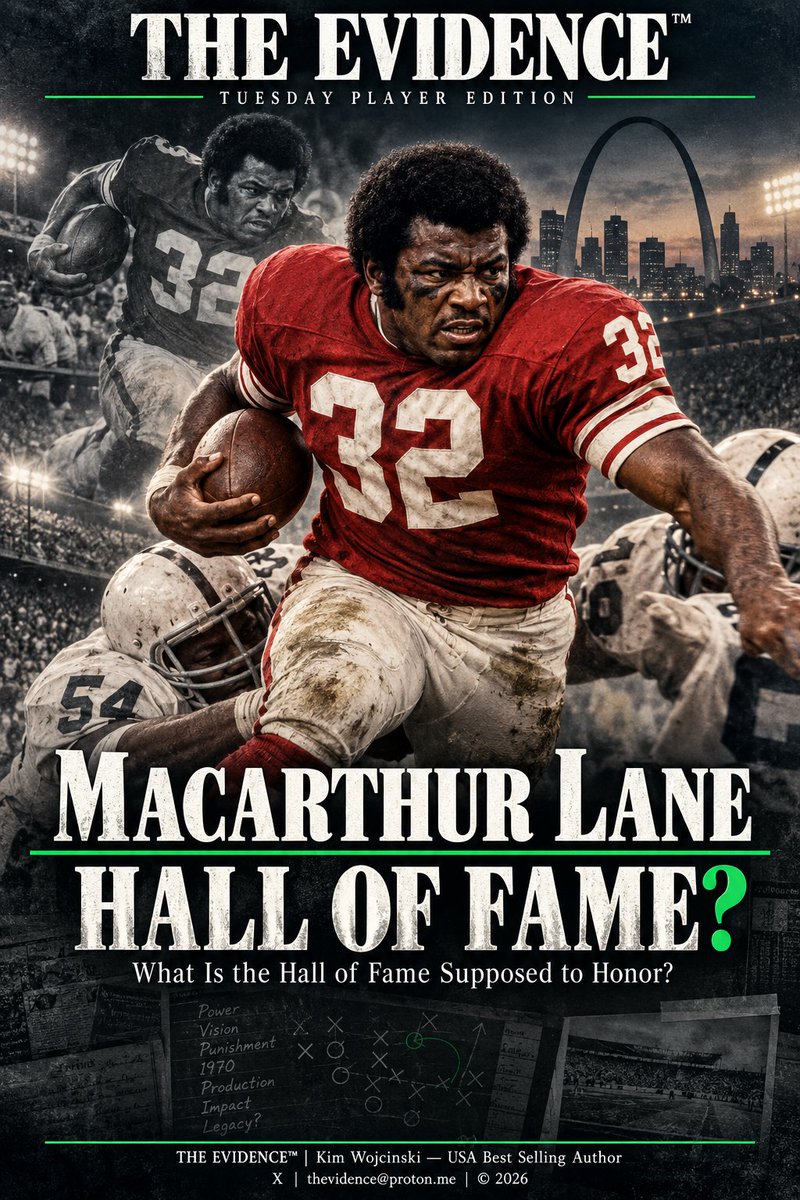
THE EVIDENCE™ — TUESDAY PLAYER EDITION
MACARTHUR LANE — HALL OF FAME?
And Perhaps the Larger Question: What Is the Hall of Fame Supposed to Honor?
The evidence will be presented. The verdict is yours.
MacArthur Lane creates a problem, but perhaps not the problem we first assume he creates. His career is easy enough to summarize. He played eleven NFL seasons from 1968 through 1978 with St. Louis, Green Bay and Kansas City, rushed for 4,656 yards, caught 287 passes for another 2,786 and finished with 7,442 yards from scrimmage and 37 touchdowns. During his extraordinary 1970 season for the St. Louis Cardinals, he rushed for 977 yards at 4.7 yards per carry, caught 32 passes for 365 more, scored 13 touchdowns and went to the Pro Bowl.
Those numbers raise the obvious question of whether they are enough for the Pro Football Hall of Fame. The more I examined Lane, however, the more convinced I became that this may be the wrong question. His case leads directly to something larger: what is the Hall of Fame intended to preserve? Is Canton primarily a museum of statistical accumulation, rewarding players who remained productive long enough to cross established thresholds, or is it supposed to recognize extraordinary football players whose absence would leave the history of professional football incomplete?
That distinction carries special weight for players from the 1960s and 1970s, whose careers cannot be separated from the football world in which they played. Their bodies absorbed punishment under rules that permitted contact now answered with penalties, fines and suspensions, and when those bodies broke down, the surgical techniques, diagnostic tools and rehabilitation methods available to them were primitive compared with what an NFL player has in 2026. Lane's career gives us an opportunity to ask whether football history has adequately accounted for that era's physical cost.
1970 WAS MORE THAN 977 YARDS
Lane's 1970 season grows more impressive once we stop treating 977 rushing yards as the whole story. In a fourteen-game schedule he carried 206 times, averaged 4.7 yards per carry and scored 11 rushing touchdowns, which led the NFL. His 13 total touchdowns also led the league. Only Larry Brown and Ron Johnson rushed for more yards, the Newspaper Enterprise Association named him first-team All-Pro, and the Pro Football Writers of America placed him on its second team.
The 1,000-yard mark he never reached tells its own story. Lane averaged 17.5 carries per game in September but only 12 per game in December, and he finished 23 yards short of a milestone that would have changed how his career is summarized today. He ended that season angry that late-season coaching decisions had cost him the goal, and more than half a century later those missing 23 yards still sit in the column many people notice first.
The Cardinals also discovered that when a game began turning against them, Lane could become the answer, and opponents knew it as well. These were not always games in which some ingenious play call caught a defense in the wrong alignment. There were afternoons when everyone in the stadium understood that St. Louis intended to put the football in Lane's hands, the defense committed itself accordingly, and Lane still changed the outcome.
The defensive coordinator knew. The defensive line knew. The linebackers knew. The safeties knew. The opposing bench knew. By the fourth quarter, even the beer man in the stands probably knew.
Lane got the football anyway.
The clearest example came October 18 in Philadelphia. St. Louis fell behind 10–0 early, and Lane responded with 125 yards on only 15 carries, three rushing touchdowns and a 26-yard touchdown reception as the Cardinals turned the deficit into a 35–20 victory. Philadelphia was no isolated eruption, because Lane had rushed for 146 yards and two touchdowns against Washington and then produced 132 rushing yards and 41 receiving yards against New Orleans the week before. By the time St. Louis reached Philadelphia, opposing defenses had plenty of film on Lane, and they still could not find a way to stop the Cardinals' best weapon.
That tells us something a season total cannot. Many good runners become dangerous because an offense creates uncertainty, while the exceptional ones remain dangerous after most of the uncertainty has disappeared. When the defensive line knows who is getting the football, the linebackers are attacking the gap and the safeties are moving downhill, and the runner still breaks the game open, we are watching something rarer than ordinary production. There is a difference between beating a defense because it guessed wrong and beating one after it guessed right.
Lane could do the second.
HE WAS MUCH MORE THAN A POWER RUNNER
Lane's case also suffers when the evaluation begins and ends with career rushing yardage. He was a large, physical back for his period who could pound the interior of a defense, break long gains, catch the football and block, and his receiving production was no afterthought attached to his rushing totals.
Traded to Green Bay in February 1972 for Donny Anderson, Lane rushed for 821 yards and added 285 receiving yards alongside John Brockington, giving the Packers a backfield that helped carry a 10–4 team to the NFC Central title, the franchise's first division championship since 1967. Four years later, at 34 years old with Kansas City, he led the entire NFL with 66 receptions, gaining 686 yards through the air and 542 more on the ground.
That creates one of the strangest statistical combinations in the history of the position. In 1970, MacArthur Lane led the NFL in rushing touchdowns. Six years later, he led the NFL in receptions. The same player finished first in the league in a major rushing category and later first in a major receiving category, which makes it difficult to reduce him to one rushing total or one offensive role.
Lane also produced more than 1,000 yards from scrimmage for three different franchises: 1,342 for St. Louis in 1970, 1,106 for Green Bay in 1972 and 1,228 for Kansas City in 1976. Three organizations, three coaching staffs and three offensive systems found ways to make him productive. That suggests adaptability rather than dependence on one coach, one scheme or one temporary circumstance.
His durability produced one more distinction that still stands. On October 1, 1978, at 36 years and 199 days old, Lane rushed for 144 yards against Buffalo, and no older player in NFL history has produced a 100-yard rushing game. Frank Gore came within 61 days of Lane's age in 2019, which tells us how rare the feat remains even after decades of advances in conditioning, nutrition, surgical repair and rehabilitation.
That breadth of contribution, spanning power running, receiving, blocking and late-career production, should widen the discussion rather than narrow it to career rushing yardage.
THE CONVENTIONAL CASE AGAINST HIM
The argument against Lane is not difficult to state, and fairness requires stating it in full. He had one Pro Bowl selection, never reached 1,000 rushing yards in a season, never won a rushing title and was never a first-team All-Pro in Associated Press voting. His career average of 3.9 yards per carry is modest, he was a little-used reserve during his first two seasons, and his career rushing total sits well below the figures normally associated with Hall-of-Fame running backs. If Hall-of-Fame membership is primarily a mathematical exercise, those facts may end the discussion.
But Canton itself tells us the matter cannot always be settled that easily. Gale Sayers played only 68 NFL games before knee injuries destroyed one of the most remarkable careers the sport had seen, yet he became a first-ballot Hall of Famer. He belongs there beyond dispute, and his induction establishes a principle that reaches far beyond Sayers himself: duration cannot always be the controlling test of greatness.
Nobody argues that Sayers needed another 5,000 rushing yards before football could acknowledge what opponents, teammates and spectators already knew. For as long as his body permitted him to perform at his highest level, he demonstrated ability so extraordinary that excluding him would have made the Hall less credible rather than more exclusive.
That does not mean Lane was Gale Sayers.
Sayers' case established the principle, not the threshold.
Lane has to be judged on the strength of his own evidence.
THE SAME QUESTION I JUST ASKED ABOUT GEORGE WEBSTER
This is also why Lane's case reminded me of the George Webster piece I just wrote. Webster was one of the dominant defensive players of the AFL era, and when the Pro Football Hall of Fame named its All-Time AFL Team in January 1970, he was the youngest player selected. Ten months later, in a November game against Lane's own St. Louis Cardinals, Webster suffered cartilage and ligament damage in his left knee and was never physically the same player.
The Webster case forces us to distinguish between a player ceasing to be extraordinary and an extraordinary player being physically altered by an injury that the medicine of his era could not adequately repair. Lane's situation is different, but the historical problem is related. We cannot compare careers across generations as though the physical rules, medical technology and ability to recover from major damage were equal.
They were not.
THE GAME LANE PLAYED
A modern fan understands in the abstract that football was more violent fifty years ago, but that statement barely describes the difference. Physical intimidation in Lane's era was an accepted strategic weapon rather than an embarrassing side effect. Washington's Hall-of-Fame linebacker Chris Hanburger earned the nickname "The Hangman," and NFL Films president Steve Sabol said he could go a whole game without making a tackle below the jawline. Hanburger explained the logic plainly: if you could eliminate a starter legally, the man who replaced him probably would not be as good.
Oakland supplied some of the era's most memorable characters. Curt Gowdy used to refer to George Atkinson as "Dr. Doom." Jack Tatum was "The Assassin," while Skip Thomas was "Dr. Death." The Raiders became famous for intimidation, but treating Oakland as though it were some isolated collection of outlaws would badly misrepresent the NFL of that period.
The Raiders did not invent the culture.
They represented it.
Across professional football, defenders wanted offensive players remembering the previous collision when the next snap began. A receiver crossing the middle was expected to understand the price. A running back knew that gaining four yards could mean running directly into two linebackers and a safety who wanted him thinking about the collision before his next carry. On the offensive side, Conrad Dobler joined the Cardinals in 1972 and later appeared on the cover of Sports Illustrated as "Pro Football's Dirtiest Player" while earning three Pro Bowl selections. The league could simultaneously recognize his talent and celebrate the intimidation surrounding the way he played.
The violence was never confined to the field because it was part of what professional football was selling. NFL Films turned the collision into theater with slow motion, dramatic narration and the crack of pads and helmets. Curt Gowdy, one of the great voices of American sports broadcasting and a man I loved listening to, understood exactly what the football audience of that era expected. When a linebacker buried a runner or a safety leveled a receiver, the hit was part of the drama and was a key factor in selling tickets and producing television ad revenue. The modern vocabulary of targeting, defenseless players and concussion protocols did not yet exist, no blue tents, and fans in stadiums and living rooms ate it up.
The totality of the situation: Players delivered the violence, coaches demanded it, television amplified it, NFL Films immortalized it, and the fans consumed it. The concept of "unnecessary roughness" or "unsportsmanlike conduct" was unheard of and in those days would have been considered counterculture.
The physical bill, another matter entirely, was staggering. Case in point: Darryl Stingley was paralyzed by a Tatum collision in 1978. Sherrill Headrick of the Dallas Texans fractured a vertebra in a pregame collision at Houston in 1960, played the entire game, learned days later that his neck was broken and returned the following week. He eventually went on NFL disability at 45 and spent the final decade of his life, quite literally frozen and in a wheelchair. Kansas City's E.J. Holub underwent eleven knee operations during his career and moved from linebacker to center when his knees could no longer carry him at the position. Raiders center Jim Otto started 210 consecutive regular-season games, underwent roughly 70 operations over his lifetime before losing his right leg to amputation in 2007, and later compared professional football to being a gladiator in a ring.
Those are just a few of the countless examples of the price paid by players, in a sport, during that era, that gave no quarter — ever.
NOW PUT MACARTHUR LANE IN THE MIDDLE OF THAT WORLD
A running back occupied the center of that violence. When Lane carried the ball twenty times, he took the football directly into defensive linemen, linebackers and safeties twenty times, and the defender's objective often extended beyond stopping forward progress to making a runner hesitate, favor a shoulder or dread the next carry. Then Lane had to run routes, catch passes, pick up blitzing linebackers and return to the huddle to do it again.
That process continued from September into December, season after season, in a league populated by men with nicknames like The Hangman, Dr. Doom, Dr. Death and The Assassin.
Lane spent eleven seasons in that league, seven of them as a primary ball carrier, and was still capable of rushing for 144 yards at age 36.
When there was an injury in that era, the technological advances of 2026 medicine did not (obviously) exist. MRI imaging was unavailable; arthroscopic surgery was in its infancy, and modern ligament reconstruction, cartilage procedures, rehabilitation science and the year-round medical apparatus surrounding today's athlete were decades away. Modern medicine would not have restored every damaged player from that period, but the difference in conditions is enormous: the earlier player absorbed more permissible punishment while possessing fewer, in some cases no, treatment options when that cumulative punishment finally destroyed his ability to perform.
This is why Lane's age-36 rushing record is more than a footnote. It tells us something, a lot actually, about the physical resilience required to remain productive at running back in that environment. A modern player reaching his mid-thirties, even in today's game, at that position is unusual enough. Lane reached that age after years spent inside one of the most punishing versions of professional football ever played and still produced 144 rushing yards in a single game. Call it longevity? More like survival.
WE MAY BE MEASURING THE WRONG THING
Perhaps professional football has gradually allowed statistics to answer a philosophical question statistics were never designed to answer. Career totals, Pro Bowls, All-Pro selections, championships, longevity and peak production are all evidence, but none of them alone defines greatness.
The larger question is whether a player demonstrated something extraordinary during his period and whether the history of the game is more complete for preserving his contribution.
Lane brings several things to question: versatility, situational dominance, adaptability and sustained productivity at the most physically punishing skill position during one of the most physically permissive periods the professional game has known.
His conventional Hall-of-Fame weaknesses, using the current metrics, are legitimate, but they should not erase the parts of his career that were notable enough to deserve careful consideration.
That evidence is stronger than his reputation suggests. Lane led the NFL in rushing touchdowns and total touchdowns in 1970 and earned first-team All-Pro recognition from the NEA. Six years later he led the entire league in receptions. He produced more than 1,000 yards from scrimmage for three different franchises and, two years after his league-leading receiving season, set the record that still stands as the oldest player to rush for 100 yards in an NFL game.
The pattern behind those numbers carries as much weight as the numbers themselves. Three organizations, under three coaching staffs and in three different offensive systems, found that Lane could become an important part of what they wanted to do, whether that meant pounding the ball inside in St. Louis, sharing a power backfield in Green Bay or serving as a major receiving outlet in Kansas City.
Runners who depend entirely on one scheme rarely lead the league in categories as different as rushing touchdowns and receptions.
Lane led in both.
SO WHERE DOES THAT LEAVE MACARTHUR LANE?
MacArthur Lane does not present an easy Hall-of-Fame case, and pretending otherwise would weaken the argument. His career lacks the massive rushing totals, repeated Pro Bowls and long list of AP first-team All-Pro selections that usually make induction straightforward. On a conventional résumé comparison, there are running backs with stronger cases.
But Lane's career becomes much harder to dismiss once the whole player is examined.
To summarize: He was a league-leading touchdown scorer, a first-team All-Pro and later the league's leading receiver. He exceeded 1,000 yards from scrimmage for three franchises, contributed to a division champion, remained productive into his mid-thirties and still owns a rushing longevity record that has survived nearly half a century.
Those facts do not automatically produce a bronze bust, but they should end the casual conclusion that his career contained "not enough." The record shows something more complicated and more interesting: a player whose contribution shifted dramatically as his career progressed, who remained useful in multiple offensive systems and who produced extraordinary individual accomplishments at opposite ends of his prime.
Here are My Closing Thoughts, my factual Summary, Presented to you, for the Verdict.
When I began examining MacArthur Lane, I expected to determine whether his résumé contained enough conventional Hall-of-Fame credentials. Instead, his career demanded a more difficult question about what football history chooses to preserve.
If the Hall exists primarily to reward the longest careers and largest totals, Lane probably remains outside. If it exists to identify extraordinary football players while accounting for what they did, when they did it, the punishment they survived, the medicine they lacked and the contributions traditional statistics never fully captured, then his case deserves far more serious consideration than it has received.
Fact: MacArthur Lane led the NFL in rushing touchdowns and later led the NFL in receptions. He produced across three franchises, survived eleven seasons in one of professional football's most punishing periods and was still capable of rushing for 144 yards at age 36.
While those facts may not outright settle the dispute, it does make the case impossible to dismiss at "only" 4,656 rushing yards.
And perhaps that is the real point.
The Hall of Fame should be acting to preserve extraordinary football players, properly framed within the era they played, not merely the cleanest statistical résumés — is that not the real issue?
MacArthur Lane would have been an extraordinary football player — in any era.
Those who will ultimately judge will be the question I plan to present to the HOF this week — on their https://t.co/WnnSUc2vlp page — stay tuned.
The evidence has been presented. The verdict is yours.
THE EVIDENCE™ — AN OPEN LETTER TO THE PRO FOOTBALL HALL OF FAME
MACARTHUR LANE AND GEORGE WEBSTER — HALL OF FAME?
And the Larger Question Canton Should Answer: What Is the Hall of Fame Supposed to Honor?
━━━━━━━━━━━━━━━━━━━━
To the Pro Football Hall of Fame (@ProFootballHOF), its Selection Committee, and the members of its Seniors Committee:
I am writing to ask for a direct reply about two players whose careers raise the same larger question. The first is George Webster, one of the most decorated young linebackers of the AFL era: a unanimous Rookie of the Year and three-time first-team All-AFL selection whom the Hall named to the All-Time AFL Team before his fourth professional season. The second is MacArthur Lane, a running back who led the NFL in rushing touchdowns and total touchdowns in 1970, later led the league in receptions, and still holds the record as the oldest player to rush for 100 yards in an NFL game.
Measured only by career totals, both cases can be outright dismissed. Measured by what each man accomplished, how highly he was regarded while playing, what distinguished his career, and the conditions under which it unfolded, the question is harder. That distinction goes directly to what “Hall of Fame” is supposed to mean.
━━━━━━━━━━━━━━━━━━━━
GEORGE WEBSTER
Houston selected Webster fifth overall in the 1967 draft, and he became an immediate force. The Associated Press named him AFL Rookie of the Year unanimously. He earned first-team All-AFL honors and an AFL All-Star selection in each of his first three seasons, 1967 through 1969. That standing did not depend on one newspaper or a case assembled decades later. People watching the game at the time consistently regarded him as one of its finest defensive players.
In January 1970 the Hall named Webster to the All-Time AFL Team; he was its youngest member. The Hall itself, evaluating the league while it was still fresh in memory, identified him as one of the finest players it had produced.
Ten months later, in November 1970 against St. Louis, Webster suffered cartilage and ligament damage in his left knee. He underwent surgery, missed the rest of the season, strained the same knee early in 1971, and continued with Houston, Pittsburgh, and New England through 1976. The player who had dominated his first three seasons was never the same. The question is not whether he accumulated enough statistics afterward. It is whether a player who reached that level, was recognized at that level by the Hall itself, and then had his career altered by a major injury should be judged mainly by what he could no longer accumulate.
A fuller examination is here:
https://t.co/DU15obKdSF
━━━━━━━━━━━━━━━━━━━━
MACARTHUR LANE
In 1970 with St. Louis, Lane led the NFL with 11 rushing and 13 total touchdowns, finished third with 977 rushing yards, averaged 4.7 yards per carry, and went to the Pro Bowl. The Newspaper Enterprise Association named him first-team All-Pro. On October 18 against Philadelphia, with St. Louis trailing 10–0, they turned the game over to Lane. The result: he rushed for 125 yards on 15 carries, scored three rushing touchdowns, and added a 26-yard touchdown reception in a 35–20 win. The highlights of that game have been indelibly etched in my mind for the past 50+ years.
That season did not stand alone. After a trade to Green Bay he produced 1,106 yards from scrimmage in 1972 for a 10–4 team that won the NFC Central, Green Bay’s first division title since 1967. In 1976, at 34 with Kansas City, he led the NFL with 66 receptions and produced 1,228 yards from scrimmage. On October 1, 1978, at 36 years and 199 days, he rushed for 144 yards against Buffalo. No older player in NFL history has had a 100-yard rushing game.
Lane’s case does not depend on rushing totals comparable to Walter Payton or Emmitt Smith. At one stage he led the NFL in rushing touchdowns; at another he led it in receptions. He produced more than 1,000 yards from scrimmage for three franchises under three coaching staffs, and he remained productive at an age when running backs are ordinarily long gone. Those facts may or may not be enough for Canton, but they should be weighed for what they were rather than dismissed because one conventional benchmark was never reached.
A fuller examination is here:
https://t.co/99A0NsOvAK
━━━━━━━━━━━━━━━━━━━━
THE CASE AGAINST THEM, AND WHY IT IS NOT ENOUGH
The arguments against both men should be stated plainly. Webster’s dominant period lasted only a few seasons. His statistical record is hard to compare with modern linebackers because sacks were not official until 1982 and tackle totals from his era are incomplete and inconsistent. Lane made one Pro Bowl, never rushed for 1,000 yards in a season, was not a first-team Associated Press All-Pro, averaged 3.9 yards per carry for his career, and finished well below the rushing totals normally associated with Hall of Fame running backs.
Those facts belong in the evaluation. If they automatically end it, Canton faces a larger question about why a Selection Committee is needed. If career totals decide membership, the process can be reduced to thresholds: 10,000 rushing yards and 50 touchdowns for running backs, corresponding cutoffs for every other position, and the arithmetic does the rest. A committee exists because careers occurred in different eras, under different rules, in different systems, across different schedule lengths, and under medical conditions that could alter a career in ways a statistics page cannot recover.
The Hall’s own history supports that principle. Gale Sayers played only 68 games before knee injuries ended one of the most extraordinary careers the game has seen. He was elected on his first ballot. That was the correct result, and it establishes a principle Canton cannot ignore: career length and accumulated totals cannot be absolute measures of greatness. Webster presents the question through an extraordinary peak shortened by injury. Lane presents it through an unusual combination of rushing, receiving, adaptability, and longevity that conventional rushing totals do not fully describe.
━━━━━━━━━━━━━━━━━━━━
THE WORLD THEY PLAYED IN
Football in the 1960s and 1970s was not today’s game with fewer rules. Intimidation and violence were part of how the sport was played, presented, and marketed. Chris Hanburger, whom NFL Films president Steve Sabol described as capable of playing a game without making a tackle below the jawline, became known as “The Hangman.” Oakland fielded players known as “The Hit Man,” “Dr. Death,” and “The Assassin.” St. Louis later employed Conrad Dobler, whom Sports Illustrated put on its cover as “Pro Football’s Dirtiest Player.” Dallas had the “Doomsday” defense. NFL Films celebrated collisions; broadcasters treated them as spectacle, and the fans ate it up.
The players paid the bill—sometimes immediately, as Darryl Stingley did, and sometimes over years and decades. Jim Otto, who started 210 consecutive games, lost his right leg after roughly 70 operations. MRI imaging did not exist. Arthroscopic surgery was still developing. Modern ligament reconstruction and rehabilitation protocols were years away. Injuries that now have a defined recovery timeline often did not.
That history belongs in both cases. Webster’s decline followed a serious knee injury. Lane spent eleven seasons absorbing punishment, seven of them as a primary ball carrier, and was still capable of 144 rushing yards in a game at 36—a record that still stands nearly fifty years later.
━━━━━━━━━━━━━━━━━━━━
WHAT THE HALL IS SUPPOSED TO HONOR
Is the Pro Football Hall of Fame a repository for career totals, or is it intended to recognize extraordinary football players? If the second, Webster belongs in the discussion. If versatility, unusual achievement, and productive longevity count, Lane belongs in it as well. If era, medical limitations, and playing conditions count, they must be weighed alongside the numbers rather than after the numbers have already decided the outcome.
None of this asks the Hall to abandon its guidelines. It asks the Hall to explain the standards. If totals are controlling, say so and establish the thresholds. If they are not, then the work of a Selection Committee is to weigh accomplishments that cannot be reduced to one statistical column. Webster and Lane are useful beyond the two men themselves because they force that definition.
━━━━━━━━━━━━━━━━━━━━
THREE QUESTIONS
I am asking the Hall, its selectors, or its staff to answer three questions directly and on the record.
Does the Selection Committee treat career length or statistical accumulation as controlling factors, and if so, how is that standard reconciled with the election of a player such as Gale Sayers?
How do selectors account for the rules, accepted violence, and medical limitations of the 1960s and 1970s when evaluating senior candidates from that period?
Have George Webster and MacArthur Lane ever been formally presented or discussed as senior candidates, and what evidence would the committee need before giving either career a serious hearing?
These are good-faith questions from a longtime student of the game. I will publish any response in full and without editing.
I would also ask one personal favor. If the Hall can forward a copy of this letter to the next of kin of George Webster and MacArthur Lane, I would be grateful. Neither man is here to see this discussion continue, but their families should know that someone still believes both careers deserve to be remembered, examined, and argued for with the seriousness their accomplishments merit.
Canton may ultimately say no to Webster, Lane, or both. That remains the Hall’s decision. What should not settle either case is the bare conclusion that the career totals were not high enough. That answer is inadequate for a linebacker the Hall itself placed on the All-Time AFL Team while he was still playing, and incomplete for a running back who led the NFL in rushing touchdowns, later led the league in receptions, and set an age record that has survived nearly half a century.
If statistics settle every argument, establish the requirements and let the numbers make the selections. If judgment still has a place in Canton, Webster and Lane are exactly the kinds of careers for which a Selection Committee exists.
I am hopeful for your earliest reply.
Respectfully,
Kim Wojcinski
The Evidence™
X: https://t.co/7ht6vlbE6I
Email: [email protected]
THE EVIDENCE™ — TUESDAY PLAYER EDITION
MACARTHUR LANE — HALL OF FAME?
And Perhaps the Larger Question: What Is the Hall of Fame Supposed to Honor?
The evidence will be presented. The verdict is yours.
MacArthur Lane creates a problem, but perhaps not the problem we first assume he creates. His career is easy enough to summarize. He played eleven NFL seasons from 1968 through 1978 with St. Louis, Green Bay and Kansas City, rushed for 4,656 yards, caught 287 passes for another 2,786 and finished with 7,442 yards from scrimmage and 37 touchdowns. During his extraordinary 1970 season for the St. Louis Cardinals, he rushed for 977 yards at 4.7 yards per carry, caught 32 passes for 365 more, scored 13 touchdowns and went to the Pro Bowl.
Those numbers raise the obvious question of whether they are enough for the Pro Football Hall of Fame. The more I examined Lane, however, the more convinced I became that this may be the wrong question. His case leads directly to something larger: what is the Hall of Fame intended to preserve? Is Canton primarily a museum of statistical accumulation, rewarding players who remained productive long enough to cross established thresholds, or is it supposed to recognize extraordinary football players whose absence would leave the history of professional football incomplete?
That distinction carries special weight for players from the 1960s and 1970s, whose careers cannot be separated from the football world in which they played. Their bodies absorbed punishment under rules that permitted contact now answered with penalties, fines and suspensions, and when those bodies broke down, the surgical techniques, diagnostic tools and rehabilitation methods available to them were primitive compared with what an NFL player has in 2026. Lane's career gives us an opportunity to ask whether football history has adequately accounted for that era's physical cost.
1970 WAS MORE THAN 977 YARDS
Lane's 1970 season grows more impressive once we stop treating 977 rushing yards as the whole story. In a fourteen-game schedule he carried 206 times, averaged 4.7 yards per carry and scored 11 rushing touchdowns, which led the NFL. His 13 total touchdowns also led the league. Only Larry Brown and Ron Johnson rushed for more yards, the Newspaper Enterprise Association named him first-team All-Pro, and the Pro Football Writers of America placed him on its second team.
The 1,000-yard mark he never reached tells its own story. Lane averaged 17.5 carries per game in September but only 12 per game in December, and he finished 23 yards short of a milestone that would have changed how his career is summarized today. He ended that season angry that late-season coaching decisions had cost him the goal, and more than half a century later those missing 23 yards still sit in the column many people notice first.
The Cardinals also discovered that when a game began turning against them, Lane could become the answer, and opponents knew it as well. These were not always games in which some ingenious play call caught a defense in the wrong alignment. There were afternoons when everyone in the stadium understood that St. Louis intended to put the football in Lane's hands, the defense committed itself accordingly, and Lane still changed the outcome.
The defensive coordinator knew. The defensive line knew. The linebackers knew. The safeties knew. The opposing bench knew. By the fourth quarter, even the beer man in the stands probably knew.
Lane got the football anyway.
The clearest example came October 18 in Philadelphia. St. Louis fell behind 10–0 early, and Lane responded with 125 yards on only 15 carries, three rushing touchdowns and a 26-yard touchdown reception as the Cardinals turned the deficit into a 35–20 victory. Philadelphia was no isolated eruption, because Lane had rushed for 146 yards and two touchdowns against Washington and then produced 132 rushing yards and 41 receiving yards against New Orleans the week before. By the time St. Louis reached Philadelphia, opposing defenses had plenty of film on Lane, and they still could not find a way to stop the Cardinals' best weapon.
That tells us something a season total cannot. Many good runners become dangerous because an offense creates uncertainty, while the exceptional ones remain dangerous after most of the uncertainty has disappeared. When the defensive line knows who is getting the football, the linebackers are attacking the gap and the safeties are moving downhill, and the runner still breaks the game open, we are watching something rarer than ordinary production. There is a difference between beating a defense because it guessed wrong and beating one after it guessed right.
Lane could do the second.
HE WAS MUCH MORE THAN A POWER RUNNER
Lane's case also suffers when the evaluation begins and ends with career rushing yardage. He was a large, physical back for his period who could pound the interior of a defense, break long gains, catch the football and block, and his receiving production was no afterthought attached to his rushing totals.
Traded to Green Bay in February 1972 for Donny Anderson, Lane rushed for 821 yards and added 285 receiving yards alongside John Brockington, giving the Packers a backfield that helped carry a 10–4 team to the NFC Central title, the franchise's first division championship since 1967. Four years later, at 34 years old with Kansas City, he led the entire NFL with 66 receptions, gaining 686 yards through the air and 542 more on the ground.
That creates one of the strangest statistical combinations in the history of the position. In 1970, MacArthur Lane led the NFL in rushing touchdowns. Six years later, he led the NFL in receptions. The same player finished first in the league in a major rushing category and later first in a major receiving category, which makes it difficult to reduce him to one rushing total or one offensive role.
Lane also produced more than 1,000 yards from scrimmage for three different franchises: 1,342 for St. Louis in 1970, 1,106 for Green Bay in 1972 and 1,228 for Kansas City in 1976. Three organizations, three coaching staffs and three offensive systems found ways to make him productive. That suggests adaptability rather than dependence on one coach, one scheme or one temporary circumstance.
His durability produced one more distinction that still stands. On October 1, 1978, at 36 years and 199 days old, Lane rushed for 144 yards against Buffalo, and no older player in NFL history has produced a 100-yard rushing game. Frank Gore came within 61 days of Lane's age in 2019, which tells us how rare the feat remains even after decades of advances in conditioning, nutrition, surgical repair and rehabilitation.
That breadth of contribution, spanning power running, receiving, blocking and late-career production, should widen the discussion rather than narrow it to career rushing yardage.
THE CONVENTIONAL CASE AGAINST HIM
The argument against Lane is not difficult to state, and fairness requires stating it in full. He had one Pro Bowl selection, never reached 1,000 rushing yards in a season, never won a rushing title and was never a first-team All-Pro in Associated Press voting. His career average of 3.9 yards per carry is modest, he was a little-used reserve during his first two seasons, and his career rushing total sits well below the figures normally associated with Hall-of-Fame running backs. If Hall-of-Fame membership is primarily a mathematical exercise, those facts may end the discussion.
But Canton itself tells us the matter cannot always be settled that easily. Gale Sayers played only 68 NFL games before knee injuries destroyed one of the most remarkable careers the sport had seen, yet he became a first-ballot Hall of Famer. He belongs there beyond dispute, and his induction establishes a principle that reaches far beyond Sayers himself: duration cannot always be the controlling test of greatness.
Nobody argues that Sayers needed another 5,000 rushing yards before football could acknowledge what opponents, teammates and spectators already knew. For as long as his body permitted him to perform at his highest level, he demonstrated ability so extraordinary that excluding him would have made the Hall less credible rather than more exclusive.
That does not mean Lane was Gale Sayers.
Sayers' case established the principle, not the threshold.
Lane has to be judged on the strength of his own evidence.
THE SAME QUESTION I JUST ASKED ABOUT GEORGE WEBSTER
This is also why Lane's case reminded me of the George Webster piece I just wrote. Webster was one of the dominant defensive players of the AFL era, and when the Pro Football Hall of Fame named its All-Time AFL Team in January 1970, he was the youngest player selected. Ten months later, in a November game against Lane's own St. Louis Cardinals, Webster suffered cartilage and ligament damage in his left knee and was never physically the same player.
The Webster case forces us to distinguish between a player ceasing to be extraordinary and an extraordinary player being physically altered by an injury that the medicine of his era could not adequately repair. Lane's situation is different, but the historical problem is related. We cannot compare careers across generations as though the physical rules, medical technology and ability to recover from major damage were equal.
They were not.
THE GAME LANE PLAYED
A modern fan understands in the abstract that football was more violent fifty years ago, but that statement barely describes the difference. Physical intimidation in Lane's era was an accepted strategic weapon rather than an embarrassing side effect. Washington's Hall-of-Fame linebacker Chris Hanburger earned the nickname "The Hangman," and NFL Films president Steve Sabol said he could go a whole game without making a tackle below the jawline. Hanburger explained the logic plainly: if you could eliminate a starter legally, the man who replaced him probably would not be as good.
Oakland supplied some of the era's most memorable characters. Curt Gowdy used to refer to George Atkinson as "Dr. Doom." Jack Tatum was "The Assassin," while Skip Thomas was "Dr. Death." The Raiders became famous for intimidation, but treating Oakland as though it were some isolated collection of outlaws would badly misrepresent the NFL of that period.
The Raiders did not invent the culture.
They represented it.
Across professional football, defenders wanted offensive players remembering the previous collision when the next snap began. A receiver crossing the middle was expected to understand the price. A running back knew that gaining four yards could mean running directly into two linebackers and a safety who wanted him thinking about the collision before his next carry. On the offensive side, Conrad Dobler joined the Cardinals in 1972 and later appeared on the cover of Sports Illustrated as "Pro Football's Dirtiest Player" while earning three Pro Bowl selections. The league could simultaneously recognize his talent and celebrate the intimidation surrounding the way he played.
The violence was never confined to the field because it was part of what professional football was selling. NFL Films turned the collision into theater with slow motion, dramatic narration and the crack of pads and helmets. Curt Gowdy, one of the great voices of American sports broadcasting and a man I loved listening to, understood exactly what the football audience of that era expected. When a linebacker buried a runner or a safety leveled a receiver, the hit was part of the drama and was a key factor in selling tickets and producing television ad revenue. The modern vocabulary of targeting, defenseless players and concussion protocols did not yet exist, no blue tents, and fans in stadiums and living rooms ate it up.
The totality of the situation: Players delivered the violence, coaches demanded it, television amplified it, NFL Films immortalized it, and the fans consumed it. The concept of "unnecessary roughness" or "unsportsmanlike conduct" was unheard of and in those days would have been considered counterculture.
The physical bill, another matter entirely, was staggering. Case in point: Darryl Stingley was paralyzed by a Tatum collision in 1978. Sherrill Headrick of the Dallas Texans fractured a vertebra in a pregame collision at Houston in 1960, played the entire game, learned days later that his neck was broken and returned the following week. He eventually went on NFL disability at 45 and spent the final decade of his life, quite literally frozen and in a wheelchair. Kansas City's E.J. Holub underwent eleven knee operations during his career and moved from linebacker to center when his knees could no longer carry him at the position. Raiders center Jim Otto started 210 consecutive regular-season games, underwent roughly 70 operations over his lifetime before losing his right leg to amputation in 2007, and later compared professional football to being a gladiator in a ring.
Those are just a few of the countless examples of the price paid by players, in a sport, during that era, that gave no quarter — ever.
NOW PUT MACARTHUR LANE IN THE MIDDLE OF THAT WORLD
A running back occupied the center of that violence. When Lane carried the ball twenty times, he took the football directly into defensive linemen, linebackers and safeties twenty times, and the defender's objective often extended beyond stopping forward progress to making a runner hesitate, favor a shoulder or dread the next carry. Then Lane had to run routes, catch passes, pick up blitzing linebackers and return to the huddle to do it again.
That process continued from September into December, season after season, in a league populated by men with nicknames like The Hangman, Dr. Doom, Dr. Death and The Assassin.
Lane spent eleven seasons in that league, seven of them as a primary ball carrier, and was still capable of rushing for 144 yards at age 36.
When there was an injury in that era, the technological advances of 2026 medicine did not (obviously) exist. MRI imaging was unavailable; arthroscopic surgery was in its infancy, and modern ligament reconstruction, cartilage procedures, rehabilitation science and the year-round medical apparatus surrounding today's athlete were decades away. Modern medicine would not have restored every damaged player from that period, but the difference in conditions is enormous: the earlier player absorbed more permissible punishment while possessing fewer, in some cases no, treatment options when that cumulative punishment finally destroyed his ability to perform.
This is why Lane's age-36 rushing record is more than a footnote. It tells us something, a lot actually, about the physical resilience required to remain productive at running back in that environment. A modern player reaching his mid-thirties, even in today's game, at that position is unusual enough. Lane reached that age after years spent inside one of the most punishing versions of professional football ever played and still produced 144 rushing yards in a single game. Call it longevity? More like survival.
WE MAY BE MEASURING THE WRONG THING
Perhaps professional football has gradually allowed statistics to answer a philosophical question statistics were never designed to answer. Career totals, Pro Bowls, All-Pro selections, championships, longevity and peak production are all evidence, but none of them alone defines greatness.
The larger question is whether a player demonstrated something extraordinary during his period and whether the history of the game is more complete for preserving his contribution.
Lane brings several things to question: versatility, situational dominance, adaptability and sustained productivity at the most physically punishing skill position during one of the most physically permissive periods the professional game has known.
His conventional Hall-of-Fame weaknesses, using the current metrics, are legitimate, but they should not erase the parts of his career that were notable enough to deserve careful consideration.
That evidence is stronger than his reputation suggests. Lane led the NFL in rushing touchdowns and total touchdowns in 1970 and earned first-team All-Pro recognition from the NEA. Six years later he led the entire league in receptions. He produced more than 1,000 yards from scrimmage for three different franchises and, two years after his league-leading receiving season, set the record that still stands as the oldest player to rush for 100 yards in an NFL game.
The pattern behind those numbers carries as much weight as the numbers themselves. Three organizations, under three coaching staffs and in three different offensive systems, found that Lane could become an important part of what they wanted to do, whether that meant pounding the ball inside in St. Louis, sharing a power backfield in Green Bay or serving as a major receiving outlet in Kansas City.
Runners who depend entirely on one scheme rarely lead the league in categories as different as rushing touchdowns and receptions.
Lane led in both.
SO WHERE DOES THAT LEAVE MACARTHUR LANE?
MacArthur Lane does not present an easy Hall-of-Fame case, and pretending otherwise would weaken the argument. His career lacks the massive rushing totals, repeated Pro Bowls and long list of AP first-team All-Pro selections that usually make induction straightforward. On a conventional résumé comparison, there are running backs with stronger cases.
But Lane's career becomes much harder to dismiss once the whole player is examined.
To summarize: He was a league-leading touchdown scorer, a first-team All-Pro and later the league's leading receiver. He exceeded 1,000 yards from scrimmage for three franchises, contributed to a division champion, remained productive into his mid-thirties and still owns a rushing longevity record that has survived nearly half a century.
Those facts do not automatically produce a bronze bust, but they should end the casual conclusion that his career contained "not enough." The record shows something more complicated and more interesting: a player whose contribution shifted dramatically as his career progressed, who remained useful in multiple offensive systems and who produced extraordinary individual accomplishments at opposite ends of his prime.
Here are My Closing Thoughts, my factual Summary, Presented to you, for the Verdict.
When I began examining MacArthur Lane, I expected to determine whether his résumé contained enough conventional Hall-of-Fame credentials. Instead, his career demanded a more difficult question about what football history chooses to preserve.
If the Hall exists primarily to reward the longest careers and largest totals, Lane probably remains outside. If it exists to identify extraordinary football players while accounting for what they did, when they did it, the punishment they survived, the medicine they lacked and the contributions traditional statistics never fully captured, then his case deserves far more serious consideration than it has received.
Fact: MacArthur Lane led the NFL in rushing touchdowns and later led the NFL in receptions. He produced across three franchises, survived eleven seasons in one of professional football's most punishing periods and was still capable of rushing for 144 yards at age 36.
While those facts may not outright settle the dispute, it does make the case impossible to dismiss at "only" 4,656 rushing yards.
And perhaps that is the real point.
The Hall of Fame should be acting to preserve extraordinary football players, properly framed within the era they played, not merely the cleanest statistical résumés — is that not the real issue?
MacArthur Lane would have been an extraordinary football player — in any era.
Those who will ultimately judge will be the question I plan to present to the HOF this week — on their https://t.co/WnnSUc2vlp page — stay tuned.
The evidence has been presented. The verdict is yours.
THE EVIDENCE™ — TUESDAY PLAYER EDITION
MACARTHUR LANE — HALL OF FAME?
And Perhaps the Larger Question: What Is the Hall of Fame Supposed to Honor?
The evidence will be presented. The verdict is yours.
MacArthur Lane creates a problem, but perhaps not the problem we first assume he creates. His career is easy enough to summarize. He played eleven NFL seasons from 1968 through 1978 with St. Louis, Green Bay and Kansas City, rushed for 4,656 yards, caught 287 passes for another 2,786 and finished with 7,442 yards from scrimmage and 37 touchdowns. During his extraordinary 1970 season for the St. Louis Cardinals, he rushed for 977 yards at 4.7 yards per carry, caught 32 passes for 365 more, scored 13 touchdowns and went to the Pro Bowl.
Those numbers raise the obvious question of whether they are enough for the Pro Football Hall of Fame. The more I examined Lane, however, the more convinced I became that this may be the wrong question. His case leads directly to something larger: what is the Hall of Fame intended to preserve? Is Canton primarily a museum of statistical accumulation, rewarding players who remained productive long enough to cross established thresholds, or is it supposed to recognize extraordinary football players whose absence would leave the history of professional football incomplete?
That distinction carries special weight for players from the 1960s and 1970s, whose careers cannot be separated from the football world in which they played. Their bodies absorbed punishment under rules that permitted contact now answered with penalties, fines and suspensions, and when those bodies broke down, the surgical techniques, diagnostic tools and rehabilitation methods available to them were primitive compared with what an NFL player has in 2026. Lane's career gives us an opportunity to ask whether football history has adequately accounted for that era's physical cost.
1970 WAS MORE THAN 977 YARDS
Lane's 1970 season grows more impressive once we stop treating 977 rushing yards as the whole story. In a fourteen-game schedule he carried 206 times, averaged 4.7 yards per carry and scored 11 rushing touchdowns, which led the NFL. His 13 total touchdowns also led the league. Only Larry Brown and Ron Johnson rushed for more yards, the Newspaper Enterprise Association named him first-team All-Pro, and the Pro Football Writers of America placed him on its second team.
The 1,000-yard mark he never reached tells its own story. Lane averaged 17.5 carries per game in September but only 12 per game in December, and he finished 23 yards short of a milestone that would have changed how his career is summarized today. He ended that season angry that late-season coaching decisions had cost him the goal, and more than half a century later those missing 23 yards still sit in the column many people notice first.
The Cardinals also discovered that when a game began turning against them, Lane could become the answer, and opponents knew it as well. These were not always games in which some ingenious play call caught a defense in the wrong alignment. There were afternoons when everyone in the stadium understood that St. Louis intended to put the football in Lane's hands, the defense committed itself accordingly, and Lane still changed the outcome.
The defensive coordinator knew. The defensive line knew. The linebackers knew. The safeties knew. The opposing bench knew. By the fourth quarter, even the beer man in the stands probably knew.
Lane got the football anyway.
The clearest example came October 18 in Philadelphia. St. Louis fell behind 10–0 early, and Lane responded with 125 yards on only 15 carries, three rushing touchdowns and a 26-yard touchdown reception as the Cardinals turned the deficit into a 35–20 victory. Philadelphia was no isolated eruption, because Lane had rushed for 146 yards and two touchdowns against Washington and then produced 132 rushing yards and 41 receiving yards against New Orleans the week before. By the time St. Louis reached Philadelphia, opposing defenses had plenty of film on Lane, and they still could not find a way to stop the Cardinals' best weapon.
That tells us something a season total cannot. Many good runners become dangerous because an offense creates uncertainty, while the exceptional ones remain dangerous after most of the uncertainty has disappeared. When the defensive line knows who is getting the football, the linebackers are attacking the gap and the safeties are moving downhill, and the runner still breaks the game open, we are watching something rarer than ordinary production. There is a difference between beating a defense because it guessed wrong and beating one after it guessed right.
Lane could do the second.
HE WAS MUCH MORE THAN A POWER RUNNER
Lane's case also suffers when the evaluation begins and ends with career rushing yardage. He was a large, physical back for his period who could pound the interior of a defense, break long gains, catch the football and block, and his receiving production was no afterthought attached to his rushing totals.
Traded to Green Bay in February 1972 for Donny Anderson, Lane rushed for 821 yards and added 285 receiving yards alongside John Brockington, giving the Packers a backfield that helped carry a 10–4 team to the NFC Central title, the franchise's first division championship since 1967. Four years later, at 34 years old with Kansas City, he led the entire NFL with 66 receptions, gaining 686 yards through the air and 542 more on the ground.
That creates one of the strangest statistical combinations in the history of the position. In 1970, MacArthur Lane led the NFL in rushing touchdowns. Six years later, he led the NFL in receptions. The same player finished first in the league in a major rushing category and later first in a major receiving category, which makes it difficult to reduce him to one rushing total or one offensive role.
Lane also produced more than 1,000 yards from scrimmage for three different franchises: 1,342 for St. Louis in 1970, 1,106 for Green Bay in 1972 and 1,228 for Kansas City in 1976. Three organizations, three coaching staffs and three offensive systems found ways to make him productive. That suggests adaptability rather than dependence on one coach, one scheme or one temporary circumstance.
His durability produced one more distinction that still stands. On October 1, 1978, at 36 years and 199 days old, Lane rushed for 144 yards against Buffalo, and no older player in NFL history has produced a 100-yard rushing game. Frank Gore came within 61 days of Lane's age in 2019, which tells us how rare the feat remains even after decades of advances in conditioning, nutrition, surgical repair and rehabilitation.
That breadth of contribution, spanning power running, receiving, blocking and late-career production, should widen the discussion rather than narrow it to career rushing yardage.
THE CONVENTIONAL CASE AGAINST HIM
The argument against Lane is not difficult to state, and fairness requires stating it in full. He had one Pro Bowl selection, never reached 1,000 rushing yards in a season, never won a rushing title and was never a first-team All-Pro in Associated Press voting. His career average of 3.9 yards per carry is modest, he was a little-used reserve during his first two seasons, and his career rushing total sits well below the figures normally associated with Hall-of-Fame running backs. If Hall-of-Fame membership is primarily a mathematical exercise, those facts may end the discussion.
But Canton itself tells us the matter cannot always be settled that easily. Gale Sayers played only 68 NFL games before knee injuries destroyed one of the most remarkable careers the sport had seen, yet he became a first-ballot Hall of Famer. He belongs there beyond dispute, and his induction establishes a principle that reaches far beyond Sayers himself: duration cannot always be the controlling test of greatness.
Nobody argues that Sayers needed another 5,000 rushing yards before football could acknowledge what opponents, teammates and spectators already knew. For as long as his body permitted him to perform at his highest level, he demonstrated ability so extraordinary that excluding him would have made the Hall less credible rather than more exclusive.
That does not mean Lane was Gale Sayers.
Sayers' case established the principle, not the threshold.
Lane has to be judged on the strength of his own evidence.
THE SAME QUESTION I JUST ASKED ABOUT GEORGE WEBSTER
This is also why Lane's case reminded me of the George Webster piece I just wrote. Webster was one of the dominant defensive players of the AFL era, and when the Pro Football Hall of Fame named its All-Time AFL Team in January 1970, he was the youngest player selected. Ten months later, in a November game against Lane's own St. Louis Cardinals, Webster suffered cartilage and ligament damage in his left knee and was never physically the same player.
The Webster case forces us to distinguish between a player ceasing to be extraordinary and an extraordinary player being physically altered by an injury that the medicine of his era could not adequately repair. Lane's situation is different, but the historical problem is related. We cannot compare careers across generations as though the physical rules, medical technology and ability to recover from major damage were equal.
They were not.
THE GAME LANE PLAYED
A modern fan understands in the abstract that football was more violent fifty years ago, but that statement barely describes the difference. Physical intimidation in Lane's era was an accepted strategic weapon rather than an embarrassing side effect. Washington's Hall-of-Fame linebacker Chris Hanburger earned the nickname "The Hangman," and NFL Films president Steve Sabol said he could go a whole game without making a tackle below the jawline. Hanburger explained the logic plainly: if you could eliminate a starter legally, the man who replaced him probably would not be as good.
Oakland supplied some of the era's most memorable characters. Curt Gowdy used to refer to George Atkinson as "Dr. Doom." Jack Tatum was "The Assassin," while Skip Thomas was "Dr. Death." The Raiders became famous for intimidation, but treating Oakland as though it were some isolated collection of outlaws would badly misrepresent the NFL of that period.
The Raiders did not invent the culture.
They represented it.
Across professional football, defenders wanted offensive players remembering the previous collision when the next snap began. A receiver crossing the middle was expected to understand the price. A running back knew that gaining four yards could mean running directly into two linebackers and a safety who wanted him thinking about the collision before his next carry. On the offensive side, Conrad Dobler joined the Cardinals in 1972 and later appeared on the cover of Sports Illustrated as "Pro Football's Dirtiest Player" while earning three Pro Bowl selections. The league could simultaneously recognize his talent and celebrate the intimidation surrounding the way he played.
The violence was never confined to the field because it was part of what professional football was selling. NFL Films turned the collision into theater with slow motion, dramatic narration and the crack of pads and helmets. Curt Gowdy, one of the great voices of American sports broadcasting and a man I loved listening to, understood exactly what the football audience of that era expected. When a linebacker buried a runner or a safety leveled a receiver, the hit was part of the drama and was a key factor in selling tickets and producing television ad revenue. The modern vocabulary of targeting, defenseless players and concussion protocols did not yet exist, no blue tents, and fans in stadiums and living rooms ate it up.
The totality of the situation: Players delivered the violence, coaches demanded it, television amplified it, NFL Films immortalized it, and the fans consumed it. The concept of "unnecessary roughness" or "unsportsmanlike conduct" was unheard of and in those days would have been considered counterculture.
The physical bill, another matter entirely, was staggering. Case in point: Darryl Stingley was paralyzed by a Tatum collision in 1978. Sherrill Headrick of the Dallas Texans fractured a vertebra in a pregame collision at Houston in 1960, played the entire game, learned days later that his neck was broken and returned the following week. He eventually went on NFL disability at 45 and spent the final decade of his life, quite literally frozen and in a wheelchair. Kansas City's E.J. Holub underwent eleven knee operations during his career and moved from linebacker to center when his knees could no longer carry him at the position. Raiders center Jim Otto started 210 consecutive regular-season games, underwent roughly 70 operations over his lifetime before losing his right leg to amputation in 2007, and later compared professional football to being a gladiator in a ring.
Those are just a few of the countless examples of the price paid by players, in a sport, during that era, that gave no quarter — ever.
NOW PUT MACARTHUR LANE IN THE MIDDLE OF THAT WORLD
A running back occupied the center of that violence. When Lane carried the ball twenty times, he took the football directly into defensive linemen, linebackers and safeties twenty times, and the defender's objective often extended beyond stopping forward progress to making a runner hesitate, favor a shoulder or dread the next carry. Then Lane had to run routes, catch passes, pick up blitzing linebackers and return to the huddle to do it again.
That process continued from September into December, season after season, in a league populated by men with nicknames like The Hangman, Dr. Doom, Dr. Death and The Assassin.
Lane spent eleven seasons in that league, seven of them as a primary ball carrier, and was still capable of rushing for 144 yards at age 36.
When there was an injury in that era, the technological advances of 2026 medicine did not (obviously) exist. MRI imaging was unavailable; arthroscopic surgery was in its infancy, and modern ligament reconstruction, cartilage procedures, rehabilitation science and the year-round medical apparatus surrounding today's athlete were decades away. Modern medicine would not have restored every damaged player from that period, but the difference in conditions is enormous: the earlier player absorbed more permissible punishment while possessing fewer, in some cases no, treatment options when that cumulative punishment finally destroyed his ability to perform.
This is why Lane's age-36 rushing record is more than a footnote. It tells us something, a lot actually, about the physical resilience required to remain productive at running back in that environment. A modern player reaching his mid-thirties, even in today's game, at that position is unusual enough. Lane reached that age after years spent inside one of the most punishing versions of professional football ever played and still produced 144 rushing yards in a single game. Call it longevity? More like survival.
WE MAY BE MEASURING THE WRONG THING
Perhaps professional football has gradually allowed statistics to answer a philosophical question statistics were never designed to answer. Career totals, Pro Bowls, All-Pro selections, championships, longevity and peak production are all evidence, but none of them alone defines greatness.
The larger question is whether a player demonstrated something extraordinary during his period and whether the history of the game is more complete for preserving his contribution.
Lane brings several things to question: versatility, situational dominance, adaptability and sustained productivity at the most physically punishing skill position during one of the most physically permissive periods the professional game has known.
His conventional Hall-of-Fame weaknesses, using the current metrics, are legitimate, but they should not erase the parts of his career that were notable enough to deserve careful consideration.
That evidence is stronger than his reputation suggests. Lane led the NFL in rushing touchdowns and total touchdowns in 1970 and earned first-team All-Pro recognition from the NEA. Six years later he led the entire league in receptions. He produced more than 1,000 yards from scrimmage for three different franchises and, two years after his league-leading receiving season, set the record that still stands as the oldest player to rush for 100 yards in an NFL game.
The pattern behind those numbers carries as much weight as the numbers themselves. Three organizations, under three coaching staffs and in three different offensive systems, found that Lane could become an important part of what they wanted to do, whether that meant pounding the ball inside in St. Louis, sharing a power backfield in Green Bay or serving as a major receiving outlet in Kansas City.
Runners who depend entirely on one scheme rarely lead the league in categories as different as rushing touchdowns and receptions.
Lane led in both.
SO WHERE DOES THAT LEAVE MACARTHUR LANE?
MacArthur Lane does not present an easy Hall-of-Fame case, and pretending otherwise would weaken the argument. His career lacks the massive rushing totals, repeated Pro Bowls and long list of AP first-team All-Pro selections that usually make induction straightforward. On a conventional résumé comparison, there are running backs with stronger cases.
But Lane's career becomes much harder to dismiss once the whole player is examined.
To summarize: He was a league-leading touchdown scorer, a first-team All-Pro and later the league's leading receiver. He exceeded 1,000 yards from scrimmage for three franchises, contributed to a division champion, remained productive into his mid-thirties and still owns a rushing longevity record that has survived nearly half a century.
Those facts do not automatically produce a bronze bust, but they should end the casual conclusion that his career contained "not enough." The record shows something more complicated and more interesting: a player whose contribution shifted dramatically as his career progressed, who remained useful in multiple offensive systems and who produced extraordinary individual accomplishments at opposite ends of his prime.
Here are My Closing Thoughts, my factual Summary, Presented to you, for the Verdict.
When I began examining MacArthur Lane, I expected to determine whether his résumé contained enough conventional Hall-of-Fame credentials. Instead, his career demanded a more difficult question about what football history chooses to preserve.
If the Hall exists primarily to reward the longest careers and largest totals, Lane probably remains outside. If it exists to identify extraordinary football players while accounting for what they did, when they did it, the punishment they survived, the medicine they lacked and the contributions traditional statistics never fully captured, then his case deserves far more serious consideration than it has received.
Fact: MacArthur Lane led the NFL in rushing touchdowns and later led the NFL in receptions. He produced across three franchises, survived eleven seasons in one of professional football's most punishing periods and was still capable of rushing for 144 yards at age 36.
While those facts may not outright settle the dispute, it does make the case impossible to dismiss at "only" 4,656 rushing yards.
And perhaps that is the real point.
The Hall of Fame should be acting to preserve extraordinary football players, properly framed within the era they played, not merely the cleanest statistical résumés — is that not the real issue?
MacArthur Lane would have been an extraordinary football player — in any era.
Those who will ultimately judge will be the question I plan to present to the HOF this week — on their https://t.co/WnnSUc2vlp page — stay tuned.
The evidence has been presented. The verdict is yours.
THE EVIDENCE™
I’M TAKING DALLAS
Before getting to the record or the selection, a reminder of what I am doing here.
The Upset Index is designed to hunt underdogs. I am deliberately looking for games in which the betting market may have placed too much weight on the favorite and not enough on matchup structure, personnel, coaching, injuries, trajectory or the specific circumstances surrounding the game. Bucky Brooks is not operating under that restriction. He can favor either side. That gives him an inherent structural advantage because I am voluntarily narrowing the universe from which I can choose.
I employ a structured evidentiary process intended to separate observation from inference, expose assumptions, identify competing explanations, price risk and force contrary evidence into the analysis before the conclusion is reached.
There is another distinction that needs to be understood because it affects the comparison.
Not every position is an explicit prediction. Sometimes the position must be inferred from what was written or said. An inferred position means the comments created a strong enough directional case that the lean can reasonably be identified. If the evidence is balanced or unclear, the position remains unscored.
That rule applies equally to Brooks and to me.
If Brooks writes an analysis that overwhelmingly favors the Rams without formally saying, “I pick the Rams,” his inferred position is still Los Angeles. By the same standard, if I analyze a Seattle game without formally listing Seattle as an Upset Index selection but everything I wrote clearly favors the Seahawks, my inferred position is Seattle.
You cannot count inference for one side of the ledger and demand an explicit pick from the other.
With that established, here is where we stand.
THE EVIDENCE™: 3–2
BUCKY BROOKS: 2–3
Now we come to Dallas and Houston.
Houston enters at 0–3. Dallas is 1–2, yet Houston is approximately a 2½-point favorite.
Brooks’ comments make his directional position reasonably clear. He wrote that a Cowboys victory was “not difficult to imagine” and questioned whether Houston could again recover from an 0–3 beginning the way it did during its previous run to 12–5. Under the same inference standard described above, that places Brooks on the Dallas side.
So this game does not create a head-to-head opportunity between us.
We are both leaning Dallas.
The question is why.
Houston’s defense presents the obvious problem. The Texans can attack the quarterback, disrupt protection rules and create the type of negative plays that can wreck a drive before it develops. Dallas cannot allow the game to become a sequence of obvious passing situations in which Houston’s defensive front dictates the terms.
But that is only half of the matchup.
Houston’s offense has struggled badly enough that the Texans are being asked to win despite an attack that has not consistently generated points. That changes the burden placed on the defense. A dominant defensive series is useful. A dominant defensive game becomes far more difficult when the offense repeatedly sends that defense back onto the field without creating separation on the scoreboard.
Dallas has the offensive personnel to make Houston pay for that.
The Cowboys do not need to dismantle the Texans. They need to survive Houston’s defensive front, avoid catastrophic mistakes, sustain enough possessions to force Houston’s offense to answer and make the Texans play from a position in which their offensive limitations become increasingly expensive.
That is the central asymmetry in this matchup.
Houston’s best unit must repeatedly control the game because its weakest unit has provided very little margin. Dallas has more offensive optionality and therefore does not require perfection from one side of the roster to remain viable.
The Texans can certainly win. Their defensive front gives them a legitimate path, particularly if Dallas turns the football over or allows the rush to dictate the afternoon.
But that is not where the evidence takes me.
THE PICK: DALLAS
Brooks appears to be there as well, so Dallas-Houston goes into the ledger as a neutral game between us, not another opportunity to widen or narrow the 3–2 margin.
The selection remains Dallas.
The evidence has been presented. The verdict is yours.
THE EVIDENCE™
SATURDAY SATIRE EDITION
HOW TO BUILD A CHRONICALLY FAILING NFL FRANCHISE
A Practical Guide for Owners Who Believe Seventeen Games a Year Are Plenty of Time to Destroy Twenty Years of Organizational Progress.
The evidence will be presented. The verdict is yours.
Building a successful NFL franchise is difficult because success demands several disciplines at once, each demanding on its own and unforgiving in combination. Ownership has to hire qualified football people and resist the urge to become one of them. General managers have to think beyond the current season. Coaches have to develop players rather than wait to inherit finished products. Scouting departments have to identify value before the rest of the league notices, contracts have to be written with the next several seasons in mind, draft capital has to be protected, and succession plans have to exist before anyone needs them. Everyone in the building also has to accept that the smartest decision in a given week may be the dullest item on the agenda. Fortunately, none of this is required of an owner who wants to build a chronically failing franchise. Failure operates from a far more forgiving blueprint, and the NFL has spent decades supplying excellent instructional material.
The process begins at the top, where chronic dysfunction becomes much easier when an owner hires experienced football executives and then treats their primary responsibility as confirming his instincts. The general manager may have spent six months studying a quarterback, interviewing coaches, reviewing medical files, examining every college snap and comparing the player against years of internal scouting data. None of that should outweigh the owner watching one nationally televised bowl game and deciding the kid “just looks like a winner.” The ideal structure gives everyone technical authority until ownership becomes interested. The general manager controls personnel until the owner has a favorite prospect, the coach controls the team until the owner dislikes the offense, and the scouting department controls the draft board until someone important falls in love with a forty-yard dash. Accountability becomes wonderfully flexible when nobody can locate the line where authority ended and interference began.
With that structure in place, the quarterback position offers one of the fastest routes to long-term instability. Draft a young passer, present him as the future of the franchise, put him behind an unfinished offensive line and give him one established receiver surrounded by developmental projects. Then demand immediate proof that he belongs among the league's best. If the offense sputters, change coordinators. If he remains erratic, change systems again. By his third season he should be learning his third terminology package, third set of protection rules and third theory of how his feet are supposed to move. At that point the front office can begin wondering aloud whether the quarterback failed to develop while carefully avoiding the question of whether the organization ever created conditions in which development was likely.
Offensive-line construction deserves the same discipline. Good linemen are expensive, slow to develop and terrible at selling jerseys, which makes them unattractive to an organization devoted to short-term excitement. Receivers generate highlights, pass rushers generate sack totals and quarterbacks generate hope. Guards and centers become visible primarily when they fail. The chronically failing franchise should therefore treat the offensive line as a maintenance expense rather than a structural priority, addressing it aggressively only after the quarterback has spent half a season getting hit before he finishes his drop. The organization can then make protection an offseason priority, spend heavily repairing several positions at once and congratulate itself for responding decisively to a problem it spent three years creating.
The draft offers additional opportunities because bad process can easily disguise itself as vision. Production should be viewed with suspicion whenever athletic traits are available. A player who performed at an elite level against strong competition for three seasons may have reached his ceiling, while another player with modest production, unusual length and a spectacular combine enjoys the protective umbrella of “upside.” Potential is especially useful because nobody can test it against NFL game film until after the pick has been made. If the prospect succeeds, the front office saw what everyone else missed. If he fails, he was a calculated swing on rare physical traits. Either explanation can be written before he reports to training camp.
Winning the transaction ranks nearly as high. Successful franchises often make moves that look uneventful when they happen because the value surfaces later through roster balance, cap flexibility and developmental continuity. A failing organization should avoid that approach because roster architecture rarely dominates television for forty-eight hours. Better to pursue moves that earn words such as *bold*, *aggressive* and *all-in*. Future draft picks make ideal currency because their consequences belong to a season that does not yet feel urgent. Trading several premium selections for one recognizable veteran produces instant enthusiasm, generates an easy press conference and allows ownership to demonstrate commitment without explaining why a roster with twelve weaknesses needed one famous player more than four affordable young contributors.
Salary-cap management should follow the same devotion to the present. Instead of structuring contracts to preserve flexibility, restructure aging veterans repeatedly until future cap space becomes crowded with money attached to players whose best football occurred several seasons earlier. Dead money carries special value because it directs resources toward people no longer on the roster, allowing one decision to weaken both the present team and the future one. When the cap finally tightens, the organization can begin a necessary financial reset, release useful contributors and replace them with cheaper alternatives. The resulting decline can then be described as the difficult but responsible cost of repairing earlier decisions, many of them made by the same people supervising the repair.
Coaching turnover supplies another essential ingredient. A rebuilding coach should inherit a flawed roster, install a new system, develop young players, compensate for depth problems and produce enough immediate improvement to satisfy an owner who publicly asked everyone for patience. If the team starts slowly, anonymous questions about direction should begin circulating. If the record improves late but the playoffs slip away, ownership can determine that progress was insufficient. The next move is critical: hire the philosophical opposite of the coach just dismissed. A defensive coach gives way to an offensive innovator, a veteran coach to a young coordinator, a disciplinarian to a players' coach, and a reserved personality to someone whose introductory press conference produces energetic clips. The pendulum swing creates the appearance of organizational learning without requiring anyone to identify what went wrong.
Assistant coaches deserve no special protection because continuity can become dangerously productive. If a position coach develops several young players, allow another franchise to hire him away. If an offensive assistant builds an effective system, consider changing coordinators before the roster grows too comfortable with the playbook. Players benefit enormously from relearning terminology, technique and responsibilities every few seasons, particularly when management intends to fault them later for uneven play. Development becomes much easier to criticize when the organization keeps pressing the restart button.
Free agency provides another excellent way to purchase yesterday's performance at tomorrow's prices. A veteran who made All-Pro three seasons ago carries name recognition, and name recognition sells more easily than an ascending twenty-six-year-old interior lineman most casual fans could not identify. Injury history, shrinking snap counts and declining efficiency can be acknowledged as long as none of them interferes with acquiring “leadership.” If the veteran performs poorly, emphasize his locker-room influence. If he misses half the season, discuss what he contributes in meetings. If he is released after one year, thank him for helping establish the culture, converting an expensive personnel mistake into an intangible organizational success.
Culture carries unusual value because it can explain almost anything while resisting measurement. When the roster lacks talent, discuss culture. When veterans become frustrated, discuss culture. When young players stall, explain that standards are being established. When the team finishes 5–12, insist that the locker room is finally filled with the right kind of people. The vaguer the definition, the more useful the concept becomes because nobody can audit an undefined idea against results. Accountability works much the same way. After a losing season, ownership should promise accountability throughout the organization and then fire an assistant coach, demonstrating that failure carries consequences somewhere in the building.
Analytics should be deployed according to convenience rather than method. When the numbers support a decision management already favors, proclaim that the franchise has embraced modern football. When the same methods challenge a cherished belief, remind everyone that football is played by human beings and cannot be reduced to spreadsheets. The objective is never to integrate analytics with scouting, coaching, medical evaluation and financial modeling because several independent lines of evidence might interfere with impulsive decision-making. Data should serve as validation when useful and decoration when necessary, while ownership preserves the freedom to ignore it whenever instinct looks more attractive.
Injuries provide another layer of protection because they allow roster-construction failures to be recast as bad luck. Every NFL team loses players, but the chronically failing franchise should build a roster whose performance depends on a handful of starters staying healthy. When three injuries expose the missing depth, management can explain that no team could survive losing that many important players. The more revealing question—why nobody credible stood behind those starters—should remain safely unasked. Depth is expensive, mostly invisible and rarely generates offseason excitement, which makes it a poor investment for organizations whose planning horizon seldom extends beyond the next transaction.
Young players should then be judged with maximum urgency. A rookie lineman who struggles in September plainly lacks NFL ability. A young cornerback who allows a touchdown has raised serious questions. A receiver without 1,000 yards in his first season was obviously overdrafted. A quarterback should establish franchise credentials before defensive coordinators have gathered enough film to identify his weaknesses. Development curves introduce patience, and patience threatens the entire system. Every young player should instead become an immediate referendum on the general manager who selected him, allowing fans and front office alike to swing between declarations of genius and incompetence on the strength of tiny samples.
The organization must also master the art of confusing activity with progress. Change the uniforms, renovate the facility, replace the general manager, reorganize the front office and hire a consultant. Release a documentary, create a slogan, trade a veteran, sign another veteran and introduce another new era. Eighteen months later, abandon the new era because results did not come quickly enough and begin its replacement. Motion creates the appearance of direction, allowing an organization to spend years moving without becoming appreciably closer to a championship.
Communication with the fan base should follow a dependable annual cycle. The offseason calls for discussions of youth, energy, competition, improved chemistry and the creativity of the new coaching staff. Training camp should generate reports that the quarterback looks more comfortable, the rookie class is ahead of schedule and several returning veterans are in the best condition of their careers. If the season deteriorates, the vocabulary shifts toward patience, long-term construction and the complexity of changing an organizational culture. The contradiction serves a useful purpose: offseason optimism sells hope, while December realism protects management from the consequences of having sold it.
For advanced practitioners, the most dependable path to chronic mediocrity is permanent residence between rebuilding and contending. Keep several expensive veterans because the playoffs remain possible, but never add enough talent to contend seriously. Trade younger players because change is necessary, then spend future picks because the competitive window is supposedly open. Protect some future cap space while pushing other contracts into later seasons. Draft developmental prospects while insisting publicly that the team intends to win now. With enough discipline, the roster becomes too old and expensive to rebuild efficiently while remaining too shallow to contend. The franchise settles into its most comfortable habitat: somewhere around eight wins, far from a championship and equally distant from the premium draft position that might materially alter the roster.
Succession planning should wait until succession becomes an emergency. The aging quarterback can be addressed later, along with the veteran tackles nearing retirement, defensive stars approaching second contracts and coordinators likely to become head coaches elsewhere. The future is inconvenient because preparing for it requires spending resources before a crisis forces everyone to acknowledge the need. A failing organization should therefore wait until the transition becomes unavoidable, pay the premium created by its own delay and describe the resulting transaction as decisive action.
When the accumulated decisions finally produce another reset, recovery should begin with a comprehensive search. Consultants can be hired, candidates interviewed and philosophies discussed while ownership promises that every corner of football operations is under examination. After several weeks, hire someone connected to people ownership trusted before the search began. Seat him beside a new head coach at an introductory press conference and emphasize toughness, accountability, collaboration, standards and championship expectations. Ownership can then explain that the franchise finally has alignment, even though the previous regime entered the building under nearly identical language.
That is the central lesson in building a chronically failing NFL franchise. Persistent failure rarely requires one spectacular mistake. It develops more efficiently through a long sequence of smaller decisions that repeatedly exchange continuity for urgency, development for instant evaluation, depth for recognizable names, future flexibility for current headlines and evidence for instinct. Each individual decision can be defended on the day it is made, and that defensibility helps explain why the structure can survive for years.
Given enough seasons, the same franchise can spend fifteen years rebuilding, cycle through several coaches and general managers, draft multiple quarterbacks, repair the offensive line more than once, push money into future salary caps and spend premium draft choices correcting earlier personnel decisions. Every spring it can assure its fans that the organization finally understands what has to change. Somewhere along the way, however, the distinction between rebuilding and institutional habit disappears. What began as a collection of defensible mistakes eventually hardens into the franchise's settled method of operation, repeated year after year by people convinced they are correcting the problem they continue to recreate.
The evidence has been presented. The verdict is yours.
THE EVIDENCE™
BONUS EDITION
HILLARY CLINTON AND THE MYSTERIOUS MEN OF “A CERTAIN RELIGION”
When Naming the Villain Proves Harder Than Describing Him.
The evidence will be presented. The verdict is yours.
A clip of Hillary Clinton is circulating again under a “NEW” label, but the remarks were made on MSNBC’s Morning Joe on September 24, 2025. The caption attached to the clip says she warned about the “rise of Christianity.” She did not say that, and she never used the word Christianity. The correction belongs up front because there is no reason to put words in her mouth when the words she actually chose are interesting enough.
Clinton spoke about people supposedly trying to “turn the clock back” and “recreate a world that never was,” describing such a world as one “dominated by, you know, let’s say it, White men, of a certain persuasion, a certain religion, a certain point of view, a certain ideology.”
That phrasing deserves attention. “Let’s say it” sounds like an announcement that the euphemisms are over. Clinton then plainly named the race and sex, but when religion entered the sentence, the clarity disappeared. If she meant Christianity, Christian nationalism, a denomination, a political organization or a theological movement, she could have identified it. Instead, the audience was left with “a certain religion.”
That ambiguity becomes more curious because Clinton has long identified with Methodism. It does not establish that Christianity was her target, and claiming otherwise would go beyond the evidence. It does mean that if she intended to describe some narrower religious-political faction, naming it would have prevented millions of Christians outside that faction from reasonably wondering whether they had been included.
There is also a historical irony in the demographic profile she chose. The political architecture of the United States was overwhelmingly designed and established by white men, many living within a culture deeply shaped by Christianity. Fifty-five delegates attended the Constitutional Convention, and 39 signed the Constitution. The National Archives describes the Convention as the gathering that created an entirely new national government, while the Library of Congress documents the powerful role religion played in eighteenth-century American life and in the formation of the republic.
That does not mean white Christian men built America alone. Women, enslaved people, immigrants, laborers, Indigenous peoples and generations of Americans from every background contributed to the country’s growth, often while confronting injustices the founding generation failed to resolve. But acknowledging those contributions does not require pretending that white men shaped by Christian culture were peripheral to the creation of the republic. They were central to it.
That is what makes Clinton’s formulation so peculiar. The people she appears to be describing are not some alien force that wandered into American history late in the afternoon. Men fitting much of that description wrote the governing documents, fought and commanded in the Revolution, created the original federal institutions and established the constitutional system in which later generations would expand voting rights, abolish slavery and fight over the meaning of equality.
The irony deepens because Clinton’s larger argument concerned America moving beyond old divisions of race and sex. Yet she described the alleged obstacle partly by race, partly by sex, partly by religion and partly by ideology. If demographic stereotyping is dangerous, changing the demographic category does not improve the method.
A white Methodist machinist, Catholic farmer, Baptist truck driver and Presbyterian engineer do not become one political organism because somebody places them in the same demographic box. Their race does not reveal their legislative agenda, their sex does not determine their constitutional philosophy, and their religion does not automatically tell us how they vote.
If a movement advocates racial domination, identify the movement. If an organization seeks an unconstitutional establishment of religion, name it. If legislation threatens equal protection, cite the legislation. If public officials are trying to remove rights from Americans, identify the officials and the policy. Those are arguments that can be examined against evidence.
“White men of a certain persuasion, a certain religion, a certain point of view, a certain ideology” works differently. It creates a silhouette broad enough for the audience to recognize but vague enough that the speaker never has to define exactly who belongs inside it.
Clinton’s “world that never was” line has the same problem. The world she was criticizing was hardly imaginary. The founding generation existed, the all-male Constitutional Convention existed, the highly religious culture surrounding the formation of the republic existed, and the government those men created still exists.
So did slavery, disenfranchisement and serious legal inequalities. Both truths belong in the same history. The founding was neither a flawless golden age nor a fictional one. It was an incomplete achievement containing ideals that later generations would use to challenge practices the founders themselves left unresolved.
The stronger argument, then, is not that Clinton explicitly attacked Christianity, because the evidence does not establish that. The stronger argument is that while speaking about equality and moving beyond America’s old divisions, she chose to describe the people allegedly pulling the country backward partly by race, partly by sex, partly by religion and partly by ideology.
And there is one final irony: the demographic outline she sketched includes many of the people who built the political framework she was criticizing them from.
Perhaps the issue is not which “certain religion” Hillary Clinton meant.
Perhaps it is why American politics keeps reaching for demographic boxes after spending generations learning what happens when people are judged by them.
The evidence has been presented. The verdict is yours.
THE EVIDENCE™ | BONUS EDITION
GEORGE WEBSTER — THE HALL OF FAMER THE HALL FORGOT?
The evidence will be presented. The verdict is yours.
Some Hall of Fame cases are built on accumulation. Fifteen seasons, hundreds of games, a stack of Pro Bowls and a long run of postseason appearances eventually produce a résumé so broad that the argument becomes almost mathematical. George Webster presents a harder problem: how much demonstrated greatness is enough when injury removes the years that normally convert greatness into longevity?
Houston selected Webster fifth overall in the 1967 common draft after an extraordinary career at Michigan State, where his combination of size, speed and range helped redefine the “roverback” position. At roughly 6-foot-4 and 220 pounds, he carried the tackling ability of a linebacker with the mobility of a defensive back, a combination that would look familiar in today’s game but was highly unusual in the 1960s. Michigan State later retired his No. 90, and Webster entered the College Football Hall of Fame in 1987.
The transition to professional football required virtually no adjustment period. During a 1967 exhibition game against Dallas, Cowboys quarterback Don Meredith completed a pass to Bob Hayes, the Olympic 100-meter gold medalist widely regarded at the time as the fastest man in football. Hayes broke into the open field, yet Webster chased him down from behind and made the tackle. That one play illustrated the extraordinary range Webster brought to linebacker, but speed was only part of his game. He was also remembered for delivering a hit so violent that it flattened a ball carrier’s shoulder pads, a story that became part of his reputation as one of the most physically imposing defenders of the AFL era.
That combination of range and force helps explain the nickname that followed him: “AFL’s Mr. Defense.” It was not a label manufactured decades later by nostalgic fans. Webster began building that reputation immediately. As a rookie in 1967, he started all 14 games, played in the AFL All-Star Game, earned first-team All-AFL honors and collected major rookie awards, including UPI AFL Rookie of the Year and Associated Press AFL Defensive Rookie of the Year.
The following two seasons confirmed that his rookie year had not been an isolated burst. Webster again started every game in 1968 and 1969, returned to the AFL All-Star Game each year and repeated as first-team All-AFL. His reputation also extended beyond the boundaries of his league. Combined AFL-NFL All-Pro selections placed him alongside the finest linebackers in professional football, including Bobby Bell and Dick Butkus, which means contemporary evaluators were not merely identifying Webster as a standout in Houston or even in the AFL. They were placing him among the best defensive players in the sport.
By the end of 1969, Webster had started all 42 regular-season games of his professional career and had earned first-team recognition every year he had been in the league. Then came the judgment that gives his Hall of Fame case its strongest foundation.
On January 14, 1970, with the AFL about to disappear into the completed merger, the Pro Football Hall of Fame released the All-Time AFL Team. The purpose was straightforward: identify the finest players from the league’s entire ten-year history. Webster was selected at linebacker despite having played only the final three seasons of the AFL’s existence. At 24, he was the youngest player on the team.
That selection is difficult to dismiss because it was made while Webster was still playing. The Hall’s selectors were not looking back decades later and reconstructing his reputation. They had watched the AFL from beginning to end and concluded that Webster’s body of work, compressed into only three seasons, was enough to place him among the finest defenders the league had produced.
Then the trajectory changed.
In 1970, Webster suffered serious damage to his left knee and appeared in only seven games. He played 10 games in 1971 after additional ligament trouble, and although he remained in professional football through 1976 with Houston, Pittsburgh and New England, he never again reached the level of recognition that had defined the opening portion of his career. The injury did not end his career immediately, but it altered the physical tools that had made him such an unusual defensive player.
That is where the argument against induction begins, and it is a legitimate one. Three dominant seasons remain three dominant seasons. The Hall of Fame cannot judge a player by the career he might have produced under different circumstances, and football history is filled with athletes whose path toward Canton was interrupted by injury or decline. Webster’s later years did not add another decade of All-Pro football to his résumé.
Yet Canton has already shown that longevity is not an absolute requirement. Gale Sayers played 68 regular-season games before injuries ended his career, and Terrell Davis played 78. Both were eventually enshrined. Their cases are not identical to Webster’s; Sayers possessed a level of offensive brilliance that made him one of the most celebrated players of his generation, while Davis added a league MVP, two Super Bowl championships and a Super Bowl MVP to his résumé. Those differences deserve to be acknowledged.
The relevant point is narrower. The Hall has already accepted the proposition that a player can establish Hall of Fame greatness within a compressed window if the peak is high enough.
Webster played 119 professional games, more than either Sayers or Davis, so the question is not whether an abbreviated career can qualify. Canton has already answered that question. The issue is whether Webster’s peak reached the necessary level.
The contemporary record gives us a strong answer. Webster entered the league and immediately became first-team All-AFL. He repeated the honor in each of the next two seasons, appeared in three consecutive AFL All-Star Games, received recognition on combined AFL-NFL teams, earned the nickname “AFL’s Mr. Defense,” and before his 25th birthday was selected to the All-Time AFL Team. His case rests not on projection but on what professional football had already decided about him while he was healthy.
Hall of Fame defensive lineman Elvin Bethea, who played beside Webster in Houston, later described him as one of the greatest linebackers ever to play professional football and as a prototype for the fast, rangy linebackers who followed. That testimony fits the available record. Webster was large enough to deliver punishing hits, fast enough to run down Bob Hayes and versatile enough to perform responsibilities that would later become standard for hybrid defenders.
The contradiction therefore remains.
In 1970, Hall of Fame selectors looked across the entire history of the American Football League and decided that George Webster already belonged among its greatest players. More than half a century later, the Hall itself has never extended that judgment to enshrinement.
Perhaps three elite seasons are still not enough. Perhaps voters believe his post-injury years failed to add sufficient weight to the opening chapter of his career. But that explanation leaves Canton with a question of its own: if Webster had already done enough by age 24 to be named to the All-Time AFL Team, what exactly became insufficient afterward?
George Webster died in 2007. He is no longer here to make his own case, and that is precisely why the record has to speak for him now. The danger is not that his accomplishments were never recognized; they were. The danger is that, as the years pass and fewer people remember seeing him play, one of the most dominant young defenders of the AFL era becomes little more than a name in an old record book.
I refuse to let that happen to George Webster.
His case does not require invented statistics, hypothetical championships or imagined All-Pro seasons. It rests on the record he actually produced before the knee injury altered his trajectory. By then he had already been judged one of the finest defenders of his league, one of the best linebackers in professional football and one of the greatest players in AFL history.
George Webster’s career was shortened at its highest point, but the evidence of greatness was already there. The youngest member of the All-Time AFL Team remains outside the building whose own selectors helped make the case for putting him inside, and whether Canton ever corrects that omission or not, his greatness should not be allowed to disappear with time.
George Webster is gone. His greatness is not.
The evidence has been presented. The verdict is yours.
THE EVIDENCE™ | BONUS EDITION
JSN & METCALF: A MODERN MEL FARR AND NICK EDDY?
What could have been.
The evidence will be presented. The verdict is yours.
Some of the most fascinating combinations in sports history are not the ones that failed. They are the ones that disappeared before anyone learned what the finished product might have looked like.
The thought returned Thursday night while watching DK Metcalf remind everyone that the physical force Seattle once placed opposite Jaxon Smith-Njigba has not disappeared.
Against Cleveland, Metcalf caught five passes for 115 yards, averaging 23 yards per reception, with a 43-yard gain in Pittsburgh’s 27–24 loss. It was his best receiving performance of the young season and the kind of night that resurrects an uncomfortable question in Seattle: what would this look like if that DK Metcalf were still lined up across from this Jaxon Smith-Njigba?
Detroit built its own version of that question nearly sixty years ago.
The Lions drafted Notre Dame halfback Nick Eddy in the second round of the 1966 draft, then waited for him to finish his college career. He was worth the wait. Eddy was an All-American who finished third in the 1966 Heisman voting, behind Steve Spurrier and Bob Griese.
A year later, Detroit used the seventh overall pick on UCLA’s Mel Farr. Two gifted young backs reaching the Lions in the same season looked like the beginning of something opponents would struggle to solve.
Farr did his part immediately. As a rookie in 1967 he ran for 860 yards, caught 39 passes, totaled 1,177 yards from scrimmage, made the Pro Bowl and was named the NFL’s Offensive Rookie of the Year.
Eddy’s luck had started turning months earlier. On the trip to East Lansing for the 1966 Notre Dame–Michigan State “Game of the Century,” he slipped on the metal step of the team train and reinjured his shoulder. One of college football’s best backs watched one of college football’s most famous games from the sideline. In Detroit, knee injuries took over, and he finished his Lions career with 523 rushing yards.
Then the injuries found Farr. He needed knee surgery in 1968. In 1969, a hit from Chicago’s Bennie McRae snapped a knee ligament in half, an injury considered worse than the first. Farr fought back to a second Pro Bowl in 1970, but the explosive rookie of 1967 never fully returned. In March 1974 the Lions traded him to Houston, and he retired twelve days later.
Opponents never solved the Farr-Eddy backfield because they never had to. Knees settled the question before any defensive coordinator could, and Detroit never saw both backs healthy and in their primes at the same time.
Seattle may have created a modern version of that question, with one difference that makes it linger longer. Detroit’s experiment was ended by injury. Seattle’s was ended by a decision.
Jaxon Smith-Njigba and DK Metcalf were never just two good wide receivers occupying the same depth chart. They attacked defensive backs in opposite ways, and that contrast is what made the possibilities so intriguing.
Anyone who watched Metcalf in Seattle remembers the physical spectacle.
At 6-foot-4 and roughly 235 pounds, with sprinter speed attached to that frame, he could turn a contested ball into something resembling a rebounding drill between players from different weight classes. On some catches he seemed to hang in the air longer than the defender, twisting until he was almost horizontal, appearing to lay on his back above the turf while somehow securing the football. Russell Wilson once called him “the best in the world at what he does.” At the time, I found that statement hard to refudiate.
If the defender stayed between Metcalf and the football, DK could go through him, over him or around him. If the defender survived the catch point, his job still was not finished because Metcalf could put a hand into his chest, extend the arm and leave him wondering how a wide receiver had just treated him like a blocking sled.
Smith-Njigba’s cruelty is entirely different. JSN rarely needs to overpower anyone because the defender frequently discovers that he is guarding space JSN has already left. Smith-Njigba slices through coverage, changes tempo, attacks leverage, plants, redirects and creates separation in spaces that appear closed until he passes through them. Metcalf could leave a defender on the ground. JSN can leave him standing upright, looking toward the sideline as though somebody forgot to tell him where the receiver was going.
One could stiff-arm you into the ground while the other could leave you speechless, and Seattle once had both of them in the same huddle.
That was the tantalizing possibility when Seattle drafted Smith-Njigba in 2023.
The Seahawks already had Metcalf, one of the most physically unusual receivers in football, and Tyler Lockett, one of the league’s finest technicians. JSN entered that established structure instead of becoming its focal point, which helps explain why the Metcalf–Smith-Njigba pairing never reached the version that looks so intriguing in hindsight.
Smith-Njigba caught 63 passes for 628 yards as a rookie, then surged to 100 receptions and 1,130 yards in 2024. Metcalf still produced 992 receiving yards despite missing two games. Seattle had a 1,100-yard receiver whose arc was climbing, lined up beside a receiver who had already posted three 1,000-yard seasons in Seattle.
Then the combination ended.
After Metcalf requested a trade, Seattle sent him and a sixth-round pick to Pittsburgh in March 2025 for the No. 52 overall selection and a seventh-round pick. That closed Metcalf’s six-year Seattle career: three 1,000-yard seasons, two Pro Bowl selections and what was then a franchise single-season record of 1,303 receiving yards in 2020.
That record lasted exactly one season after he left.
Smith-Njigba exploded. In 2025 he caught 119 passes for an NFL-leading 1,793 yards and 10 touchdowns, breaking Metcalf’s franchise mark by nearly 500 yards. He was a unanimous first-team All-Pro and the Associated Press Offensive Player of the Year, and Seattle went 14-3 and beat New England 29-13 in Super Bowl LX.
Through Seattle’s first three games of 2026, JSN added 27 receptions for 405 yards and six touchdowns, with games of 122, 155 and 128 receiving yards.
The question therefore is no longer what Smith-Njigba might eventually become. We have seen enough to know.
What if Seattle could have put this JSN beside DK Metcalf?
Not the rookie learning an NFL offense or the second-year receiver hinting at what was coming, but the finished version who bends coverage toward him before the football is snapped.
Put that player on one side of the formation and Metcalf on the other, and a defensive coordinator inherits an unpleasant geometry problem. Tilt the safety toward Metcalf and Smith-Njigba receives room to slice underneath, break across the middle and attack the leverage of the remaining defenders. Rotate coverage toward JSN and Metcalf gets the one-on-one chances that made him terrifying in Seattle.
Press Metcalf and risk allowing a 235-pound receiver with elite speed to win physically at the line. Play off JSN and hand him the space he uses to manipulate a defender before cutting through the opening.
One receiver could beat your cornerback at the catch point while the other could beat him before the football was thrown.
There is also a psychological side that receiving totals cannot measure. A cornerback preparing for Metcalf knows he may spend the afternoon wrestling one of football’s strongest receivers, defending vertical routes against elite speed and trying to survive contested catches against a man who can rise above him and secure the ball from positions that barely look anatomically possible.
The cornerback on the other side gets no relief because his assignment is JSN, whose routes force him to process leverage, acceleration, deceleration and direction changes before the play has fully developed.
Football defenses are built to limit choices. Metcalf and Smith-Njigba together could have multiplied them.
That does not mean Seattle made the wrong decision. The Seahawks won the Super Bowl without Metcalf, which ends any argument that trading him kept Seattle from the summit.
The front office also had salary, roster construction and Metcalf’s trade request to weigh. The return included a second-round pick, and what happened next gives the front office strong evidence that its broader restructuring worked.
But winning without a player does not answer what might have happened with him. That is a different question.
Seattle learned that Smith-Njigba could become one of the most productive receivers in football. It already knew Metcalf could produce 1,000-yard seasons, threaten deep, dominate physically and make catches that looked less like receiving technique than aerial combat.
Thursday night in Cleveland supplied another reminder that the physical traits never left: five catches, 115 yards and repeated evidence that when Pittsburgh could get him the football, Metcalf could still change the dimensions of the field.
What Seattle never learned was what opposing defenses would have done with both players on the field as established problems at the same time.
The comparison to Mel Farr and Nick Eddy is not positional or statistical. Farr and Eddy were running backs in another era and another offensive system. The connection is the unfinished experiment, and the two experiments ended in opposite ways.
Detroit never got to choose. Farr’s knees and Eddy’s knees made the decision, and the Lions spent the rest of that era with a question no one could answer.
Seattle got two seasons of Smith-Njigba and Metcalf together, but only while one half of the pairing was still developing.
It never got the version we can now imagine: mature JSN and DK Metcalf lined up together after Smith-Njigba had become a receiver who commands a defense by himself. Detroit’s question was taken away. Seattle’s was traded away, with full knowledge of what Metcalf was and only a partial view of what Smith-Njigba was about to become.
Perhaps it would have been financially unsustainable. Perhaps Metcalf would not have accepted sharing the targets. Perhaps Seattle’s offense would have leaned too heavily on its receivers. Perhaps the draft capital and financial flexibility from the trade ultimately gave the organization more value. Those possibilities deserve consideration, as does the possibility that Seattle once had the ingredients for the most physically and stylistically contrasting receiving tandem in football and split them up just before one half became Offensive Player of the Year.
Thursday night was another reminder of why the question refuses to disappear.
DK Metcalf can still rise into the air, take the football away from a defender and turn a routine completion into a collision. Jaxon Smith-Njigba can cut through a secondary so fast that the defender sometimes appears to be searching for an explanation.
One could beat you with force while the other could beat you with geometry.
Seattle will never know what the finished combination might have become, and neither will anyone who remembers Detroit in 1967.
Years from now, when Seahawks fans look back on this period, they may remember the championship, the trades, the contracts and the statistics and still allow themselves one question Lions fans have carried for six decades:
What could have been?
The evidence has been presented. The verdict is yours.
THE EVIDENCE™ | BONUS EDITION
THE JERRY LEWIS TELETHON
Billions Raised. Decades Passed. What Did We Get?
The evidence will be presented. The verdict is yours.
For generations of Americans, Labor Day weekend meant Jerry Lewis on television, celebrities onstage, banks of ringing telephones, firefighters filling boots with cash, children in wheelchairs and a giant tote board counting America's generosity one pledge at a time. The first Jerry Lewis Labor Day Telethon aired on a single New York television station in 1966 and raised just over $1 million. By 1970, the MDA "Love Network" had grown to 65 stations, eventually expanding to more than 150, and the Muscular Dystrophy Association says the telethons raised more than $2 billion during Lewis's 45 years as host.
That much money, collected over that many years, invites a question that nostalgia tends to avoid: What did America get for it?
The question takes nothing away from Jerry Lewis, the children and families who appeared on the broadcasts, the volunteers who answered the phones or the millions of Americans who reached for their checkbooks. Any organization that spends decades asking the public for billions of dollars to fight devastating diseases should expect someone, eventually, to look backward and compare the money raised with the medical results produced. The people watching in 1966 could only hope that their donations were moving science toward treatments and cures. Sixty years later, we have the luxury of checking the record.
AMERICA WAS NOT DONATING TO A SCIENCE FAIR
The telethon succeeded because it turned a complicated collection of neuromuscular diseases into something almost anyone could understand. There were sick children. There were researchers searching for answers. There was a telephone number. There was a tote board. Nobody had to look into the camera and promise that a cure would appear the following year because the entire presentation carried its own unmistakable implication: give enough money, support enough research, and eventually these diseases would be beaten.
People were not mailing twenty-dollar checks because they wanted another journal article published or another graduate student funded. They gave because children were losing the ability to walk, then losing the strength to breathe, and in too many cases losing their lives. They expected the money to help change that outcome.
That is why the accounting cannot stop with the total raised.
WHERE DID THE MONEY GO?
The more than $2 billion raised through the telethons did not all go into laboratories. MDA money supported a nationwide clinic network where patients could receive diagnosis and specialized care, and it also paid for wheelchairs, braces and other equipment, summer camps, support services, public education, advocacy and the expenses involved in operating a national charitable organization. Research was one destination among several.
MDA says it has invested approximately $1.1 billion in research since 1950, and some of that money came from sources other than the telethon. Even if every research dollar had come from Jerry Lewis's broadcasts, which it did not, research would still represent only about half of the telethon total. The remainder bought clinical care, equipment, patient assistance, camps, advocacy and organizational support. Those programs unquestionably helped families, but they were probably not what most viewers imagined when Jerry Lewis looked into the camera and asked America to help find answers.
That also means the $2 billion cannot honestly be divided by the number of treatments eventually approved and presented as a price per drug. The money was spread across research, patient care and an enormous support structure. What can be examined is the timeline, and that timeline is remarkable.
TWENTY YEARS JUST TO FIND THE GENE
When the Labor Day telethon began in 1966, researchers did not know the genetic cause of Duchenne muscular dystrophy, the disease most closely associated with the broadcasts. It would take another twenty years before MDA-supported researcher Louis Kunkel and his team identified the Duchenne gene in 1986. The protein produced by that gene, dystrophin, was identified the following year. Without sufficient dystrophin, muscle fibers are progressively damaged, which finally gave researchers a far clearer understanding of what they were trying to attack.
Consider what that says about the starting point. Americans had been watching telethons and sending money for two decades before science even identified the genetic defect behind Duchenne. The researchers were not standing one step away from a cure waiting for enough money to finish the job. They were still trying to understand the disease itself.
Finding the gene, however, did not produce a treatment. Another thirty years would pass before the first drug aimed at the underlying cause of Duchenne reached FDA approval.
In September 2016, the FDA granted accelerated approval to eteplirsen, sold as Exondys 51, for patients with a particular group of Duchenne mutations representing roughly 13 percent of cases. Earlier that year, MDA said it had spent approximately $209 million on Duchenne research over 65 years, more than any organization other than the federal government.
The calendar is difficult to ignore.
The first Labor Day telethon was in 1966.
The first drug of its kind for Duchenne was approved in 2016.
Fifty years had passed.
Children shown during the early broadcasts grew older, declined and died long before such a treatment reached patients. Parents who sent checks during the 1960s, 1970s and 1980s could easily have lived the rest of their lives without seeing the kind of treatment they believed they were helping to finance.
There is no need to dramatize those dates. They are dramatic enough.
THEN THE RESULTS FINALLY BEGAN TO COME
After 2016, the medical landscape began changing far more quickly. In December of that year, the FDA approved Spinraza for spinal muscular atrophy. Treatments based on exon skipping, RNA-directed medicine and gene replacement began moving from laboratories into clinical practice. In June 2023, the FDA approved Elevidys, the first Duchenne gene therapy, initially for young boys who could still walk. Its history has not been smooth; after patient deaths involving acute liver failure, the FDA added a boxed warning in November 2025 and restricted its use to ambulatory patients. MDA now says that more than 25 treatments for neuromuscular diseases have received FDA approval during the past decade.
The timing is striking. Jerry Lewis hosted his last telethon in 2010. For most of his years on television, viewers saw the money accumulate far more quickly than they saw treatments emerge. Only after decades of genetics, molecular biology and clinical research had accumulated did the results begin appearing with greater frequency.
That does not mean the earlier money was wasted. It means the medical payoff came far later than most viewers probably imagined when they watched the tote board climb.
DID PATIENTS AT LEAST LIVE LONGER?
Yes, and the improvement has been considerable.
A 2021 meta-analysis involving 2,283 Duchenne patients found median survival of approximately 18.3 years for those born before 1970, 24 years for those born between 1970 and 1990, and 28.1 years for those born after 1990. Another international review placed median survival near 30 years among patients receiving assisted ventilation.
Those gains did not come from a single breakthrough. Ventilatory support kept patients breathing longer. Better cardiac treatment prolonged life as heart complications became better understood. Steroids slowed muscle decline. Respiratory management improved. Multidisciplinary clinics brought specialists together. Genetic diagnosis became more useful, and targeted therapies came later.
So the record does not support the claim that billions were raised and nothing happened. A great deal happened. Patients lived longer. Families received better care. Scientists learned what caused diseases that had once been poorly understood. Drugs eventually appeared. Gene therapy eventually appeared.
The problem is that "eventually" covered generations.
THE TOTE BOARD CREATED AN ILLUSION SCIENCE COULD NEVER MATCH
Television fundraising has an enormous advantage over medical research because money moves fast enough to watch. A celebrity hands Jerry Lewis a check and the number changes. A corporate sponsor makes a pledge and the number changes again. The phones keep ringing, another city reports its total, and before the broadcast ends everyone can see that more money has been raised than the year before.
Medical research offers nothing comparable.
A laboratory may spend five years discovering that a promising idea does not work. Another group may spend ten years understanding a protein that becomes useful only when somebody else develops a delivery technique twenty years later. A researcher may eliminate an approach that would otherwise waste another decade, yet there is no flashing number on a television screen showing how much closer the cure has become.
Lewis could tell America how many dollars had been raised by midnight. He could not tell America how many years had been removed from the search for a treatment, because nobody knew.
That disparity may explain much of the uneasiness when the telethon is examined in hindsight. The fundraising machine delivered visible results every Labor Day. Science did not.
WHAT DID JERRY LEWIS ACCOMPLISH?
He built one of the most successful charitable fundraising operations in American history and forced neuromuscular disease into the national consciousness. He put children with diseases most Americans had never encountered in front of millions of viewers, raised billions of dollars, helped support specialized clinics and patient services, and helped finance research that eventually identified the Duchenne gene and contributed to an entire field of neuromuscular medicine.
That deserves to be included in any fair accounting.
So does the other side.
America watched for decades and donated for decades. Families waited for decades. Half a century separated the first Labor Day telethon from the first drug aimed at the underlying cause of Duchenne. There is still no cure for Duchenne, and there are still neuromuscular diseases for which treatment options remain limited.
After more than seventy-five years of organized fundraising and research, the work is unfinished.
That does not make the entire enterprise a failure. Neither should the word "progress" be used as though it settles the question.
HINDSIGHT
Picture someone sitting in front of a television in 1966 and sending Jerry Lewis twenty dollars.
Now suppose that donor had been shown the schedule in advance.
Scientists would need approximately twenty years to identify the Duchenne gene. They would need another thirty years before the first targeted Duchenne drug reached FDA approval. Gene therapy would not appear until seven years after that. Many children appearing on the early broadcasts would never live to see any of those treatments, and many of the people mailing checks would not see them either.
Would America still have given?
Almost certainly.
Parents would still have wanted help. Viewers would still have wanted children cared for. Researchers would still have needed money, and the eventual discoveries would still have required decades of work.
But the telethon might have looked very different if the public had understood that the road could run for half a century before a targeted Duchenne drug appeared.
That is where hindsight leaves us.
Jerry Lewis helped America raise more than $2 billion. MDA built clinics, helped families, funded research and supported a field that eventually produced longer lives, targeted treatments and gene therapy. The money did not disappear into a scientific black hole, and the record does not justify pretending that nothing was accomplished.
The record also does not justify pretending that the results came quickly.
They did not.
Generation after generation gave money while generation after generation of patients waited.
The question is therefore not whether Jerry Lewis raised an extraordinary amount of money. He did. Nor is it whether medical progress occurred. It did.
The question is whether the progress ultimately produced matched what millions of Americans reasonably believed they were financing when they watched that tote board climb year after year, whether some of the delay could have been shortened, and how long the public should be expected to keep writing checks before asking what all that money has produced.
Billions were raised.
Patients lived longer.
Treatments came.
Gene therapy came.
The cure did not.
The evidence has been presented. The verdict is yours.
THE EVIDENCE™
FREE-FORM THURSDAY
THE SMALL BUSINESS MEMORIAL SOCIETY
Preserving the Memory of Businesses That Were Once Foolish Enough to Open
There was a time when America celebrated the small-business owner: the person who mortgaged the house, emptied the savings account, signed personal guarantees, worked weekends, hired neighbors, trained employees, sponsored the Little League team, donated to the high-school auction, collected taxes for governments without receiving a commission and somehow managed to unlock the front door every morning with enough enthusiasm to pretend this had all been a good idea.
Those people were once called entrepreneurs.
Today, an increasing number may qualify for membership in a new organization created specifically to honor their sacrifice.
The Small Business Memorial Society.
Its motto could be:
“Gone, but still receiving mail from the Department of Revenue.”
Membership would be exclusive, although regrettably not difficult to obtain. Applicants would need only demonstrate that they once operated a business, attempted to earn a profit, employed at least one person and eventually discovered that their most profitable remaining option was turning off the lights.
The initiation ceremony would be dignified. Former owners would gather around an empty storefront while a ceremonial FOR LEASE sign was placed in the window. A representative from the state would read the deceased company’s final tax return, after which another representative from the state would interrupt to explain that it had been filed incorrectly.
Refreshments would unfortunately not be available.
The caterer closed in June.
A MEMBERSHIP ORGANIZATION WITH ENORMOUS GROWTH POTENTIAL
The Small Business Memorial Society should have little difficulty recruiting members because America has spent decades producing candidates.
Restaurants could have their own division. Independent retailers could have another. Contractors, trucking companies, family manufacturers, repair shops, dry cleaners, neighborhood pharmacies and every other enterprise whose owners once believed that “being your own boss” meant nobody else could tell you what to do would all be eligible.
The Society’s membership brochure could open with one inspirational question:
“Did you once have customers?”
If the answer is yes, congratulations. You may already qualify.
Premium membership could be reserved for those extraordinary individuals who survived long enough to experience multiple generations of tax changes, insurance increases, wage mandates, licensing requirements, compliance rules, supply disruptions, labor shortages and government officials explaining that every new requirement would have “minimal impact on small business.”
These people should receive more than a membership card.
They deserve military-style campaign ribbons.
Three regulations and a recession could earn the bronze ribbon. Surviving a pandemic, an insurance renewal and a commercial lease renegotiation in the same twelve-month period could earn silver.
Anyone who survives all of those and still opens another business should probably receive psychiatric evaluation rather than an award.
THE SMALL BUSINESS MAUSOLEUM
Every serious memorial organization eventually needs a permanent monument, and the Small Business Memorial Society should construct one worthy of the entrepreneurs it represents.
The centerpiece would be the Small Business Mausoleum, an enormous wall modeled after a columbarium, except instead of holding cremated remains, each niche would contain a brass placard commemorating a departed business.
For a modest contribution, former owners could purchase a memorial plaque:
JOE’S HARDWARE
1987–2026
He fought Amazon. Amazon won.
Or:
MARY’S FAMILY RESTAURANT
1994–2025
Survived three recessions, two divorces and seventeen health inspections. Taken suddenly by rent.
Premium plaques could include a small photograph of the owner taken during happier times, preferably before payroll.
Families could visit on anniversaries, place flowers beneath the company name and tell the grandchildren stories about the strange period in American history when ordinary people rented buildings, stocked them with merchandise and expected customers to walk inside and buy things.
A separate section could honor businesses that disappeared so completely that nobody remembers what occupied the building before the tattoo parlor, cannabis dispensary, vape shop and twenty-seven pinball machines moved in.
THE ANNUAL CONVENTION
Naturally, the Society’s annual convention should be held in a former shopping mall.
There would be plenty of parking.
The Restaurant Graveyard Pavilion could feature photographs of establishments where families once ate dinner before the locations became tattoo parlors, cannabis dispensaries, vape stores, escape rooms and establishments containing enough vintage pinball machines to make visitors wonder whether civilization peaked in 1978.
One particularly moving exhibit could display restaurant equipment in its natural post-restaurant habitat: Craigslist.
The Retail Remembrance Hall would honor stores that disappeared after competing simultaneously against online giants, rising rents, shoplifting, payroll increases and customers who spent forty-five minutes receiving expert advice from the owner before announcing, “Great. I found it online for $6 less.”
The Manufacturing Memorial would recognize companies that spent decades making products domestically before being told that competing against overseas labor costs while absorbing domestic regulatory costs represented the wonders of the free market.
Former trucking-company owners would receive their own quiet room. There would be comfortable chairs, complimentary coffee and absolutely no discussion of diesel fuel, insurance premiums, DEF systems, freight rates or federal compliance because the Society’s lawyers would consider that an emotional-health hazard.
THE BENEFITS OF MEMBERSHIP
Unlike conventional business associations, which provide resources intended to help companies grow, the Small Business Memorial Society would offer benefits specifically designed for people who have already escaped.
Members could receive discounts on storage units where they keep desks, shelving, obsolete computers, employee handbooks and boxes containing 2,700 company pens bearing a telephone number that has since been disconnected.
Auction companies could offer preferred pricing on forklifts, restaurant equipment, office furniture and industrial machinery purchased for $78,000 and eventually sold to a man named Earl for $3,400.
The Society could establish a legal hotline for former owners who make the understandable mistake of assuming that closing a business causes government agencies to stop writing.
It does not.
Counselors would therefore specialize in helping members through the five recognized stages of business closure: denial, anger, bargaining, liquidation and forwarding mail.
The Society might also negotiate group discounts with shredding companies, because nothing provides emotional closure quite like watching twenty years of payroll records disappear into an industrial machine.
THE ANNUAL AWARDS DINNER
The Small Business Memorial Society’s annual awards banquet could become the social event of the year for people who no longer have to be at work at 6:00 the next morning.
The Last Man Standing Award would recognize the business owner who survived the greatest number of regulatory expansions before finally collapsing under one described as “common sense.”
The Death by a Thousand Forms Award would go to the company completing the largest number of government documents during its final year.
The We Value Small Business Award would be presented jointly by eighteen government agencies immediately after each collected a separate fee.
The Customer Loyalty Award would recognize the customer who shopped at a business for twenty-two years, then switched permanently to an online retailer over a $3.17 price difference.
The You Should Have Raised Your Prices Award would honor the owner whose customers complained bitterly about a five-percent increase while paying twelve dollars for a cup of coffee somewhere else without blinking.
The Golden Padlock, however, would remain the Society’s highest distinction and would be presented to the entrepreneur who personally locked the front door for the final time after realizing that retirement, unemployment and possibly incarceration all offered more predictable schedules.
Recipients would undoubtedly deliver emotional acceptance speeches thanking their spouses, children, employees, accountants, attorneys and loyal customers.
Several would also thank the government.
Without its assistance, they might still be working.
BUSINESS NETWORKING FOR PEOPLE WHO NO LONGER HAVE BUSINESSES
Traditional business organizations encourage members to exchange referrals and leads. The Small Business Memorial Society would provide networking opportunities better suited to its constituency.
Conversations might begin with:
“Who handled your auction?”
“Did the landlord come after the personal guarantee?”
“How long did it take the state to admit you were closed?”
“Did anybody buy the copier?”
“What did you do with 600 embroidered polo shirts?”
Networking tables could be organized according to stage of business bereavement.
Thinking About Closing would sit near the entrance.
Closing Soon would receive drink tickets.
Closed but Still Receiving Government Mail would be the largest table.
Sold Everything and Moved to Arizona would occupy the VIP section.
There would also be a table labeled Opened Another Business, although medical personnel would be stationed nearby.
THE JUNIOR MEMBERSHIP PROGRAM
The Society could perform a valuable public service by establishing a junior membership for people currently considering entrepreneurship.
These optimistic young people could attend seminars conducted by veteran former business owners who have already traveled the entire road from business plan to liquidation auction.
The curriculum might begin with Before You Sign Anything, followed by That Revenue Projection Is Adorable, Your Employee Costs More Than His Paycheck, The Lease Is Twenty-Seven Pages for a Reason and the advanced seminar, Meet Your Silent Business Partners: Everybody Who Can Fine You.
A final panel would bring together former restaurateurs, retailers, contractors and manufacturers to answer one deceptively simple question:
“Knowing what you know now, would you do it again?”
Organizers should probably schedule the session for the entire afternoon.
Security might also be prudent.
THE SOCIETY GIFT SHOP
No nonprofit organization should overlook merchandising.
The Small Business Memorial Society gift shop could sell coffee mugs reading:
I OWNED A SMALL BUSINESS AND ALL I GOT WAS THIS PERSONAL GUARANTEE.
T-shirts could announce:
FORMER ENTREPRENEUR — ASK ME ABOUT CASH FLOW.
Another popular item might read:
I SURVIVED PAYROLL.
For owners whose businesses had survived at least twenty years before closing, there could be a commemorative bumper sticker:
MY BUSINESS PAID TAXES IN THIS TOWN BEFORE YOUR CONDO WAS BUILT.
The premium gift item would naturally be a miniature bronze padlock mounted on walnut with a brass plate reading:
“I finally got my evenings back.”
THE NATIONAL MEMBERSHIP DRIVE
The Society��s first advertising campaign would require no celebrities, jingles or expensive creative agency.
Just an abandoned storefront.
Paper covering the windows.
A faded outline where the company sign used to hang.
Across the screen would appear the question:
“Do you remember the business that used to be here?”
Then:
“So do we.”
Finally, beneath the logo of the Small Business Memorial Society:
“Membership openings available daily.”
The campaign would probably be enormously successful.
That is where the satire becomes uncomfortable.
Because behind every ridiculous award, ceremonial padlock and brass memorial plaque is a business that once had somebody unlocking its doors in the morning. Someone supplied it, someone worked there, somebody depended upon its paycheck and somebody invested years of his or her life believing that enough work, judgment and perseverance could keep the enterprise alive.
The Small Business Memorial Society does not exist.
Yet.
Given the available membership pool, somebody probably ought to reserve the domain name.
The evidence has been presented. The verdict is yours.
THE EVIDENCE™
FREE-FORM THURSDAY
THE COVID RECKONING
WHEN “MISTAKES WERE MADE” IS NO LONGER AN ADEQUATE EXPLANATION
Americans were told to trust the science, trust the statistics, trust the hospitals and trust the regulators. Six years later, the record demands a harder examination of what happened when government money, medical policy and institutional authority all began moving in the same direction.
The evidence will be presented. The verdict is yours.
There comes a point in examining institutional failure when incompetence stops explaining enough. One bad judgment can be a mistake, several can arise from confusion during an emergency, and recommendations can legitimately change as evidence develops. The COVID-19 record, however, reveals a more troubling pattern in which uncertainty was repeatedly presented as certainty, inconvenient distinctions were minimized, massive financial incentives were inserted into the medical system, competing treatments were publicly disparaged while evidence was still developing, vaccine safety depended partly upon a passive reporting system already known to miss adverse events, and Americans were expected to trust statistics and treatment protocols produced by many of the same institutions receiving unprecedented federal money.
That pattern does not by itself prove genocide, democide or a centrally directed plan to kill Americans, because intent remains the final evidentiary requirement for those conclusions. What the record already establishes is enough to justify a far deeper examination of whether portions of the response involved deliberate institutional conduct intended to preserve policy, funding, authority and public compliance even when the evidence available internally was weaker than the certainty communicated publicly. The disturbing part is how serious the case remains after the weaker allegations are removed.
FOLLOW THE MONEY
The financial structure surrounding COVID cannot be pushed to the edge of the discussion because it shaped the environment in which diagnosis, hospitalization, treatment and vaccination occurred. Section 3710 of the CARES Act increased the Medicare diagnosis-related-group weighting factor by 20 percent for qualifying patients diagnosed with COVID-19, creating an explicit connection between a COVID diagnosis and hospital reimbursement.
The design deserves closer examination. The enhancement applied whether COVID was the principal diagnosis or a secondary diagnosis, meaning a patient admitted for another condition could still qualify when COVID appeared elsewhere in the coding. During the first months of the program, the enhancement required the diagnosis but not a positive viral test documented in the medical record. CMS did not impose that requirement until admissions beginning September 1, 2020, citing program-integrity concerns.
When the HHS Office of Inspector General later audited the program, it examined claims from September through November 2020, after the positive-test rule was already in place, and found that 146 of 149 sampled claims complied with federal requirements. That finding demonstrated that hospitals in the sample generally followed the rule during those three months, but it did not examine the spring and summer period when no positive test was required, nor did it determine how often COVID appeared as a secondary diagnosis unrelated to the principal reason for admission.
That was only one stream of money. Congress appropriated $178 billion to the Provider Relief Fund, while two major high-impact hospital distributions were tied directly to COVID admissions. The first paid qualifying hospitals at a rate of $76,975 per eligible COVID admission, while the second used $50,000 per eligible admission. The admission counts used to calculate those distributions were supplied by the hospitals themselves.
The federal government also reimbursed providers for treating uninsured COVID patients, including hospital care, physician services, emergency treatment, oxygen, ambulance transportation and authorized therapeutics. Medicare then created the New COVID-19 Treatments Add-on Payment for qualifying inpatient cases involving certain COVID therapies, including remdesivir. Vaccination generated another payment stream when Medicare increased reimbursement in March 2021 to approximately $40 for each dose administered by physicians, hospitals, pharmacies and other authorized vaccinators.
Those payments could overlap. A Medicare inpatient carrying a COVID diagnosis could qualify for the 20 percent enhancement, potentially generate additional treatment reimbursement when an eligible therapy was used, and contribute to admission counts used for hospital relief distributions. An uninsured COVID patient entered a separate federal reimbursement channel.
None of those programs proves that an individual physician, nurse or hospital intentionally harmed a patient, and emergency support for health-care institutions had legitimate purposes. What the programs establish beyond dispute is that COVID diagnosis, COVID admission, certain COVID treatments and COVID vaccination all carried financial consequences for the medical system**, while several payment calculations depended upon codes and counts supplied by the institutions receiving the money.
That creates a question no serious inquiry should avoid: did those incentives influence coding, treatment decisions, hospital protocols, vaccination targets or administrative pressure placed upon physicians? If they did not, hospital records, compensation arrangements and claims audits should demonstrate it.
THE SYSTEM AND THE INDIVIDUAL ARE NOT THE SAME THING
The federal record documents extraordinary payments to hospitals, physician groups, pharmacies, nursing facilities and other providers. It does not document a national program in which individual bedside doctors or nurses received a personal bounty when a patient died.
Those are different propositions, and confusing them weakens the investigation.
A physician could work inside a hospital receiving enormous COVID-related reimbursement without personally receiving the additional payment attached to a diagnosis. A nurse could work for that hospital without possessing any financial interest in whether a particular patient was coded as COVID.
The stronger inquiry examines whether the institutions employing them created financial or administrative incentives capable of influencing medical judgment. That requires examining hospital bonus structures, physician productivity arrangements, coding policies, vaccination targets, treatment protocols, administrative directives and any compensation tied directly or indirectly to COVID volume. The federal payment structure provides ample reason to conduct that examination, but the conclusion must come from records rather than assumption.
VAERS WAS NEVER ENOUGH BY ITSELF
VAERS, the Vaccine Adverse Event Reporting System, is jointly administered by CDC and FDA and depends heavily upon reports submitted by medical professionals, patients, relatives and others. A VAERS report does not establish that a vaccine caused the event described, which means raw reporting totals cannot responsibly be converted directly into confirmed vaccine injuries or deaths.
The opposite limitation deserves equal attention. Passive reporting systems miss events because somebody must recognize a possible connection and then submit the report. An AHRQ-funded Harvard Pilgrim Health Care project conducted before COVID attempted to automate vaccine adverse-event reporting from electronic medical records and concluded that adverse events following vaccination were substantially underreported in the environment studied.
That study does not prove that only one percent, five percent or any fixed percentage of COVID-vaccine injuries reached VAERS. It does demonstrate that serious underreporting limitations in passive vaccine surveillance were known before the largest vaccination campaign in American history.
A campaign on that scale should therefore have been accompanied by exceptionally aggressive active surveillance capable of identifying potential injuries even when nobody filed a report. When VAERS reports accumulated, officials correctly emphasized that a report did not prove causation, but Americans heard far less about the opposite weakness: an event that is never reported remains invisible to VAERS.
Both limitations belong in an honest accounting.
THE DEATH CERTIFICATES
The distinction between dying from COVID and dying with COVID became another source of public distrust. CDC did not instruct physicians to place COVID on every death certificate only because a patient had tested positive. Its guidance said COVID should be listed when it caused or contributed to death.
CDC did, however, permit COVID to be certified as probable or presumed when laboratory confirmation was unavailable but the certifier believed the evidence supported that conclusion. That flexibility may have been understandable during an emerging outbreak when testing was limited, but it means not every death counted as COVID required laboratory confirmation.
CDC later reviewed hundreds of thousands of 2020 death certificates and reported that the overwhelming majority contained medical sequences matching known severe COVID outcomes, which argues against the sweeping claim that most recorded COVID deaths were fabricated. It does not eliminate the need to examine questionable cases, especially when diagnosis affected statistics, reimbursement and public policy at the same time.
The appropriate response is neither blind acceptance nor blanket rejection of the numbers. It is independent retrospective review against medical records wherever the documentation permits it.
REMDESIVIR
Remdesivir became one of the most controversial hospital treatments used during the pandemic, and its history should be stated accurately.
The drug had previously been tested in the PALM Ebola trial in the Democratic Republic of the Congo. Mortality was 53.1 percent in the remdesivir group, compared with 49.7 percent for ZMapp, 35.1 percent** for mAb114 and 33.5 percent for REGN-EB3. The remdesivir and ZMapp arms were discontinued after interim results showed the other two treatments performing better. The trial did not establish that remdesivir itself was killing the participants.
When remdesivir was later studied for COVID, NIH's ACTT-1 trial reported median recovery of 10 days compared with 15 days for placebo, while mortality was 11.4 percent versus 15.2 percent, a difference that did not reach statistical significance. FDA approved remdesivir for hospitalized COVID patients in October 2020.
The WHO Solidarity trial's interim results initially found little or no effect on overall mortality, ventilation or hospital duration. Its final results, published in 2022, were more favorable than the interim description suggested, finding a modest reduction in deaths among hospitalized patients who were not already ventilated, while showing no mortality benefit among those already receiving mechanical ventilation.
That history leaves a legitimate question without overstating the science. Why did a treatment with a modest and contested mortality benefit become such a prominent component of American hospital care, particularly when Medicare created additional reimbursement for qualifying cases involving it? The medical evidence and payment system should be examined together rather than as unrelated subjects.
IVERMECTIN
Ivermectin provides another example of how public-health communication became entangled with institutional policy.
Ivermectin was an established human antiparasitic drug with decades of medical use. Veterinary formulations also existed, and some people dangerously self-medicated with products designed for animals. Federal messaging blurred those two realities when FDA told Americans, “You are not a horse. You are not a cow."
The ridicule obscured the fact that physicians were prescribing an approved human medication off-label, something doctors routinely do with many drugs. Three physicians sued FDA, arguing that the agency had crossed from communicating regulatory information into interfering with medical practice. The Fifth Circuit allowed their case to continue, emphasizing the distinction between FDA's authority over drugs and physicians' authority to practice medicine. FDA later settled the litigation and removed the challenged ivermectin posts and materials.
The settlement did not prove ivermectin was an effective COVID treatment, and later large randomized trials failed to demonstrate the dramatic benefits claimed by some advocates. NIH ultimately recommended against using it for COVID.
The troubling portion of the history concerns what happened while the evidence was still developing. At the time of FDA's widely circulated messaging, NIH's own guidance said evidence was insufficient to recommend either for or against ivermectin. Federal public communication nevertheless sounded considerably more certain and contemptuous than the underlying scientific uncertainty justified.
A disputed clinical question should have been settled by controlled trials, careful comparison and transparent evidence rather than ridicule directed at physicians and patients using the human formulation of an approved medicine.
THE EUA QUESTION
Federal emergency-use law requires FDA to determine that no adequate, approved and available alternative exists for the emergency use involved. That provision is frequently cited as proof that ivermectin had to be suppressed in order to preserve vaccine authorization.
The statute does not establish that conclusion.
Ivermectin was approved for parasitic disease rather than COVID. Its availability for off-label prescribing did not automatically transform it into an approved COVID alternative capable of invalidating vaccine EUA. Had ivermectin later been demonstrated and approved as an adequate and available alternative for the same use and population, the legal calculation could have become more complicated. That is different from proving that FDA had to destroy ivermectin or lose the vaccine authorization.
The stronger inquiry concerns incentives. Federal agencies had invested enormous political, regulatory and financial capital in the vaccination strategy while also influencing treatment guidance and public communication. That combination deserves reconstruction from internal records so the public can see what officials knew, which alternatives they considered and whether policy objectives ever displaced an impartial evaluation of competing evidence.
WHEN DOES ERROR BECOME DECEPTION?
The central historical question surrounding CDC, FDA, NIH, HHS and the broader public-health system is not only whether officials were wrong, because a person can be wrong without lying. The harder question is whether officials possessed information that contradicted the certainty they communicated publicly and continued presenting that certainty because acknowledging uncertainty threatened policy, funding, public compliance or institutional reputation.
The answer lies in contemporaneous records. What did officials know about breakthrough infection when categorical statements about vaccination were being made? What did they know about myocarditis, and when did they know it? Which vaccine-safety signals were being discussed internally before public acknowledgment? What did agencies understand about infection-derived immunity while mandates often treated prior infection as though it barely existed? What did officials privately say about competing treatments? What communications occurred with social-media companies, and which internal data were not being emphasized publicly?
Those records can distinguish honest error from reckless communication and reckless communication from deliberate deception.
THE PATTERN IS THE STORY
The death-certification rules, VAERS limitations, hospital-payment formulas, Provider Relief Fund, admission-based distributions, treatment add-ons, remdesivir protocols, ivermectin messaging and vaccine-administration payments should not be examined as isolated episodes because they were components of one national emergency response in which government policy, hospital finance, treatment protocols, pharmaceutical markets, vaccination programs and public information became tightly connected.
That structure created an environment in which powerful institutional incentives repeatedly pointed in the same direction while individual patients and dissenting physicians frequently possessed less influence over policy than large agencies, hospital systems and regulators.
That is enough to justify a national forensic investigation into whether incentives distorted diagnosis, treatment, safety reporting or public communication, and whether officials ever withheld evidence because disclosure threatened the system they had constructed.
GENOCIDE AND DEMOCIDE REQUIRE THE LAST PIECE: INTENT TO KILL
The public record establishes intentional policies, intentional mandates, intentional reimbursement programs, intentional treatment guidance and intentional communication campaigns. Those decisions were consciously made.
What the public record has not yet established is that those policies were adopted **for the purpose of killing large numbers of Americans**. Financial motive can provide evidence in fraud, corruption or other criminal investigations, but the existence of financial motive does not by itself establish an intention to commit murder.
If internal communications, testimony, medical records or financial documents eventually establish that officials or medical personnel knowingly pursued actions because they intended patients to die, then criminal prosecution should follow the evidence wherever it leads. Until then, the strongest provable case is that extraordinary money, extraordinary authority and extraordinary medical power were concentrated inside institutions that still have not provided the transparency necessary to determine how those forces interacted.
THE RECKONING IS OVERDUE
America does not need another commission designed to restore confidence in the institutions being examined. It needs the records.
Hospitals receiving high-impact relief should be audited against the admissions they reported to obtain those payments. Medicare claims from the months before the September 2020 positive-test requirement should be examined for changes in COVID coding after the 20 percent enhancement began, including how frequently COVID appeared only as a secondary diagnosis. Treatment records should be compared with COVID-treatment add-on payments, and compensation structures should be reviewed for bonuses or incentives tied to COVID admissions, vaccination performance or other pandemic metrics.
Death certificates should be sampled against complete medical records. Vaccine-safety databases should receive independent analysis. Internal CDC, FDA, NIH, HHS and White House communications should be preserved and released wherever legally possible. Hospital protocol committees should explain when and why remdesivir was adopted, which alternatives were considered and whether reimbursement influenced those decisions.
The questions should become direct and difficult: Who knew what? When did they know it? What did they tell the public? What did they leave out? Who received money? How much did they receive? Which actions increased those payments? Which warnings were ignored? Which dissenting physicians were overruled? Which adverse-event signals were investigated, which were discounted and why?**
That is how an investigation separates emergency medicine from profiteering, mistaken judgment from misconduct, institutional self-protection from deception and deception from criminal behavior.
Americans surrendered extraordinary authority because they were told an extraordinary emergency required it. The institutions exercising that authority also received extraordinary amounts of money, and the public has every right to demand an accounting that follows both the medicine and the dollars.
If the evidence establishes fraud, prosecute the fraud. If it establishes falsification of records, prosecute the falsification. If it establishes criminal medical conduct, prosecute those responsible. If some allegations prove unsupported, say so plainly. What should no longer be acceptable is refusing to conduct the examination because the implications are uncomfortable.
The COVID ordeal should not end with another government report placed on a shelf. It should end with the complete medical, financial and communications record placed before the American people so the country can determine how far the betrayal went and whether anyone crossed the line from catastrophic policy into criminal conduct.
The evidence has been presented. The verdict is yours.
@GovBobFerguson "A hard time" you say? More like a field day, when they see that mess FKA Seattle. What a shame too - no doubt that's a word (shame) you are not even familiar with at this point. Isn't that right, Boob?
The sharper connective tissue is not that every company literally said “no,” but that many exhibited the same institutional pathology: success hardened into certainty, certainty became arrogance, and arrogance made contrary evidence easier to dismiss.
THE EVIDENCE™
BONUS EDITION
THE “POWER” OF “NO”
How One Small Word May Have Destroyed More Business Than Most Competitors Ever Could
The evidence will be presented. The verdict is yours.
Business schools teach strategy, finance, marketing, leadership and competitive advantage, yet one of the most powerful forces inside many companies requires no degree, training or analytical ability.
The word is “no.”
No, we do not do that. No, that is not our policy. No, we are not interested. No, you cannot speak with that person. No, management would never approve it. No, we have never done it that way.
The beauty of “no” is its efficiency. It requires almost no investigation, creativity or understanding of the opportunity being rejected, and the person issuing it frequently bears none of the economic consequences when that opportunity disappears.
Companies can spend millions generating leads, building brands, attracting customers and developing strategic relationships, then place employees between those opportunities and the people authorized to evaluate them. Marketing spends a fortune making the telephone ring, somebody answers it, says no, and the opportunity disappears before management ever knows it existed.
That is what makes this form of loss so dangerous: it is usually invisible.
A bad debt appears on the books. A canceled contract can be measured. A failed advertising campaign can be analyzed. The customer, partnership, referral or cross-selling opportunity dismissed before evaluation produces no invoice, accounting entry or variance report.
Perhaps annual reports need a new category:
Revenue We Never Earned Because Someone Said No Before Asking a Question.
The problem reaches well beyond sales. An employee proposes a process improvement. A customer asks for a reasonable accommodation. A vendor suggests a new channel. Someone identifies an inefficient procedure. A manager proposes testing an unfamiliar idea.
“No.”
Eventually the organization becomes exceptionally good at preventing mistakes because it has become equally good at preventing opportunity.
THE CORPORATE ROGUES’ GALLERY
Business history is crowded with companies that discovered, usually too late, what happens when yesterday’s success becomes tomorrow’s blind spot.
Kodak helped pioneer digital photography while remaining economically and culturally attached to film.
Blockbuster watched home entertainment move away from the store-centered rental model it had dominated.
Borders entered the digital era while remaining heavily dependent upon physical bookstores.
Nokia dominated mobile phones, yet organizational dysfunction, bureaucracy and strategic inertia impaired its response as competition shifted toward software platforms and app ecosystems. Researchers studying Nokia later described conservatism, hubris and deteriorating strategic decision-making as recurring problems inside the company.
BlackBerry possessed one of the strongest positions in mobile communications, then watched consumer expectations move toward touchscreen devices, richer software ecosystems and broader applications.
Sears once represented American retail power but failed to translate its extraordinary distribution heritage into leadership in the emerging digital retail economy.
RadioShack possessed thousands of locations and enormous consumer recognition, yet struggled to find a durable role as electronics retailing changed around it.
Circuit City surrendered ground while competitors changed how electronics were sold and consumers increasingly moved online.
Pan Am once symbolized international aviation, but prestige could not compensate indefinitely for strategic and financial weaknesses.
Yahoo possessed enormous traffic, brand recognition and an early position in the Internet economy, yet repeatedly struggled to convert those advantages into durable strategic leadership.
MySpace once dominated social networking before Facebook changed the product, experience and competitive architecture around it.
Xerox became so synonymous with photocopying that its name became a verb, while technologies developed around its own research ecosystem helped shape the personal-computing revolution elsewhere.
Palm was once nearly synonymous with handheld computing but could not preserve that position as the smartphone absorbed the category.
Toys “R” Us commanded enormous brand recognition and category presence while retail economics and consumer behavior shifted toward online commerce and mass merchants.
Bed Bath & Beyond spent years operating one of America’s most recognizable retail brands while changes in e-commerce, merchandising and competition steadily weakened the model.
These businesses did not fail for one reason, and several of the names above survived in altered forms. Economic conditions, debt, competition, execution, technology and capital allocation all played different roles.
But look beneath the individual histories and a recurring set of attributes begins to appear.
Corporate arrogance.
Success creates evidence that management is right. Continued success creates more evidence. Eventually the organization begins confusing a strategy that worked with a strategy that must continue working.
Then comes institutional inertia. Existing revenue streams, organizational charts, compensation structures, distribution systems and internal power centers all become reasons to defend what already exists.
Then comes confirmation bias. Information supporting the established model travels upward comfortably. Information threatening it becomes inconvenient.
Then comes bureaucratic insulation. The people closest to customers, competitors and emerging technologies may recognize the threat before senior management does, yet large organizations can become extraordinarily efficient at filtering uncomfortable information before it reaches the top.
Then comes perhaps the most dangerous stage:
The company stops asking whether the market is changing and starts explaining why the market is wrong.
That is the corporate version of “no.”
No, customers will not want that.
No, that technology will never replace ours.
No, consumers will not change that quickly.
No, the competitor cannot make money doing it that way.
No, our brand is too strong.
No, our customers are too loyal.
No, we have plenty of time.
Sometimes the most expensive word in business never needs to be spoken aloud.
It becomes a culture.
This is not an argument for indiscriminate approval. Businesses need compliance controls, underwriting standards, credit policies and operational boundaries. There is, however, an enormous difference between evaluating an opportunity and declining it and preventing the opportunity from being evaluated at all.
The answer is not to replace “no” with “yes.”
It is to replace reflexive rejection with curiosity.
What is being proposed? What evidence supports it? What could invalidate our current assumptions? What is the downside? Can the exposure be limited? Can it be tested? Who should evaluate it?
Those questions require thought.
A reflexive “no” requires almost none.
Competitors can take customers. Recessions can reduce demand. Costs can rise. Technology can disrupt an industry. Yet some businesses quietly destroy enormous amounts of opportunity without outside assistance because their own systems become designed to preserve yesterday rather than investigate tomorrow.
Nokia provides an unusually well-documented example. Research based on interviews with company insiders found that organizational fear, filtered information, bureaucracy and overconfidence in internal capabilities contributed to strategic paralysis as the smartphone market changed.
Eventually the competitor does not have to kill the opportunity.
The organization can do it itself.
One “no” at a time.
The evidence has been presented. The verdict is yours.