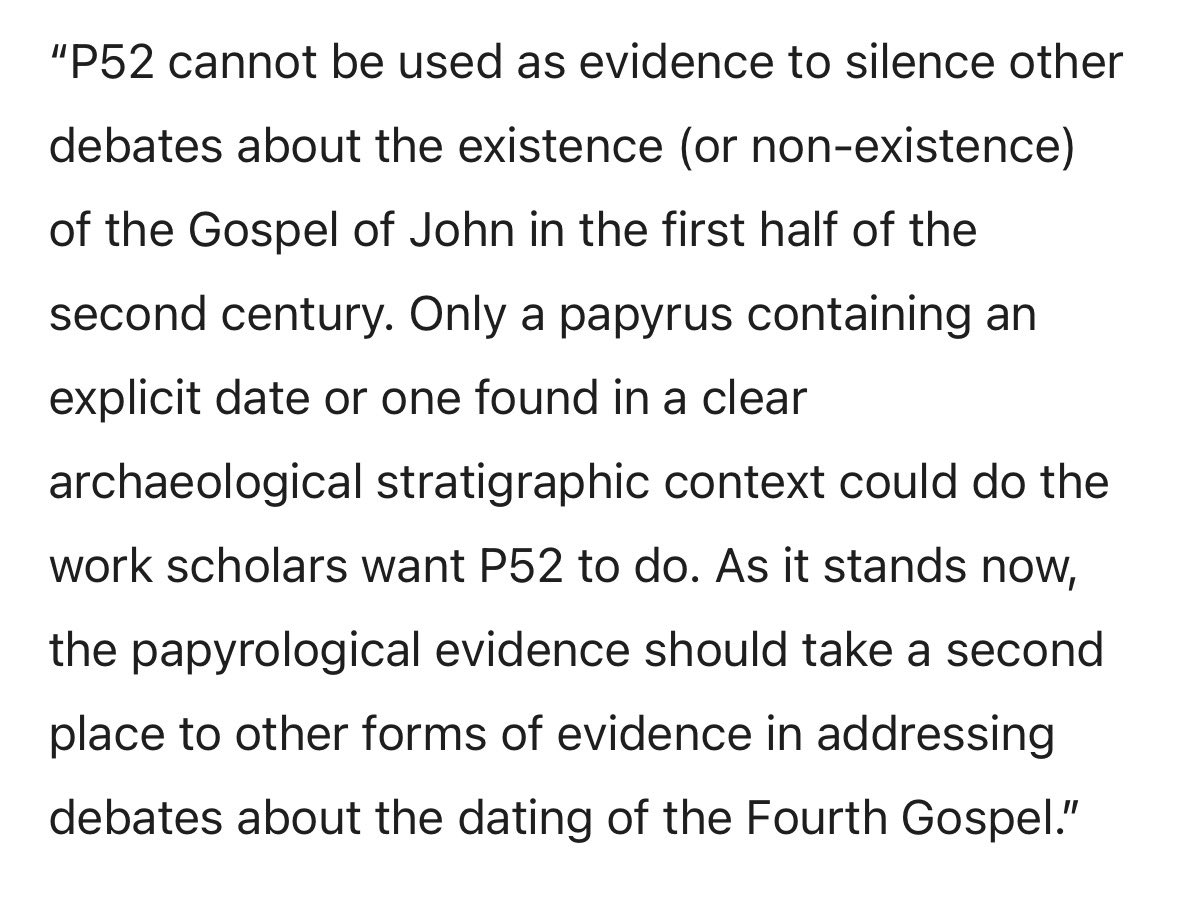
@reasoned_islam The abuse of P52 goes both ways. Nongbri reiterated his words just last year on his website that; “P52 cannot be used as evidence to silence other debates about the existence OR NON-EXISTENCE of the Gospel of John in the first half of the second century”.
Why would you expect this?
The apostles did not primarily rely on written Gospels because they themselves were the living witnesses of Jesus. In the first century the gospel was transmitted mainly through oral teaching, memorized tradition and creeds. One of which we can find in 1 Corinthians 15.
The written Gospels were produced to preserve and stabilize that testimony, especially as the eyewitness generation began to die. Early figures like Papias even state that they preferred learning from the “living voice” of those who had heard the apostles rather than from books. Only after the eyewitnesses died did the written Gospels become the central teaching texts of the Christian congregations. The expectation of finding evidence that the earliest Christian communities relied on the written Gospels as their primary means of teaching is historically unfounded. Such an assumption fails to adequately account for the historical context of the first-century Christian congregations, which functioned primarily within an oral culture, and overlooks key insights from form-critical scholarship regarding the transmission of the Jesus tradition.
I have added a few pages from James Dunn’s book Jesus remembered where he highlights the importance of the oral tradition.
@ALimanchi@Ihunanya_chi “None of the original Gospel manuscripts contain the authors’ names”
Do you have any manuscript evidence for this claim? Last I checked every early manuscript that has the title page intact has the titles present
It still seems that we are not fully aligned, as I feel there remains some confusion between the date of a manuscript and the date of the reading it preserves.
The re-evaluation of the palaeographic dating of P66 and P75, or the lack of early attestation of the Johannine prologue, does not invalidate the claim that the major uncials preserve readings from the 2nd century.
A terminus ante quem of the 4th century does not preclude an earlier terminus post quem. Authorities such as NTVMR continue to date P52, P90, P98, P129, P104 and P137 Post Quem as 2nd century and P75 and P66 to 200–225 CE (3rd century).
Therefore…
“…scholars are able to track a consistent line of careful copying practices from the second century, with P4 and P64+67, to the third century, with P66 and P75, all the way to the fourth century, with 01 and 03, and beyond, all of which cohere closely in their wording”. - Myths and Mistakes in New Testament Textual Criticism
Also see the quotes added from “The New Testament in the Second Century: Text, Collections and Canon - L. Hurtado to further substantiate my claim.
I am glad to see that you appear to agree that NA28 contains 2nd-century readings.
Although I did not receive an answer to my earlier question(s), I appreciate your engagement on this matter. Until next time
Nowhere have I made such a claim. You have shifted the discussion to an entirely different argument. My point concerned the fact that many of the Uncial readings can be traced back to the 2nd century, whereas you are now referring to critical editions whose base text is derived from the early Uncials. These are two distinct issues.
Even so, regarding your point, I can demonstrate that within this eclectic text, several readings of certain verses indeed go back to the 2nd and 3rd centuries. See attached pictures
You are overlooking a crucial distinction. The primary purpose of a critical text is to reconstruct the earliest attainable reading. The date of a manuscript whether from the 4th century or later does not necessarily indicate the age of the readings it contains. A manuscript copied in the 8th century may preserve a textual reading older than one found in a 6th-century manuscript.
I am beginning to question whether you fully understand the difference between dating a manuscript (via paleography, carbon dating, or colophon evidence) and dating a reading (through comparison with earlier textual witnesses). For instance, I have provided an example of a 2nd-century reading found in your NA28, based on P52, from John 18:31.
To make this discussion more precise, do you agree with critical scholar Bart D. Ehrman’s statement that:
“Even though there are enormous problems in establishing what the authors of the New Testament originally wrote, in most instances textual critics are reasonably certain that they know.”
(The New Testament, p. 31)
I’m not sure what you’re looking for here. The statement I made wasn’t derived from a single source, but rather from the accumulation of studies I’ve done one of which I referenced earlier and will now include a screenshot of. At no point did I suggest that I was quoting anyone directly, in case that was being implied.
Now, I’d like to move the discussion forward rather than get sidetracked. Do you agree that, in most cases, we have a clear idea of what the autographs looked like? If not, could you explain why?
Comparative studies of Codex Sinaiticus and Codex Vaticanus indicate that the readings shared by these great uncials derive from a common ancestor, which can be plausibly dated to the second century. For a detailed discussion, see The New Testament in the Original Greek: Introduction and Appendix to the Text Revised by Brooke Foss Westcott and Fenton John Anthony Hort, pp. 222–223. I assume you are aware of the distinction between the dating of a manuscript itself and the dating of the textual readings it preserves, right?
I’m afraid I cannot follow your line of reasoning, nor do I see the necessity for further hypothesizing. The empirical evidence already available sufficiently accounts for the situation. An internal analysis of the major uncials dated to the fourth century, demonstrates that their readings largely trace back to the second century, reflecting the earlier exemplars upon which they were based. This leaves a temporal gap of roughly a hundred years from the autographs, a period during which many of the original writings would likely still have been extant. Given this, would you propose on the basis of known scribal tendencies that the text underwent dramatic alteration within that relatively short interval? And if so, what would be the empirical foundation for such a claim?
In Greek ἵνα + subjunctive expresses the intended result or purpose, not optionality.
So “every knee should bow” doesn’t mean “it’s optional,” but rather “this is what will happen / what is intended to happen.”
It’s roughly equivalent to English “that every knee will bow” but “should” was chosen by translators as a formal English rendering of the Greek subjunctive mood.
Here is entirety of episode 1 of the Can I Trust the Bible? documentary I filmed in Egypt 2 years ago. In it we tackle the issue of biblical vs. apocryphal/Gnostic gospels.
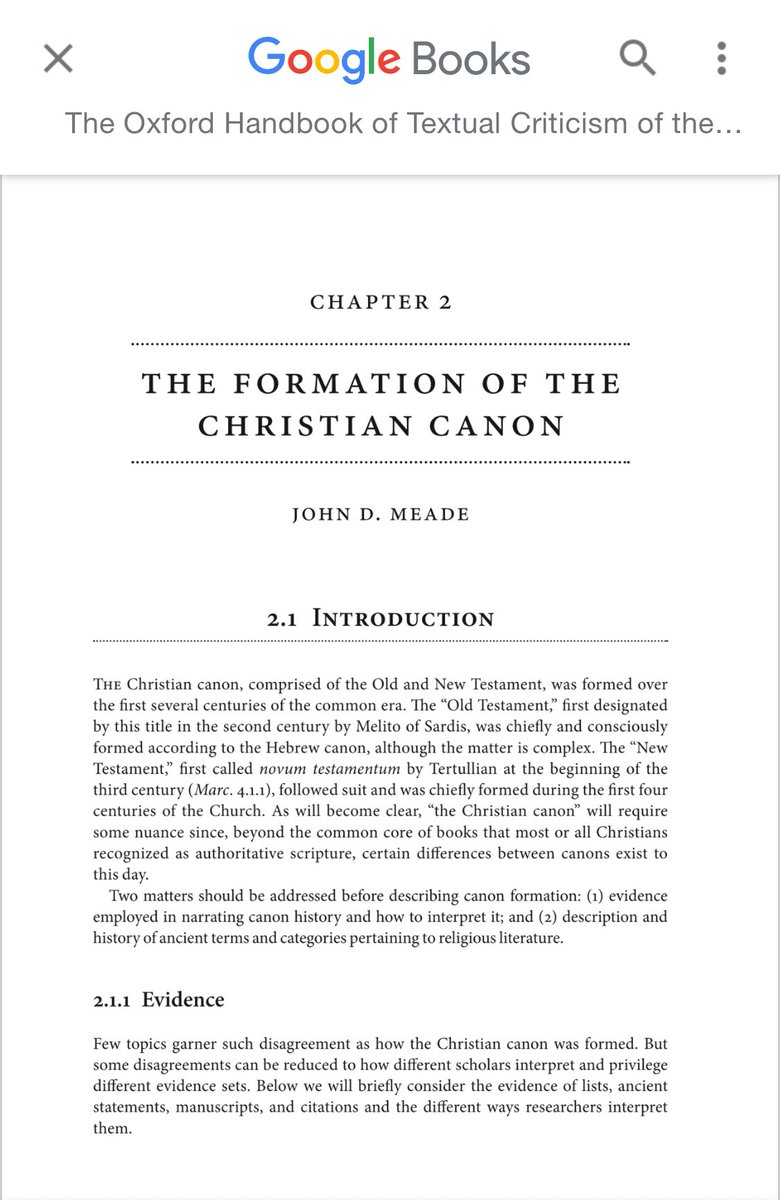
My chapter (and others) on “The Formation of the Christian Canon” in the forthcoming @OUPAcademic Handbook of Textual Criticism of the Bible can be freely read on Google Books.
I hope it’s useful to you.
https://t.co/yC9ypM0Pdx