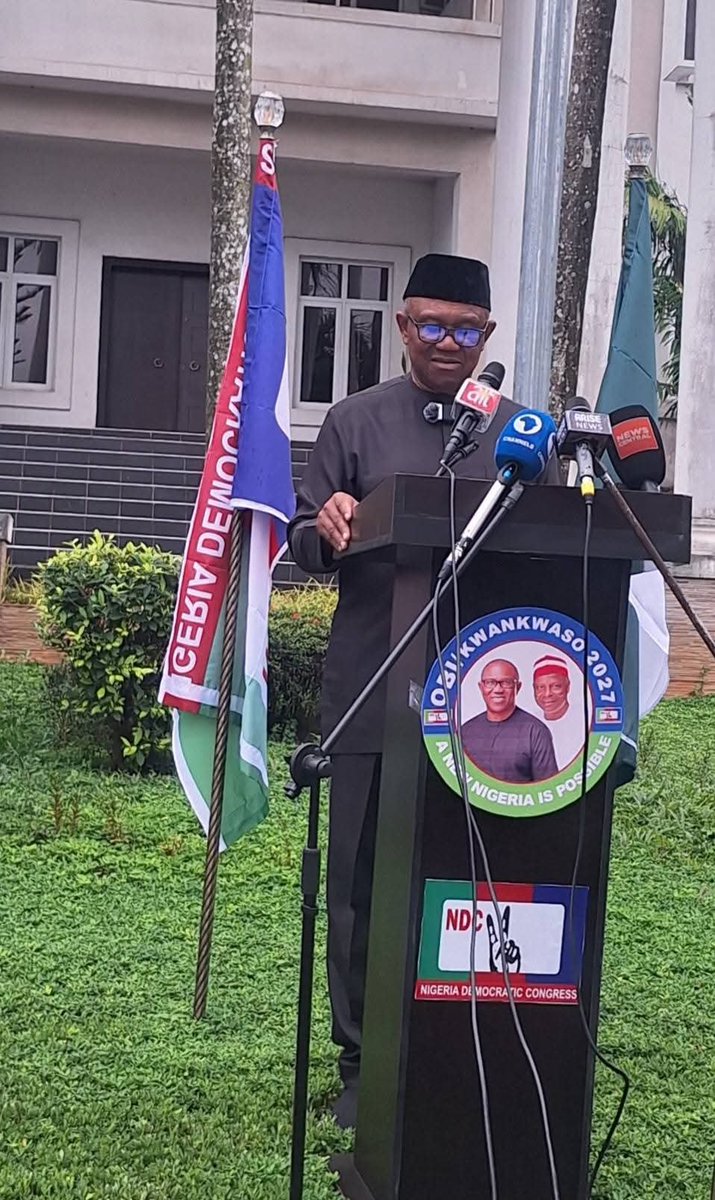
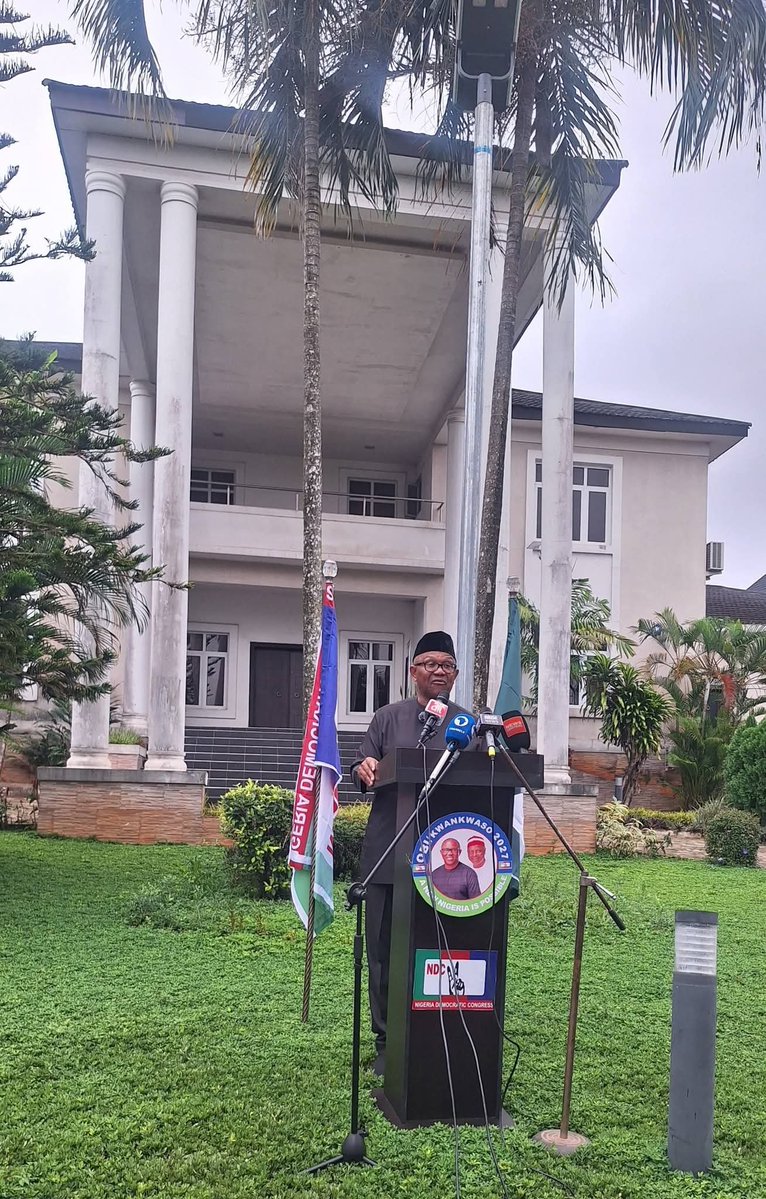
MY ADDRESS TO MARK THE COMMENCEMENT OF THE 2027 PRESIDENTIAL AND NATIONAL ASSEMBLY CAMPAIGNS
21 August 2026
Dear Compatriots,
Members of the Press,
Distinguished ladies and gentlemen,
Wednesday, 19 August 2026, marked the official start of the campaign period for the 2027 Presidential and National Assembly elections.
There is no doubt that this is a defining moment for our democracy. This moment gives Nigerians the opportunity to assess the records, ideas, and plans of those seeking their mandate to lead their country at a time of grave uncertainty in our rapidly changing world.
I consider myself quite privileged to be one of those seeking your mandate to deal with these challenges facing our country.
I enter this contest with one firm conviction: Nigeria can work, and Nigeria must work.
Nigeria faces several serious challenges. Some of them are indeed of existential proportions.
According to the IMF, 63%, or over 140 million Nigerians, live at or below the national poverty line, while humanitarian agencies estimate that 35 million people will need food assistance during the 2026 lean season. About 3.6 million Nigerians remain internally displaced, largely because of conflict and insecurity. Each year, millions of young people enter the labour market, yet too many struggle to find productive opportunities. Weak infrastructure, unreliable power, insecurity, and the excessive cost of doing business continue to burden households and constrain enterprise.
These are more than statistics. They reflect the daily realities of Nigerian families, farmers, workers, students, and businesses.
Yet I do not believe Nigeria lacks the ability to overcome these challenges. We have the people, resources, market, talent, and enterprise. What we must do now is turn these strengths into security, productivity, and shared prosperity.
LEADERSHIP MUST DELIVER RESULTS
My successful private-sector experience, studies in institutions of repute on policy and business matters, and my service as Governor of Anambra State have shaped my understanding of public leadership. Government must manage resources responsibly, set clear priorities, and measure the outcomes of its decisions. Public office is not a reward; it is a responsibility to the people.
In Anambra, I prioritised the foundations of long-term development: education, healthcare, infrastructure, fiscal discipline, and institutional capacity. I do not present that record as perfect, but as an experience from which Nigerians can draw their own conclusions.
Senator Rabiu Musa Kwankwaso brings a different but complementary governing experience.
As Governor of Kano State, he focused strongly on education, technical training, scholarships, infrastructure, and human-capital development. His administration’s investments in education and skills showed an understanding that the people are a state’s most important long-term resource.
Our experiences are different, but our conclusion is the same: Nigeria must invest in its people and manage public resources with discipline.
BUILDING AN ECONOMY THAT WORKS
Nigeria needs more than reactive reforms. We must focus on the questions that matter:
Are Nigerians better off than they were four years ago? Can they afford food, education, and healthcare? Can businesses produce, expand, and create jobs? Can young people find productive work? Can farmers work safely and get their produce to market?
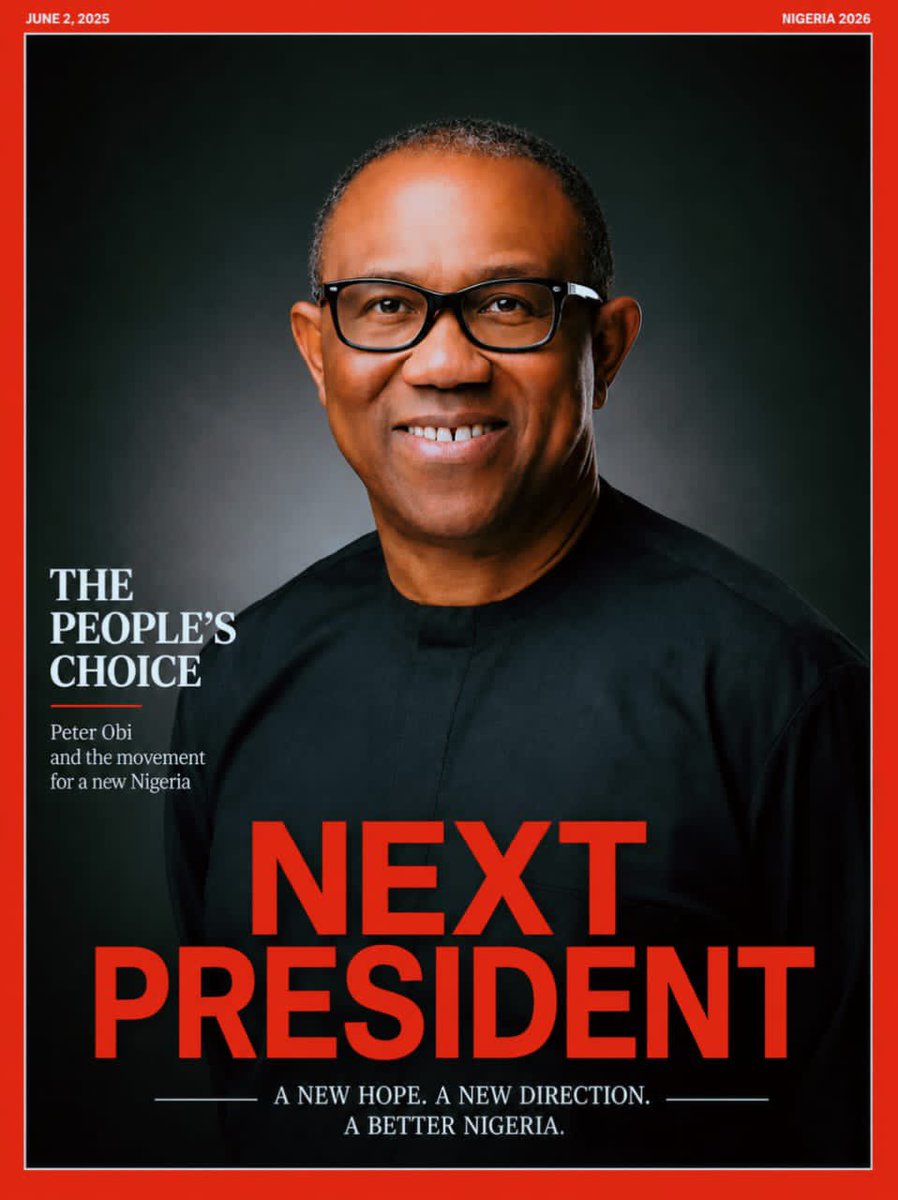
H.E Peter Obi.
No public office blemish, no corrupt cases, no shady pasts - walks the talk & has proven that there's an upright way to do politics.
You're the man we say you are & thrice the man you think you are.
In my lifetime, you will be president and THAT IS NEXT YEAR.
You measure success by one award. I measure it by sold-out arenas, billions of streams, global influence, and people singing my songs across continents.
You had government backing and still couldn't convince enough people to back you in your small constituency..
You’re a small boy who came into politics by accident..
You spent 8yrs with the ex president and couldn’t make a change in your poverty stricken community..
We all have different trophies Bashir, I’ll keep inspiring the young ones and generations to come while you wait for the next government job to get crumbs.
My Visit to Ogoja
After visiting the Catholic Maternity Hospital in Ogoja, where I supported the hospital and its School of Midwifery, I stopped at the INEC Continuous Voter Registration Centre at St. Ben’s Demonstration Primary School, Ogoja. I observed the voter registration exercise and the orderly conduct of the citizens who came out to register.
Thereafter, I honoured the invitation of the Missionary Diocese of Ogoja, Church of Nigeria (Anglican Communion), where the newly installed Bishop held his first Synod and unveiled a vision centred on expanding access to education and healthcare through the establishment of a school and a hospital.
In support of this noble mission, I made an initial contribution of ₦5 million. Investing in education, healthcare, and the welfare of the less privileged remains one of the most meaningful ways to build a productive, compassionate, and prosperous society.
I sincerely thank the Bishop and the Diocese for their commitment to serving humanity.
We thereafter proceeded through Okuku, Yala LGA where we greeted the people.
Together, through purposeful investments in people and institutions, we can build a better Nigeria.
A New Nigeria is POssible. -PO
Why the voter registration exercise should be extended.
As we continue to encourage Nigerians to participate actively in our democracy, I respectfully appeal to INEC to consider extending the voter registration window to the latest practical date that still allows adequate time for the preparation of a credible voters’ register before the 2027 general elections.
Every day, more young Nigerians attain the age of 18 and become constitutionally eligible to vote. They are not just our future; they are stakeholders in our present. It would be unfortunate if many of them were denied the opportunity to exercise their civic responsibility simply because the registration process closed long before the elections.
Moreover, this position is legally supported by the High Court judgment delivered on 22 November 2022 in Anaja Salmat & 3 Others v. INEC (Suit No. FHC/ABJ/CS/1342/2022). In that decision, the Federal High Court held that voter registration should continue until 90 days before a general election to protect the constitutional voting rights of eligible Nigerians.
I appreciate the enormous responsibility placed on INEC to deliver free, fair, and credible elections. I also recognise the need for sufficient time to clean the register and make the necessary logistical preparations. However, our electoral process should, as much as possible, maximise participation rather than limit it.
A democracy is strengthened when every eligible citizen has the opportunity to be heard. I therefore urge INEC to adopt a registration timeline that protects the integrity of the process while ensuring that no eligible Nigerian, especially our young people, is unnecessarily disenfranchised. -PO
FIFA World Cup: A Gallant Finish
The FIFA World Cup concluded successfully today, with the best team emerging victorious.
This is yet another fitting birthday gift, further demonstrating that the youth have not only arrived but are proving that excellence, when given the opportunity, will always prevail.
Today, competence, capacity, character, and capability were on full display. It is a powerful reminder that when young people are properly nurtured, entrusted with responsibility, and given the opportunity to lead, they deliver outstanding results.
This is the spirit we must replicate across every sector of our national life. A New Nigeria is Possible, and it must be reflected in every endeavour that brings pride, progress, and honour to our nation. -PO
I shall dedicate the end of the month to visiting one school or hospital as my modest way of commemorating my birthday. At each institution, I hope to make a modest contribution towards its work, however little, as a practical expression of my gratitude to God. Rather than a celebration centred on me, I desire a celebration that places humanity at the centre.
My prayer is that God will continue to give me the strength, wisdom, and humility to serve. At 65, I am more convinced than ever that the true measure of a life is not the wealth accumulated or the honours received, but the positive difference made in the lives of others.
May God continue to bless Nigeria and guide us towards becoming a united, inclusive and compassionate nation, where we love one another and work together to build the country we are capable of becoming. -PO
Reflections on My 65th Birthday
Today, July 19, 2026, marks my 65th birthday. At sixty-five, birthdays should naturally become moments of deep reflection - moments to look back with gratitude to Almighty God for His abundant graces, examine the journey so far, and ask how the remaining years can be devoted more meaningfully to the service of God and humanity.
Perhaps in countries where basic human needs have largely been met, where institutions function effectively, and where citizens enjoy a greater measure of security and dignity, such attainments may rightly call for elaborate celebrations. In Nigeria, however, our reality compels a different kind of reflection.
Our nation is blessed with enormous human and natural resources, yet millions of our people continue to struggle with challenges that demand our collective attention. We cannot afford to celebrate ourselves excessively while many around us are burdened by poverty, ill health, unemployment, and limited opportunities. Rather, occasions such as this should remind us of our responsibility to contribute towards building a nation where future generations can genuinely celebrate.
This is why I have always seen birthdays not merely as occasions for personal celebration, but as opportunities for sober reflection, thanksgiving, and a renewed commitment to service.
As I reflected today, I came to a simple conclusion: the greatest celebration of life is not what we receive from others, but the lives we can touch positively.
This conviction has guided my approach throughout my years in business, in the corporate world, and as Governor of Anambra State. In each of these roles, I have tried to see every privilege not as a personal entitlement but as an opportunity to improve the lives of others.
Whenever people or institutions sought to celebrate me with expensive gifts or elaborate ceremonies, I encouraged them instead to redirect those resources towards projects that would have a lasting impact. Over the years, this philosophy has resulted in the building of schools, hostel blocks, support to schools, and other facilities that continue to benefit the less privileged. I have always believed that resources meant for personal comfort can often be transformed into instruments of hope for many.
The greatest honour anyone can receive is not found in gifts, ceremonies, or public admiration, but in knowing that one’s life has contributed, however modestly, to making another person’s life better.
Today, therefore, I give thanks to Almighty God for the gift of life and for bringing me to this important milestone of 65 years. I began the day with a Mass of Thanksgiving in Onitsha, thanking God for His grace, protection, guidance, and the countless blessings He has bestowed upon me over the years.
After the Mass, I proceeded to St. Raphael’s Hospital, Umueri, a small rural hospital in Anambra East Local Government Area. In furtherance of my belief that birthdays should be occasions for service rather than self-indulgence, I donated the sum of ₦10 million to support the hospital’s work of providing quality healthcare to the people.
As I was conducted around the hospital and saw patients in their moments of vulnerability, I was reminded again of our shared humanity. Some of those receiving care may not even have the financial means to settle their hospital bills, yet they deserve compassion, dignity, and access to quality healthcare. Their condition was a reminder that leadership, in its truest form, is about caring for people, especially those who cannot repay our kindness.
Hospitals and schools remain two of the greatest investments any society can make. A hospital preserves life; a school shapes the future. Supporting both is, therefore, not just an act of charity - it is an investment in humanity and in the future of our nation.
Roadmap to a New Nigeria That Is Possible – Part II
Education and Healthcare: The Foundation of a Renewed Nigeria
Recall that on July 1st, in Part 1 of "My Vision for a Productive and Prosperous Nigeria," I outlined the broad framework of my proposed roadmap for national renewal. In it, I emphasised that the transformation of Nigeria must begin with rebuilding our human capital through quality education and healthcare, supported by reforms in Technical and Vocational Education and Training (TVET), character and civic education, and strategic investments that will move our nation from a consumption-driven economy to a production-driven one. I promised to follow up with other parts in the coming weeks and months.
Today, July 16th, in the middle of July, I wish to expand on these two critical pillars - education and healthcare - because they are the bedrock upon which every prosperous nation is built. They are the cornerstones of the foundation that will ensure that a son of nobody can become somebody and remove many from the ranks of the disaffected who often become tools in the insecurity challenges confronting us.
Evidence from around the world shows that quality education and accessible healthcare are among the clearest distinctions between thriving nations and lagging ones. Princeton University Nobel Prize-winning economist Angus Deaton highlights this reality in his book, “The Great Escape: Health, Wealth, and the Origins of Inequality.”
Nothing, therefore, could be further from the truth than the claim by some young people that “education is a scam.” Education, when combined with good health, provides the ladder for individual upward mobility and drives economic growth for the nation.
We must become more intentional about aligning education with our national priorities, as Singapore did, and challenge our country to value education in the same way Deng Xiaoping repeatedly urged China to do from 1978 onwards, with the remarkable transformation we see today.
We will work through commissions that strengthen collaboration among the tiers of government, ensuring that primary education is domiciled at the community and local government levels, with strong parental involvement and curricula that are sensitive to local economic factor endowments and the value chains derived from them.
State governments will be supported to expand high-quality Technical and Vocational Education and Training (TVET), as well as general secondary education, through targeted grants and incentives.
We are also developing schemes that will enable universities to focus more deliberately on specialised areas of teaching and research, making them globally competitive while producing a workforce equipped for the demands of the future.
A NEW Nigeria is POssible. -PO
This is the sickbay and a classroom in a public school in Abia State.
19 more like this are currently being built, and education is completely free.
Education is taking back its place in our society.
The Role of the Diaspora African in Sustainable Development
On Friday, July 10, 2026, I had the honour of delivering the keynote address at Mandela Hall, African Union Permanent Observer Mission to the United Nations in New York, on _The Role of the Diaspora African in Sustainable Development across Africa.
Africa is a continent of immense riches. Indeed, it is the richest continent in the world, not only because of its vast mineral resources but also because of its greatest asset, its people. It is the second largest continent by landmass, after Asia, covering more than 30 million square kilometres. It is also the second most populous continent, with over 1.5 billion people. Significantly, more than one billion of these are young people in their productive years, making Africa home to the largest youthful workforce in the world.
When this demographic advantage is combined with nearly one billion hectares of arable land, about 60% of which remains uncultivated, it becomes clear that Africa possesses everything required not only to feed itself but also to become the food capital of the world.
Regrettably, despite this enormous potential, Africa remains home to the largest concentration of the world’s poorest people. Of the approximately 800 million people living in extreme poverty globally, nearly 60% are in Africa. That is about 480 million people, with Nigeria and the Democratic Republic of the Congo among the countries most affected. In other words, nearly one in every three Africans lives in extreme poverty. Likewise, in multidimensional poverty, Africa continues to bear the greatest burden.
The question, therefore, is simple. With all these advantages, why has Africa not been able to lift its people out of poverty?
It means there is a missing link. That missing link is Competent Leadership with Capacity, Compassion, Character, and Commitment to good governance.
What Africa needs is leadership that will rise to the challenge and drive the continent in the right direction. This means competent leadership with character, capacity, compassion and commitment to begin turning the continent around. When we get leadership right, everything else begins to change. We start realising our true potential.
So, what is the role of the Diaspora African in this journey?
You have an enormous role to play.
Because you live in societies where institutions largely work, where democracy is strengthened by accountability and where systems function more effectively, you have both an opportunity and a responsibility to help build Africa. It is time to become stronger advocates for good governance. Even where you cannot vote, your voices matter. They should be heard both at home and abroad whenever things are going wrong on our continent. Stand firmly for what is right. Speak truth to the leaders who visit you. Let them know where they are getting it wrong. That is what some of us have continued to do.
The contribution of the African diaspora extends far beyond advocacy. History teaches us that many of the world’s great economic transformations were driven, in part, by their diaspora communities.
Japan offers one example. Following the Meiji Restoration of 1868, the country embraced modernisation and benefited immensely from Japanese scholars, professionals and citizens who studied and worked abroad, especially in Germany, before returning home to drive the technological transformation for which Japan is admired today.
China presents another remarkable example. It was under Deng Xiaoping’s reforms, beginning in 1978, that China embraced education, innovation and global engagement. These reforms created opportunities for the Chinese diaspora to contribute significantly to the country’s extraordinary economic transformation. In 1980, China had more people living in poverty than Africa. Today, China has reduced extreme poverty dramatically, while Africa continues to struggle with the challenge.
TO THE HONOURABLE MINISTER OF AVIATION, MR. FESTUS KEYAMO
Contrary to your account of events surrounding Mr. Peter Obi’s transit through the Abuja Airport on Saturday, July 4, it has become necessary to set the record straight.
Mr. Peter Obi does not have any police or civil defence personnel attached to him in Abuja, despite being entitled to VVIP protection by virtue of his status as a leading opposition figure in Nigeria. He certainly does not have a police officer serving as his driver. Your reference to a “police driver” appears to have been based on the assumption that he enjoys the level of security protection ordinarily accorded to someone of his standing. He does not.
Mr. Obi travels through multiple airports across Nigeria well over a dozen times every week. As someone who frequently travels with him, I have personally witnessed repeated instances of unusual discourtesy directed at him by some government personnel.
From your own account of events, it is evident that the incident Mr. Obi referred to during his interview occurred on a different date and at a different airport from the one referenced in your tweet.
However, let me address the incident you chose to publicise.
KEY CLARIFICATIONS
1. The incident you posted is entirely different from the one Mr. Peter Obi narrated in his interview. In that interview, he clearly stated: “I was there…” In the incident contained in your tweet, he was not present.
If we now have at least two separate incidents in which vehicles associated with Mr. Obi were clamped under questionable circumstances, does this not suggest a pattern of targeting an individual simply because of who he is?
2. The entire sequence of events you referenced, from arrival to the eventual clamping of the vehicle, lasted approximately five minutes.
At most airports around the world, including major international airports, a ten-minute drop-off window is generally considered acceptable. Where, then, did the claim of 30 minutes originate?
Do you not agree that half-truths can sometimes be more misleading than outright falsehoods?
3. Is it not a fact that several other vehicles were in the vicinity of Mr. Obi’s vehicle without attracting similar attention from airport officials? Indeed, some of those vehicles had been parked there long before Mr. Obi’s vehicle arrived, yet none was clamped.
4. I have personally been at the airport on several occasions when serving and former government officials arrived in large convoys, blocked access routes, and caused considerable inconvenience to the travelling public, without any agency of government taking similar action.
5. Under your watch, there have been other high-profile airport incidents, including:
The disruption involving Senator Adams Oshiomhole and airline staff.
The incident involving Mr. Wasiu Ayinde Marshal (KWAM 1), a known associate of the President, who allegedly attempted to prevent an aircraft from departing.
You are undoubtedly aware of both incidents.
Where was this same enthusiasm to instigate public outrage and issue official condemnations? Was CCTV footage from those incidents also released, or was the CCTV system only activated when it involved Mr. Peter Obi?
6. Can the publication of CCTV footage detailing Mr. Peter Obi’s movements on your personal social media platform be considered a serious breach of his personal security?
Your footage established no wrongdoing. Instead, you further exposed the movements of a leading opposition figure whose security concerns are already significant.
Would you release equivalent CCTV footage of other presidential candidates of Mr. Obi’s standing who travel in private and presidential aircraft funded by taxpayers?
Should a leading presidential candidate not be accorded security protocols consistent with democratic best practices?
At Sam Mbakwe airport Owerri, a billboard has been put up for our star boy, Egejurum Onyedikachi, to celebrate him as he arrived in Owerri today.
He is 11 years old and the world’s best in the Primary category for Mathematics.
He is so good that he finished the exam and fell asleep.
What a star!
This week, I have observed with deep concern two notable media appearances: one by my brother, Mr. Peter Obi, and the other by the family of Malam Nasir El-Rufai.
In his interview with Mr. Chude Jideonwo, Mr. Obi voiced serious worries about his personal safety and the adverse impact his role as an opposition leader has had on his businesses. Even more troubling was the Federal Government’s response, which resorted to personal insults and derogatory language instead of the restraint and maturity expected of a democratic administration.
Let me state clearly: like every Nigerian, our presidential candidate and all of us deserve the full protection of the state, not ridicule for raising legitimate concerns.
Democratic leadership requires fairness, justice, and restraint.
A government entrusted with protecting citizens should not dismiss or mock credible calls for help from any individual, including Mr. Peter Obi.
On the other hand, it was distressing to watch the wives of Malam Nasir El-Rufai publicly express the family’s anguish over his prolonged detention.
Regardless of political affiliation, Malam El-Rufai, like every Nigerian, is entitled to due process and the presumption of innocence until proven guilty by a competent court. The continued delay in granting him bail through what many perceive as stringent and unreasonable conditions is deeply concerning. As an unconvicted citizen, he deserves a fair and expeditious trial, while his health and that of his family are adequately safeguarded.
I therefore join well-meaning Nigerians in urging the Federal Government to handle these matters with transparency, accountability, and justice. These issues must not be weaponised to settle political scores.
For our democracy to truly thrive, every citizen; young or old, regardless of ethnicity, religion, or political persuasion must receive equal and equitable treatment under the law from the government that exists to protect us all. - RMK