Court dismisses application seeking to compel State to produce missing security analyst Mwenda Mbijiwe, dead or alive; finds family failed to prove he is or was in custody - https://t.co/DEv93N3Cgc
All roads lead you back to yourself;
the standards you ignored.
the boundaries you softened.
the intuition you doubted.
Life will keep repeating lessons until you listen.
What makes a population of over 50 Million people normalize dysfunction from a few politicians? Is it fear, conditioning, survival, or something else entirely?
Who actually understands this, psychologists, sociologists, historians, anyone?? Feel free to weigh in✌🏾
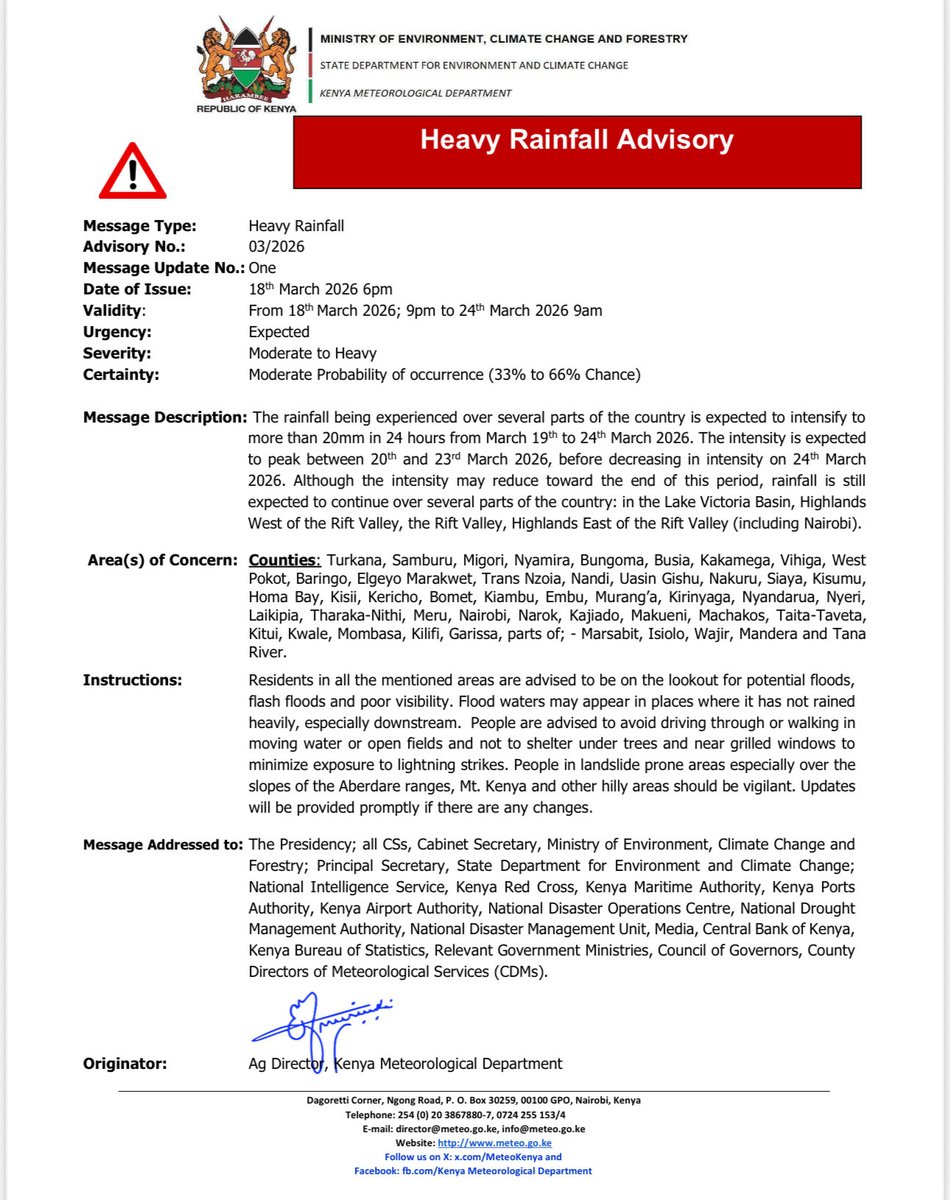
Nairobi Metropolitan Rainfall Update – 12 March 2026 🌧️⚠️
Moderate to heavy rainfall expected in parts of Nairobi and surrounding counties over the next 24 hours (09:00 today – 09:00 tomorrow).
Official sources only – stay updated:
•Kenya Meteorological Department website: https://t.co/bUbIOGbrTT
•Daily Forecast: https://t.co/2vTZneh0Di
•7-Day Forecast: https://t.co/o7ruSeCC04
•WhatsApp channel for alerts: https://t.co/hxKngV85ez
•X (Twitter): https://t.co/v7FFL9w6v2
Tag a friend who needs this heads-up! Stay safe & dry, Nairobi fam 🇰🇪💧 #NairobiWeather #HeavyRain #FloodAlert #KenyaRains
HR warned a Gen Z employee that leaving exactly at 5pm every day shows “lack of dedication.” The next day the guy stayed until 6pm. At 6:01 he walked into HR’s office and asked where to submit the overtime form. HR told him it wasn’t paid overtime. The Gen Z guy went back to leaving at 5pm.
He was the richest man in the world—and his doctors said he had one year to live. Then he did something that changed everything.
John D. Rockefeller was born on July 8, 1839, and built an empire that would make him the first billionaire in human history. By age 25, he owned one of the largest oil refineries in the United States. By 31, he was the world's largest oil refiner. By 38, he controlled 90% of all oil refined in America. By 50, he was the richest man in the country.
Every decision he made, every relationship he cultivated, every business move he calculated—it was all designed to build wealth. And it worked. When he died in 1937, his fortune was worth approximately $340 billion in today's dollars.
But at age 53, everything changed.
Rockefeller's body began to break down. He was wracked with pain. His hair fell out completely—eyebrows, eyelashes, everything. His digestion failed. The man who could buy anything he wanted could only stomach soup and crackers. He couldn't sleep. He couldn't smile. According to those close to him, "Nothing in life meant anything to him anymore."
His personal physicians examined him and delivered their verdict: he would not live another year.
Here was the richest man in the world, lying in bed, unable to enjoy a single dollar of his fortune. All that money, all that power, all that control over the business world—and he had no control over his own body. He could buy companies, but he couldn't buy health. He could purchase industries, but he couldn't purchase peace.
That year crawled by in agony. And then, one morning, something shifted.
Rockefeller woke up with a clarity that had been missing for years. A simple, undeniable truth settled over him: He wasn't going to be able to take any of it with him.
Not one dollar. Not one property. Not one share of Standard Oil. When he died—and the doctors assured him it would be soon—all of it would stay behind.
So he made a decision that would not only change his life, but the lives of millions.
He called in his lawyers, accountants, and advisors. He told them he wanted to give his money away—to hospitals, research institutions, charitable causes. In 1913, he established the Rockefeller Foundation, dedicating vast sums to improving human welfare around the world.
The foundation would go on to fund some of the most important medical breakthroughs in history. In 1941, it financed the research of Howard Florey and Norman Heatley, whose work on penicillin would save countless lives during World War II and beyond. The foundation supported education, public health, and scientific research on a scale never seen before.
But here's the most astonishing part of the story.
As Rockefeller began to give his wealth away—not just in amounts, but with genuine intention and joy—his health began to return. His body, which had been shutting down, started to heal. The stress that had been killing him began to lift. He started sleeping again. Smiling again. Living again.
The doctors had said he'd die at 53. Instead, John D. Rockefeller lived to be 97 years old.
He had been given a death sentence, and he turned it into four more decades of life—decades he spent not accumulating, but giving away.
Rockefeller was a devout Baptist who attended Euclid Avenue Baptist Church in Cleveland.
Before his death, he reflected on the transformation that had saved his life. He wrote: "God taught me that everything belongs to Him, and I am merely a conduit to carry out His will. My life has been one long, happy holiday since then; full of work and play, I let go of my worries along the road, and God was wonderful to me every day."
The man who had once measured his worth in dollars learned to measure it in impact. The man who had controlled 90% of an industry learned he couldn't control his own mortality—but he could control his legacy.
President Samia Suluhu has made costly mistakes, and the consequences are now unfolding. Tanzania, which was once among Africa’s most peaceful and stable nations is suddenly on edge.
A people long known for their calm and unity are now in the streets, protesting what they see as a one-sided election. From the look of things, curfews and military deployments will do little to calm the situation.