Top leaders should push power downward,empowering people at all levels to make decisions. This will increase the collective intelligence adaptability, and resilience of the organization over time, by harnessing the wisdom of those outside the traditional decision-making hierarchy
Congratulations, President @WilliamsRuto, on marking 3 years in office as the President of the beautiful Republic of Kenya. From delivering on affordable housing, stabilising year-to-year inflation, and supporting Kenyan sports like never before, to curbing corruption, setting up a panel of experts to compensate families of victims of demonstration, all while working to lower the cost of living, and improving healthcare standards, your leadership has steered the country through remarkable milestones.
Being President is no easy task, especially in the midst of a volatile political climate. I look forward to seeing what the next two years will bring, and I urge all of us to support the President in our own spheres.
#Ruto@3
What will count in the next election is one’s track record of pushing forward the development agenda of Kenyans, across all the 47 counties.
Kenya will not care about empty slogans, and vengeful schemes to determine who serves for how many terms in office.
@otienowill Progressive democrasis uses social media to verify who you are and gage the caliber of person they are issuing the visa to. It will not be new in the Kenyan context. Nationalism is not one-sided. Rather, our lenses should be able to revolve into 36o degrees to see the other side
@AokoOtieno_ The history demonstrates times beyond number that any Kenya who resigns from jobs abroad to vie for the presidential seat will always lose. It will be a double loss in 2027 for him; financially and presidential.
"Unless we confront the scourge of disinformation now, we risk sacrificing not just a single presidency but the future of our nation. It's the time for us to collectively rise above the roar of lies & seek truth with unwavering resolve. A nation divided by lies cannot move forward." ~ Dida, Sunday Standard.
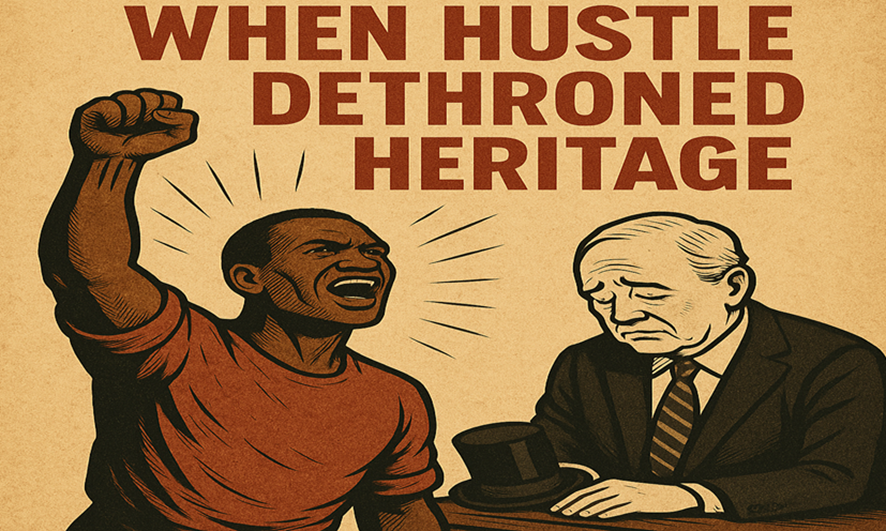
Ruto Broke the Code: Now the Gatekeepers Want Revenge.
In the din of Kenya’s political discourse, one truth remains largely unspoken yet deeply entrenched: much of the visceral anger directed at President William Ruto has little to do with his policies, governance record, or leadership choices. It has everything to do with who he is — and more importantly, where he came from.
Critics may dress up their disdain in the language of economic analysis or civic concern, but beneath the rhetoric lies a resentment that refuses to accept that a man from Sugoi — son of a peasant — rose to the highest office in the land. They are not perturbed by what Ruto does. They are perturbed by what he represents.
For decades, Kenya's political establishment has been a guarded citadel, largely passed between children of the old elite. Then came Ruto — an outsider by all definitions of Kenyan political aristocracy. His ascent was not paved by lineage, but carved through grit, ambition, and a belief that hustlers, too, have a right to dream. That is the sin that many cannot forgive him for.
When Ruto champions the Bottom-Up Economic Model, they scoff — not because they have a better plan, but because the very idea of economically empowering the underclass threatens their entrenched privileges. When he speaks the language of Boda Bodas and Mama Mbogas, they don’t hear policy—they hear a disruption of the old order where politics was the playground of the polished, not the platform of the poor.
Let’s be honest: if the same housing programme Ruto is pushing were launched by one of the "blue bloods," it would be hailed as visionary. If the same reforms to healthcare, fertilizer subsidies, and digitization of government were carried out by a scion of the elite, the media would be singing paeans of praise. But because it is Ruto — a man who wasn’t supposed to make it to State House—his actions are viewed not through the lens of merit, but through the fog of class contempt.
Even the language used to attack him betrays this truth. They call him "clever" as a slur. They call him "schemer" and "survivor" as if those are criminal traits. What they really mean is: he outsmarted a system that was never meant to let someone like him in.
This isn’t to suggest that Ruto’s government is beyond scrutiny—far from it. In any democracy, leaders must be held accountable. But let the criticism be about governance, not genealogy. Let it be about results, not resentment. Let it not be clouded by the bitterness of a ruling class that lost its grip on power and now seeks to claw it back by weaponizing public discourse.
The real political divide in Kenya today is not between parties or ideologies. It is between the gatekeepers of privilege and the children of struggle; between those who believe leadership is their birthright and those who believe it must be earned. And Ruto, whether you love him or loathe him, embodies that uncomfortable truth.
What we are witnessing is not political opposition—it is backlash. A backlash against the very idea that a man who rose from the village to the presidency without the blessing of dynasties, can govern without the support of gatekeepers of power and privilege.
It is class war, clothed in the language of critique. And it is time we called it what it is.
@MutembeiTV So forgiveness from you to people is acceptable but forginess from Ruto to the people is not acceptable! The optics used to gauge the forginess is not one sided. It should be applied with wisdom and discernment.
I have learnt with sadness about the death of Kenya's beloved teacher, writer, playwright, and public intellectual, Prof Ngugi wa Thiong'o. The towering giant of Kenyan letters has put down his pen for the final time.
Always courageous, he made an indelible impact on how we think about our independence, social justice as well as the uses and abuses of political and economic power.
In his bold and creative career, Prof Thiong'o showed us how to make contributions that cannot be ignored and speak in ways that both supporters and opponents cannot ignore.
His patriotism is undeniable, and even those who disagree with him will admit that Prof Thiong'o's discourse always sprang forth from a deep and earnest quest for truth and understanding, devoid of malice, hatred or contempt.
Many Kenyans cannot remember a time when we were not united in the hope that Prof Thiong'o would finally receive the Nobel Prize for Literature, which we all felt he more than deserved.
Be that as it may, he will always remain the champion of literary emancipation and innovation in our hearts and minds.
May his family find peace and comfort in this period of mourning, and may Prof Thiong'o rest in eternal peace.