In previous research, we found that Claude expresses over 3,000 values, like honesty and warmth. In new work, we asked how the values Claude expresses vary between Claude models and across languages.
We analyzed 300K+ anonymized conversations to find out.https://t.co/PgxsMXipt5
Tomorrow (Wednesday) I'll be giving a talk at the Mathematical and Scientific Machine Learning #MSML2021 conference. I'll talk about a physics-inspired problem that is not easy for ML and a toy version where we can compute the answer exactly.
https://t.co/ELKA9EOZte
Idea: automatic task creation for meta-learning based on UL.
NN creates embeddings. Clustering algorithm uniformly distributes cluster centers over the feature space and, based on the distance to the centers, creates pseudo labels. Meta-learning is run for the generated tasks
A gradient-based method for creating a task-dependent NAS is described.
Features for rapid learning:
1. Uses DARTS first order optimization.
2. Weights and architecture parameters are optimized simultaneously both in the inner loop and in the outer one.
The method in the article combines optimization-based meta-learning and NAS.
The problem is splitted into two issues: 1) find an architecture controller that effectively generates models, 2) estimate optimal weights for generated model.
MetaNas combines two gradient methods: Reptile and DARTS.
Features:
1. Develop the idea of DARTS and implement a soft-pruning mechanism for selecting architecture operations.
2. Weights and architectures are updated simultaneously.
Idea: combine progressive search PNAS with first-order learner Reptile.
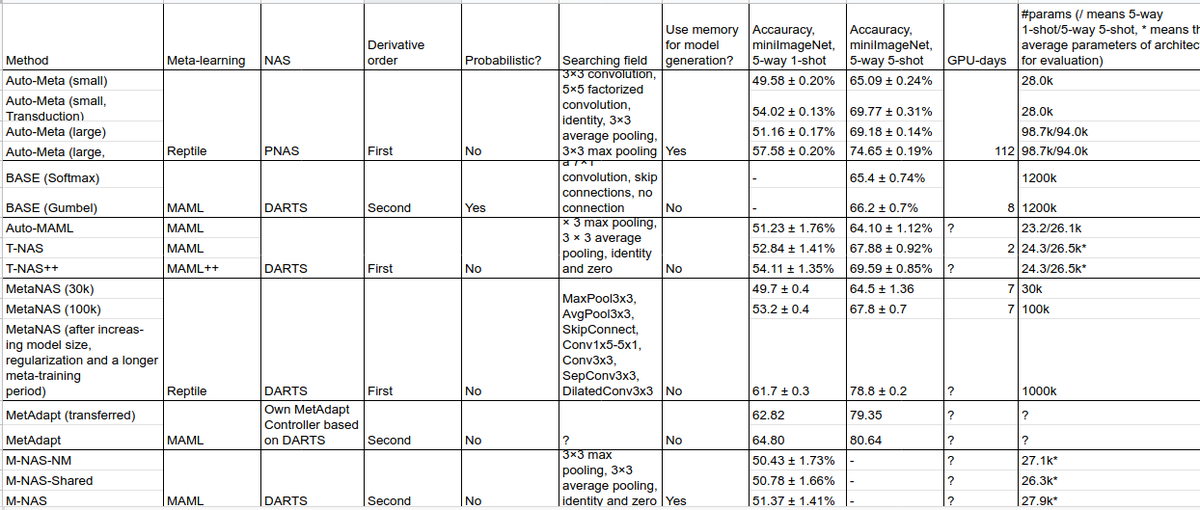
This article is the first in the field of meta-learning + NAS. Generating dynamic architecture gives higher accuracy on the benchmark compared to static meta-learning architecture.
I continue to review articles related to my scientific work!
Today's review is about meta-NAS.
🎓Auto-Meta: Automated Gradient Based Meta Learner Search
by Jaehong Kim, Sangyeul Lee, Sungwan Kim, Moonsu Cha et al.
#ML#AI#datascience#deeplearning#programming#machinelearning