I am not in principle opposed to the use of military force against the Islamic Republic of Iran; over this regime's 46-year history it has not only killed Americans and Israelis but has brought immense harm to Lebanon, Iraq and Syria while also violently suppressing its own population. My reservations relate to Trump, the fact everything he does focuses on his own aggrandizement, and his total lack of interest on substantive policy issues whether foreign or domestic. And that he is violating our constitution.
How Trump handled the strikes on Iran last June illustrated his unfitness. He immediately came out and held a press conference claiming that Iran's nuclear program was "totally annihilated," something that was inherently implausible and impossible to know that quickly. (Many Iranian facilities are buried under mountains.) When weeks later the Pentagon's Defense Intelligence Agency reached an assessment that Iran's program was only modestly set back by the strikes, Trump reacted by firing the head of the DIA (Lt. Gen. Jeffrey Kruse). This sent the message that honest analysis was not wanted. This should be getting more coverage given the current campaign.
Trump's appointment of incompetent loyalists in senior positions means no rational policy process is possible. The only two figures in Trump's inner circle with any brains are Marco Rubio and JD Vance, & both sold whatever principles they had for access to the Trump cult. "Secretary of War" Hegseth might have been qualified to co-host a Fox News program but is clueless heading the Pentagon, and talks like a high school jock. Director of Nat'l Intelligence Tulsi Gabbard and CIA Director John Ratcliffe were both lacking in intelligence expertise and appointed because they were Trump loyalists.
The history of air campaigns is that alone they do not remove regimes. The closest positive example has been Slobodan Milosevic in Serbia, but the NATO bombing campaign in 1999 was followed by an election in 2000 which Milosevic lost. Not only is the Islamic Republic not going to hold elections, but the Basij, a thug militia used to brutalize anti-regime protesters, is still there. Although Israel has reportedly bombed the Basij HQ in Tehran, that will not likely destroy them. Can ordinary Iranian civilians outfight the state militia?
The lack of planning is shown by the fact that now, after the war was launched, Trump is reportedly trying to get Iranian Kurds to rise up against the regime. The fact that Axios mistakenly identified Iraqi Kurdish leaders as Iranian shows how ill-prepared the media is to keep the administration accountable. I can predict now that if they rise up the Kurds will liberate their areas in northwest Iran; they will not fight for all of Iran. And if the regime survives, it will take a horrible revenge on them as Trump moves on to his next theatrical event.
Most disturbing for me is Trump's violation of our constitution, which says that only Congress can declare war. It is a terrible precedent to set that the President can take the country to war on his own.
So we are now on Day 4 of this new war, the 2026 War I'll call it, and Trump, surrounded by sycophants, is flying blind. Israel's annihilation of Iran's senior leadership, with American help, has been impressive, and the likes of Ali Khamenei deserve no remorse. But where does this go if the regime holds on? Trump could just find an opt moment to declare victory and pull away. If so, the consequences in the years to come are impossible to predict.
1. If Vance could at least pronounce "laissez faire" correctly it would be an improvement.
2. Vance's economic vision is pure abstract theory. Protectionism and state-directed investment are not creating jobs in manufacturing or highly-paid working class jobs anywhere.
1. Vance does not understand economics or American economic history at even a basic gradeschool level.
2. His takes on both subjects are primarily motivated by the fact that he wants a right wing version of the New Deal.
The traffic jam to leave Crimea on the last road out has turned into a parking lot, with cars starting to run out of fuel.
Sevastopol, Crimea's largest city, is without power. Electricity has been knocked out for half of Crimea.
All the roads, bridges, and the ferry have been disabled or are under too great a threat to use.
All fuel sales have been suspended.
Crimea's tourism industry has collapsed.
Strikes against Russian airfields, administrative centers, air defense, and energy infrastructure have been carried out by Ukraine's elite Alpha Unit.
The systematic dismantling of Russian civil and military systems in Crimea will either lead to complete abandonment of their position or a poorly-supplied force without the fuel and munitions to sustain a long fight.
Crimea, already strategically vulnerable, is now isolated, and it's only going to get worse.
The war started in Crimea. Now it may end there too.
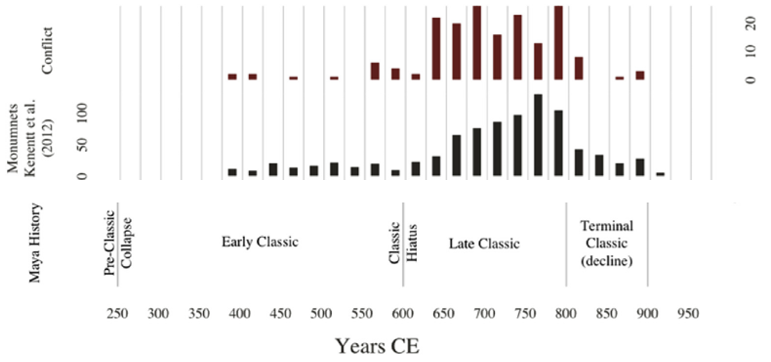
Decline and fall of the Mayans.
Frequency of recorded conflicts in Mayan inscriptions increases. The construction of new Mayan monuments decline and stop.
The Trump administration has struggled to reconcile why four months ago they believed Iran warranted military confrontation, while today they believe the same regime—whose conduct and ambitions appear unchanged—warrants significant economic incentives. @ThisWeekABC with
@jonkarl
How messed up this is: the mediators, Qatar & Pakistan, are long-standing state-sponsors of Sunni jihadist groups & other terrorists, & Iran has the talks focused on its priority of protecting the terrorist group Hizbullah.
https://t.co/yfBOwJ7JJI
Iran has now published its version of the US-Iran memorandum of understanding through the official IRNA news agency.
The two texts are largely identical, but there are some differences in wording and emphasis:
• Title:
🇮🇷 “Islamabad Memorandum of Understanding on ending the imposed war by the United States and the Zionist regime against Iran.”
🇺🇸 “Memorandum of Understanding Between the United States of America and the Islamic Republic of Iran.”
• Paragraph 1 (Lebanon):
🇮🇷 parties will “guarantee” Lebanon’s sovereignty and territorial integrity.
🇺🇸 parties will “respect” Lebanon’s sovereignty and territorial integrity.
• Paragraph 4 (shipping):
🇮🇷 vessel traffic shall be maintained at levels proportional to pre-war traffic volumes, “as determined by the Islamic Republic of Iran.”
🇺🇸 vessel traffic shall be progressively restored toward pre-war levels.
• Paragraph 5 (Strait of Hormuz):
🇮🇷 says it will discuss the future administration of the strait with Oman and “consult” other Gulf states.
🇺🇸 says Iran will engage with Oman and other Gulf littoral states.
• Paragraph 8 (nuclear):
🇮🇷 Iran will not “produce or acquire” nuclear weapons.
🇺🇸 Iran will not “procure or develop” nuclear weapons.
The Iranian text also refers to Iran’s “nuclear needs.”
• Paragraph 10 (oil exports):
🇮🇷 crude oil, “petrochemical” products and derivatives.
🇺🇸 crude oil, “petroleum” products and derivatives.
“Petrochemical products” is broader and includes chemicals and industrial feedstocks beyond refined fuels.
If this is true, Obama's 2015 deal with Iran was much better for the U.S. b/c Obama's deal at least got lots of nuclear restrictions before waiving sanctions. Trump is giving it all away just to reopen Hormuz.
https://t.co/0CnzORTajK
@WSJ@nytimes What Iran gets up front is immediate sanctions relief on it exports. In return, Iran agrees to reopen Hormuz, which was already an open international waterway when the war began. The rest is saved for further negotiations. Iran is winning so far.
Two odd points stand out to me from this:
1) The reopening of Hormuz is touted as a major achievement, although it mere restores the status quo ante Feb. 28. Iran gains sanctions relief it did not have before; the U.S. gets nothing new.
2) Graham puts forward KSA-Israel normalization as the "ultimate goal." Really? Not preventing Iran from having nuclear weapons? Nothing about aid to regional terrorist groups?
https://t.co/3xuAnL4D5C
I just had a very lengthy and productive discussion with @SEPeaceMissions@SteveWitkoff about the state of play regarding Iran.
After this discussion, it is my opinion that signing the MOU will be beneficial to the United States, in as much as the Strait of Hormuz will begin to open, and the hostilities with Iran will stop.
Whether or not the United States can reach an acceptable, verifiable deal with Iran regarding its nuclear program and other issues is yet to be determined, but I see little downside to trying.
The economic stability that comes from opening up the Strait and the cessation of hostilities could create a pathway to peace well beyond the Iranian conflict.
The expansion of the Abraham Accords and normalizing relations between Saudi Arabia and Israel is President Trump’s and my ultimate goal. I think that is best achieved by creating economic stability for the United States, the region and the world, as well as the cessation of hostilities. The signing of the MOU is an essential step to make that happen and thus it is worthwhile.