The Court of Appeal has found that the appearance of a hearing date on ECCMIS was insufficient to establish effective service in circumstances where the Appellant’s advocates were omitted from the hearing notice, no electronic notification was shown to have been sent to them, and physical service was instead effected upon the former and current advocates of the Respondent.
In Gazonja Andrew v Registered Trustees of Tororo Diocese, Court of Appeal Civil Application No. 793 of 2026 (arising from Civil Appeal No. 250 of 2020), the Court found that the email notification printout did not show any notification for the hearing of Civil Appeal No. 250 of 2020 having been sent to the Appellant’s advocates, M/s Nabukenya Muliira & Co. Advocates. It further found that physical service of the hearing notice had instead been effected upon the former and current advocates of the Respondent.
The Court consequently held that no effective service was made on the Appellant.
The Court further noted that the hearing notice uploaded on ECCMIS omitted the Appellant’s advocates and considered the omission fundamentally serious. It emphasised that Poor or ineffective service of court process undermines the rule of law and access to justice.
The Court also stated that it is prejudicial and a violation of the parties’ constitutional right to deny them a hearing when there is glaring negligence and omission on the part of the court Registrar in directing service to the parties’ advocates or on the part of the court process server in effectively serving either party.
The Court accordingly held that the Applicant had shown sufficient reasons for his non-appearance in court or through his advocates, set aside the dismissal of Civil Appeal No. 250 of 2020, and reinstated the appeal to be heard on its merits inter partes.
This decision could not be more timely for our Online Symposium on Electronic Service of Court Process, organised by @pmlawhub. It raises a critical question for the ECCMIS era: When is electronic service truly effective?
The decision underscores how ineffective service can implicate the rule of law, access to justice and the constitutional right to be heard.
Join the conversation as we examine the evolving law and practice of electronic service of court process in Uganda’s digital justice system.
Register here: https://t.co/ZD1MKcJJwC
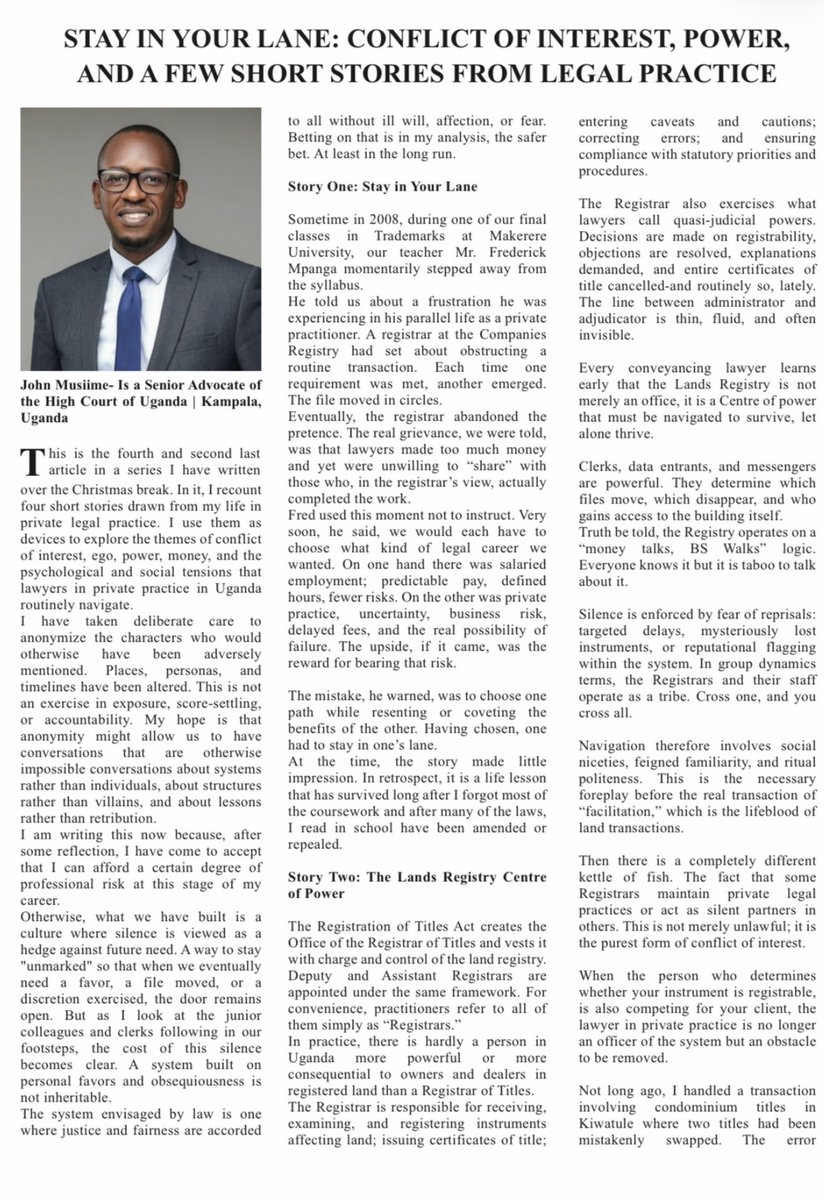
STAY IN YOUR LANE: CONFLICT OF INTEREST, POWER AND A FEW SHORT STORIES FROM LEGAL PRACTICE.
“…Clerks, data entrants, and messengers are powerful. They determine which files move, which disappear, and who gains access to the building itself.
Truth be told, the Registry operates on a
"money talks, BS Walks" logic. Everyone knows it but it is taboo to talk about it…”
As a nation, we commemorate the courage of those who fought for our independence and renew our commitment to justice, equality, and service to our country. At Samuel Ssebadduka & Co. Advocates, we remain devoted to upholding the rule of law and protecting rights.
His Lordship’s unwavering dedication to justice, profound wisdom, and steadfast integrity have left an indelible mark on our legal fraternity and the nation at large.
Justice G.W.K served with exceptional honour & intellect.
MHSRIP 🙏.
Me as me I have one KWESHONI: with all this obsession of trying Civillians in military courts, if today, by God’s grace, Joseph Kony, who started an armed rebellion and killed many people in Northern Uganda under LRA, is arrested: which Court is likely to try him: civillian Court or Court Martial?