As of yesterday, March 30, nuclear industry received a big update - the first new reactor licensing framework issued by the NRC since 1989, after issuing part 52. This biggest bottle neck is the rulebook, and that's changing fast.
10 CFR Part 53, the first new reactor licensing framework since 1989, is now final. It’s technology-neutral and risk-informed (PRA = Probabilistic Risk Assessment), which means molten salt, high-temp gas, and microreactor designs no longer have to hack their way through rules built for a completely different reactor type.
Previous frameworks (Part 50 & 52) created cumbersome frameworks for non-light water designs. Part 53 offers a voluntary, performance-based alternative that can be used for any reactor technology, including non-LWRs and LWRs alike.
Nuclear still has a long road. Cost, supply chain, public trust, which none of that got solved yesterday.
But “there’s no clear licensing path” has been a legitimate blocker for 35 years. It’s not anymore.
https://t.co/cDyngjJ10a
Excited to announce this one with @Google - we've been busy. Energy markets don't reward good intentions, it rewards those who can actually execute. The ERCOT market has been a gift that keeps on giving since I've started developing projects in 2015. Last year we struck a deal with @Meta and now @Google - next up, project announcements in regulated markets.
https://t.co/8b0Zko93Ne
We’re excited to announce a new partnership with @ElPasoElectric, launching a pilot program that will use home battery systems to strengthen the electric grid during times of high demand.
This program represents a scalable model for utilities seeking to add 24/7 dispatchable, demand-side capacity to the grid on significantly shorter timelines than traditional infrastructure buildout, supporting El Paso Electric in addressing local capacity constraints while improving customer resiliency.
@basepowerco will be a first mover in many directions, it's inspiring to watch! During my research, it is clear that PJM regulators/utilities across IL, VA, MD, MI have the market signals to expand quickly, and obviously western expansion in CA, CO, etc. have serious incentives, which will be incredible to watch. What really got me thinking was how this model can expand to "Insurance Partnerships" to offer homeowner discounts for BESS. Power outages cost a lot of money. Or, Real Estate Brokers that can integrate Base into home sales workflow (seller value increase, buyer "backup" incentive). These are beyond the obvious opportunities in multifamily, small commercial/critical facilities, and a generator replacement campaign, in addition to their homebuilder partnerships. To say this is exciting is an understatement, this is the future. Batteries are normalized, now it's all about deployment.
We’re excited to announce a new partnership with @ElPasoElectric, launching a pilot program that will use home battery systems to strengthen the electric grid during times of high demand.
This program represents a scalable model for utilities seeking to add 24/7 dispatchable, demand-side capacity to the grid on significantly shorter timelines than traditional infrastructure buildout, supporting El Paso Electric in addressing local capacity constraints while improving customer resiliency.
The US has the biggest power grid on earth. It also has the lowest demand response utilization, just ~4% of peak load, of any major system the IEA tracks.
IEA says scaling DR in the US could save $15 billion/year by 2030. ERCOT alone: $3.3-5B/year.
600 GW of global AC load sits almost entirely inflexible. The US EV fleet is barely tapped. FERC Order 2222 opened the door for aggregated DERs, but implementation is crawling.
The tech works. The economics work. The regulatory barriers are standing in the way. Time to get to work.
Biggest whitespace in US energy right now.
The US has the biggest power grid on earth. Meanwhile, it also has the lowest demand response utilization of any major system the IEA tracks, just ~4% of peak load.
Ireland is at 9%. Italy at 8%.
Studies cited by the IEA say scaling DR in the US could save $15 billion/year by 2030. ERCOT alone: $3.3-5B/year.
600 GW of global AC load sits almost entirely inflexible. The US EV fleet is barely tapped. FERC Order 2222 opened the door for aggregated DERs, but implementation is crawling.
The technology works. The economics work. The regulatory barriers are legacy, and that is where WE need to get to work.
Biggest whitespace in US energy right now.
New Jersey is now the 4th PJM state to mandate VPP development in 90 days.
BPU just directed PSE&G, Atlantic City Electric, JCP&L, and Rockland Electric to identify grid constraints and lay groundwork for distributed energy aggregation. Responses due March 5.
The pattern across PJM is impossible to ignore:
→ IL: VPP tariffs mandated by June 2026
→ VA: 450 MW VPP pilot filed
→ MD: All IOUs required to file VPP programs
→ NJ: BPU RFI issued, 180-day VPP program deadline
Same driver everywhere: $333/MW-day capacity prices + data center load growth.
Companies with distributed battery platforms and aggregation capability are about to have a very busy year.
@UtilityDive
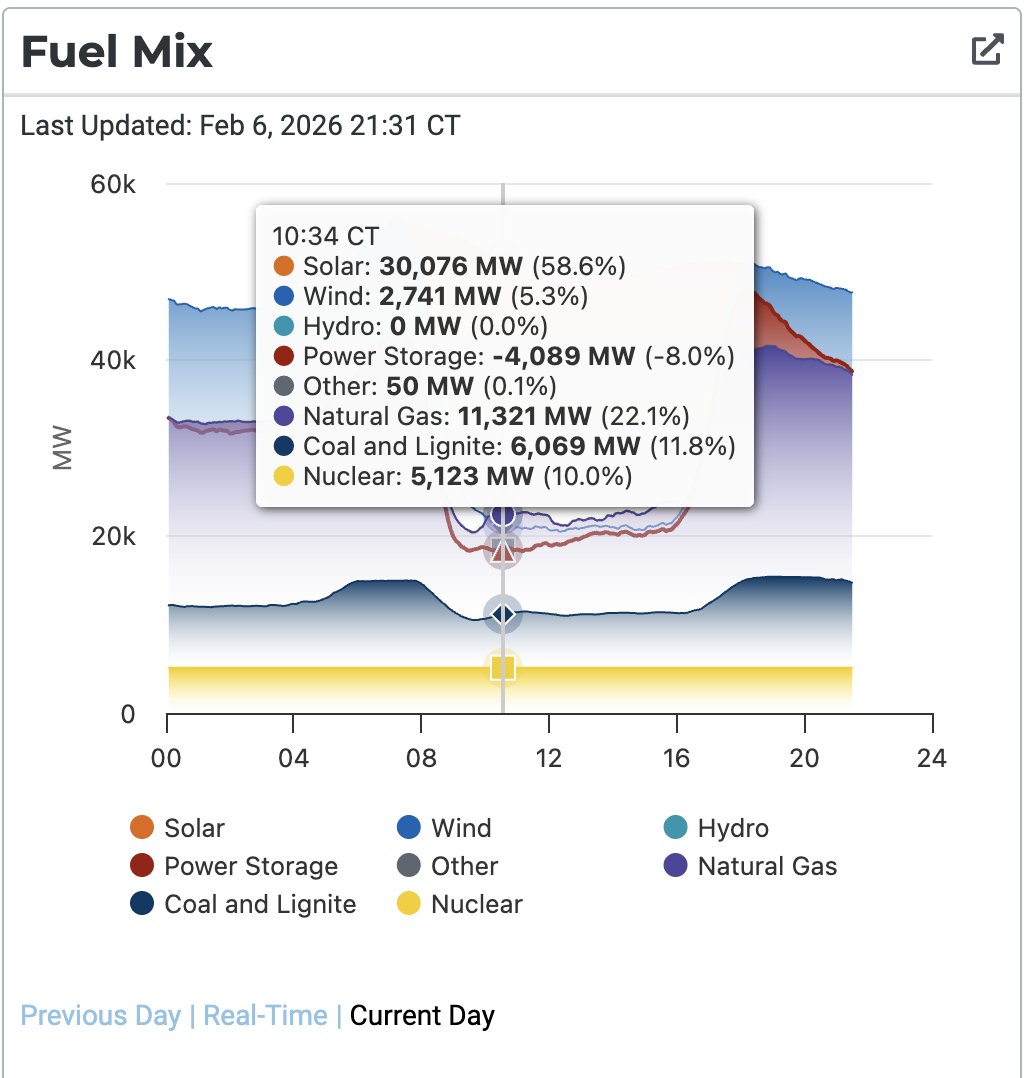
Two new solar records today in Texas/ERCOT:
🏆 first time over 30,000 megawatts
☀️first time over 58% of supply
Quite the progression:
2015: 500 megawatts
2017: 1,000 megawatts
2021: 5,000 megawatts
2022: 10,000 megawatts
2024: 15,000 megawatts
Feb. 2026: 30,000 megawatts!!
Developers need to be more involved in IRP & PUC cases. We have the data, experience and solutions (VPP, BESS, generation, etc.) - actions > words.
Per BBG, PJM warned of a potential 60 GW power shortfall over the next decade as data center demand accelerates. Solving it would cost an estimated $180 billion. PJM plans to file with regulators in May and hold a special procurement event in September.
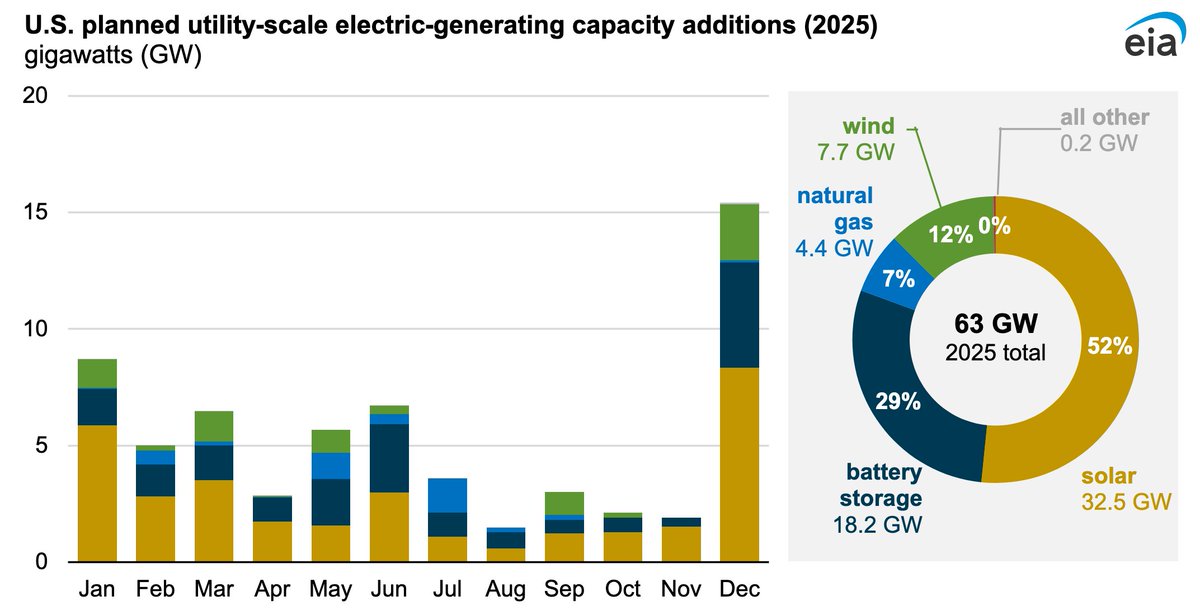
Solar and battery storage combined drove 81% of new U.S. grid capacity in 2025.
32.5 GW solar + 18.2 GW storage = 50.7 GW of zero-fuel infrastructure.
The grid isn't choosing renewables anymore.
It's economically opting to - with Texas leading the way
@JLopas "Those who have lived in software land don't realize they're about to have a hard lesson in hardware" - Elon on Dwarkesh's latest podcast. Meanwhile, us hardware junkies are suddenly developing (vibe coming) software. What a time to be alive.
Elon Musk just told Dwarkesh & John Collison he'd rather put data centers in space than deal with permitting and interconnection on Earth.
As someone who's developed power projects for over a decade, I've never felt more validated and more demoralized at the same time. 🧵
The greatest entrepreneur alive built 1 GW of behind-the-meter power for xAI and came out of it saying the easier path is literal outer space.
That's not a technology problem. That's a system problem.
Power developers have been saying this for years. Now maybe someone will listen.