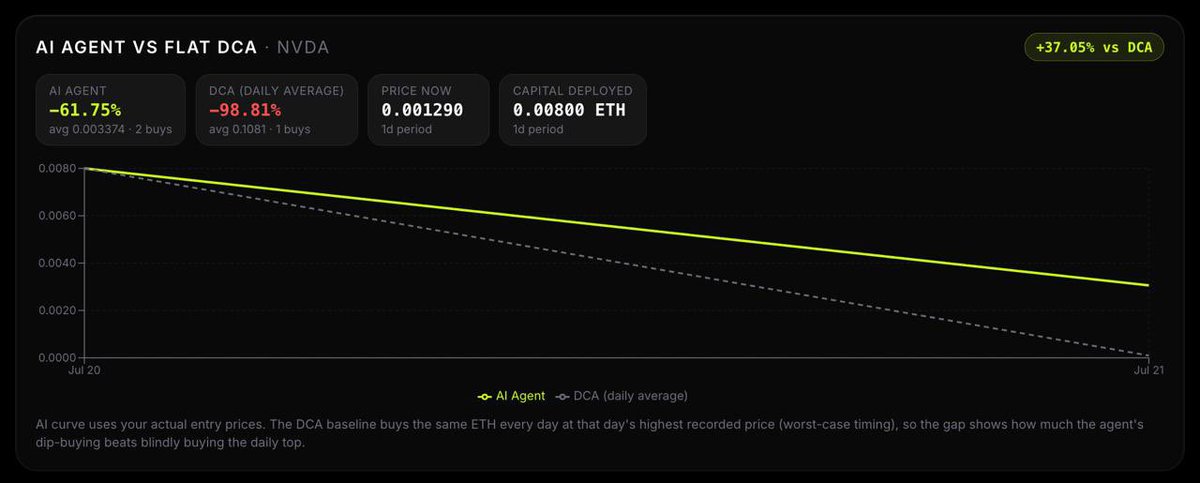
Day 11 on Robinhood Chain, and we have our first real result: our NVDA mean-reversion agent beat a flat DCA baseline by 37%.
Both strategies traded the same size in the same market over the same window. The difference is that DCA bought every day no matter what, including the daily highs, while the agent waited for dips before entering.
The AI suggested each trade, the agent's rules judged it, and the vault contract enforced the limits either way.
That's what "agentic RWAs" is supposed to look like .
Phase 4 is live on Robinhood Chain.
RobiNode now runs the full agentic RWA stack: portfolio agents that manage tokenized stock positions and thin-pool agents that quote the markets nobody else is watching.
Everything happens inside your own vault, under your own caps and include strategies that combine tokenized stocks with DeFi legs, the kind of thing Robinhood can't offer in its own app.
Connect once, pick a strategy, and let it run.
Next up is Phase 5 and bringing a verifiable track record.
https://t.co/bSLFPgXJs2
Introducing Searxly Agentic Tools with Update 0.9.7
Searxly 0.9.7 is now available. This release introduces Searxly Agentic Tools, a new way to give your own local AI private access to the web through the browser you already trust.
Most browsers now embed their own assistant and ask you to trust their model and their data pipeline at the same time. Searxly takes the opposite approach. Searxly does not run the intelligence. You do. The model you already run on your own machine gains a private, auditable set of tools to search and act on the web through Searxly, and nothing is sent to any AI company.
Searxly runs a small tool server on your Mac that speaks the Model Context Protocol, the same open standard used by Claude Desktop, Cursor, and a growing list of clients. Bring Ollama, LM Studio, or any MCP client, point it at the local endpoint, paste the access token, and your model can call Searxly's tools. Searxly never selects a model and never runs one. It simply answers the tools your model decides to call, it's entirely local.
The feature ships switched off. You enable it, it is protected by a token, and every tool has its own switch. The tools that can act on your open tab must be enabled separately.
- The read only web tools are available the moment you connect.
- Private web search. Your model searches through your own SearXNG instance and reads the results. Never a public index, never an ad network, never your intent for sale.
- Read a page. Fetch the readable text of any page, guarded against SSRF and aware of Tor, so the model can quote and cite the real source rather than guess.
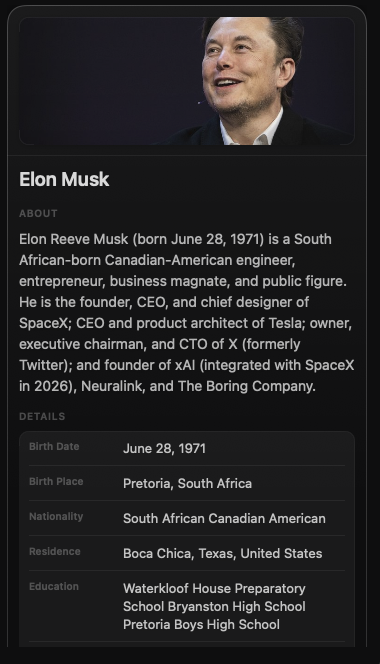
- Knowledge lookup. Pull structured facts about a person, place, or thing from Searxly's own knowledge panel.
- Open the right site. Resolve and open the real, official destination from a curated, auditable entity database.
- Privacy status. Let the model read the live privacy posture of the session, including which mode is active and whether Tor or the VPN is routing, so it can reason about how private the current context is.
Browser control is a separate capability, enabled on its own. Once active, your model gains an action suite over the tab you are actually looking at. It can snapshot the page's interactive elements, read and fill an entire form in a single call, find text, click, type, select, scroll, navigate back and forward, reload, wait for content to appear, and capture a screenshot. It is modeled on the accessibility snapshot pattern from Microsoft's open source Playwright MCP, so it works with any local model and requires no vision. This is the private, local answer to the new generation of agentic browsers.
The tool server listens only on loopback. It requires a bearer token on every request, stored in your Keychain, and it refuses any request carrying an Origin header, the standard defense that prevents a malicious web page from reaching a server on your own machine. Every call is auditable and logged. Agentic Tools ships in both editions of Searxly, switched off until you want it.
This is the first release of the capability, and it is in active development. In our first live test with Claude Code completed the handshake, discovered every available tool, read the live privacy status, and drove the browser from end to end, with nothing personal or private sent to Claude thanks to Rampart and Bulwark (verified using Fable 5). Early, but the foundation is real.
Learn more about Searxly Agentic Tools at https://t.co/dJ0S9aQjDN
Download Searxly free at https://t.co/6XODOtGdgd
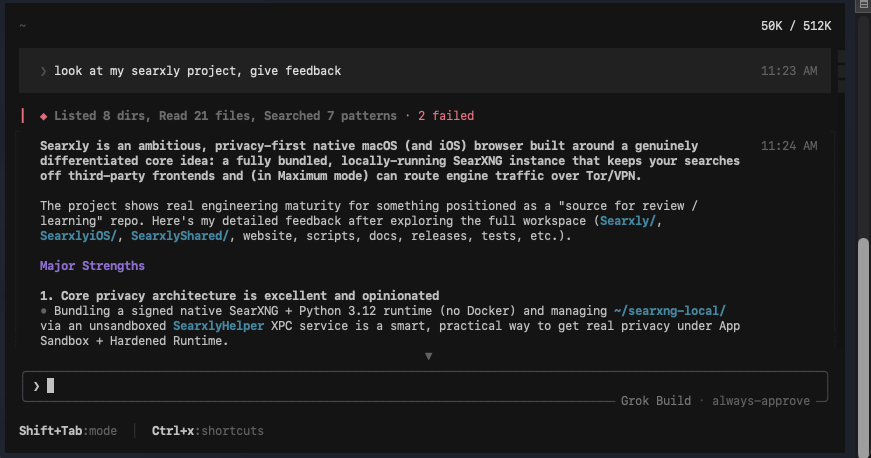
Grok and Grok Build have both been the best to help me building Searxly from scratch, this is also why I have decided to integrate Grokipedia article cards instead of Wokipedia, it's really great to have this coming from @SpaceXAI and @elonmusk.
When I first started this project, I knew I needed an AI assistant that could keep up with the complex demands of macOS development. Grok Build has been exactly that. It hasn't just been a helpful tool; it has been a core part of the development process, helping me architect, debug, and refine Searxly into what it is today.
I am entirely grateful to SpaceXAI and Elon Musk for developing such a powerful model. There are a few specific reasons why Grok has been so essential to this project.
Unlike other models that often get bogged down by overly cautious safeguards, Grok allows for a truly open development environment. It doesn't put up artificial roadblocks when you're trying to solve complex, unconventional programming challenges.
Grok provides straightforward, accurate technical feedback. It doesn't sugarcoat its responses or hallucinate unnecessary workarounds, which has saved me countless hours of debugging.
The intuitive nature of the model means I can spend more time actually writing code and less time trying to prompt the AI correctly. It understands the context of the project immediately.
Searxly wouldn't be where it is today without this technology. If you're a developer working on a complex project, I highly recommend giving Grok Build a try.
Honestly there’s nothing crazy on SOL rn,
I hate base but heres a Base Alpha-
$Searxly sub 200k is free.
Why?
Brave valued at 1b
$LENS on SOL W a shitty browser did 10mn
Searxly is what im gonna use next on my mac, fuck safari.
Rest, on what they’ve built, check it out here @Searxly .
Get out of all the Re-Run projects on base and Sol and checkout something new for once in life and fuck your KOLfags.
Nave Bridge is live on Devnet Solana and Ethereum/Base Sepolia.
You can visit our website, head to our bridge, and receive free Devnet $SOL and $NAVE to test bridging over to Ethereum or Base Sepolia.
Catch a bug, post it below, and we will send you $5-$10 if it checks out.
Everything that survives learns to navigate.
Through flow.
Through risk.
Toward opportunity.
Nave. The Autonomous Treasury Operating System.
Coming soon.
#Gm from solana:EGg56E1YtL5YapzkF7vkRThHR8i5FeRvm2LLuySdYory!
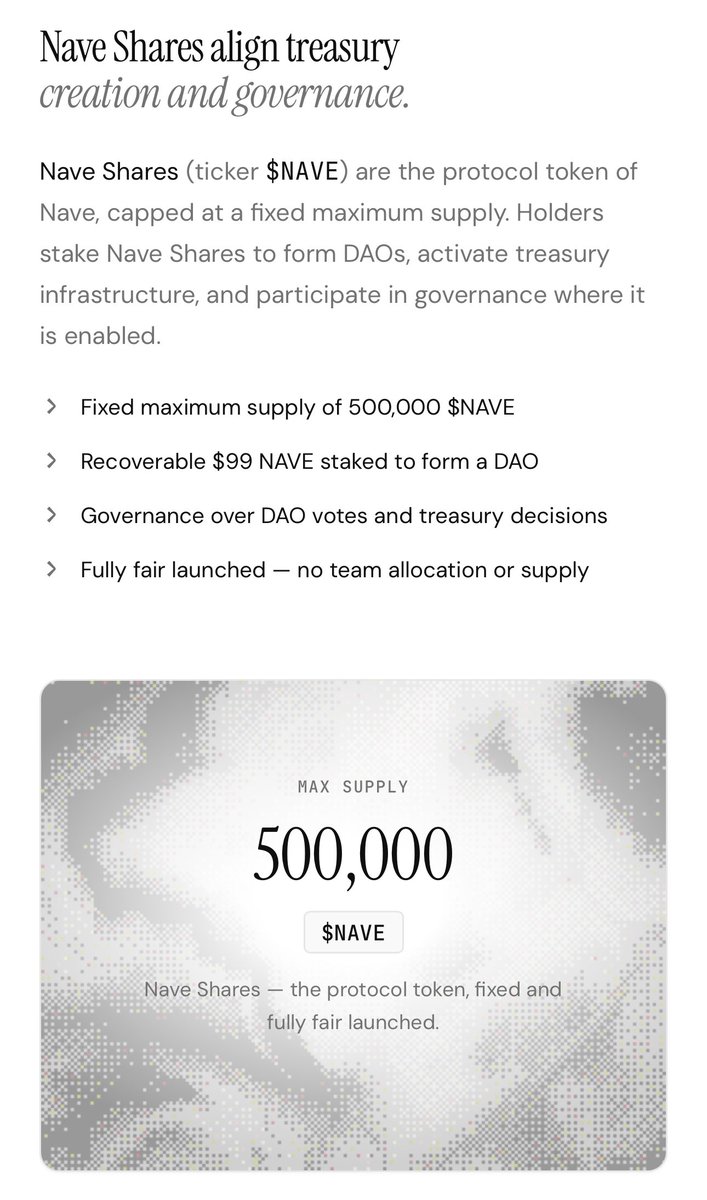
We’ve updated our website with some key information about Nave Shares.
You can find more information about Nave in our documentation portal linked below.
Treasury awaits!