Words don’t live alone.
A vocab list may help learners recognise a word.
But context helps them understand how to use it.
Into phrases.
Into sentences.
Into meaning.
That’s where words turn into communication.
https://t.co/cTZeSrtbg0
#LanguageLearning#MFL#LearnThroughPlay
Words don’t live alone.
A vocab list may help learners recognise a word.
But context helps them understand how to use it.
Into phrases.
Into sentences.
Into meaning.
That’s where words turn into communication.
https://t.co/cTZeSrtbg0
#LanguageLearning#MFL#LearnThroughPlay
Why do some new words stick while others disappear?
Research suggests that discovering an answer can make it more memorable than simply being shown it.
That small “aha!” moment matters.
https://t.co/3BSvCSRP8O
#LanguageLearning#LearnThroughPlay
What if language learning isn't about remembering more?
What if it's about experiencing more language?
More patterns.
More interaction.
More use.
That's often where language starts to feel natural.
https://t.co/xLd0xhlLSN
#LanguageLearning#LearnThroughPlay#MFL
Many people try to learn a language through conscious effort.
Research suggests fluency depends more on familiarity with repeated patterns.
Interaction. Repetition. Play.
How to make language learning natural 👇
https://t.co/xLd0xhlLSN
#LanguageLearning#LearnThroughPlay#MFL
We often treat using a language as the reward after learning.
But research suggests it may be part of the learning itself.
Use. Interaction. Repetition.
That’s where progress often starts.
https://t.co/jdo1QHZ2JX
#LanguageLearning#LearnThroughPlay#MFL
We often treat using a language as the reward after learning.
But research suggests it may be part of the learning itself.
Use. Interaction. Repetition.
That’s where progress often starts.
https://t.co/jdo1QHZ2JX
#LanguageLearning#LearnThroughPlay#MFL
We’re often taught to study a language before using it.
Research suggests real learning may happen the other way round — through use, interaction and play.
New piece: Language Is Learned Through Use, Not Study
https://t.co/jdo1QHZ2JX
#LanguageLearning#LearnThroughPlay#MFL
If language learning feels slow, try this shift:
Less:
Repeat words
More:
Use them
Combine them
Say them
That’s when it starts to stick.
Short read: https://t.co/i6Wm9OWRsc
Post:
One quiet truth about language learning:
Lower pressure → higher participation.
When learners feel safe experimenting, they engage more — and retention improves.
Why play-based learning works:
https://t.co/j70nolQGBl
Pressure often backfires in language learning.
When learners worry about being wrong, they participate less.
But when learning feels like exploration — participation rises.
That’s when language starts to stick.
Full article: https://t.co/7Aj3jr5xTe
Spanish has overtaken French at GCSE level in the UK.
The interesting part isn’t the rivalry — it’s the lesson:
Relevance drives engagement.
When language feels culturally alive, uptake follows.
Worth reading.
https://t.co/rkicyLg7BF
#LanguageLearning#Education
Most language learning fails for one simple reason:
we teach rules before meaning.
Games flip that order — and the brain responds differently.
I wrote a short piece on why play works when study stalls 👇
https://t.co/QbG16VeFsY
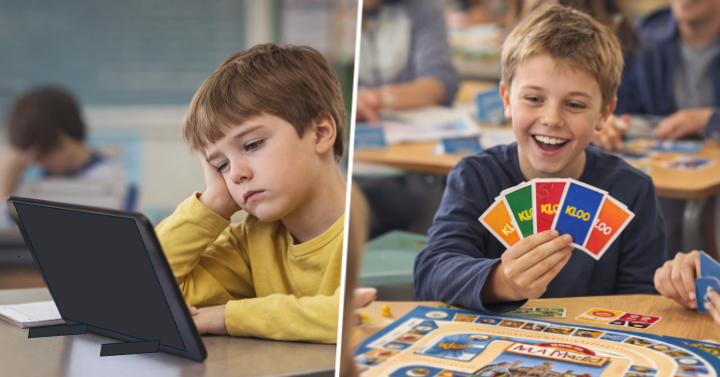
Kids don’t learn languages by tapping screens.
They learn by speaking, thinking, and playing — with real people.
That’s why board games still outperform apps for language learning. 🎲🗣️
👉 Why it works (and why teachers love it): https://t.co/O0gYr2W1V7
Neuroscientists have found that when people are in a playful state, dopamine—the brain’s natural “feel-good” chemical—increases. This boosts motivation and memory retention. That's why playing our KLOO games works so well at helping you learn a #language! https://t.co/f2bgSZgQM1
🌊🏝️El Mar de las Calmas in El Hierro (Canary Islands) will become a National Park🤩
24,000 hectares of sea south of El Hierro
The first entirely marine national park in our country 🇪🇸🌊