♞ Introducing Knight Trust Intelligence @KnightIntelco
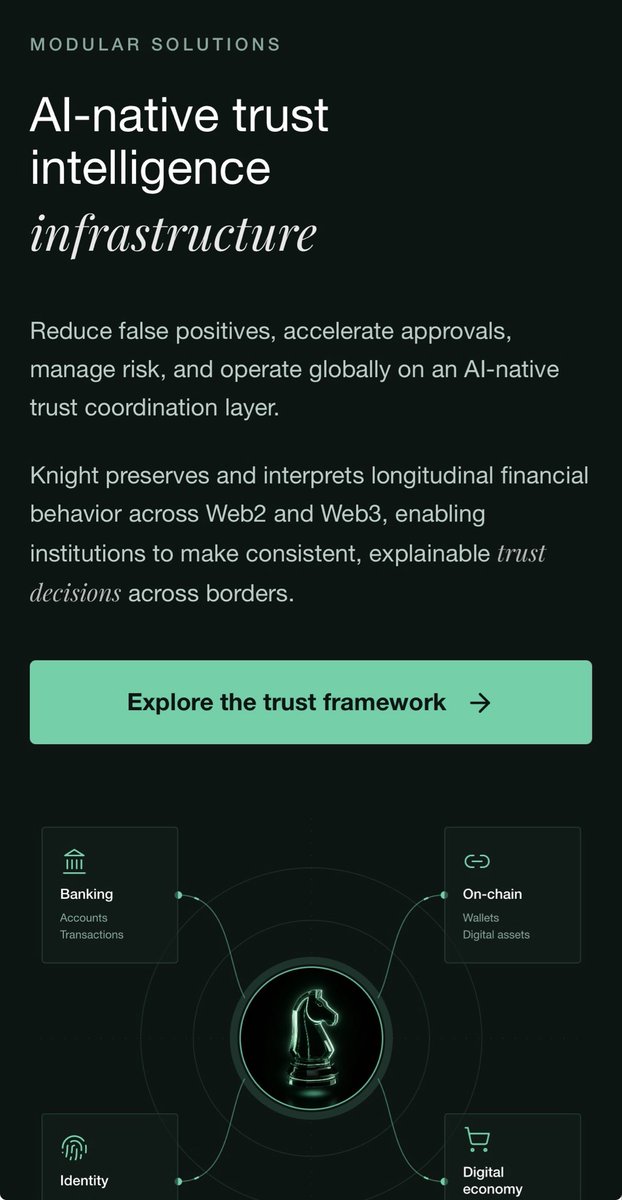
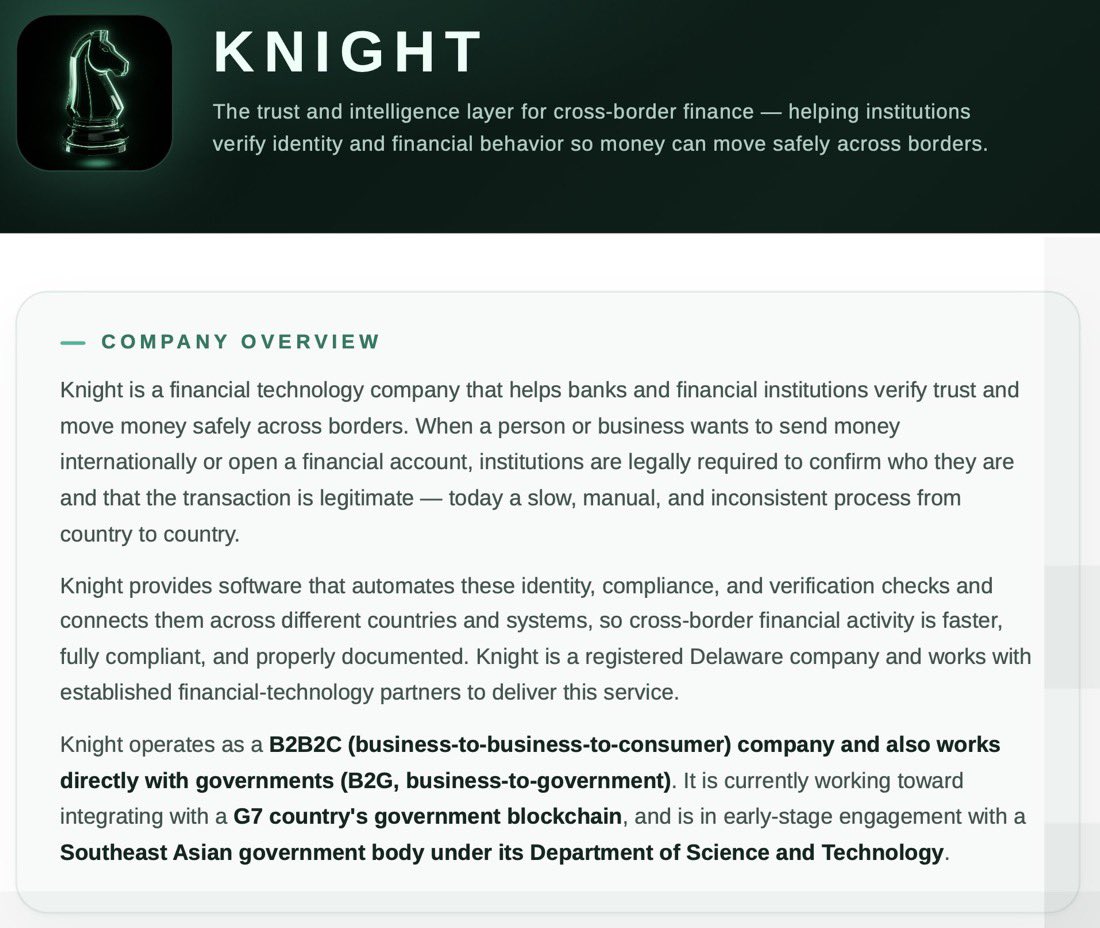
An AI-powered financial intelligence platform aiming to bridge traditional finance (TradFi) and Web3. With participation in Coinbase’s Base APAC Accelerator, Knight is positioning itself at the intersection of AI, finance, and blockchain infrastructure.
Key areas of development:
🔹 AI-powered financial intelligence
🔹 Banking and on-chain data integration
🔹 KYC/KYB and identity verification
🔹 Institutional-grade trust and risk analysis
The vision is clear: building a unified intelligence layer to support more transparent, connected, and trusted cross-border financial ecosystems.
$KNIGHT | Robinhood Chain
CA: "0xD79eb5D4EdF7bd843eeF5109F1a1FF5C96b17948"
📊 Chart: https://t.co/PwIH1MGiB4…
🌐 Website:https://t.co/7cqniNFyEX
Real-world financial infrastructure and AI-powered trust solutions are worth keeping an eye on. 👀
#KNIGHT #RobinhoodChain #AI #Web3
#Ad | DYOR. NFA.
AI agents will trade across borders in seconds. Trust will no longer resets at every jurisdiction.
Knight’s portable intelligence layer makes KYC/KYB + Know-Your-Agent continuous, private & machine readable.
$KNIGHT is building the trust rails the agentic era actually needs. ♞
Just came across Knight Trust Intelligence - @KnightIntelco 👀♞
An AI-native financial intelligence platform bridging TradFi and Web3, backed by its participation in Coinbase's Base APAC Accelerator.
Knight is building a unified intelligence layer for cross-border finance, combining:
• AI-powered financial intelligence
• Banking + onchain data integration
• KYC/KYB and identity verification
• Institutional-grade trust analysis
Interesting to see a project focused on real-world financial infrastructure and institutional adoption.
$KNIGHT | Robinhood Chain
CA: 0xD79eb5D4EdF7bd843eeF5109F1a1FF5C96b17948
Chart: https://t.co/8ThXiu93Ud
Website: https://t.co/EiQBBLXKMU
Worth watching. 👀
#Ad | DYOR. NFA.
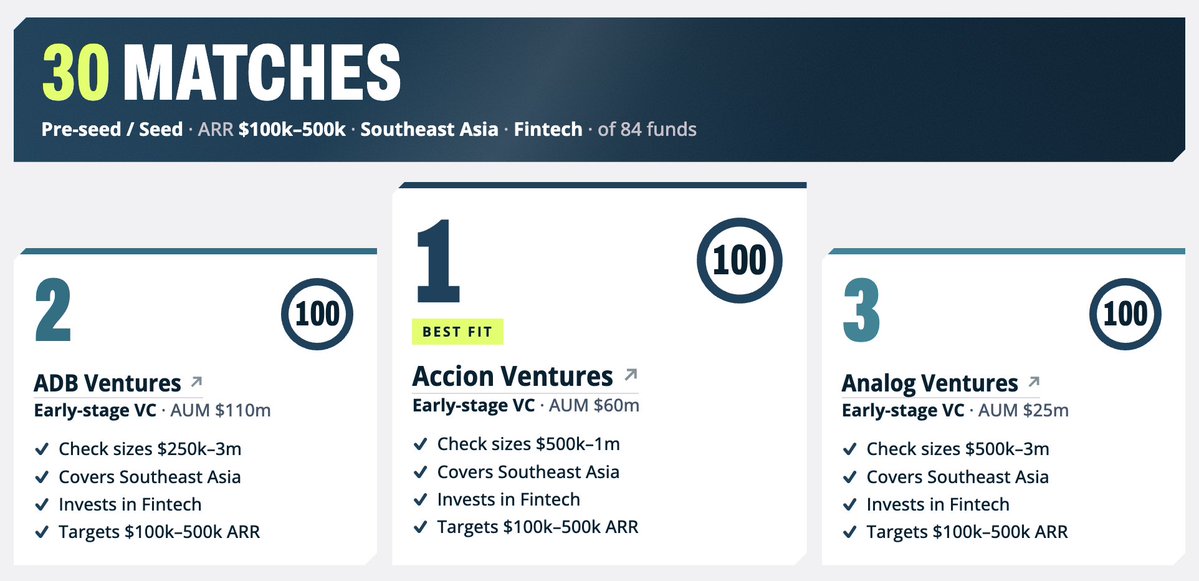
The list of investors matched with @KnightIntelco for SFF Investor Hours is getting pretty interesting.
We've got a mix of family offices, traditional VCs, and, interestingly, the highest concentration comes from banks' investment arms.
Which makes this particularly exciting, considering we're building financial infrastructure for the very institutions these investors understand.
Here's a little glimpse of what's lined up for us so far. :)♞
One of my favorite things about the upcoming Singapore FinTech Festival? Investor Hours.
Think Shark Tank-style pitching meets investor matchmaking. Almost like a blind date, except you're pitching your startup instead of yourself. 😝
A week before SFF, and @KnightIntelco 's calendar is already getting booked with investor meetings.
Shit feels like the Super Bowl for founders. Months of building, and now it's time to get in front of the people who can actually write the checks.
Should I share the investor lineup? :) ♞
Part 3 of our key insights from Hong Kong FinTech Week × StartmeupHK 2026.
A Founder's Skin in the Game: Why Market Presence Means Nothing Without Market Execution.
On the difference between showing up, building real institutional relationships, and turning market opportunities into commercial traction.
Boots on the Ground: Hong Kong FinTech Week × StartmeupHK 2026 Insights 🇭🇰 (PART 3)
I think this is probably one of the most important takeaways I brought home: SKIN IN THE GAME.
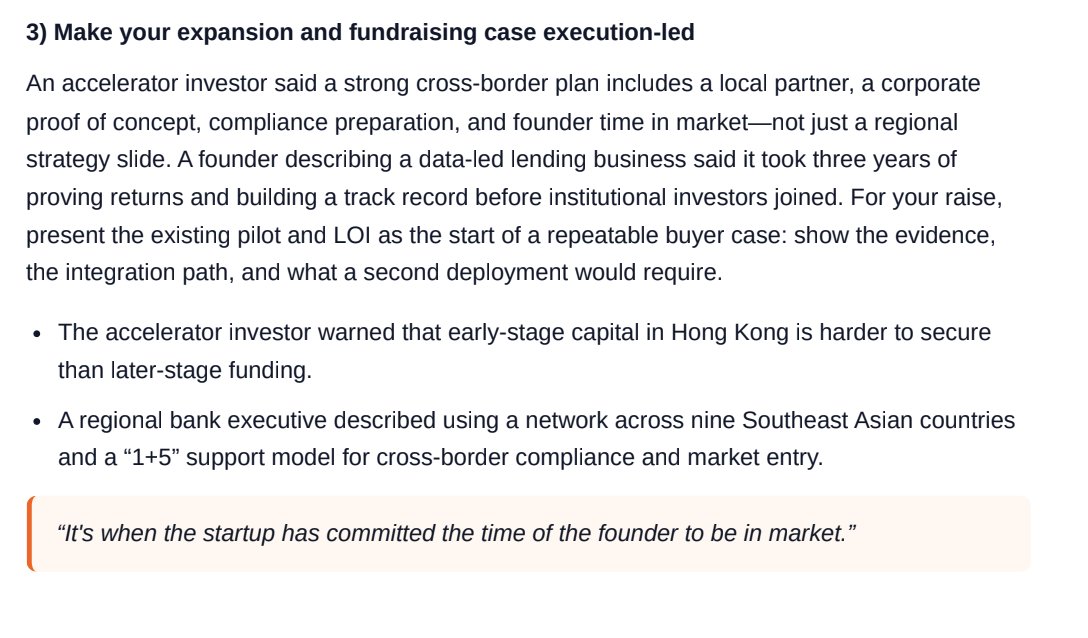
One thing that really stuck with me was a conversation with an accelerator investor about what it actually takes for a startup to expand into a new market.
And the answer wasn't another pitch deck, a bigger TAM, or a regional expansion strategy with 10 countries on a slide. 😂
It was much simpler.
Has the founder actually committed the time to be in the market?
Do you have a local partner? Have you secured a corporate POC? Do you understand the regulatory environment? Have you spent enough time with potential customers to understand how they actually buy?
Because there's a HUGE difference between having a market opportunity and being operationally ready to capture it.
And this is something I've been learning firsthand building @KnightIntelco across different jurisdictions.
I also think Crypto Twitter has somewhat polluted our perception of what conferences are supposed to accomplish. Haha.
We've normalized an entire culture of conference attendance where projects fly people around the world, hire e-girls to hand out flyers, throw expensive side events, and flood the timeline with photos just to prove they're somehow "building."
But where's the conversion? Where are the actual customers, integrations, signed agreements, and revenue?
Don't get me wrong, visibility matters. But visibility without commercial conversion is just an expensive marketing exercise.
And I think founders need to start distinguishing between being present in an ecosystem and actually penetrating a market.
Especially in institutional finance, where a single meaningful relationship that converts into a deployment can be worth more than a hundred conference appearances.
Being seen is not the same as being adopted.
Another founder shared that it took 3 YEARS of proving returns and building a track record before institutional investors came in.
3 years.
And I think this is where the reality of building fintech infrastructure is fundamentally different from the usual startup narrative of raising fast, scaling fast, and entering five markets overnight.
Institutional adoption is not a distribution problem alone. It's an evidence problem.
Can your product survive a real institutional workflow? Can you integrate with existing systems? Can you demonstrate compliance readiness? And most importantly, can you repeat that success with a second customer?
My biggest conviction coming out of Hong Kong is this:
You cannot build a cross-border business entirely from behind a laptop and expect the market to trust you.
At some point, the founder has to get on the plane, sit across the table, understand the local financial system, build relationships, and do the unglamorous work of turning conversations into actual deployments.
That's skin in the game.
That's been my life for a year now building @KnightIntelco.
The market doesn't owe us adoption because we built something clever.
We have to earn it.
I've reached that point in building @KnightIntelco where I've become very selective about who gets to see our product demo.
Too many LARPs out here who just wanna see what you're cooking but can't put their money where their mouth is.
I've even had someone approach me under the guise of being a VC, only to find out they're already invested in another startup developing KYA, similar to what we're building at Knight.
Basically just window shopping. 😂
And I've learned that protecting what you're building is just as important as building it.
And my favorite part? When you politely decline their demo request and suddenly they think you're just talking shit because you won't show them what you've built.
I love how some people assume every founder is so desperate to raise capital that we'll happily open up our entire product, architecture, and IP just because someone introduces themselves as an investor.
Only to get hit with a
“hold up, I ain't showing you shit.” 😂
It's even funnier when they don't expect you to say no.
Because in their heads, you're either desperate for their money or you're bluffing about what you've built.
And I genuinely love leaving them wondering which one it is.
Not every investor deserves a demo. Not every conversation deserves access. Period.
You can be hungry to build without being desperate to prove yourself.
Been receiving listing invitations for @KnightIntelco from exchanges and platforms since robinhood:0xd79eb5d4edf7bd843eef5109f1a1ff5c96b17948 launched.
But lately, the names have been getting bigger and bigger. :)
Most recently, @LBank_Exchange reached out.
Let's cook? ♞
@KnightIntelco - robinhood:0xd79eb5d4edf7bd843eef5109f1a1ff5c96b17948 - $350K
🟢 Knight completed its second bi-weekly buyback, acquiring 2.5M+ KNIGHT for the Knight Strategic Reserve, which now holds 15M KNIGHT.
🟢 Knight is working on KYA, a Know Your Agent capability built on intelligence, behavioral history and the sociology of deviance rather than identity alone, extending its work on identity, Web2 financial evidence and onchain activity to agents acting for a principal.
https://t.co/1tcudrD5mq
🧵 41/81
Part 2 of our key insights from Hong Kong FinTech Week × StartmeupHK 2026.
Exploring the future of agentic finance, AI trust, and Know Your Agent (KYA), including research presented by a university professor highlighting trust concerns, deployment barriers, and the growing need for agent identity, authority, and accountability in financial systems.
Boots on the Ground: Hong Kong FinTech Week × StartmeupHK 2026 Insights 🇭🇰 (PART 2)
Let's talk about Agentic AI, trust, and deviance.
One of the newest capabilities we're developing at @KnightIntelco is KYA (Know Your Agent).
KYA is still an emerging category, and I find it particularly interesting because we're witnessing the introduction of autonomous economic actors into financial systems originally designed around humans and institutions.
Most emerging approaches to KYA begin with identity.
Give the agent a unique identifier. Verify who owns it. Establish credentials and permissions.
All necessary foundations.
But at KNIGHT, we're approaching this from another direction: intelligence, behavioral history, and the sociology of deviance.
Here's why.
During Hong Kong FinTech Week, a university professor presented research involving 109 agentic-AI professionals.
The findings were interesting:
- 76% reported trust concerns.
- 40% experienced deployment delays.
- 23% said customers or partners had refused to work with them because of agent use.
The research distinguished three dimensions of trust: identity, credit, and permissions.
And this is precisely where I think the conversation becomes much more interesting.
Identity tells us who an agent is.
But identity alone cannot tell us whether its actions are trustworthy. 💯
Consider a financial agent acting on behalf of a person or institution.
We can assign it an ID, verify its principal, and establish its permissions.
But how do we evaluate its actions against the context of the principal it represents?
What constitutes expected behavior?
What happens when an agent begins acting outside established patterns, delegated authority, or financial expectations?
This brings me to a concept I've been particularly interested in: deviance.
In sociology, deviance refers to behavior that departs from established norms. It doesn't necessarily mean wrongdoing. It means understanding behavior in relation to its social context.
And I believe this distinction matters enormously in financial intelligence.
A transaction that appears unusual for one individual or institution might be completely ordinary for another.
The same principle becomes even more important when machines begin initiating financial decisions.
KNIGHT's existing thesis is to synthesize fragmented identity, financial history, and onchain activity into explainable intelligence.
With KYA, we're exploring how that contextual understanding can extend to agents acting on behalf of those principals.
Not simply asking whether an agent has an identity, but whether its actions are consistent with its authority, the principal's context, and the rules governing the transaction.
Of course, behavioral intelligence is not a substitute for explicit authorization. Both are necessary.
One financial-infrastructure executive at the event emphasized that machine-initiated actions require defined authority, enforceable controls, and accountability.
Another provider described a banking workflow where automated actions are evaluated against compliance limits, exceptions are escalated to humans, and evidence is preserved before settlement.
This is where I believe agentic finance is heading.
We've spent decades building systems to verify human identity.
Now we need systems that can establish not only who an autonomous agent represents, but what it is authorized to do, whether its behavior warrants further scrutiny, and who remains accountable.
For KNIGHT, this is a natural extension of the financial-intelligence infrastructure we're building.
Because the next challenge in AI-driven finance isn't simply making agents capable of acting.
It's making their actions understandable, accountable, and trustworthy enough for financial institutions to rely on.
More from the ground in Part 3.
Just shared a product and architecture update with our $KNIGHT Discord community! 🫶
A closer look at what we're building with KNIGHT V2 on Robinhood Mainnet and what's coming next.
Make sure you're in the Discord to stay in the loop! ♞
🐎 $Knight Bi-Weekly Buyback #2 Complete
2,494,239 $KNIGHT acquired in our latest buyback and added to the Knight Strategic Reserve.
This marks another step in our ongoing treasury strategy as we continue building Knight's institutional financial trust infrastructure.
We're committed to transparency, disciplined capital allocation, and keeping our community informed as the company progresses.
Total $KNIGHT held in the Strategic Reserve: 14,957,358.
Onwards. ♞
TXN:
https://t.co/LaezhHgmkb
Finally had the time to sit down and review all 150+ applications!
We'll be sending out the 1st batch of emails this week to shortlisted candidates who made it through our initial review for both positions.
Thank you to everyone who applied and expressed interest in building with @KnightIntelco.
Really appreciate the overwhelming response! 🫶
Keep an eye on your inboxes! 😉