🤖 World Action Models predict the future to act better. However, WAM research remains fragmented in code, ad hoc in design, and unprincipled at scale.
💡 Today, we release 𝗢𝗽𝗲𝗻𝗪𝗔𝗠: 𝗔𝗻 𝗢𝗽𝗲𝗻, 𝗠𝗼𝗱𝘂𝗹𝗮𝗿 𝗘𝘅𝗽𝗹𝗼𝗿𝗮𝘁𝗶𝗼𝗻 𝗧𝗼𝘄𝗮𝗿𝗱𝘀 𝗦𝘆𝘀𝘁𝗲𝗺𝗮𝘁𝗶𝗰 𝗪𝗼𝗿𝗹𝗱–𝗔𝗰𝘁𝗶𝗼𝗻 𝗠𝗼𝗱𝗲𝗹 𝗣𝗿𝗲𝘁𝗿𝗮𝗶𝗻𝗶𝗻𝗴 to change this.
🌐 https://t.co/pPPO3Mlcil
🧵1/14
Turns out that humans are far from optimal when intervening on robot behavior. This makes many algorithms for learning from human interventions either too conservative or incorrectly reliant on human optimality.
@_pranavnt, @sriyash__ and team first analyze how people actually intervene on robots. Then they use this to a propose a simple RL algorithm - Q-OIL that uses these interventions to learn very quickly.
Q-OIL proposes a simple idea - be optimistic on state-action pairs where people intervene. Think of it as - "even if the human isn't perfectly right, it's probably worth checking that out". This leads to fast improvement and a lot fewer human interventions for robots learning with RL in the real world.
If you are doing RL in the real world using interventions, this should be a simple drop in for things like HiL-SERL etc. We've got lots of robot results + a fun interactive demo.
Website: https://t.co/HT8YxG9a9c
Paper: https://t.co/n9HrEqJKyi
I’ve been roommates with Yiming for almost 2.5 years. Aside from being a world-class expert on VLMs, he has always been the Doraemon guy who pulls out the perfect software tools every time I ask for them.
This time, he developed his own tool, a masterpiece software for researchers. I have been using this and helped develop it since its very early prototypes, and it has helped boosting my efficiency a lot especially for writing papers.
Introducing Lattice, a local LaTeX workspace for your research.
A paper is more than a .tex file: the papers you cite, notes, slides, Overleaf co-authors and now an AI agent.
I wanted it all in one app, so I built it.
Free to download, open source:
https://t.co/hnoC9AQ84m
OpenWAM won Best Paper at the CoRL TAG workshop. Unfortunately I could not make CoRL in person, but Kefei will be presenting our oral presentation at the workshop. Pls stop by☺️
🤖 World Action Models predict the future to act better. However, WAM research remains fragmented in code, ad hoc in design, and unprincipled at scale.
💡 Today, we release 𝗢𝗽𝗲𝗻𝗪𝗔𝗠: 𝗔𝗻 𝗢𝗽𝗲𝗻, 𝗠𝗼𝗱𝘂𝗹𝗮𝗿 𝗘𝘅𝗽𝗹𝗼𝗿𝗮𝘁𝗶𝗼𝗻 𝗧𝗼𝘄𝗮𝗿𝗱𝘀 𝗦𝘆𝘀𝘁𝗲𝗺𝗮𝘁𝗶𝗰 𝗪𝗼𝗿𝗹𝗱–𝗔𝗰𝘁𝗶𝗼𝗻 𝗠𝗼𝗱𝗲𝗹 𝗣𝗿𝗲𝘁𝗿𝗮𝗶𝗻𝗶𝗻𝗴 to change this.
🌐 https://t.co/pPPO3Mlcil
🧵1/14
Qwen plays robots🔥!
Check out @zuo_yuxin@x_h_ucb ‘s brainchild, an open and highly-performant harness for robot-use agents! Glad to have played a small part in the project😤
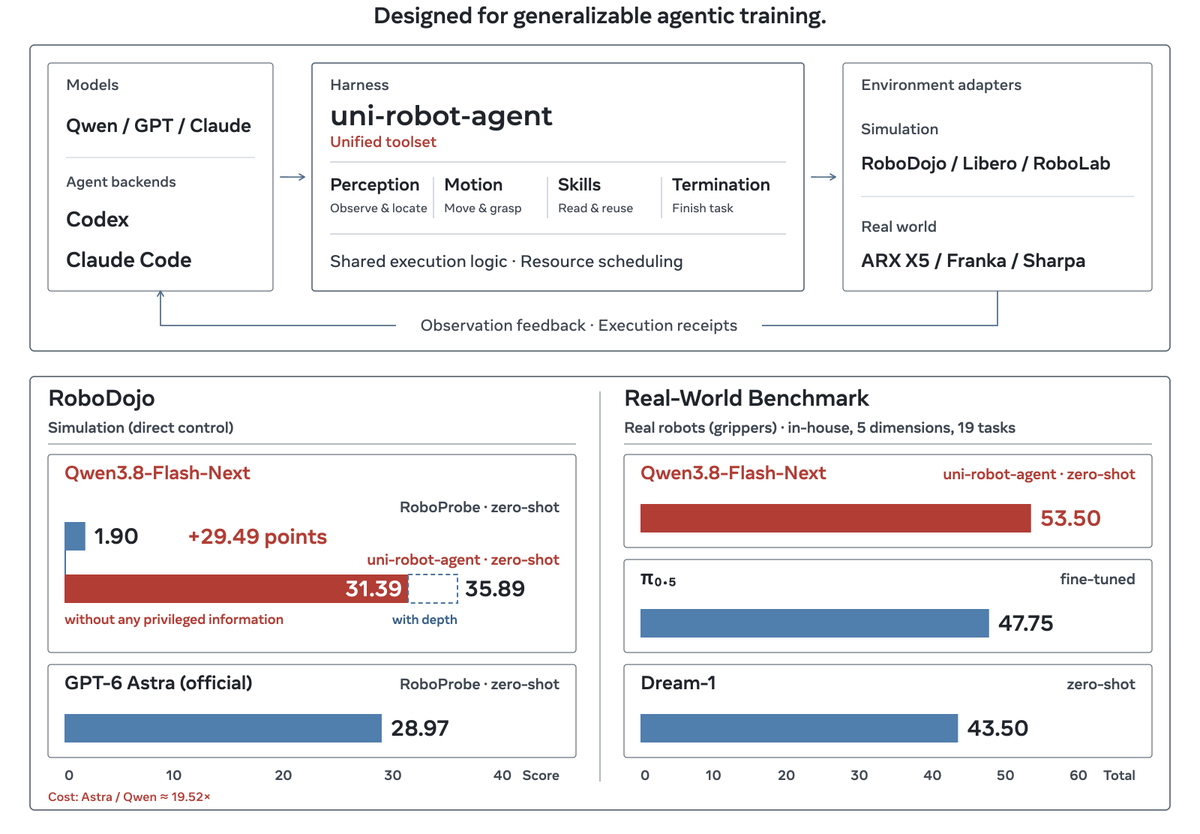
‼️ Can Qwen directly control the robot as well as GPT-6 Astra?
🚀 Introducing uni-robot-agent: a unified harness for Robot-Use Agents (RUAs), a first step toward RUA training and local deployment.
We tested uni-robot-agent with Qwen3.8-Flash-Next running locally:
1️⃣ On RoboDojo, its score rose from 1.90 to 31.39, surpassing the RoboDojo Team’s score with GPT-6 Astra.
2️⃣ On real-world tasks, it outscored fine-tuned π0.5 by 5.75 points and zero-shot Dream-1 by 10 points.
🧵 [1/7]
Check out @grandpadzb 's new work on streaming action tokenization! Zibin is the goat on action tokenization, and his works highly inspiring. I believe more compact and structured action representations can lead to faster adaptation, and can't wait to see what's next!🐐🐐🐐
(1/5) ActionCodec2: A Streaming Action Tokenizer Predict action tokens while executing actions. No more waiting for the next action chunk.
🌐 Project: https://t.co/ZnG68QOBvY
🔗 GitHub: https://t.co/qeNhicxpec 🤗 HF: https://t.co/gUY1NmSx95
Why ActionCodec2? 👇🏻
Sad that Genie 4 was still a classical world model most likely built on the bi-directional video gen -> ar distill paradigm.
But glad to see that they are seeing changes happening in the field.
Code+R2V is the future of world models.
This is Genie 4, our most realistic and interactive world model yet. 🌐
Explore dynamic environments in real time to see how the scene responds, sounds, and how the people in it move, react, and speak.
https://t.co/gmtfr0I9IS
OpenWAM is the most fascinating open‑source project I have ever taken part in, and it has received the best feedback.
It is not merely a single research project; rather, it represents collective creation by the community. We zeroed in on what people care about and built an open‑source platform for everyone to explore freely and get started.
There used to be very few unified open‑source repositories related to WAM, so we believed it was necessary to take this step.
This may not be all about intelligence, but it is about curiosity and passion. It is also about enabling sustainable growth for this community.
When I see first‑ and second‑year undergraduates, as well as junior PhD students aiming to work on embodied intelligence, joining in to help build this project, I realize some endeavours do not need to be driven by utilitarian concerns.
Thank you to the OpenWAM Team, and to my friends: @KnightNemo_@YuranWang_rise. (btw, siqiao is looking for 27fall phd position, if you are interested with his great works, don't forget to discuss with this talent guy!)
Congratulations on hitting our milestone of 1k stars! This project would never have succeeded without all of you!
Great work by friend @RunhanH ! It is exciting to see how frontier LLMs change the status of long-standing problems in the field, which in this case is the way to explore during "learning while deploying". Code-as-Policies is a start, and a major component of robotics tool-use.
Robotics has spent years scaling demonstration data and model size. What happens when we scale EXPLORATION for robot agents?
We're incredibly excited to share RAX, an agentic robotics system that learns by scaling online exploration.
A coding agent connects directly to the robot’s perception and control APIs, learns from feedback, and builds programs that perceive, plan, and act. The model stays frozen. As exploration scales, the agent improves its programs and builds up reusable skills.
The results:
• ZERO teleoperation or action demonstrations on real robots—from insertion with 0.1 mm clearance and air-fryer manipulation to deformable objects and long-horizon mobile whole-body control.
• +37 percentage points on average over leading learned policies across five simulation benchmarks: RoboDojo, BEHAVIOR-1K, HumanoidArena, DexJoCo’s bimanual tasks, and LIBERO-Pro.
• One framework spanning single-arm, bimanual, dexterous, humanoid, and mobile robots, with new embodiments connected through APIs.
The craziest part: on each real-world embodiment, going from scratch to mastering the tasks took roughly two hours. No teleop. No model finetuning.
We’re open-sourcing the full framework AND every experiment session. We can’t wait to see what people build with it!
Project + sessions: https://t.co/O04Z5PUgqY
Paper: https://t.co/sd66qnYZWB
GitHub: N
Project fully led by @RunhanH and @xczhangxx who are absolutely awesome.
How it works, experiments, and robot videos below 🧵
(1/N)
Wrist cameras give robots close-up views, but only where the hand happens to be.
What if the policy could decide where to look?
Introducing FoveaVLA: a VLA that replaces the wrist camera with learned foveation actions.
FoveaVLA predicts where it will need to look next, then crops that region from the full-resolution external image. The full view gives context; the foveal crop gives close-up detail.
With one external camera and no wrist camera, FoveaVLA reaches 70.8% success on 48 real-world trials, vs. 52.1% for π0.5 with a wrist camera.
• No additional demonstrations
• No camera calibration
• No wrist camera
Paper, code, and models are all open 🧵
@Yuchenj_UW Another important, if not the most important thing is they had good product managers. The success of muse is because it is a very appealing product with reasonable model capabilities.
(1/5) Everyone says dexterous manipulation needs real-world data. These policies were trained with none. Our robots mesh gears, thread nuts, and insert pegs zero-shot from RGB, and the same recipe works for locomotion across terrains much harder than before.
The missing piece wasn't a better RL algorithm, but a small tweak to what the robot practices.
Today we're releasing Success-Guided Sampling (SGS), a simple change to the task sampler that unlocks new levels of dexterity and agility with large-scale, end-to-end sim2real RL.
No demonstrations, no per-task reward tuning. Just PPO at scale.
Check out the policies yourself at https://t.co/dnwUr0tabh! All videos at 1x speed! 🧵 🔈