The effects haven’t been large enough because utility price changes lag. The data being used is also referring to cloud computing data centers and not AI data centers which use 2-4x more electricity.
We won’t talk about that though.
Warren's repeating the blatant lie that people's electricity bills near data centers have gone up by as much as 267%. Completely fake. This is a misreading of a Bloomberg article that found that wholesale nodal power prices very close to data centers rose as much as 267%. This is NOT a rate that residents pay, and her team is surely smart enough to know that. It has some effect on residential bills, but the effects haven't been large enough to be noticeable as a general pattern.
NEW: World Cup tickets cost up to $11.5 million — you could get into the last WC for $11.
This time FIFA could rake in $13 billion using dynamic pricing, resales, and lax U.S. rules.
We found FIFA President Gianni Infantino funneling that money into keeping himself in power.
OpenAI is also the company that wants to take all the information in the world to better its AI model and then charge people for access to it while removing all safeguards.
this company burns tens of billions a year and this is only a dodgy way of socializing the losses. It's a sign that OpenAI knows it's cooked, unclear what the stake would be, nor whether said stake would save it when the reaper arrives
From 1966 to 2025 we dropped sterile flies over South America that ate screwworm and thus prevented them from spreading, but the le epic efficient cracked coders at DOGE thought this was a silly waste of the ~0 dollars it cost us.
END OF THE TRUMP-KENNEDY CENTER: The “Trump” name must come off the Kennedy Center, and out of official documents by June 12, per general counsel memo obtained by our @ElizLanders
They are going to need to build more and/or bigger power plants. Modern AI data centers are ~1,800MWh/day. I do like that they are building them though and trying to self power them.
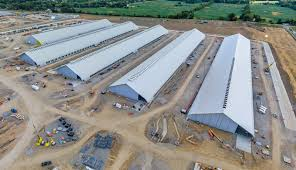
Meta is building dozens of massive tents at campuses across the US, sticking billions of dollars of chips inside, and powering them with off-grid turbines.
The AI race has officially entered its Mad Max phase.
Over the last month, I reviewed hundreds of documents and satellite images for Cleanview's latest report on behind-the-meter data centers. Meta's data center strategy, which is very visible from space, was one of the weirder approaches I came across.
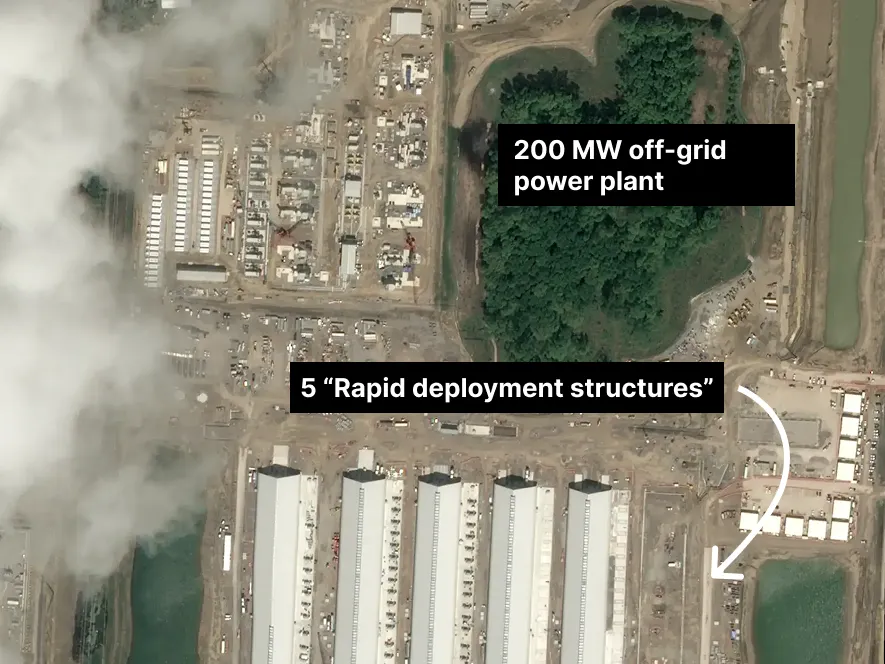
Mark Zuckerberg recently ditched the data center designs that Meta had perfected over the last decade and told his team to stick tens of thousands of chips in tents outside their data center in New Albany, Ohio. Each of these chips costs about $60,000. Zuckerberg plans to stick billions of dollars worth of them in the tents.
The strategy has helped cut the time to build compute in half. The first five buildings at Meta’s New Albany, Ohio data center took between two and three years to build. Meta started building five ~125,000 square foot tents between April and June of 2026, according to city permits. Satellite images show the structures have all been built.
To power those "rapid deployment structures", as they are officially named, Meta signed a 10-year deal with Williams to build a pair of 200 MW off-grid power plants. Those power plants began construction about a year ago and are nearly complete.
Meta is using the same strategy to build a data center in Tennessee, bringing the total count of tent data centers to three.
Strategies like this are part of the reason behind-the-meter data center capacity is growing so quickly.
In Cleanview's report, I found that there's currently about 2 GW of BTM capacity online today. By the end of the year, it will likely be 3 GW—equivalent to three nuclear power plants. By the end of 2027, it could be as high as 13 GW—more than the power demand of NYC.
I've been talking to a lot of reporters about this research. When I told one reporter about these tents and other companies powering their data centers with jet engines, he said, "It's like a scene out of the movie Mad Max."
7) His property would lose tremendous value if there weren't any courts to enforce ownership, no deed/title system, no zoning, no police, no road to it, no utilities, no school, and no local gov.
1) He enjoys the benefits of having an educated population
2) If someone steals his car, who investigates?
3) Who enforces ownership rights?
4) Who recognizes legal boundaries?
5) Would rather pay tolls to use roads
6) Would rather house burn down than pay insurance (fire dpt) ->
My property doesn’t require “community services” either.
My land doesn’t require public schools.
I can defend my land against trespassers by fencing it off, having dogs, and buying guns. If someone breaks into my house, chances are that the first call I’m making is to the local coroner, not the local police department.
My land doesn’t require roads. Roads are not part of my personal property. They can be paid for with gas and sales taxes.
I have never needed the fire department. Most people never will. If you do, they can send you a utility bill, or alternatively, they can be funded for with sales taxes (most states generate enough revenue to allow this) OR they can be volunteer fire departments, which are often subscription-based.
Property taxes should only be paid for by business and corporations.
Property tax on residential land is theft.
NJ is moving from banning new nuclear construction to subsidizing it. The state Assembly’s Utilities Committee unanimously voted for a bill that would direct the state’s energy regulators to begin soliciting bids for new nuclear power. Article link in reply.
The bill would effectively subsidize construction of at least 1,100 MW of new nuclear capacity in the state.
TBH, I have mixed feeling about this. Allowing nuclear to compete on a fair playing field is one thing. Picking winners (nuclear in this case) is another.
Removing the state's baseless nuclear construction moratorium was clearly the right thing to do. Giving nuclear a financial advantage over other clean sources is not. Equal subsidies for clean sources, over fossil sources, is justifiable (lack of pollution and CO2 emissions is something of tangible value). If this new nuclear subsidy is not higher than the subsidies that renewable sources are getting, then it's fine.
Some might argue that nuclear deserves higher subsidies to reflect its reliability benefits. I think the utilities would figure out that they need to keep the lights on, and would account reliability in their decisions.
The over $1 billion depends on how it is taxed. I will need to find numbers. As for the 100% of electricity use...good because the use is insanely high. This is what is needed. Data centers should power themselves.
Stargate Michigan will bring over 2,500 union jobs and over $1 billion in new tax revenue for local schools and services. And as part of our broader commitment to paying our own way on energy, this data center will also pay for 100% of the electricity it uses so that our operations don't increase your prices.
This energy usage is ~50x the use of the old cloud data centers and ~15x the use of the more modern AI data centers. This is 800,000 homes on average. This is 10-20 steel mills.
I was told they were the same though.
We’re breaking ground on Stargate Michigan—a 1GW data center utilizing closed-loop cooling that uses water at the rate of a typical office building, creates thousands of union jobs, and brings over $40m in free Codex credits for all college, community college, and trade school students statewide. https://t.co/3a3w9vL91T