🇫🇷 A French tax official was arrested for selling crypto investors' home addresses and financial records to criminal networks.
41 kidnappings followed. One every 2.5 days since January 2026.
The criminals didn't need to hack anything. They bought a list from someone inside the government.
France is the most dangerous country in the world right now if you hold crypto and someone knows about it 💀
Source: Le Mond
41 kidnappings of crypto holders in France in 3.5 months of 2026.
Why?
🥖 French tax officials selling crypto owners' data to criminals (Ghalia C.) + massive tax database leaks.
Now the state also wants IDs and private messages of social media users.
More data = More victims.
Soviet chandelier factories received production quotas measured in tons, not quality or function. Factory managers responded rationally to the incentive structure: they packed chandeliers with extra metal, concrete, and lead weights to hit their tonnage targets. The heavier the chandelier, the better their performance metrics looked to central planners in Moscow.
Apartment dwellers across the USSR paid the price. Chandeliers weighing hundreds of pounds crashed through ceilings, destroying furniture and injuring families below. Reports from the 1970s and 1980s document dozens of ceiling collapses in Kiev, Leningrad, and Moscow as these industrial monstrosities proved too heavy for residential construction. Factory managers got their bonuses while citizens dodged falling light fixtures.
The system worked exactly as designed. When you divorce production decisions from market prices and consumer preferences, you get perverse outcomes. Central planners measured success through crude metrics they could track from their desks, not through the satisfaction of end users. Factory managers optimized for the measurement system, not for making chandeliers that actually functioned as lighting.
You see identical dynamics today wherever bureaucrats substitute their judgment for market mechanisms. Public school systems optimize for standardized test scores rather than education. Hospitals game Medicare reimbursement codes rather than focus on patient outcomes. Police departments chase arrest quotas rather than reducing crime. The Soviet chandelier problem lives on in every corner of the administrative state.
The market solves the chandelier problem instantly through profit and loss. Customers refuse to buy chandeliers that destroy their homes, driving bad producers out of business and rewarding those who build functional products.
Síntomas de que estás enfermo de SOCIALISMO:
1. Te molesta más el éxito ajeno que tu propio fracaso.
2. No quieres lo que los demás tienen, sino que los demás no lo tengan.
3. Prefieres igualdad en la miseria antes que desigualdad en la prosperidad.
4. Crees que eres pobre porque otro es rico.
5. Justificas tu propio fracaso culpando a la "explotación estructural del Capitalismo".
6. Prefieres prohibir antes que competir.
7. Crees que subir impuestos no tiene consecuencias.
8. Consideras sospechoso cualquier éxito ajeno.
9. Piensas que regular arregla las cosas.
10. Te convencen más los discursos simbólicos que la propia realidad.
Pero tranquilo, no es una enfermedad incurable, el primer paso es coger un libro. Saludos 🫡
Why Socialism Doesn't Work, Explained for a 10-Year-Old.
You're in a class of 30 students. One kid works like crazy and gets an 18 average. Another does nothing and gets a 4. The teacher decides it's unfair and gives everyone the class average: 11.
The one who had 18 stops working. Why bother if it changes nothing? The one who had 4 keeps doing nothing. Why work if you're handed 11 for free?
The next year the class average is 7. Then 5. Then 3.
The teacher doesn't get it. He thinks the problem is that the students aren't supportive enough of each other. So he starts punishing those who don't put in enough effort. He monitors everyone. He decides who studies what. He bans switching classes.
That's exactly what happened. Every time. In every country. No exceptions.
USSR, China, Cuba, Venezuela, North Korea, Cambodia, Ethiopia, East Germany. 40 attempts. Same result. Every time.
Socialism punishes those who produce and rewards those who don't. Everyone ends up producing nothing. And when no one's producing anymore, the government uses force to make people work.
It's not an accident. It's the design.
- @brivael
“Socialism always attacks 3 basic social institutions: religion, the family, & private property. Religion, because it offers a rival authority to the state; the family, because it means a rival loyalty to the state; & property, because it means material independence of the state”
You don't need a PhD to understand why people are poor.
Poverty goes away when prosperity shows up. And prosperity doesn't fall from the sky or get delivered by a UN truck.
It gets built by entrepreneurs who start businesses, hire people, and create things worth buying.
But those entrepreneurs need somewhere they can actually operate without spending half their life begging for permits and paying fees to people who produce nothing.
Countries that get this right get rich. Countries that don't, stay poor.
The whole thing fits on a napkin and yet we've got entire university departments overcomplicating it.
This is the best part from Pierre Poilievre appearance on the Diary of a CEO podcast;
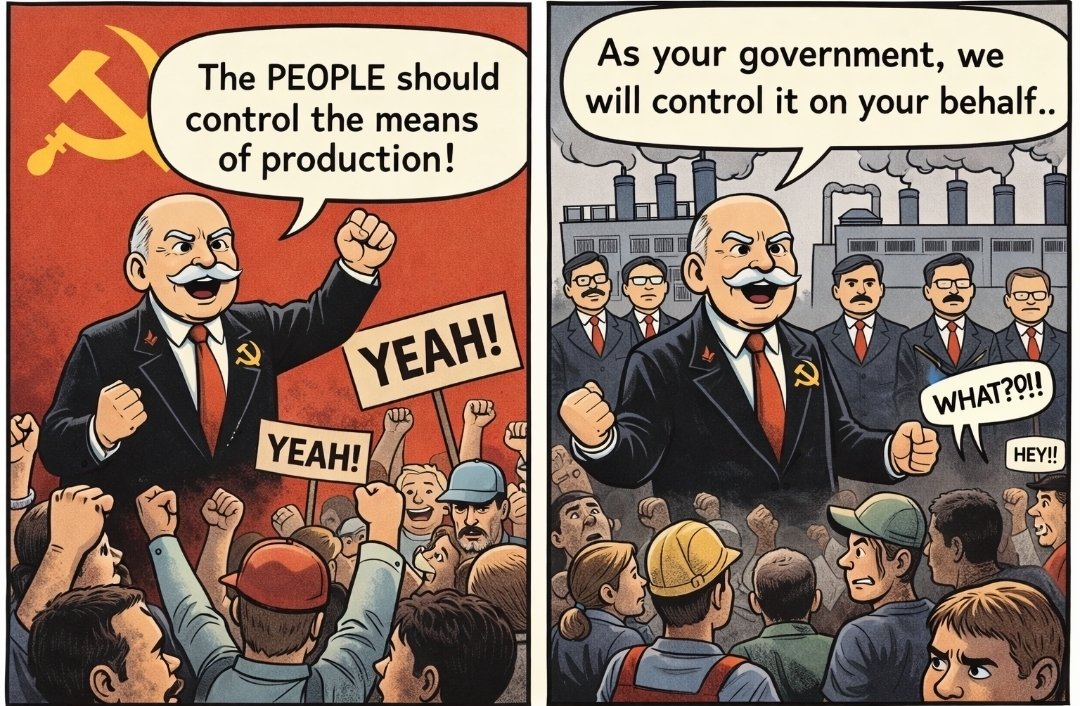
"Those who push a socialist ideology have a gross contradiction in their view of human nature.
They say that human beings are wretched, self-interested, greedy when they’re in the private voluntary economy, but they’re angels when they’re in the governmental economy.
They argue that the government should just control everything because then we have all these angels that will decide for us."
🎯
The left sees the world as a zero-sum game. As they are not able to create anything, they focus on stealing other people’s money.
Free market supporters focus on growth, which drives prosperity for all.
That’s the difference.
The Korean peninsula offers the most brutal natural experiment in economic systems the world has ever seen—identical people, identical culture, two radically different approaches to organizing society.
In 1953, both Koreas started from the same devastated baseline. North Korea actually had the industrial advantage, inheriting most of Japan's heavy manufacturing infrastructure. The South got the farms. Any reasonable central planner would have bet on the North. And for a decade, they would have been right—North Korea's GDP per capita exceeded the South's until the mid-1960s.
Then market forces unleashed their magic. South Korea embraced private property rights, foreign investment, and export-oriented capitalism. Entrepreneurs like the founders of Samsung and LG built global empires from nothing. The government stayed out of the way (mostly) and let prices signal where resources should flow. By 1990, South Korean per capita income was ten times higher than the North's. Today, that gap has widened to roughly 25:1.
Meanwhile, North Korea doubled down on central planning, state ownership, and autarky. Same Korean work ethic, same Confucian values, same geographic advantages. But without price signals, profit incentives, or private ownership, their economy collapsed into chronic famine and technological stagnation. The regime now spends 25% of GDP on military while millions eat grass soup.
You can't blame this on culture, geography, natural resources, or historical accidents. Two identical populations, two different economic systems, two radically different outcomes. And yet somehow Western intellectuals still debate whether socialism "works."
“If money is infinite, why is there poverty?”
Because money isn’t wealth. It’s a claim on wealth.
You can print claims. You can’t print the goods and services those claims are supposed to buy.
Give everyone $10 billion and nothing gets richer. Prices just explode until that “wealth” buys nothing.
Poverty isn’t a shortage of paper.
It’s a shortage of production.
Printing money doesn’t solve that. It hides it for a moment, then makes it worse.