Excited to announce that @KnotAPIs is now collaborating with @PayPal.
With Knot’s CardSwitcher™, PayPal users will soon be able to seamlessly add their PayPal branded cards as a payment method across their favorite merchants—making paying with PayPal easier.
From day one, Knot has been building the merchant connectivity layer, removing friction from payments. Everyone wins. Consumers get access to fast, efficient checkouts and merchants can see higher conversion rates with fewer abandoned carts.
Excited to team up with PayPal to bring even more innovation to digital payments. More Knot updates coming soon!
Many fintech apps know where their users shop. Very few know what they buy.
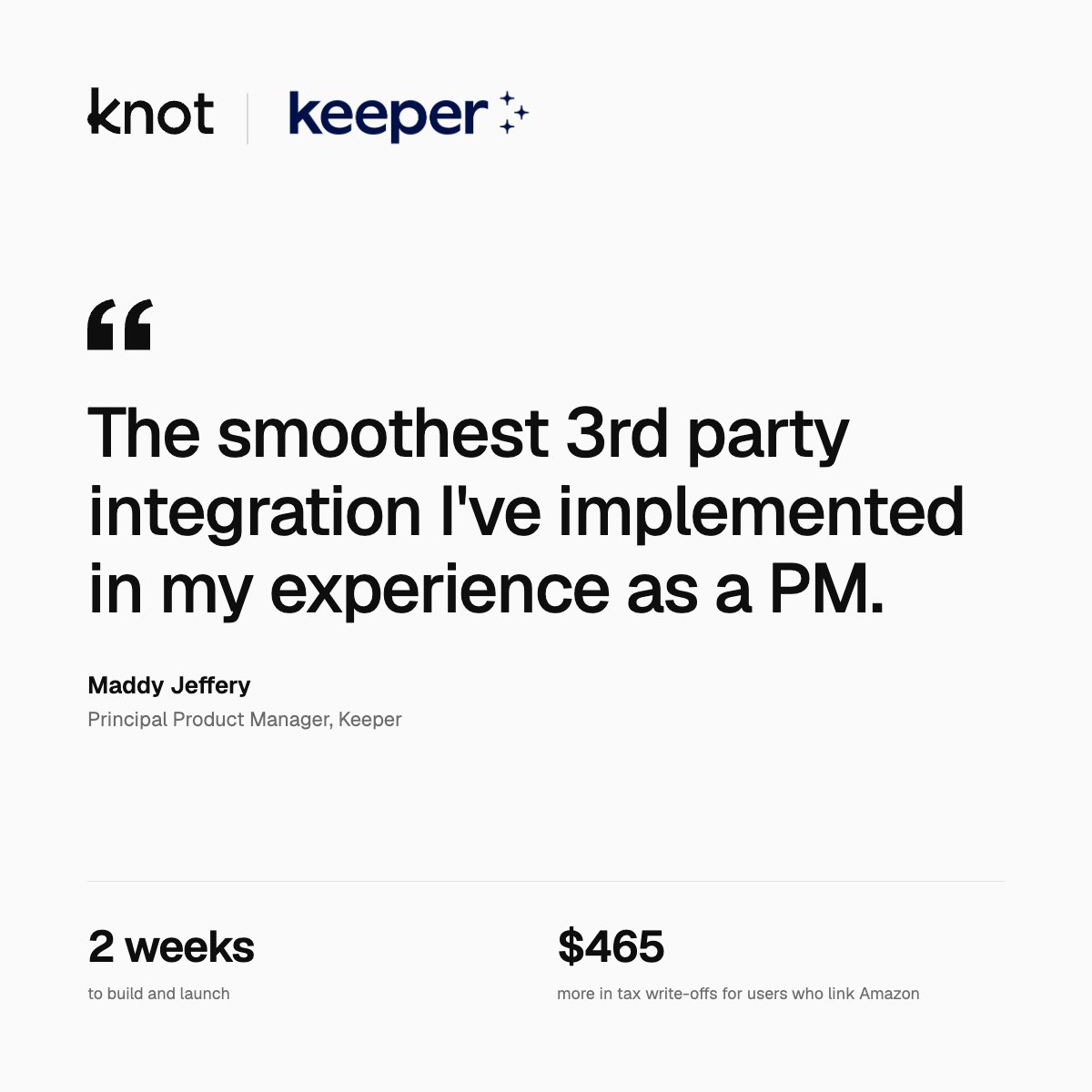
@keepertax ran into this with Amazon. A user's bank feed showed one Amazon charge, and the business purchases inside it stayed hidden unless the user went digging through their order history. Keeper had tried to get item-level Amazon data before but never found a source it could rely on.
With TransactionLink, Keeper users link their Amazon account once and every order comes through item by item, right inside the app.
Since launch:
- Users who link Amazon find $465 more in write-offs than those who don't
- 78% link completion, on par with the most popular banks Keeper users connect
- 2 weeks to build and launch
Full story in the comments below.
.@stripe is clearly building a payments network, one move at a time, and it’s fascinating to watch.
Mastercard, Visa, and Amex still hold the strongest pieces: trust, buyer protection, and global acceptance.
But this will be a great match, and the battlegrounds being decided right now may determine the winner.
With everything going on in cybersecurity lately, here's some good news.
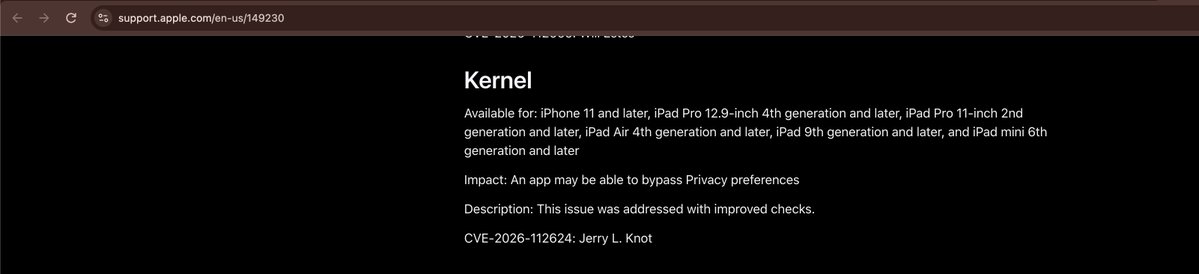
One of our engineers at @KnotAPIs found a vulnerability in Apple's iPhone kernel.
We reported it. Apple patched it.
The world was saved.
I couldn't be more excited to introduce Knot Zero.
Card-on-file switching usually starts with a roadmap slot, an SDK integration, and a mobile release cycle. For some issuers, planning and implementation are the biggest roadblocks before using Knot.
Knot Zero removes all of that.
With Knot Zero, issuers can launch Knot’s CardSwitcher from a link or QR code. No SDK. No app download. No backend card data integration required.
How it works:
1️⃣ Upload a spreadsheet in the Knot Dashboard or call our API
2️⃣ Get a unique short link for each cardholder
3️⃣ Send it however you already reach them: email, SMS, push, or a QR code on the card carrier
4️⃣ Cardholders verify with a one-time code, pick their merchants, and switch
That’s it. It works on iOS, Android, or desktop.
Where we’re seeing it fit:
→ Card activation: QR codes on carriers and in-branch, so top-of-wallet happens at day one
→ Marketing campaigns: reach your entire cardholder base through the channels you already use
→ Support: agents can send a link mid-call or mid-chat
→ A fast first step for teams that want results before committing to a full integration
Getting your card on file where people actually spend is the most important driver of top-of-wallet. Knot Zero means every issuer can start doing that this week, not next quarter.
Money2020 this year was unforgettable for @KnotAPIs, and I believe we'll look back on it as the inflection point for merchant connectivity.
Two months ago, "merchant connectivity" was a niche concept: connecting users to their merchant accounts, keeping those connections alive, and, with their permission, taking action on their behalf.
Now everyone needs a merchant connectivity strategy, and Knot's need is growing rapidly. The stakes are bigger, and the penalty for not owning the merchant connection is massive.
Here's why it suddenly matters:
Banks risk becoming a commodity if they don't own the relationship between their customers and merchants. Personal agentic apps (Muse, Instinct, and the dozen more coming) want that seat. Outsource it, and disintermediation is a matter of time. First they get the eyeballs. Then they get the money. Suddenly, you're trying to hold onto a customer who's getting more personalized service elsewhere and can switch at any time.
Networks risk losing for the same reason. If someone else holds the connection between the user and the merchant accounts, you've handed Stripe and everyone like them a new front to compete on. It now becomes frictionless to switch from card -> pay by bank, stablecoins, etc.
Whoever owns the connections owns the future.
Some people on the floor think the frontier is browser automation: an agent clicking through a website like a person would. It isn't. The real frontier is turning browser automation into deterministic APIs. Same call, same result, every time, securely, at scale. It’s the less glamorous work behind more than 1 million actions Knot powers every day.
Which brings me to Supernova, which is the tool we built internally to ship every merchant integration we have. In the past week, we've had requests from some of the largest companies in the world and some of the smallest, across industries well outside fintech. Use cases I would not have guessed. I couldn’t be more excited to pull more people off the waitlist and see what they build, which, right now, is a lot of agentic shopping on industry-specific sites.
Shoutout to our friends for always making this week so special. See you next year. A lot to show you before then!
@KnotAPIs We've spent years solving the hardest parts of building and maintaining integrations: authentication, persistent connections, health checks, self-healing, and reliability at scale. What took us years to build is now available to every team.
I couldn't be more excited to announce Supernova by @KnotAPIs.
For years, we've poured our hearts and souls into building the technology behind Knot.
Today, it powers more than 1 million actions every day for some of the largest financial institutions in the world.
Now, we're putting that same technology in your hands: Supernova turns virtually any action on any website into an API.
Tell Supernova what you want to do and Supernova, if needed, uses a VM to learn the action once, then turns it into a reusable API. Frictionless authentication, persistent connections, health checks, self-healing, and ongoing maintenance? All handled by Supernova.
The result: An API you can call over and over, without spinning up a browser every time.
Think about what this unlocks:
🛒 Commerce: Build APIs to search, shop, and purchase across retailers.
🏦 Financial services: Connect accounts, retrieve transactions, and manage payments.
🚀 Entrepreneurs: Build the next Finicity/Plaid/MX for procurement, Stripe for returns, or an entirely new API business.
Everything we've built at Knot is proof of what's possible. But our products are just a handful of ideas from one team.
Our ambition isn't just to build the next great Knot product. It's to help you build tens of thousands of your own, including things we never would have imagined.
We're opening the Supernova waitlist to developers, and we can't wait to see what you build.
Sign up for the waitlist below👇
https://t.co/cuDBsp4ef5
At our first @money2020, @KnotAPIs had one product and a pitch most people hadn’t heard before: let consumers move their card to a merchant in a few taps.
This year we arrive with record quarter-over-quarter growth, millions of connected merchant accounts, and our most exciting partnership opportunities yet.
The conversation has changed. We’re no longer explaining why Knot should exist. Prospects experience Knot for the first time in the apps they already use, everyone understands the revenue opportunity, and financial institutions want Knot live before they’re the only ones without it.
What started with CardSwitcher has become something much bigger: infrastructure that connects users to their merchant accounts, automates actions, and keeps those connections working securely at scale. CardSwitcher has become the perfect wedge into selling additional products, and new Knot cross-sells have surpassed even my own expectations.
In the past few months, the market has moved entirely in our favor too. Merchant connectivity is the layer the whole industry decided it needed. Issuers want top of wallet, networks want their token in the merchant file, and nobody wants a third party disintermediating the relationship between them and the consumer. It’s now clear that whoever owns the connectivity layer owns the consumer relationship.
We’re heading into Vegas with more excitement and a fuller calendar than ever: issuers, partners we couldn’t have dreamed of, and everyone wanting a piece of the merchant connectivity layer.
The question is no longer why Knot, or whether Knot works: It’s who will own the connection between users and merchants.
Knot's expansion in Canada continues 🇨🇦
I couldn't be more excited to announce that we’re now powering card switching for @GetKoho, one of Canada’s largest neobanks with more than 2.5 million customers.
KOHO users can now add their KOHO Mastercard® Prepaid card to the places they already shop in just a few taps, without leaving the KOHO app.
It's great to see banks and fintechs alike focus on the same thing: making it as easy as possible for people to use their payment details everywhere.
Big thanks to the KOHO team for partnering with us to make that happen.
Muse is great, and the banks' instinct is right: whoever sits between the customer and the merchant wins. Owning the connection is the most important. That's exactly why we built @KnotAPIs: customers connect to merchants directly via Knot, we keep that connection live, and then take actions on the customer's behalf.