School's back in session, and kids are spending up to 90% of their day indoors, where poor #IAQ is a concern, especially for children. This week, we talk with leaders from @knaufinsulation and Allergy Standards about why this matters. https://t.co/foFeN2i1ds
DOE estimates that 31% of residential HVAC systems are oversized. That's a problem that ultimately costs homeowners money, wastes energy, and creates comfort issues. Here's how to prevent it.
https://t.co/qrgvbIxdcD
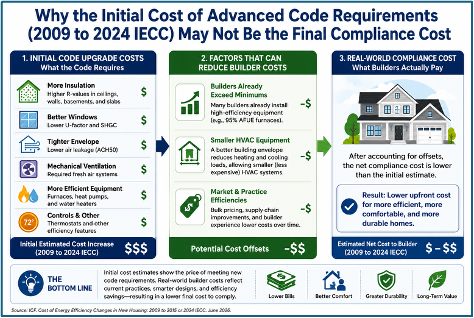
New analysis from ICF Consulting shows that the cost to build a home to the 2015 or 2024 IECC is just a few thousand dollars above that of meeting the 2009 code, contradicting home builders' claims that costs run into the tens of thousands.
https://t.co/tregBXreBN
Energy efficiency is the fastest growing sector of the US energy job market. From 2023-2024, the sector grew by 100K jobs to a record total of 2.4M workers.
Continued expansion supports both US manufacturing and energy independence.
@Forbes has more: https://t.co/D4nBY65m1H
In 2019, gas cost $2.69 a gallon, eggs were $1.50 a dozen, and rent averaged $1,300 a month. Today, those same essentials cost dramatically more, and American households need $15,400 more per year just to maintain the same standard of living, according to a new Common Sense Institute analysis.
Affordability declined in 29 states, with Rhode Island suffering the sharpest drop, where households are spending 8.4% more of their income on rising costs. Massachusetts followed at 8.1% and California at 7.1%.
More: https://t.co/X2cwsYG41G
In Virginia, Governor Spanberger is expected to sign a flurry of bills that will help tackle the problem of high utility bills by expanding support for energy efficiency improvements in homes.
We explored how these bills will help Virginians.
https://t.co/Rsd43FtWq5
The latest Energy Information Administration Residential Energy Consumption Survey shows a notable increase in Energy Insecurity in America. This is not an issue we can ignore. https://t.co/fU30Z4lhkS
Building energy codes have saved U.S. families and businesses billions of dollars in recent decades by ensuring new homes and buildings become increasingly energy efficient.
A new proposal from the body that develops model codes threatens to upend that.
https://t.co/o340hBNKRv
Energy costs are skyrocketing, and 61 percent of home #Builders believe they could deter prospective homebuyers. Here's what they're doing to address that.
https://t.co/xXoU3F7AMd
"Now, amid a mounting energy-affordability crisis, that program has officially survived — and even gotten a funding boost." #LIHEAP#EnergyStar
https://t.co/9HSAGkQ9iU
The @ENERGYSTAR program has rare, bipartisan support. Its survival clearly demonstrates its value.
Long live Energy Star! #EnergyEfficiency
https://t.co/BVImhTUIDI
This week's blog post from the Insulation Institute features an interview with architect and designer Rachel Wagner, who discusses how to make housing better and more resilient for the future.
https://t.co/b8WzpHi1lI
The building industry creates a tremendous amount of waste. NAIMA and Installed Building Products are running a pilot plastic packaging take-back program to reduce landfill waste and increase sustainability.
https://t.co/65uoDslpsd
"Denim Insulation" Is Here to Replace Fiberglass—But Is It Actually Better?
It’s soft, sustainable, and safer to install—but not without a few trade-offs.
https://t.co/Yng0OFna3v
Time is running out to take advantage of the #25C tax credit, which ends on December 31. Take advantage of the credit to add insulation to your home's attic and lower your utility bills, enjoy a more comfortable home, and cut your tax bill.
https://t.co/VkiUHsEvaK
It costs anywhere from $1,700 - $2,500 to re-insulate an attic. However, it's money well spent. The payback period for the job can be as little as one year.
#insulateandsave
Time is running out to take advantage of the #25C tax credit, which ends on December 31. Take advantage of the credit to add insulation to your home's attic and lower your utility bills, enjoy a more comfortable home, and cut your tax bill.
https://t.co/VkiUHsEvaK