How fruit flies are helping us to understand genetic diseases and nutrition.
A KiW original by Laura Martin-Coll and Siamak Redhai.
https://t.co/mi2O6m4vwG
Courtesy of Hubble:
The deepest image of the Universe ever captured.
Most patches of light in the image are galaxies, each one is home to billions of stars.
#Cosmos
This is what happens when galaxies collide; a billion year gravitational waltz.
This supercomputer simulation includes images from Hubble of actual galactic collisions at different stages.
Credit: NASA, ESA, and F. Summers
The archer fish preys on land-based insects and other small animals by shooting them down with jets of water from their mouths aimed with incredible accuracy—adult fish almost always hit the target with their first shot.
Credit: BBC. Full video: https://t.co/w0lu3DyUkv
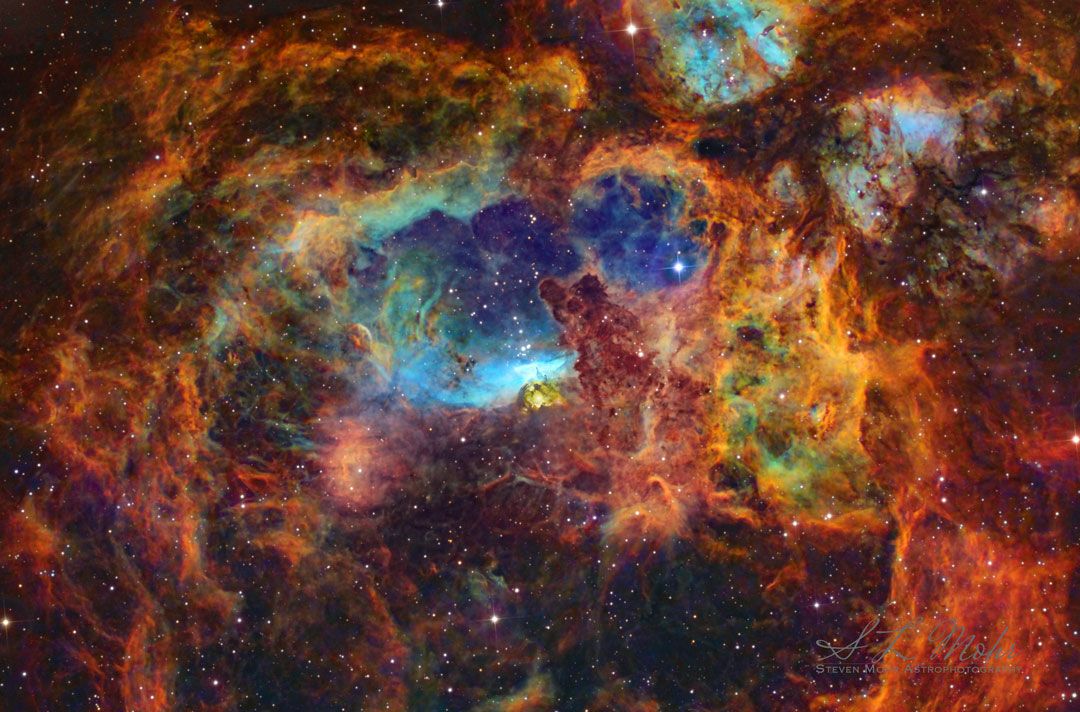
Why is the Lobster Nebula forming some of the most massive stars known? No one is yet sure. Cataloged as NGC 6357, the Lobster Nebula houses the open star cluster Pismis 24 near its center -- a home to unusually bright and massive stars https://t.co/5mMgktiU8i
A spinning bicycle wheel suspended by one end of its axle seems to defy gravity—staying upright instead of falling over due to the gyroscopic effect.
Credit: MIT. Source: https://t.co/YXygKueeiH
The heart of a supermassive black hole simulated in a supercomputer shows how the immense gravity bends light from accretion flows when seen from different points of view.
Credit: T.Müller/M.Pössel https://t.co/elgxDkKrhS
https://t.co/8epI3mHzuS
The best visualisation of light and relativity I've seen.
(And a antidote to the simulation theory thrown in for free)
#Einstein