I am not afraid to say what many people on this app are afraid to say for fear of backlash from those who do not want citizens to speak honestly about the facts.
The reality is that strategic ambiguity is what brought us to where we are today. The party had no meaningful structures, no constitution, and no clear succession plan. It became a one-man band, a briefcase political party built around an individual rather than enduring institutions.
Unlike many people who are afraid to say these things, I am not. You can call me whatever names you want; I genuinely do not care. The fact of the matter is that Nelson Chamisa made serious political mistakes, and part of the reason we are where we are today is because those mistakes were never openly confronted. Instead, they were defended by zealots who practise personality politics rather than politics based on ideas, institutions and principles.
History must be recorded honestly. If we cannot critically examine the mistakes of those we support, then we learn nothing from them and remain condemned to repeat them. Political movements are not strengthened by blind loyalty; they are strengthened by accountability, structure and honest reflection.
These are the 35 opposition Members of Parliament who voted YES alongside ZANUPF in support of Constitutional Amendment Bill No. 3 (CAB 3).
Their votes proved decisive in helping ZANUPF secure the two-thirds majority required to pass the bill through the National Assembly.
Without support from these opposition MPs, the ruling party would not have had sufficient numbers on its own to amend the Constitution. The bill now proceeds to the Senate for consideration.
Bacillia Majaya
Bridget Nyandoro
Charles Moyo
Consilia Chinanzvavana
Constance Chihota
Diana Marikano
Fransica Ncube
Jabulani Hadebe
Josiah Makombe
Juliana Makuvire
Libion Sibanda
Lungile Ncube
Melphiner Gwabeni
Memory Linyani
Mxolisi Sibanda
Nomathemba Ndlovu
Nomvula Nguni
Nyasha Batitsa
Ottilia Sibanda
Prince Dube
Samantha Mureyani
Samukeliso Maseko
Sibongile Maphosa
Sichelesile Mahlangu
Sikhuphukile Dube
Sithabisiwe Moyo
Surrender Kapoikulu
Susan Matsunga
Tendayi Nyathi
Tendeukai Matara
Thomas Muwodzeri
Truswell Chikomo
Tsungirirai Rungwave
Vincent Sihlabo
Vivian Chitimbe
🔸Good day @nickmangwana,
How were the renovations at Parirenyatwa Hospital @PGHZIM funded? Is it true that every student nurse had to pay $100 towards the renovations every year as well as a $100 renovation fee? Did you thank the nurses for the contribution or you claimed that it was all state-funded? How much did the renovation cost? By what process were the contractors appointed?
We need new leaders.🇿🇼
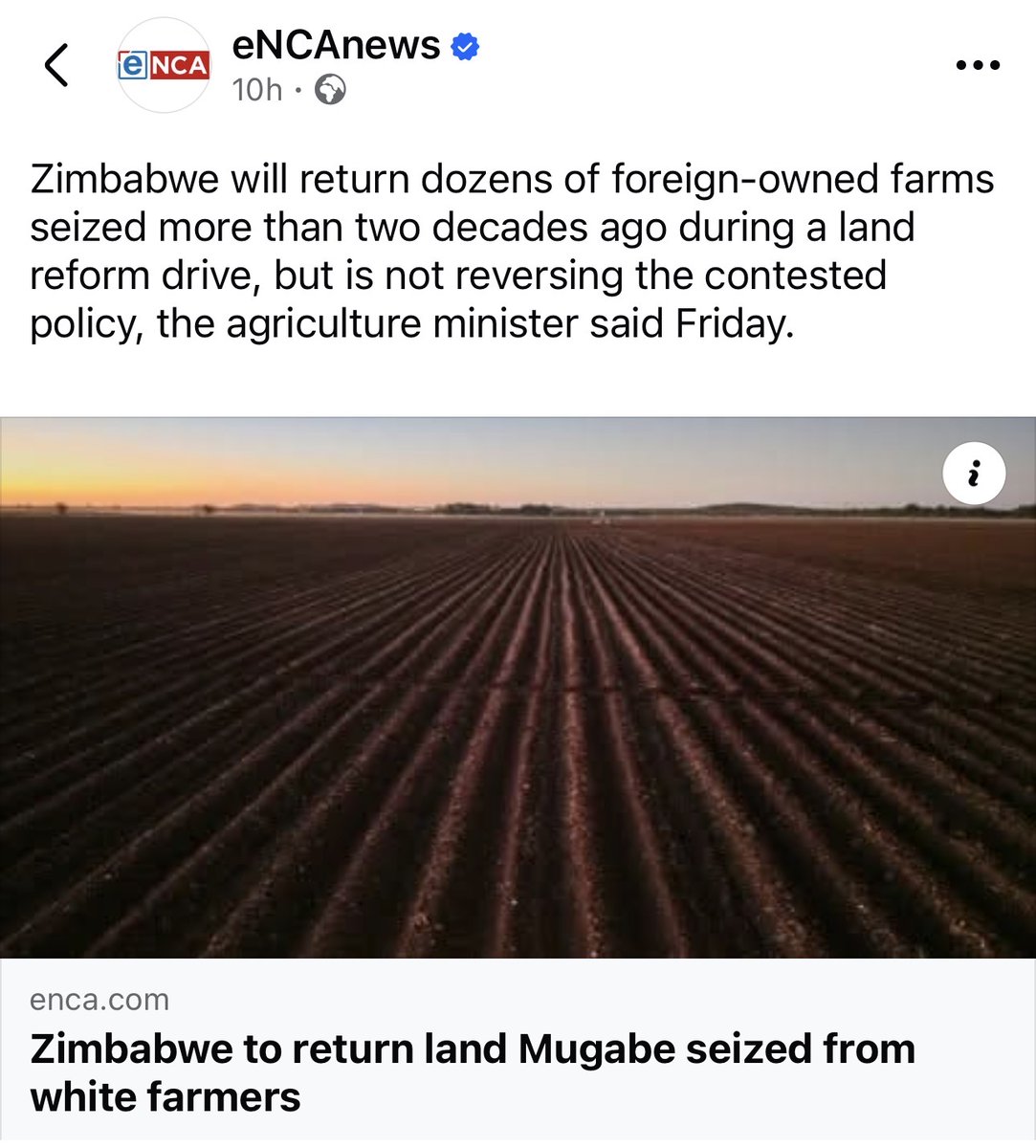
People are misunderstanding this issue completely. Zimbabwe is not reversing the entire land reform programme. These are specific farms protected under Bilateral Investment Promotion and Protection Agreements, BIPPAs, signed between Zimbabwe and foreign countries.
Many of these farms were bought after independence, not during colonial rule, and their expropriation violated legally binding agreements that Zimbabwe itself had signed.
What happened in 2000 was chaotic, violent, and deeply political. Mugabe had just lost the constitutional referendum in 2000 and his grip on power had weakened significantly.
ZANUPF was facing growing opposition from a restless population, particularly people who supported the party and were angry that they still did not have land 20 years after independence. To regain political control, Mugabe latched onto the land issue and unleashed a fast-track land reform programme that was often violent and lawless.
The tragedy is that while the principle of land reform itself was necessary because of colonial land imbalances, the implementation became corrupted. Productive farms were handed to political cronies, chefs, military elites, judges, and connected individuals, many of whom could not farm.
Some received multiple farms while genuinely capable black farmers were sidelined. Even today, some of that land is being rented back to white commercial farmers because the beneficiaries failed to utilise it productively.
Zimbabwe’s agriculture has never fully recovered from that chaos. The country destroyed an advanced agricultural system without putting in place a competent replacement system based on productivity, financing, skills, irrigation, and accountability. You cannot build agricultural success by simply handing land to politically connected people who have no farming capacity.
So what the government is doing now is not a reversal of land reform. It is trying to correct a legal and economic mess it created 26 years ago by violating its own laws and international agreements. It was criminal for the Zimbabwean government to sign BIPPAs and then ignore them when it became politically convenient.
The important question now is not whether the farms are being returned. The important question is who currently holds those farms, whether they were being used productively, and what happens going forward. I can guarantee you that many of those farms were not being fully utilised anyway. Land must be in the hands of people who can actually produce.
That is why I always say to countries considering land reform that land cannot simply be taken and distributed randomly. Even in precolonial African kingdoms, land belonged to the king and was allocated to people who could use it productively. You did not automatically get land simply because you belonged to the kingdom.
I always use my own example. I was the third biggest Boer goat breeder in Zimbabwe, operating from just two acres at my ancestral village, yet producing far more than all Zimbabwean farmers sitting on massive commercial farms except for only two.
Had I been given access to proper farming land, which I would have bought, I would probably have become the number one goat breeder in Zimbabwe. But that opportunity never came because productive land was often allocated to the wrong people for political patronage rather than agricultural competence.
Robert Mugabe and ZANUPF’s chaotic and violent land reform programme was not really designed to build a productive Zimbabwean agricultural society. It became a political patronage system. Of course, some ordinary Zimbabweans benefited from the land redistribution, but the system was structured in such a way that land ownership often depended on political loyalty to ZANUPF. If you spoke against the government, you risked losing that land.
Many black Zimbabweans have lost farms over the years simply because they fell out of political favour. That alone tells you that this was never truly about empowering citizens equally under the law. It became a tool of political control.
And as we saw during the divorce case involving Mugabe’s daughter, she was given 21 farms. One person with 21 farms in a country where millions were supposedly land hungry tells you everything about how chaotic, corrupt, and mismanaged the entire programme became.
Land reform was supposed to correct colonial imbalances and create productive black commercial farmers. Instead, in many cases, productive land was captured by politically connected elites, multiple farm owners, and people without farming expertise, while genuinely capable farmers struggled to access land.
The current leadership in Zimbabwe, the President, the Vice Presidents, and many men and women of the old guard will not be in power in ten to twenty years’ time. They will all be gone. A new generation will eventually take over, and a lot more will be done to restructure Zimbabwe’s agriculture and bring back sanity, productivity, professionalism, and proper land utilisation.
No country can build a strong agricultural sector on political patronage, chaos, and fear. Eventually, competence and productivity will have to matter more than political connections.
It is embarrassing that with all that productive commercial farming land not being put to proper use, Zimbabwe now has to import maize from South Africa. That alone tells you how badly the agricultural sector was damaged.
And unfortunately, the Zimbabwean example is now making many South Africans fearful of land reform because they look across the border and see collapse instead of increased productivity. But Zimbabwe should never be used as the standard example of proper land reform because what happened there was not a properly planned agricultural transformation programme.
It became a violent, chaotic, and corrupt political project driven largely by patronage and power retention rather than long-term agricultural productivity and economic sustainability.
Real land reform should increase production, strengthen food security, empower capable farmers, and grow the economy. It should not destroy a country’s ability to feed itself. Zimbabwe has capable black farmers, those are the ones that should have been given access to land not these grifters who are renting out famers and running protection rackets.
Great initiative by #GreatmanMusic. RETWEET and help him reach as many people as possible!
You know what, my people? A retweet costs you nothing. And when you see somebody who is disabled, like Great Man, pushing this initiative, it should shame us who are able-bodied that we are not able to assist those who are disabled.
The least we can do is to RETWEET so that those who have the heart to help can actually support this cause.
So I ask you again, please RETWEET this initiative that Great Man, who is disabled, has started to assist people like him who are disabled.
It costs you nothing at all as a Zimbabwean or an African to simply RETWEET, or as any other nationality.
This is thirty-one-year-old Jenifer “Niffer” Jovin, a Tanzanian businesswoman who has been arrested and charged with TREASON; a crime punishable by death in Tanzania.
Her alleged offence? Taking part in this viral video “Nywinywi” Challenge. She was charged with treason for this specific video.
The Tanzanian regime accuses her of two counts of treason, conspiracy to damage infrastructure, and incitement during the general election — all stemming from this harmless online challenge.
That is how absurd and repressive Madam Dictator’s Tanzania has become, a complete laughing stock before the world.
The challenge uses the Swahili phrase “Hakutakuwa na nywinywi, nywinywi wala nywenywinyi”, which is loosely translated as “no more excuses” or “we are done being fooled”.
Jenifer “Niffer” Jovin was tortured while in police custody in Tanzania. Her lawyer stated in court that she was physically assaulted by police officers, and forced to sign a statement.
The lawyer also said that on 5 November, 21 of her co-accused had visible injuries, some still limping or bearing gunshot wounds. That is how shameless Madam Dictator’s regime has become, a bloody stain on Tanzania’s reputation.
So, President Hakainde Hichilema of Zambia is flying to Dodoma to witness the inauguration of a dictator who jailed opponents, shut down the internet, and killed citizens for demanding free elections.
Africa never misses an opportunity to embarrass itself. Instead of standing with the victims of tyranny, our leaders line up to shake hands with the oppressor, and then wonder why the continent remains the global capital of suffering.
What a shameful tradition of solidarity with the abusers instead of the abused.
This is especially depressing because Hakainde Hichilema has falsely portrayed himself as an ethical president who does not support repression, and yet here he is, attending the inauguration of a tyrant who has killed over 800 people inside two days.
It means that whatever he was saying about Zimbabwe was pretentious, there was clearly another problem beyond what he was claiming to stand for.
This is so embarrassing and tragic. A man who once spoke about democracy now lends legitimacy to a dictator with blood on her hands. And with Zambia heading towards its own election, Zambians should start praying for themselves.
It pains me deeply to see how so many Africans are conned by religious crooks like Benny Hinn. It truly breaks my heart. The idea that someone can be persuaded to hand over their hard-earned money with the false promise that God will multiply it is a reflection of how far we have sunk as a continent.
How can a person struggling to feed their family take a thousand dollars, often borrowed, and give it to a manipulative preacher who flies around in private jets funded by their gullibility?
If you said such a thing in England, people would laugh. They would think it was a comedy skit. But in Africa, this tragedy is normalised, even glorified.
That is why Africa remains backward, because we have built more churches than schools, more shrines than hospitals, and more temples for deception than centres of innovation. We pray instead of plan, we tithe instead of think, and we are shocked when development passes us by.
When you look at countries like Rwanda, which have taken a firm stand against such religious charlatans and banned them, you begin to understand why they are progressing. Compare that to countries like Zimbabwe, where the pulpit has become a theatre of lies and manipulation. The contrast is painful.
Today, Zimbabwe cannot even provide a decent salary for a teacher. Our educators are leaving in droves for countries like Rwanda, which has already taken over 700 Zimbabwean teachers. Even our doctors and pilots are migrating there.
This is not happening because Rwanda possesses some secret formula or magic wand. It is happening because of leadership, the kind of leadership that builds systems, values professionalism, and does not allow religious charlatans to manipulate and impoverish the people.
Someone once said that Muslims leave their shoes at the door of the mosque, but some Christians leave their brains at the door of the church. That statement captures the problem perfectly. Religion was meant to be a moral compass, not a con game.
I am not a Christian myself, but I believe in the Creator. I believe in the power of thought, honesty, and truth. Faith should inspire critical thinking, not suspend it.
But in Africa, too many people have chosen blind faith over reason. And as a result, our people remain poor, sick, and ignorant while conmen like Benny Hinn grow rich off their desperation.
In Zimbabwe today, children sleep on empty stomachs, hospitals have no medication, and people walk over raw sewage, Zimbabweans are risking their lives crossing the crocodile-infested Limpopo River, yet they gather in stadiums to give their last cent to an American crook. This is not faith, it is madness disguised as religion. What a cursed people!
🔸Mari yembudzi yakabiwa hongu but akakwenyera vakomana tirikumuziva. Matsotsi haagerane. This is a cautionary tale to vaye vakabuda musaga marimwe zuro. Muchina wacho unosvipa vana vayo faster faster. Mazhet anoita sekuti arikufaya muchivaka mazimba anepekutuhwinisa hove next thing mananga Chikurubi. Mafia yacho haina Code.
Hazviperi mushe.
We need new leaders.🇿🇼
@daddyhope This regime is taking us for a ride. They don't respect the rule of law. When will we, as Zimbabweans, wake up and fight for what belongs to us? Anyone who speaks against corruption is thrown into a dungeon. We need new leaders.
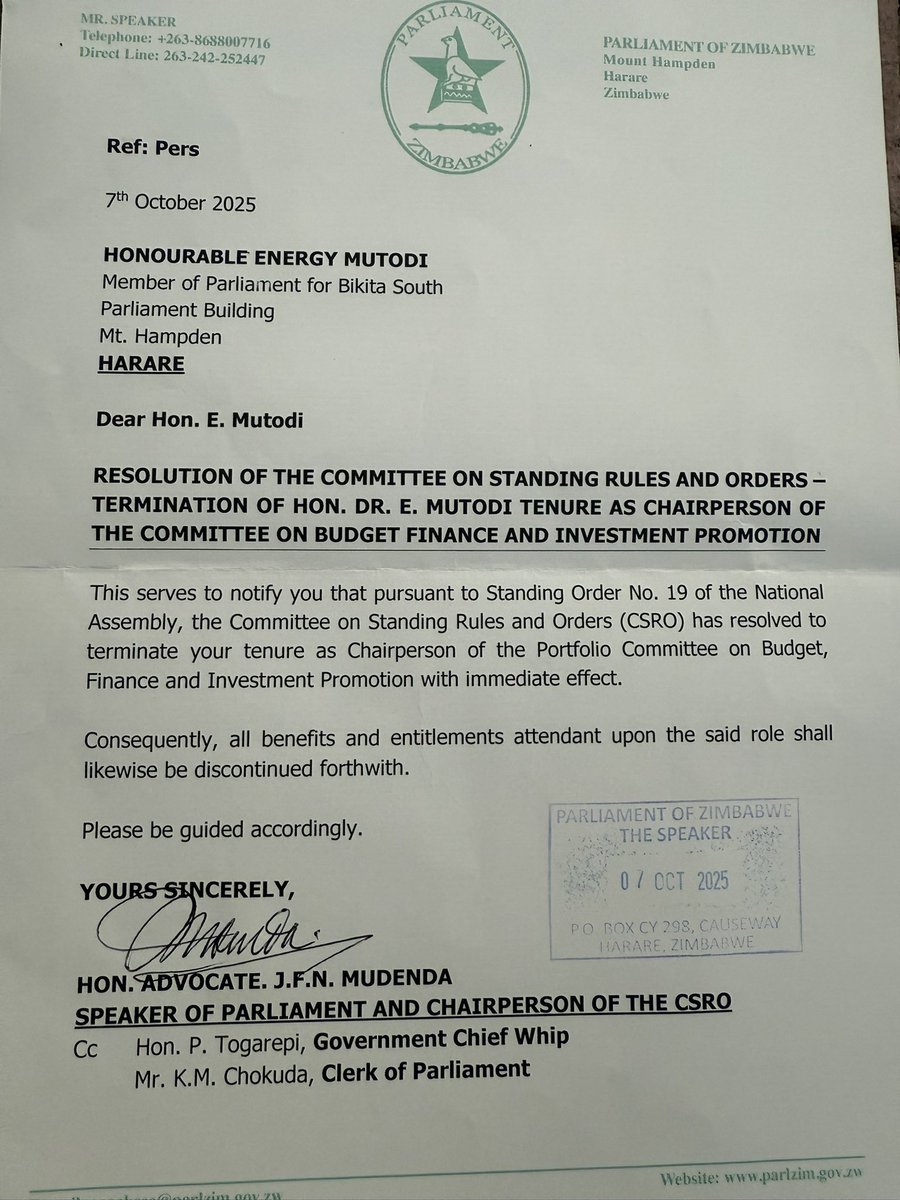
ZANUPF Member of Parliament and Chairperson of the Portfolio Committee on Budget, Finance and Investment Promotion has been dismissed with immediate effect from chairing the committee by the ZANUPF controlled Committee on Standing Rules and Orders, according to a letter signed by the ZANUPF Speaker of Parliament and Chairperson, Advocate Jacob Mudenda.
Energy Mutodi’s removal follows his public criticism of corruption within the government, where he explicitly named the Permanent Secretary in the Ministry of Finance, George Guvamatanga.
His dismissal underscores how speaking out against corruption within ZANUPF remains a political taboo that can swiftly end a parliamentary career, or result in being jailed if you are a journalist.
President Emmerson Mnangagwa is at the Zimbabwean State House right now with the Tourism Minister, Barbara Rwodzi, and other political players, where they are launching the Tourism and Hospitality Industry Policy.
This comes with a Tourism Bill which is a looter’s charter and a driver for massive corruption and looting of state assets.
I put the 42 page new bill into Google Pinpoint and this is what I got. I hope opposition parliamentarians and all Zimbabweans are paying attention to this.
The New Tourism Bill 2025
1. The bill has excessive ministerial power.
It gives the minister power to make binding “policy directions” to the Zimbabwe Tourism Authority (Clause 9), control the Tourism Fund (Clause 18), designate tourist facilities (Clause 22), and preside over appeals (Clause 42).
This undermines the autonomy of the ZTA and politicises decision making.
2. It creates an entity called Mosi Oa Tunya Development Company, which of course has the power to cause cronyism and corruption.
Clause 17 of the bill empowers the minister to expand this opaque government-owned company and register more subsidiaries. This opens the door for politically connected elites to grab tourism assets under the guise of development through government.
3. The bill is hostile to small and informal players through mandatory registration, licensing, inspections, fees, penalties, and compliance requirements, making it harder for informal or community-based tourism operators to survive (Clauses 23��40).
Failure to comply will lead to fines, shutdowns, or imprisonment.
4. It creates a surveillance and intrusion culture when it says designated officers can enter, search, question, and seize property from tourism operators (Clause 44) without a warrant. It removes independent oversight of how these powers are used.
This is aimed at foreign journalists and their local producers who travel across the country staying in tourism facilities like hotels and lodges.
5. It also carries a platform control and data extraction burden which it gives to operators. It forces online accommodation platforms like Airbnb to register, license, monitor hosts, and share data with the Authority (Clauses 32–35).
This creates a surveillance and heavy regulatory environment that will stifle digital tourism innovation.
6. The bill introduces civil penalty orders (Clause 47), where fines can be imposed administratively, bypassing the courts. This undermines basic legal protections for operators. There must be a legal route to disputes, not arbitrary fines that are not appealable.
7. The Tourism Minister acts as trustee of the Zimbabwe Tourism Fund and controls grants (Clause 11), creating opacity over how money is allocated.
There is no provision for public reporting or independent audit of the Fund’s expenditures.
8. Every operator must register, be inspected, renew licences annually, keep detailed records, and comply with evolving regulations (Clauses 23–40, 41, 48).
This heavy regulatory framework discourages investment and innovation.
9. Appeals against registration or licence cancellation go first to the minister (Clause 42), who also appoints the board and controls the Fund.
This makes fair adjudication unlikely, creating a weak appeal protection system.
10. It is not clear on indigenous benefits. While indigenous rights are mentioned (Clause 50), there is no obligation for benefit-sharing in state-led projects, nor protections against land dispossession.
So, this Tourism Bill cloaks control and patronage in the language of reform. It concentrates power in the hands of the tourism minister, giving her broad, unchecked authority to government-appointed officers, and burdens operators with red tape while empowering a controversial state company to dominate the industry. It is a perfect law for cronyism and a nightmare for tourism growth in Zimbabwe.
One world to use for the bill is kleptocratic!
I have posted the bill via my telegram channel 👇🏿https://t.co/f3TcNRwoAl
🔸Dear @nickmangwana,
Why must @ZBCNewsonline be paid a cent in license fees by the public when it is so incompetent, archaic, boring, partisan, shameless, dishonest, gaslighting and all-round awful?
We need new leaders.🇿🇼
A NEW LAW requiring motorists to buy radio licence before renewing their vehicle licences that has been signed into law is too draconian, anti-citizens and outrightly heartless.
So a person who owns a car pays Zinara, Zbc, Insurance and toll gate, how are people supposed to survive?
When shall all this end?
Citizens are being pauperized left, right and centre, why does the citizenry of this country deserve so uncaring & heartless a leadership?
What are people supposed to do with all this cruel taxation?
Why must I pay for a service I don't use?
Why should I pay for partisan propaganda, where i am attacked in person and demonized from dawn to dusk?
Do we have a parliament in Zimbabwe?
Which other country does this to her citizens?
Is this not naked provocation?
Is Zimbabwe not a crime scene?
🔸Good morning @nickmangwana,
I said, what kind of public healthcare system is this? Why are cardboard boxes now being used to mend fractures? What are the bandages dirty and overused? Why are mattresses torn? Where is the bedding? Your incompetence stinks.
We need new leaders.🇿🇼
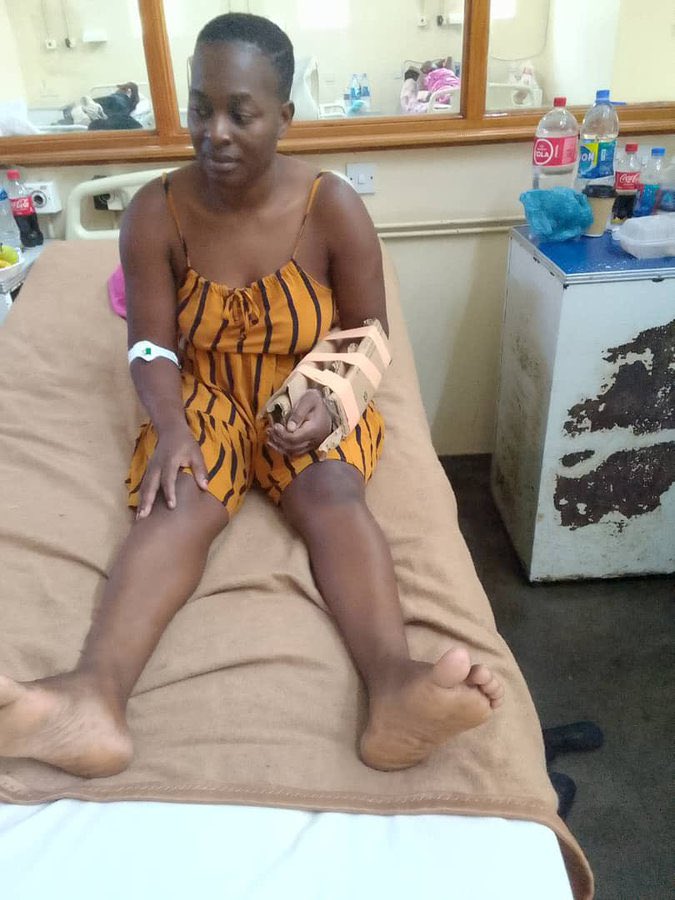
This woman was involved in an accident in Zimbabwe.
She needed urgent medical care, including a cast, but the material was not available.
So, she was given a cardboard box with tape at a major hospital in Zimbabwe.
This is the same country where the government has been paralysed because the president wants a third term.
All of Zimbabwe’s six central hospitals need only US$60 million a year to run smoothly without any shortages, but the money is looted by criminal cartels controlled by the president.
Today the hospitals struggle to get pain killers, thousands of Zimbabweans are dying daily unnecessarily from easily treatable diseases, tragic!