@inter_link If all your ambassadors say they should be distributed as rewards, then you should absolutely burn them all. The ambassadors already have enough ITLs.
The Future of Blockchain Is Ownership for Everyone
For decades, access to valuable assets has been limited by wealth, geography, and exclusive financial systems. While billions of people contribute to the global economy every day, only a small percentage have the opportunity to truly own a share of it.
Blockchain has the power to change this.
Its greatest purpose is not simply decentralization. It is democratizing ownership, allowing anyone, regardless of nationality, gender, income, or social background, to own and benefit from digital assets.
At @inter_link , we believe the next generation of blockchain should create equal opportunities for everyone. Whether you are a student, a developer, a small business owner, or an entrepreneur, you should have the same ability to participate in the digital economy and build long term value.
This is why @inter_link is building infrastructure for payments, digital identity, tokenized businesses, and real world assets. Our goal is not just to connect people to blockchain, but to connect billions of people to ownership.
Because decentralization is only complete when ownership belongs to everyone.
As @inter_link approaches 10 million users worldwide, something special is on the horizon. Stay tuned. 🚀
#InterLink #ITLG #ITL
Digital assets are truly aligned with the principles of decentralization when everyone has the opportunity to own and use them, regardless of social status, wealth, gender, nationality, or background. InterLink is no exception.
We believe the future of digital assets should be open, inclusive, and accessible to everyone.
Something big is about to happen…
@scott_itlg@reina_itl
InterLink’s New Website Is Now Live 🌐
As @inter_link evolves from a free mining app into a sustainable blockchain ecosystem, our new website marks a new chapter in that journey.
Explore the InterLink Network, discover its expanding ecosystem and technology, and learn more about the long-term vision shaping the future of @inter_link.
A clearer vision. A stronger ecosystem. A new digital home for @inter_link.
Explore now: https://t.co/o6RgbVNaOD 🚀
#InterLink #ITLG #ITL
Preparing for the Explosive Growth of the InterLink Ecosystem Through dApps
The Next Direction of the InterLink Foundation
It has now been exactly two weeks since the launch of the Seoul Private Mainnet. During this period, most people have focused on experiencing token transfers, receiving tokens, and a few basic features.
Now is the time when the real race begins.
As we said six months ago, InterLink has been strategically transitioning from a free mining model to a more sustainable ecosystem model. With this direction, InterLink will be able to grow faster and deliver stronger real-world utility than any other project. Although this decision requires significantly more resources—from building blockchain infrastructure that can scale to support a massive user base, to ensuring security through DevOps and security engineers, and allocating resources to build and develop dApps across the ecosystem—we believe it is worth trying. If we never take on a challenge big enough, we will only limit our own potential.
This month, dApps will begin to be developed, with a series of applications launching directly on the InterLink Private Mainnet. Going forward, we will place increasing focus on developing practical applications across the ecosystem.
Many people have asked me about the OTC market over the past few weeks.
As I said from the very beginning, the OTC market is not managed by the InterLink Foundation. It is a free market. InterLink does not participate in it, nor does it own any ITL tokens that could be used to influence this market.
The OTC price also does not fully reflect the true value of ITL. It is simply the result of willing buyers and willing sellers reaching an agreement, and it should not be considered an official price.
At the current stage of the OTC market, almost none of the major roadmap items of the InterLink Foundation have been officially announced or launched, including the InterLink Business Token Exchange (IBTE), Payment Points, ecosystem dApps, the post-quantum infrastructure, and many other initiatives. Therefore, the current OTC price carries very little meaning and does not yet reflect anything about the actual value of the project.
The combination of dApps and the InterLink Business Token Exchange (IBTE) will create a very strong relationship for every business token within the ecosystem. The objective is already very clear. Now, the only question is how quickly we can execute it.
The InterLink Foundation is committed to dedicating all of its resources to supporting qualified dApp owners by providing them with the best possible conditions to build successfully and contribute to the overall success of the network.
The continuous growth of dApps will gradually build a strong decentralized economy for InterLink, where users can do far more than simply hold their tokens after receiving them. Instead, they will be able to use ITL across a wide range of real-world use cases and applications, supported by a diverse ecosystem of powerful and compelling utilities. This is the foundation of our long-term vision: an ecosystem where utility drives adoption, adoption drives activity, and activity creates sustainable value for the entire InterLink network.
And with a pace of development that we believe will surpass any blockchain ecosystem today, I believe that one day the value of ITL will truly reflect its full potential and its role in the decentralization revolution.
Revenue Models and the Economic Sustainability of dApps
Decentralized applications are commonly evaluated through scalability, security, and transaction performance. However, their long-term survival depends on a more fundamental question: Can a dApp generate recurring revenue without continuously relying on token emissions?
Revenue Models
DApps typically generate income through:
- Transaction and service fees
- Subscriptions and premium access
- Marketplace commissions
- Lending interest spreads
- Performance and asset-management fees
- APIs, data services, and enterprise integrations
Diversified revenue sources can improve resilience during periods of lower market demand. However, the most suitable model depends on the dApp’s core utility. A DEX may rely on trading fees, while a lending protocol can generate income from interest spreads and liquidation fees.
Revenue vs. Token Incentives
Airdrops, liquidity mining, and token rewards can accelerate user acquisition, but they are expenses, not operating revenue.
A protocol may report high transaction volume while spending more on incentives than it retains. Therefore, analysis should distinguish between:
- Total fees paid by users
- Revenue retained by the protocol
- Rewards distributed to service providers
- Token incentives
- Value captured by token holders
This reveals whether growth comes from genuine demand or temporary subsidies. If user activity declines immediately after rewards are reduced, the protocol may have attracted incentive-driven participants rather than loyal users.
Measuring Sustainability
Relevant indicators include:
- Protocol revenue growth
- Revenue per active user
- User retention
- Customer-acquisition cost
- Incentive-to-revenue ratio
- Treasury runway
- Token-emission rate
A simple measurement is:
> Economic sustainability = Protocol revenue ÷ (Operating costs + Token incentive costs)
When a dApp consistently spends more than it earns, it must depend on treasury reserves, external capital, or further token issuance, potentially causing long-term dilution.
Early-stage dApps do not necessarily need to be profitable immediately. The key question is whether incentives eventually create recurring usage and whether the protocol has a realistic path toward reducing subsidies.
The Role of InterLink
A sustainable revenue model also requires dependable infrastructure. Downtime, difficult integration, and high development costs can prevent a promising dApp from achieving commercial viability.
@itl_fdn supports developers through:
- Reliable and scalable infrastructure
- Developer-friendly SDKs and APIs
- Faster, simpler integration
- Accessible technical resources
- Continuous ecosystem assistance
- 24/7 developer support
Reliable infrastructure reduces operational risk, while easier integration lowers development costs and shortens time to market. These advantages allow teams to focus more resources on product utility, user retention, and revenue generation.
Sustainable dApps align four essential elements: infrastructure, real utility, recurring revenue, and fair value distribution. Token incentives may attract early users, but long-term growth begins when users stay because the product delivers genuine value.
> Sustainable dApps convert real demand into recurring revenue and lasting ecosystem value.
#InterLink #ITLG #ITL
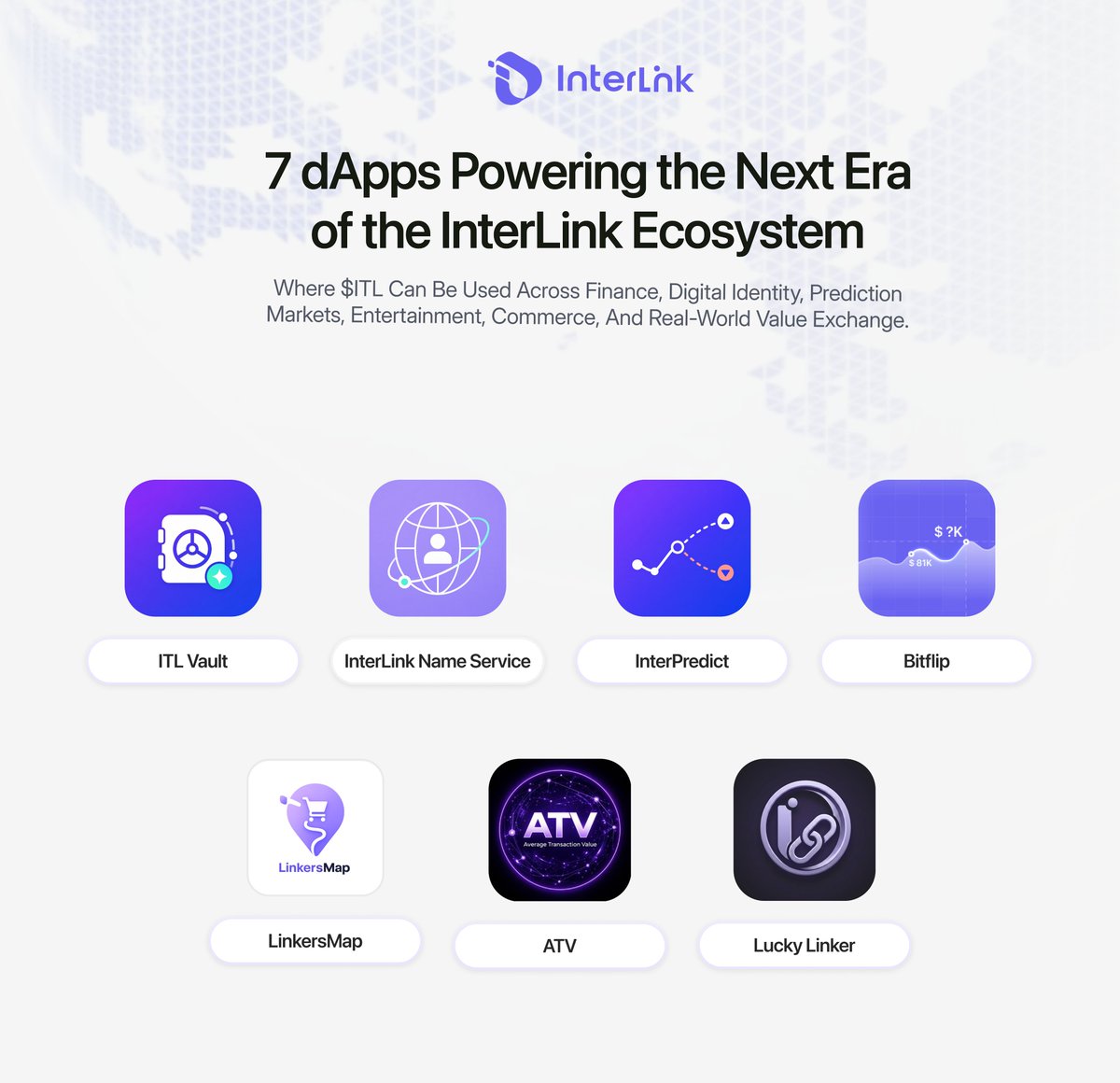
7 dApps Powering the Next Era of the InterLink Ecosystem 🌐
@inter_link is building more than a blockchain. It is creating an interconnected ecosystem where $ITL can be used across finance, digital identity, prediction markets, entertainment, commerce, and real-world value exchange.
Here are six key dApps shaping the next phase of the @inter_link ecosystem:
🏦 1. @itlvault
Overview: A secure crypto-backed borrowing platform.
Mechanism: Users deposit $ITL as collateral to borrow $USDT. The system auto-calculates the LTV, strictly blocking any request over a 30% Max LTV. Eligible requests enter a pending state for manual approval by the dApp owner before disbursement.
Note: Collateral value is currently based on OTC pricing, with a decentralized Oracle integration planned for the next phase.
🆔 2. INS (InterLink Name Service)
Overview: The standard decentralized Web3 identity protocol.
Mechanism: It maps complex, unreadable wallet addresses into simple, human-readable domains (e.g., yourname.itl). This serves as a universal digital passport that streamlines transactions and eliminates the risk of sending funds to the wrong address.
📊 3. @InterPredict
Overview: A decentralized prediction market natively built on the Interlink chain.
Mechanism: Users utilize crypto to buy "Yes" or "No" outcome shares on real-world events across various domains such as politics, sports, crypto volatility, etc. Users with correct predictions claim rewards upon transparent settlement.
⚡️ 4. Bitflip
Overview: A fast-paced, real-time Bitcoin price prediction game.
Mechanism: Players place Up/Down predictions on BTC price action within fixed, short-term timeframes. Winning forecasts are resolved instantly, allowing users to claim their rewards directly via smart contracts.
📍 5. @LinkersMap
Overview: A Web3 Geo-commerce platform bridging the physical and digital worlds.
Mechanism: An interactive map where users can discover on-chain verified real-world businesses and merchants. It allows users to seamlessly pay for physical products and services directly using $ITL.
📊6. @ATV_Interlink
Overview: The Average Transaction Value dApp, driven by real commodity and service exchange transactions.
Mechanism:
ATV Reference = Total Fiat Value ÷ Total ITL Used
A consensus-based value framework where the worth of $ITL emerges from real exchanges of goods and services not speculation, not assumption, not external markets.
🎰7. @luckylinkerlabs
Overview: A transparent, decentralized lottery platform within the ecosystem.
Mechanism: Users can participate by purchasing entry tickets for a fixed price of 0.1 $ITL each. Once the round concludes, the system utilizes a randomized on-chain draw to select a winning ticket, awarding the prize pool to the lucky participant.
Together, ITL Vault, INS, InterPredict, Bitflip, LinkersMap, and ATV create an interconnected utility layer for the @inter_link ecosystem.
From borrowing and digital identity to entertainment, merchant payments, prediction markets, and real-world value discovery, each dApp expands how $ITL can be used across the network.
This is how @inter_link moves beyond speculation and toward a blockchain economy powered by real users, real businesses, and real economic activity.
The next era of the @inter_link ecosystem is being built now.
#InterLink #ITL #ITLG
THE INTERLINK ECOSYSTEM IS ABOUT TO EXPAND 🔥
Next week, a new wave of dApps goes live on InterLink Chain mainnet.
LinkersMap
ATV
BitFlip
InterPredict
ITL Vault
InterLink Name Service
Six applications, one settlement asset. Every interaction across these dApps runs through $ITL. More applications means more transactions. More transactions means more $ITL in motion.
This is what utility actually looks like. Not a promise on a roadmap, but an economy with something to spend on.
The ecosystem is not growing slowly. It is about to expand all at once.
Because the goal was never to launch a few applications. The goal is to build an ecosystem large enough and strong enough to carry a real economy, one that lasts long after the moment it was created.
#InterLink #ITLG #ITL
@avgerinosx 😃😃 Her şeye rağmen yunanistanlı komşularımızı seviyoruz.
Biz Atina’yı hayal etmekten vazgeçelim Yunanistanlılar ise Istanbul’u hayal etmekten vazgeçsin.
Why dApps Are the Most Important Layer of a Blockchain Ecosystem
A blockchain is only infrastructure. No matter how fast, secure, or decentralized it is, its long-term success depends on one thing: whether people actually use it. That usage comes from decentralized applications. dApps are where users make payments, trade assets, play games, invest, communicate, and interact with digital economies. Without dApps, a blockchain is simply a network waiting for activity.
History has already proven this. Ethereum did not become the largest smart contract blockchain because it had the highest TPS or the lowest fees. It became dominant because thousands of developers built products that millions of people wanted to use. DeFi protocols created new financial markets, NFT marketplaces introduced digital ownership, stablecoins enabled global payments, and blockchain games attracted entirely new audiences. Every successful dApp generated more transactions, attracted more users, encouraged more developers to build, and reinforced Ethereum’s network effects.
The value of a blockchain grows exponentially as its application layer expands. Every new dApp becomes another gateway that brings new users into the ecosystem. A payment application attracts merchants and consumers. A decentralized exchange attracts traders and liquidity providers. A Real World Asset platform attracts businesses and investors. A social platform attracts creators and communities. Each application serves a different audience, but all of them contribute to the same blockchain by generating transactions, consuming block space, increasing liquidity, and creating demand for the native token.
This is why developers are the most valuable resource in any blockchain ecosystem. Every new team building on the network has the potential to create an application that brings thousands or even millions of new users. The success of one dApp often benefits every other project on the chain because users who enter through one application can easily discover and use others. This creates a powerful network effect where the ecosystem becomes more valuable as more builders participate.
For @inter_link, the vision goes far beyond launching a blockchain. The objective is to create a complete digital economy where businesses, developers, entrepreneurs, and communities can build applications that solve real-world problems. Whether it is payments, decentralized exchanges, AI services, Real World Assets, business tokenization, gaming, social platforms, or financial infrastructure, every successful dApp strengthens the entire ecosystem while increasing demand for ITL as the network’s core asset.
In the long run, blockchains will not compete solely on technology. They will compete on the strength of their ecosystems. The blockchain with the most useful applications, the largest developer community, and the strongest network effects will ultimately create the greatest long-term value. Technology builds the foundation, but dApps build the economy, and the economy is what determines the success of a blockchain.
#InterLink #ITLG #ITL
EVERY ITL PAID IN TRADING FEES ON IBTE WILL BE BURNED 🔥
Every fee paid in $ITL on the InterLink Business Token Exchange is permanently removed from supply. No recycling. No redistribution back into circulation. Once burned, gone for good.
Most tokens fight against dilution. $ITL fights back.
Most networks reward growth with more emissions, which means more tokens entering circulation over time. IBTE takes the opposite path. Every trading fee collected in $ITL is destroyed permanently, so growth in trading activity works against supply instead of adding to it.
How the burn works
When a business token is traded on IBTE, the exchange fee is paid in $ITL. That fee never returns to a treasury, a team wallet, or a rewards pool. It is sent straight to a burn address and removed from the total supply forever.
Stacking on top of existing burn mechanisms
This is not $ITL's only burn channel. Base fee burns already remove $ITL with every transaction on the network, and validator slashing burns remove $ITL from any validator that misbehaves. IBTE trading fee burns now add a third channel, directly tied to real economic activity rather than network usage alone.
Why growth compounds the effect
As more businesses list and tokenize on IBTE, trading volume increases. As trading volume increases, more $ITL gets burned. This means the more successful the InterLink Business Token Exchange becomes, the faster $ITL supply compresses. Growth and scarcity move in the same direction, not opposite ones.
From trading asset to store of value
Most tokens ask holders to believe in future demand. $ITL backs that belief with a mechanism. Every fee burned is permanent, every burn is public and verifiable on-chain, and every unit of ITL removed makes the remaining supply scarcer. This is what allows $ITL to be positioned as a long-term store of value, not just an asset to trade in and out of.
The more the InterLink ecosystem grows, the less $ITL there is to go around.
#InterLink #ITLG #ITL
Every ITL Paid in Trading Fees on IBTE Will Be Burned. 🔥
To me, RWA is one of the most sustainable long-term trends of the next decade, alongside AI. According to McKinsey, the RWA market could reach approximately $2 trillion by 2030.
So where does InterLink fit into this picture?
Today, tokenizing a technology company is still extremely difficult, almost impossible for businesses that lack strong legal and regulatory resources. InterLink Business Token Exchange (IBTE) changes that by allowing businesses of any size to tokenize themselves directly on their own blockchain. This is something that very few platforms have been able to offer.
Today, when a company wants to tokenize, it usually relies on someone else’s infrastructure. For example, Ondo Finance tokenizes assets on Ethereum. InterLink, however, aims to provide the entire stack, from business token consulting and deployment to blockchain infrastructure, AMM, and protocol support. Everything is designed as a complete end-to-end workflow, enabling any business to issue and list its token within a single ecosystem.
What about ITL?
ITL will be the asset used to invest in these business tokens, rather than using stablecoins from Tether, Circle, or any other native token. ITL will also be used to pay gas fees, invest in business tokens, provide liquidity, and pay exchange fees. In addition, all fees collected by IBTE will be permanently burned, helping protect ITL against inflation and positioning it as a long-term store of value.
Over the past few days, I’ve noticed that many people on X have been focusing almost entirely on buying and selling ITL. Of course, @itl_fdn cannot prevent this because once the tokens have been distributed, every holder has the freedom to use them as they wish. However, I don’t think the focus should be on speculation alone.
At this stage, ITL still does not fully reflect the vision or the ecosystem that can be built around it in the future. Most OTC trading today is simply based on agreements between buyers and sellers. It does not represent the real value that ITL can create through actual utility.
ITL is meant to power the ecosystem, to be used across dApps, to pay gas fees, to make payments, to invest in business tokens, and even to be staked by validators securing the network. It was never designed to be just another speculative asset.
InterLink Unveils IBTE Marketplace To Tokenize Real-World Business Revenue
@Inter_link announces the upcoming launch of the InterLink Business Token Exchange (IBTE), a dedicated liquidity layer for verified commercial entities.
Built on infrastructure currently supporting 9M+ verified users, IBTE enables real-world businesses to convert transaction revenue into on-chain liquidity.
Every token listed on the exchange represents an active operating business, moving the ecosystem away from speculative assets toward verifiable RWA.
The @itlx_defi Perpetuals market is now live with permissionless listings, including:
$GLW — Corning
$AAOI — Applied Optoelectronics
$SYN — Synapse
$EIGEN — EigenLayer
$GRAM — Gram
This is exactly how permissionless markets should work. @itlx_defi is liquidity infrastructure—not a gatekeeper. Markets can be listed permissionlessly, liquidity providers supply the liquidity, and users simply trade.
Today, users can access perpetual markets for major U.S. equities, crypto tokens, and other assets directly on blockchain infrastructure.
This is just the beginning.
#ITLX #ITLG #ITL
INCOMING: THE INTERLINK BUSINESS TOKEN EXCHANGE 🌐
IBTE is coming soon to the @inter_link ecosystem. This is not just another listing platform. It is the exchange layer where real business activity turns into on-chain liquidity, built on infrastructure already trusted by 9M+ verified humans.
What IBTE is
IBTE is a dedicated marketplace for business tokens built on top of @inter_link's infrastructure. Only businesses that have gone through verification can list here. Every token traded on IBTE represents a real, operating business, not a speculative idea.
Real revenue, not hype
Business tokens on IBTE are anchored to actual transaction revenue. As a business processes real customer payments through the network, that activity strengthens the token's backing over time. This is what separates IBTE from typical exchanges built purely on trading volume.
The AMM behind it is the real engineering feat
IBTE runs on a protocol-embedded AMM, not a bolted-on trading tool. Every time a business processes a payment, the protocol automatically routes a portion into that business's liquidity pool and executes a buy against $ITL. The result is liquidity that deepens with every real transaction instead of every speculative trade.
$ITL as the settlement backbone
Every token pair on IBTE settles against $ITL. This makes $ITL the universal reserve asset behind the entire exchange. As more businesses list and trade, demand for $ITL grows alongside real commerce, not speculation.
The future of RWA starts here
Real world assets stop being a buzzword the moment business revenue becomes verifiable on-chain. IBTE is built for that future. 2026 targets 100+ companies integrating InterLink Token into their business operations, with 10,000+ payment points feeding real activity into the system.
IBTE is incoming. Official launch details will follow.
Do you already have $ITL ready to invest in Business tokens across the @inter_link ecosystem?
#InterLink #ITLG #ITL