Imagine you are in a serious road traffic crash in Accra tonight.
Or imagine a friend/relative suddenly collapses at home from cardiac arrest.
In that moment, nobody is thinking about politics.
Your family is asking one question:
Can Ghana’s emergency system keep you alive long enough to reach definitive care?
That is the only question that matters.
⸻
Now ask the harder question:
What are your chances of surviving a time-critical emergency in a system where we’ve normalized the phrase “No Bed Syndrome”?
That phrase sounds like a hospital crowding problem.
It’s not.
“No Bed Syndrome” is a symptom of a poorly functioning emergency care system.
The bed is just the final explanation the public hears.
The failure often starts much earlier.
⸻
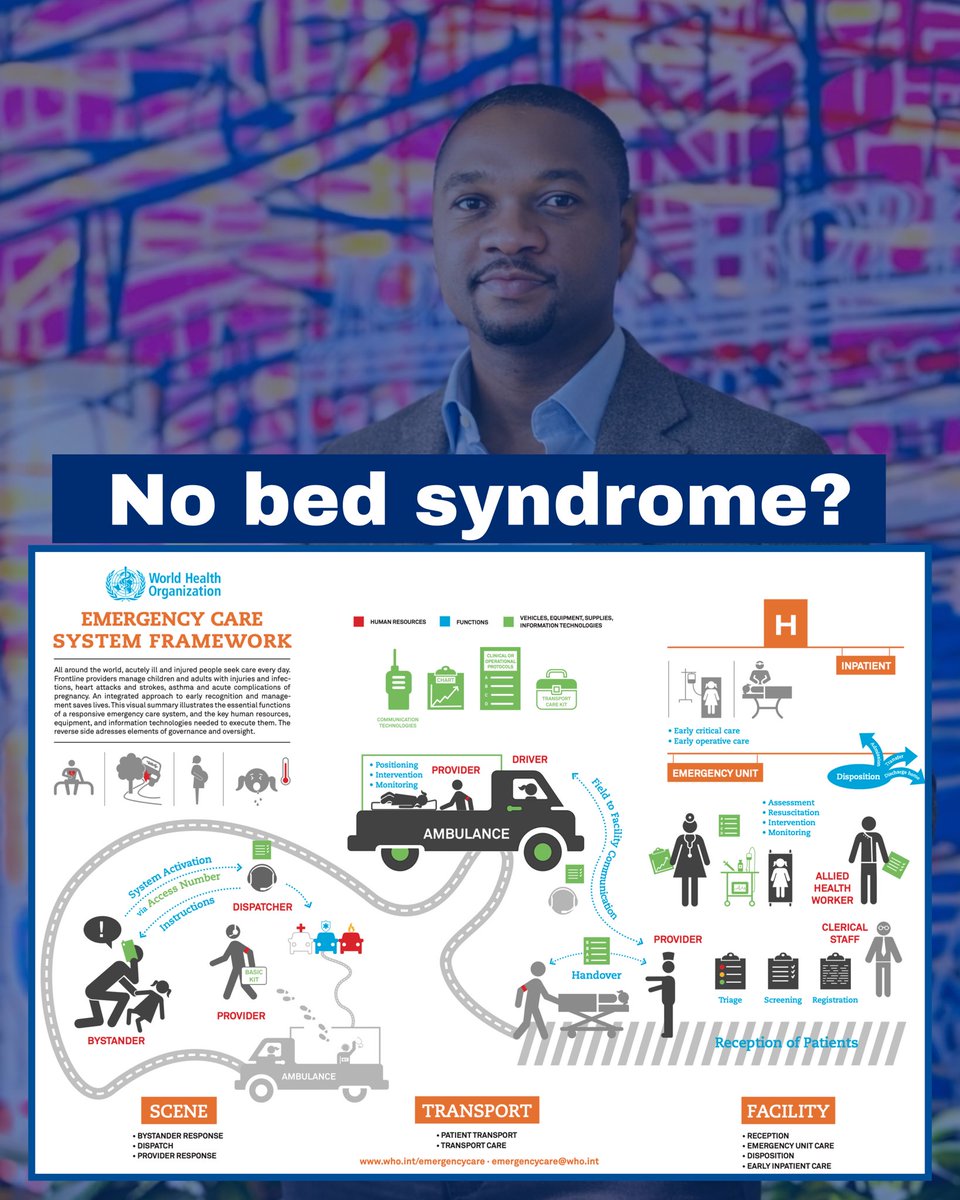
The World Health Organization is clear on this:
Emergency care is not a ward or bed.
It is a system, from:
→ The scene
→ To transport
→ To the facility
→ Too early inpatient care
Survival depends on the full chain, not just what happens at a hospital entrance.
So Ghana must stop discussing “No Bed Syndrome” as if it’s only a space problem.
It is the public name for an emergency system failure.
⸻
After every tragedy, we repeat the same cycle:
People blame one doctor.
One nurse.
One hospital.
The debate becomes emotional.
Then the country moves on.
That cycle is exactly why the problem persists.
Yes, individual accountability matters.
Yes, professional ethics matter.
Yes, hospital leadership matters.
But when multiple facilities fail one patient in sequence, the problem is no longer only individual.
It is structural.
Because:
A doctor cannot create a referral network during a crisis.
A nurse cannot produce an ambulance without fuel.
A hospital cannot function as a national emergency system on its own.
If we keep asking frontline staff to compensate for weak coordination, weak transport, weak communication, and weak operational rules…
…then Ghana will keep producing the same headlines.
⸻
A functioning emergency system requires:
→ Trained personnel
→ Vehicles and dispatch
→ Equipment and essential supplies
→ Communication and information systems
→ Clinical + operational protocols
→ Accountability that is measurable, not rhetorical
Public anger is valid because the public understands something policy debates often avoid:
A person in an emergency should not have to negotiate the health system while dying.
That is the real meaning of “No Bed Syndrome.”
It is not a phrase about beds.
It is a warning that Ghana has allowed emergency care to operate without the coordination, readiness, standards, and accountability required to save lives reliably.
⸻
If Ghana wants to prove that human life is truly a national priority,
This is where the proof must begin.