Williams speech, and why the Fed Will Need to Cut in 2027
Monday’s reinstatement of Jensen Huang as Nvidia’s chief executive was the first step, removing a cloud of uncertainty over the AI buildout.
John Williams’s latest speech is a second step in the right direction. Compared with Christopher Waller’s call for a half-point hike to “shock people,” the New York Fed president offered a welcome measure of restraint. But he needs to follow his analysis to its logical conclusion.
Consider his most important acknowledgement: “Although the effects of tariffs, geopolitical conflicts, and the AI surge are showing up in prices of certain categories of goods, there is little evidence of these spilling over significantly into broader and more persistent inflation.”
That is no minor qualification. It decides the policy debate.
The data back him. In the year to September, consumer energy prices rose 20 per cent; core goods rose 0.7 per cent. That is a supply shock, not a wage-price spiral.
Private-sector wages are up 3.1 per cent, and the five-year, five-year-forward breakeven, at 2.11 per cent, is lower than a year ago. Williams’s own forecast has inflation just above 2 per cent next year.
I’m sorry, but a focus on headline numbers is not good enough! And the Fed keeps hiding behind it!
A 2 per cent target never required every component to rise at 2 per cent. From 1995 to 2019, core PCE inflation averaged 1.7 per cent while services excluding energy and housing averaged 2.5 per cent and core goods 0.2 per cent. Services ran hot; goods did the balancing.
Now the energy shock is reversing, and fast. The 3-2-1 crack spread, the refiners’ margin, is now close to $ 38 a barrel, down from $ 79 in late September. West Texas crude is heading below $ 80, from $ 115 at its April peak. Wholesale gasoline is below $ 2.45 a gallon.
When crude and refining margins fall together, pump prices fall faster than either. Gasoline at the pump is already down 15 per cent since September, to $ 3.81, and retail margins remain 30 cents above normal. More relief is coming.
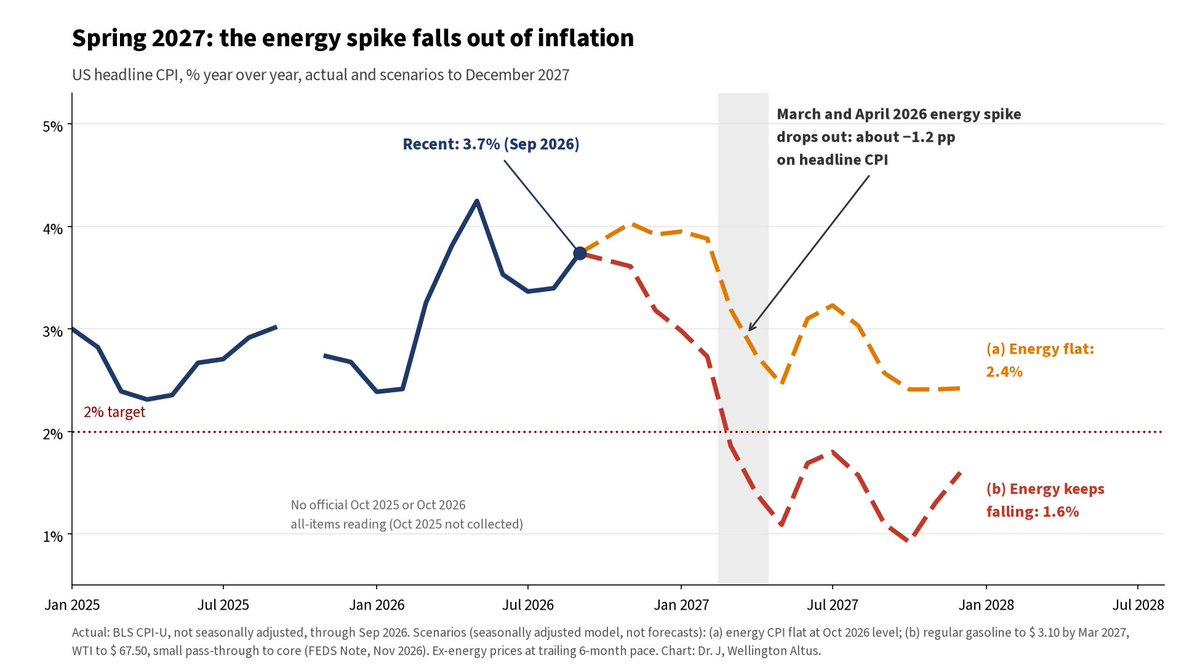
Then come the base effects. Energy prices jumped almost 11 per cent in March 2026 alone. Even if energy merely holds at October levels, that increase drops out of the annual comparison and subtracts about 1.2 percentage points from headline CPI inflation, and 0.6 from PCE, by April.
Here is what the hawks miss: the Fed can tighten without raising rates. Hold the funds rate at 3.75 to 4 per cent and let the real rate do the work. In our scenario, with gasoline easing to $ 3.10 and crude to the high $ 60s, headline PCE inflation falls to about 2 per cent by mid-2027. The real policy rate climbs from 0.2 per cent today to roughly 1.9 per cent, without a single hike. The New York Fed’s own models put the neutral real rate between 1.0 and 1.65 per cent; the FOMC says 1.2. Two cuts would be needed just to get back to the FOMC’s neutral; six to keep today’s stance unchanged.
Even the Fed’s own September projections, PCE inflation of 2.3 per cent and a 4.1 per cent funds rate at the end of 2027, imply a real rate of 1.8 per cent, well above its own neutral.
The hawks’ counterpoints are energy echoes: core’s three-month pace is inflated by transportation services, up 0.8 per cent in October alone, and Michigan’s one-year expectations jumped from 3.8 to 4.7 per cent when gasoline spiked in April.
Williams himself warned against being “overly focused on inflation’s path in the past.” Steering by the rear-view mirror is how a central bank tightens into a slowdown. With the 30-year mortgage rate at 7.28 per cent and existing-home sales at a 3.75 million pace, housing is already paying.
Huang’s return was the first step. Williams’s speech is the second. What is needed now is a Fed that is objective, apolitical and truly data-dependent. As energy falls, the data will say one thing: cut in 2027.