A watchman upon Western walls, defying the Eastern Red Dragon's grasp and strange dogmas of this age. Herein lies truth unvarnished, spoken with no regret.
🌟The Parasite's Privilege🌟
Intellectual history is, among other things, a long chronicle of men denouncing things. The work is popular, well-compensated in social currency, and requires — this is its chief attraction — no construction of anything whatsoever. The footlights are flattering. The costume requires no fitting.
Consider the curious spectacle of authoritarian critique, that grandest of drawing-room consensus sports, in which the modern liberal and the Austrian economist, the Burkean conservative and the neo-Thomist, the neo-classicist and — with characteristic late-arriving zeal — the Fabian, all find themselves, improbably, occupying the same row of seats. One might mistake this for a coalition. It is not. These traditions are, in most substantive respects, mutually hostile — disagreeing on property, on liberty, on human nature, on the very grammar of political life. Their shared denunciation of tyranny is rather like a gathering of rival architects who all agree, loudly, that a particular building is hideous, whilst harbouring violently incompatible visions of what ought to replace it. The agreement is real. It is also worthless.
📌The Question No One Wishes to Answer
The true test, then, is not the denunciation. It is the blueprint.
If the present order is rotten — and perhaps it is; perhaps the rot is structural, load-bearing, irreversible — then the relevant question is not what you oppose but what you would erect in its place. This question, deceptively simple in its architecture, clears the room with remarkable efficiency. The reckless answer is easily offered and equally easily dismissed. The honest answer is something else entirely: a full public inventory of one's intellectual formation, one's moral commitments, one's sense of human destiny. To answer it seriously is to stand on the shore of a lake so pellucid that every fish and pebble at its bed lies visible without obstruction — not merely exposed, but legible. The nakedness is not metaphorical. It is precise.
Criticism, for all its apparent daring, is a parasitic enterprise. It requires a host. It takes its shape, its occasion, its very vocabulary from the object it assails, and unmoored from that target, it ceases to exist. This is why the critic may appear reckless — he is, in a sense, free, free in the manner of a vine that has never been asked to stand upright on its own. Construction is the opposite condition entirely. The builder must first become a host himself — must offer himself as the ground upon which something can stand — and that obligation forecloses the comfortable fiction of sovereign detachment. One cannot simultaneously lay foundations and pretend to float above the earth.
📌Allegiance Is Architecture
A builder does not raise walls from nothing. Before the first stone is set, he must place himself honestly within a tradition — intellectual, cultural, theological — and declare it. The declaration need not be theatrical; it may be quiet, even oblique, perceptible only to those with sufficient formation to read such things. But it must be real, because the tradition's structural load will bear down on everything he subsequently builds. Those equipped to read such things will see the allegiance clearly, whether announced or merely implied. Novices will miss it. This is as it should be.
Criticism may operate in shadow. Construction is, by its nature, conducted in daylight, with one's name on the scaffolding.
📌A Word to Those Who Have Mistaken Me for Company
There are those who, observing that I have criticised certain things which they also wish to criticise, have concluded — with varying degrees of sincerity — that I am their fellow traveller. I must be candid: I am not, and I cannot be. A shared object of contempt establishes nothing except proximity of grievance, and proximity of grievance is not a political philosophy. It is a waiting room.
My own allegiances — intellectual, confessional, and institutional — are already fixed. They were not forged through negation. They were built, slowly and with considerable effort, upon the foundations of religious revelation and political philosophy, and these foundations precede my criticisms, outlast them, and determine their meaning.
Those who have catalogued my objections and declared kinship on that basis have, I am afraid, been reading the scaffolding and mistaking it for the building.
The building is elsewhere. It has always been elsewhere.
She’s delusional. The people who actually support Taiwan independence tend to do it peacefully. Contrast that with the pro-Palestinian crowd we keep seeing torching buildings, looting stores, and rioting (France was just the latest example). Taiwan legalized same-sex marriage years ago and protects LGBTQ rights. Hamas and large parts of Palestinian society treat being gay as a death sentence—they execute or torture their own for it. Queers cheering for that movement aren’t practicing solidarity. They’re ignoring the people who’d throw them off a roof. The two causes aren’t the same genre.
French teenagers are rioting for the right to fail.
And the adults are cheering them on.
Who am I? What am I here for?
Across vast swathes of white French youth, these two questions have no answer. Since childhood they have been told they are European, not French; citizens of the world; that their ancestors were racists and rapists in the colonies; and that France is still a rich and prosperous country.
This is why they feel empathy with migrant rioters who attack police officers and teachers.
It is also why they demand more money.
They are ignorant of France’s decline. Passengers on a plane heading for a crash, yet they feel like first-class travellers entitled to every luxury.
These teenagers are the sons and grandsons of May 1968. The generation that replaced duty with pleasure and honour with comfort. They act as if life were a party and France a massive nightclub. So they want to play, sing and dance, whatever tomorrow brings.
Some demand free and unrestricted access to whichever university they please, without any selection process. L’Union Étudiante is calling for the admission of 250,000 extra students next year, as if obtaining a degree were a human right and passing exams an offence against human rights.
Some give the impression they feel entitled to a life without effort or hard work — as if everyone had the right to become a footballer at Manchester United, earning thousands of euros a day simply to have fun. Several pupils have said on camera they are outraged at having to go to school on Saturday mornings or attend classes from 10am to 6pm on weekdays.
These teenagers are delusional. To some extent they have a right to be: adolescence is a time for illusions.
But what about the adults?
Many teachers have joined the movement or given it their moral support. Some lawyers have done so too, advising protesters on how to avoid answering police questions if they are arrested. According to an Elabe poll, 85 per cent of left-wing voters support the movement, as do 73 per cent of young people. Not all of them are black or Arab. The vast majority of the French population is still white and comes from a Christian background.
Part of the country refuses to face reality.
France is bankrupt. The deficit is over 5 per cent of GDP and public debt exceeds €3.5 trillion. France already spends a great deal on education: around €15,000 per secondary-school pupil, well above the OECD average. The education budget has increased by €12bn under President Emmanuel Macron. Yet educational performance is falling. The latest PISA results have sounded alarm bells over mathematics and reading, with sharp declines in French pupils’ scores.
The very adults who support the student protests are often the same people who eagerly voted for the political leaders who have brought the nation to ruin: Mitterrand, Chirac, Sarkozy, Hollande and Macron. All made disastrous decisions that led to the shutting down of France’s engines of prosperity: meritocracy, excellence and hard work.
France — or at least a part of it — is revolting against reality. Many schools need renovation, not necessarily because the education ministry lacks funding, but because its bureaucrats are incompetent. Wherever the toilets are out of order, there is a bureaucrat hiding behind the camouflage of “It’s not my fault”, backed by a pile of regulations whose message is simple: “Shut up and comply.”
Many pupils swelter in the summer because environmentalists have imposed fatwas against air-conditioning. Many teachers are reluctant to work in the banlieues because parts of them have become no-go zones. And if something happens to them, they are convinced that their superiors will not stand by them.
L’Éducation nationale, once the backbone of the French Republic, is dying from within, not because it lacks the means, but because it lacks courage. Or, more precisely, because it has lost its faith. The republic no longer believes in itself. It asks for money like a drug addict asking for another fix of cocaine. Nobody believes in a resolution any more — they just want a little more time before the end.
In short, the mass student protests are the joint product of two sick societies: New France — or, to be fair, its most toxic elements — and a decadent Old France. One has its roots in North Africa and sub-Saharan Africa; the other in May 1968. One often belongs to the lumpenproletariat; the other is frequently bourgeois. Both have played a part in raising the new generation of students.
These are the white teenagers who say wallah and swear on the Koran.
And these are the black and Arab teenagers who say the French state can solve all their problems.
Each sick society has passed its own bad inheritance on to the other.
And nobody saw that coming.
When a nation forgets what made it great, is collapse the only remaining teacher?
@gummibear737 Macron should declare a state of emergency, send in the army, greatly expand law enforcement, and arrest the rioters and vandals by every means available.
France has form.
Violent revolution sits in the national DNA. The precedents are clear.
If Macron fails to crush this Paris outbreak now, it spreads across Europe. That is the reality.
Macron and Trump should coordinate. When police and courts cannot contain it, deploy the army. No half-measures. Crush it.
Some will cry double standard: “Then Deng was right in 1989. Beijing was right to back force in Hong Kong 2019.”
Two facts kill that argument.
Tiananmen 1989: University students sat in peaceful, rational protest. They demanded anti-corruption and fairer distribution of wealth. No smashing. No looting. No arson. Not the same thing.
Hong Kong 2019: Began as peaceful rational action by citizens and students. Then came the false-flag theatre — outsiders posing as protesters smashed shop windows and set fires at MTR entrances. Classic Reichstag fire method. Hitler used it. The CCP uses it. Pattern is obvious once you stop pretending.
Paris this time? Riot from the first minute. Schoolchildren setting teachers alight. Shops looted immediately. Islamist extremists embedded from the start. Outgoing presidents warned years ago that Washington-backed anti-Western chaos would erupt. Completely different animal.
When a movement opens with arson and Islamist infiltration rather than a sit-in, why do so many still believe is a social revolt for better education?
Australia cannot afford to repeat the mistake of mass migration which is tearing apart Europe.
Countries like France, Germany, Belgium and the U.K. are all suffering because of mass migration.
Unless Australia stops importing people who reject our democracy, our way of life and the values of Western civilisation, these riots will eventually be coming to Australian cities.
I assume this was to punish Ukraine for continuing to attack Russian diesel refining after Trump warned them to sop
A few thoughts (actually criticisms) about the US and Europe
US:
1) There's a fundamental hypocrisy in US policy because they sanction Russian energy, but won't allow Ukraine to attack it. Just lift the sanctions then instead of pretending they have any teeth
2) There's actually double hypocrisy because the US can exert a pressure campaign against Iran that hurts global energy markets...but Ukraine can't, even though their fight is imminently existential in nature
3) You just don't pull a stunt like this with your allies. It makes the US an unreliable partner. And yes, that still matters because going it alone is becoming more and more difficult
Europe:
4) Europeans can cry me a river because you would have had your own Starlink by now if they hadn't focused solely on entitlements and a socialist utopia to the detriment of entrepreneurship and economic growth
5) Europeans have had 4.5 years to get their act together in terms of defense after Russia's 2022 invasion of Ukraine. They've done very little
6) Europeans were a net negative in the operation against Iran...something which is also in their best interest to address. Russia, Iran...both threats to European security
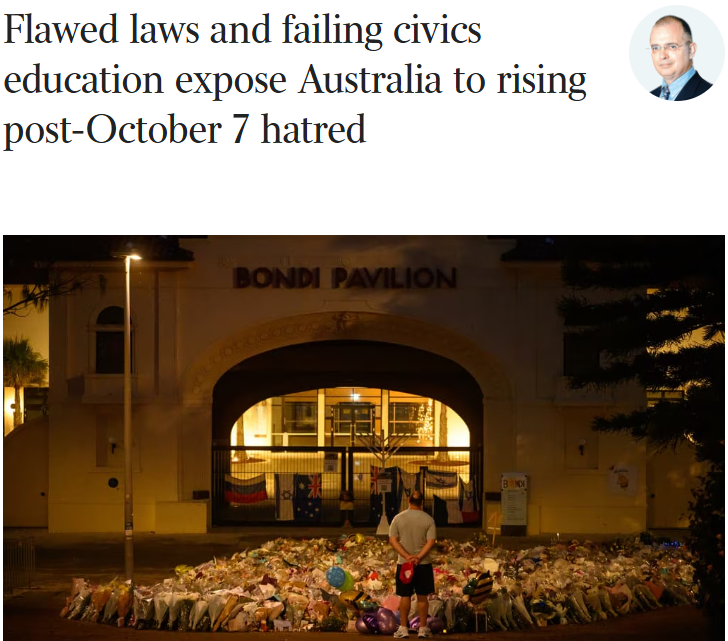
Next Wednesday marks the anniversary of two failures of public policy. One was inflicted from outside. The other we staged ourselves.
In Israel, the 2023 invasion by Hamas demonstrated that deterrence, however carefully maintained, is not a permanent shelter against those who treat its destruction as doctrine.
In Australia, 7 October became the opening night of a sustained assault on the principle that equal protection under the law is not negotiable by race, religion or imported grievance.
What we are confronting is a collapse of our own construction.
The law alone has proved unequal to the malaise that has turned universities and public squares into licensed theatres for the incitement of hatred and violence. Prosecutions remain rare. The avalanche of antisemitic abuse does not.
If the object is to reverse the wave rather than merely catalogue it, the sickness in the culture must be treated. That demands far more intensive civic education — not merely in the schools, but among those who arrive seeking permanent residence and citizenship.
At what point did the intolerable become the background noise we learned to ignore?
Hatred does not wait for a weapon. It becomes dangerous when slogans are repeated until their meaning is no longer examined, when intimidation is excused as passion, when abuse is rationalised as context, and when each boundary surrendered makes the next one cheaper to cross.
What has occurred in this country since 7 October is largely the product of our own naivety. Civic equality is so foundational to the architecture of our life that we simply assumed it arrived with the luggage.
We accept permanent residents and new citizens from regions where democracy and the rule of law are unknown quantities. The rules are identical for all. The preparation required to understand them is not.
By failing to supply that instruction to those who most need it, we have done ourselves no favours. The past three years have removed the last excuse for complacency.
When did we decide that importing people was the same thing as importing their attachment to the country they were joining?
Like a teenager who used to be bullied, China is bigger and stronger now but that past trauma lurks just beneath the surface, ready to be triggered at any point.
Perhaps one day it will grow up to be more relaxed and confident, less easily offended. But I doubt it. After all, the politics of victimhood is just too powerful and the CCP knows it.
This post touches the raw nerve of the Little Pinks. Hence I shall repost it again, just to press on this point: you can't accept that Japan is perceived more favorably than PRC amongst the international community; your narrative failed to gain traction. Go take a chill pill. 🙃
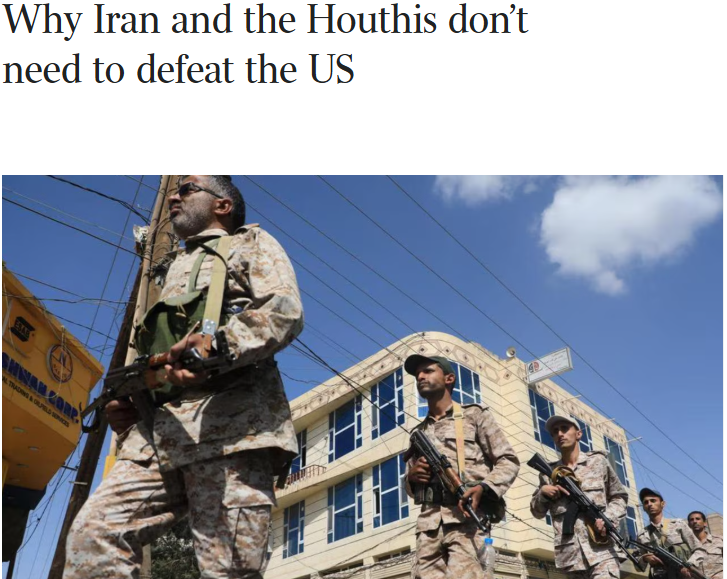
Iran and the Houthis don’t have to defeat America.
They just have to stop America converting its military superiority into a result Donald Trump is willing to keep paying for.
That’s it. That’s the whole strategy.
The Vietcong understood this in Vietnam. The Taliban understood it in Afghanistan. Survive the attacks. Make the war expensive, disruptive and politically ugly. Time does the rest. The stronger side has the weapons. The weaker side has the patience.
Iran and the Houthis are running the same playbook. And so far, it’s working.
Iran doesn’t need to match American aircraft, carriers, satellites or precision munitions. It just needs to make those advantages ruinously expensive to use.
Iranian and Houthi missiles and drones are cheap. Intercepting them with sophisticated American or Gulf air-defence systems is not. Even a successful intercept still burns ammunition, flies aircraft and keeps an elaborate defensive network running. The defender is paying premium rates to swat flies.
There is no single battlefield. Iran works through a network of partners and proxies. The Houthis have geography on their side in Yemen. The fight now stretches across Iran, Iraq, the Persian Gulf, the Red Sea and the approaches to the Bab al-Mandab Strait.
America has to be everywhere at once. Its opponents do not.
The Houthis don’t need to halt all Gulf oil exports. They only need to make shipping and energy infrastructure look vulnerable enough that insurance costs jump, routes change, production gets interrupted and oil prices rise.
That leaves Washington with a nasty choice. Protect Gulf shipping and infrastructure and you lock in an ever-larger American military commitment. Don’t protect it and your Gulf allies start wondering what the American security guarantee is actually worth.
The United States can defend its forces, its allies, its shipping and its critical infrastructure across the region. Doing all of that at the same time, against a spreading set of threats, is a different matter.
Military superiority stays overwhelming. Translating it into a clean political outcome gets steadily harder.
A US government watchdog report has already put the cost at $US37.5bn and recorded extensive damage to American facilities around the region. That number is only going one way.
Strategic victory for the weaker side does not mean sinking a carrier or occupying Washington. It means stopping the stronger side from turning its firepower into a result it can live with.
Iran and the Houthis do not have to win this war.
They just have to make Donald Trump decide the price is no longer worth paying.
How many more billions, how many more disrupted shipping lanes, and how much more political discomfort before that calculation changes?
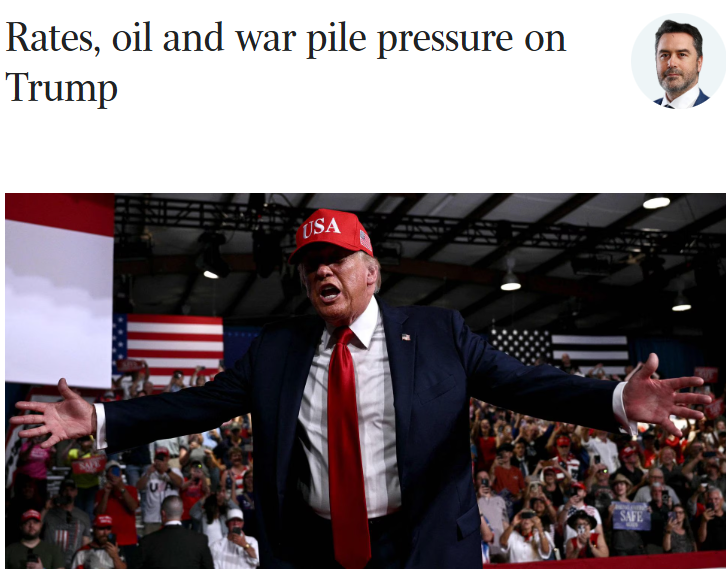
Trump demanded cheaper money.
His own Fed chair hiked rates instead.
Kevin Warsh — the man Trump installed — raised rates 25 basis points this week and said the quiet part out loud: inflation is “too high and has been for too long.”
No cut. No kneel. No political favour.
November midterms are weeks away. This is not the week you want.
An unpopular war with Iran. Houthis hitting shipping in the Red Sea. Brent crude already close to US$110 a barrel this month.
Then the fiscal mess. Debt fears. A Treasury sell-off. The 10-year yield punching through 5 per cent — highest since 2007.
Higher borrowing costs. Dearer energy. Voters feeling it in mortgages and at the pump. House and Senate control hanging in the balance.
Warsh chose price stability over the President’s calendar.
The question isn’t whether this hurts.
It’s how many seats it costs him.
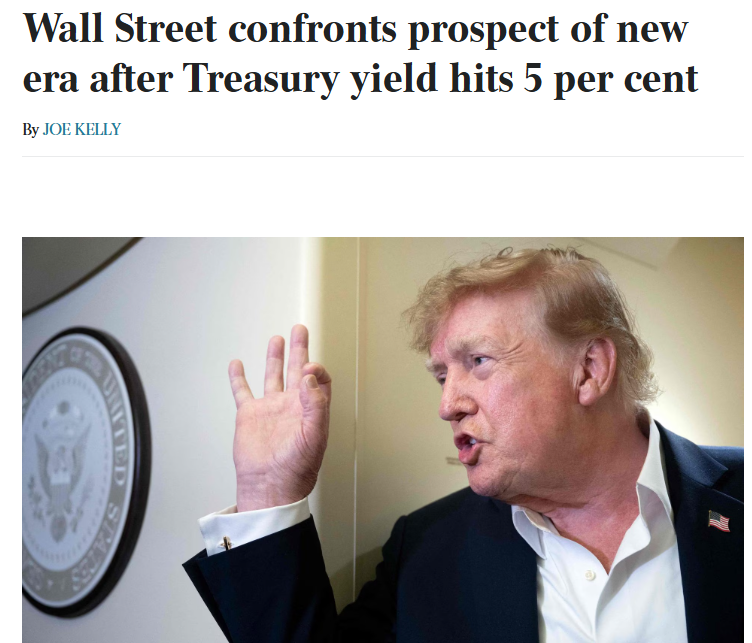
America just punched through 5 per cent on the 10-year Treasury.
Again.
Last time was 2023. This time the 30-year has hit 5.38 per cent — a level not seen since 2007.
In a fortnight the 10-year has ripped from below 4.7 per cent to over 5 per cent. Oil is surging. Inflation is still sticky. And the new Fed chair, Kevin Warsh, is being told to hike rates with the midterms eight weeks away.
Washington is now financing its vast deficits at the highest long-term borrowing costs in nearly two decades.
The bill lands on everyone else.
New homebuyers are paying nearly 7 per cent on mortgages. Other loans are worse. Firms that wanted to invest now think twice. Growth slows. Ordinary Americans end up poorer than they needed to be.
If rates stay even 80 basis points above the official forecasts, interest on the national debt hits $2.7 trillion a year by the end of the decade.
That’s more than Medicare. More than Social Security retirement benefits.
Interest begets debt. Debt begets interest. Eventually the spiral takes over.
A fiscal crisis used to be “unthinkable”.
It isn’t any more.
When the bond market starts writing fiscal policy, who do you reckon blinks first?
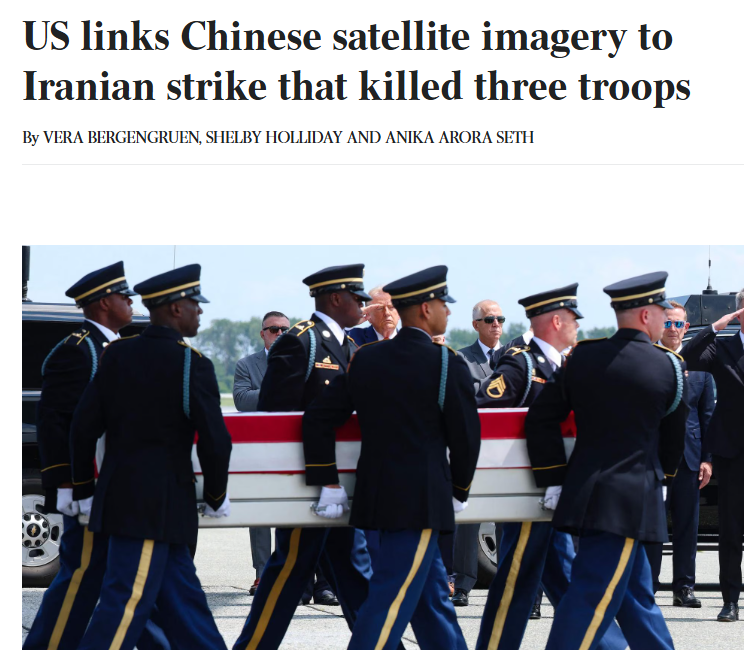
China handed Iran high-resolution satellite photos of the US base in Jordan.
Three American troops are dead.
That’s not a rumour. That’s what US officials now say they can prove.
Before the 17 July attack, Tehran acquired those images from Chinese entities. Officials familiar with the incident have connected the imagery directly to the strike.
It is the clearest evidence so far that Chinese support for Iran during the war has had lethal consequences for US forces.
Senior American officials raised it with their Chinese counterparts.
Beijing’s response? Push back. Demand proof. Dismiss the lot. Refuse to accept that any Chinese companies are involved.
Trump has told his team that maintaining good relations with China — and Xi in particular — is the priority.
So officials are busy avoiding any public confrontation that might overshadow or derail the summit.
A White House official even claimed that no outside assistance had enhanced Iran’s ability to attack the United States.
They just didn’t address the satellite pictures.
This isn’t new. Iran’s access to Chinese satellite imagery has been a recurring point of tension for years.
China’s satellite industry blurs the line between commercial and state on purpose. Even the ostensibly private firms operate under extensive government oversight and many have direct links to the Communist Party.
They know. They just don’t want to say it out loud while the summit is still on the calendar.
How many more American troops have to die before “good relations with Xi” stops being more important than the truth?
Singapore just came first in reading.
Second in maths. Second in science. Second in the brand-new computational problem-solving test.
6,551 fifteen-year-olds. 157 schools. No participation trophies.
They break down messy real-world problems, design algorithms, and actually solve them. Meanwhile half the OECD is still arguing about whether times tables are oppressive.
Singapore also has one of the highest shares of top performers and one of the lowest shares of kids who simply cannot keep up. Fifteen per cent of our students are academic all-rounders — top in reading, maths *and* science. OECD average? Three per cent.
The results are not subtle.
Meritocracy works. High standards work. Selecting by ability works.
You can lower the bar, rename failure “equity”, and wonder why your PISA scores keep sliding. Or you can look at the table.
How many more international league tables does the West need before it admits that pretending every child is equally gifted is just expensive cruelty?
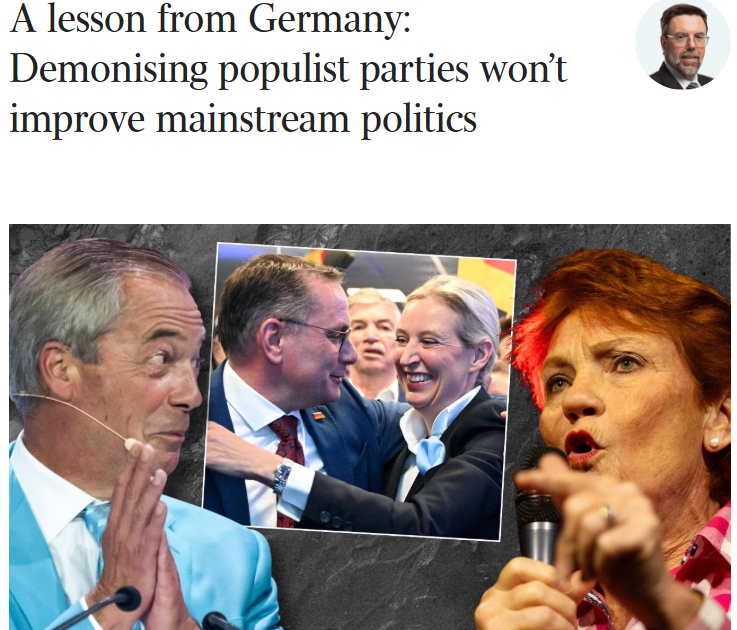
Flying the Pride flag from every public school is not a test of whether you live in a democracy.
AfD wants them taken down. Some of its culture-war stuff is a bit nutty. This bit isn’t.
Democracies should be tolerant of everybody’s sexuality. Good. That is not the same thing as requiring the rainbow flag to fly from every state school in the land.
There are, certainly, elements of the AfD that give rise to legitimate concern. One of their worst is their sympathy for Russia and Vladimir Putin.
But the European establishment helped drive some of those right-wingers into Russian arms. Mainstream banks for a time wouldn’t deal with Le Pen’s movement in France. Farage was briefly de-banked in Britain. So Le Pen’s lot went to Russian banks.
Banks should not be running an absurd political censorship operation in any democracy. Behaviour like that is a perfectly good argument for renationalising them, or at least regulating them so they stop playing politics. The same banks that refuse to finance fossil-fuel projects in Australia never asked the voters for that job. Who voted for the banks?
The same dynamics operate in Australia, just less intensely.
The obscene Bondi massacre produced a huge rise in One Nation’s support. At first it looks strange. What’s the connection?
It convinced a lot of voters that both major parties had made a mess of the country. Look what you’ve done to my country, was the cry.
The one figure in Australian politics who has stood most clearly against unregulated immigration from the Middle East, and from South Asian nations with strong Islamist traditions, is Hanson. Her position may have been right or wrong. It has never been unclear.
Immigration populists are reshaping Western politics. That is a historic failure by the mainstream parties.
Shooting the messenger is no solution.
If voters keep walking towards the parties the establishment spent years calling illegitimate, whose failure is that?
MAHIYA NAMAN KAYO | Secretary of National Defense Gilberto C. Teodoro, Jr. responded to a note from the Chinese side during the Seoul Defense Dialogue (SDD) 2026 in Seoul, Republic of Korea.
#DNDPHL#DiKaPasisiil#SDD2026
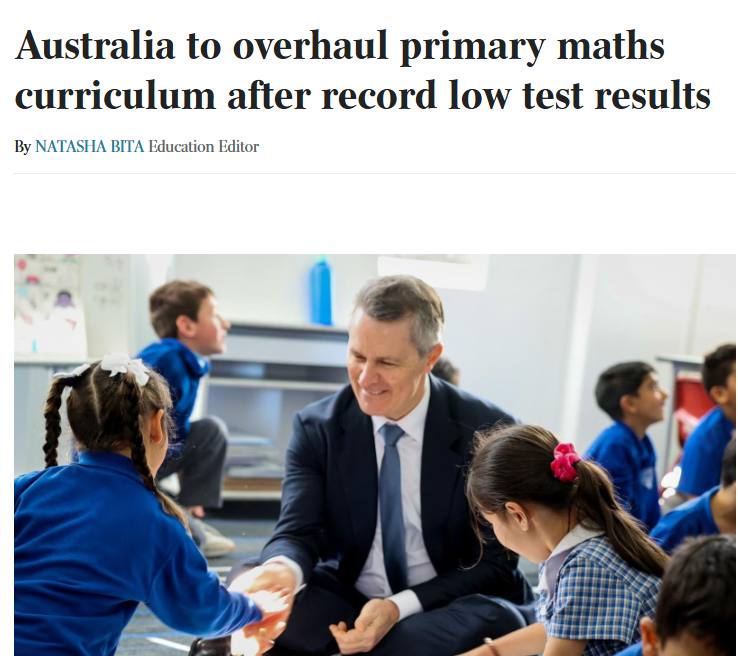
Australian teenagers are now two years behind the students who sat the equivalent test 20 years ago.
Half of them struggle with basic reading and mathematics.
Federal Education Minister Jason Clare wants Australia to copy the United Kingdom: mandate old-school explicit instruction and phonics-based reading to stop the slide.
The Asian tiger economies — China, Singapore, Japan and Korea — smashed the global test. Chinese 15-year-olds are performing at a level six years ahead of Australian students. That means a Year 10 student in China is operating at the level of an Australian university student.
Even in reading, the Chinese kids are two years ahead.
If our schools are producing kids two years behind their own parents and China’s are six years ahead, why are Chinese families still lining up to send their children into Australian classrooms?
🐼China is edging, step by step, into Japan's trap
There is a particular kind of headline that Beijing would rather not have to write twice, and this week it wrote it again. China's Ministry of Finance has pumped upwards of 300 billion yuan into eight financial institutions: 100 billion into Industrial and Commercial Bank of China, of which the ministry supplied 70 billion; 160 billion into Agricultural Bank of China, 130 billion of it from the state, the remainder shouldered by China Tobacco; 35 billion into China Life. The list goes on, each figure more forgettable than the last, and that is rather the point — a recapitalisation dressed up as routine business.
It is not routine. This is only the second such rescue since 2023, when Beijing issued 520 billion yuan in bonds to shore up the banking system's liquidity. On the day the latest injection was announced, shares in all forty-two of China's listed banks fell — Industrial and Commercial Bank, China Construction Bank, China Life, Minsheng Bank, the lot. Markets, unlike ministries, do not pretend not to have noticed.
🐼The bill nobody wants to open
Hui Ka Yan, the founder of Evergrande, has been sentenced to life imprisonment, which offers a certain narrative satisfaction and settles nothing whatsoever. He walked away, in effect, from two trillion yuan in bank debt, and that debt has not vanished merely because its architect is now behind bars. Nobody in Beijing has volunteered to establish precisely how much of it the banks are still quietly absorbing, because to ask the question is to invite an answer nobody wants. The result is a banking sector trading, without exception, below book value across all forty-two listed names — Minsheng Bank, Evergrande's largest lender, worst of all, at a price-to-book ratio of just 0.22. A bank valued at little more than a fifth of its stated worth is not being modest. It is being disbelieved.
🐼The decade consumption forgot
China's property bubble has now run a full decade since 2017, and the first casualty, as ever, was the willingness to spend. Wang Wang, the snack conglomerate whose fortunes track the Chinese consumer about as faithfully as any single stock can, has fallen below three Hong Kong dollars. Shein's Hong Kong listing dropped for three consecutive days the moment trading opened. None of this is coincidence; it is the arithmetic of a population that has watched the value of its principal asset fall and has concluded, reasonably enough, that cash in hand beats cash spent.
🐼A lesson Japan already sat through
What comes next is worse than falling prices. It is the grinding, decade-spanning discipline of deflation, and Japan wrote the manual whether China cares to read it or not. After 2001, Japanese life insurers buckled, banks failed in clusters, and the survivors spent years merging themselves into financial holding companies simply to stay upright. All the while, and quite against the wishes of anyone trying to export their way out of trouble, the yen kept rising — climbing, even as the 2011 earthquake and tsunami left the country reeling, to 75.35 against the dollar.
Worse followed. Japanese interest rates fell to zero and beyond; ten-year government bond yields dipped to minus 0.27 per cent. The lower rates fell, the stronger the yen grew, and the less inclined ordinary households felt to spend a yen of it. Businesses and households refusing to borrow at any price, however cheap, and instead racing to pay down what they already owed. It took Japan thirty years to climb out.
🐼The currency that will not behave
Around 2017, Washington leaned on Beijing to let the yuan rise, and Beijing, characteristically, refused — economists lined up to warn that China must not repeat Japan's mistake. Now nobody is asking. The pressure has stopped and the yuan has strengthened anyway, of its own accord, even as Chinese interest rates keep falling. Falling rates and a rising currency, together, are precisely the combination that makes deflation hardest to bear — the one moment in the cycle when a country has the least room left to manoeuvre.
🐼Capital voting with its feet
Beijing has responded by tightening the screws elsewhere: heavier taxes on companies, larger fines, stricter oversight from the centre. The predictable consequence is that insiders are working harder than ever to move their money offshore, and the tighter the regulatory grip, the faster the capital slips through it, flowing in exactly the direction the state least wants.
If none of this changes, China's next decade will be harder than its last. Hui Ka Yan has his life sentence and his ledger has been quietly closed by the state that once financed his empire. The bill, however, does not know it has been closed. It is still sitting in forty-two banks' accounts, waiting, with the patience only a balance sheet can manage, to be opened again.
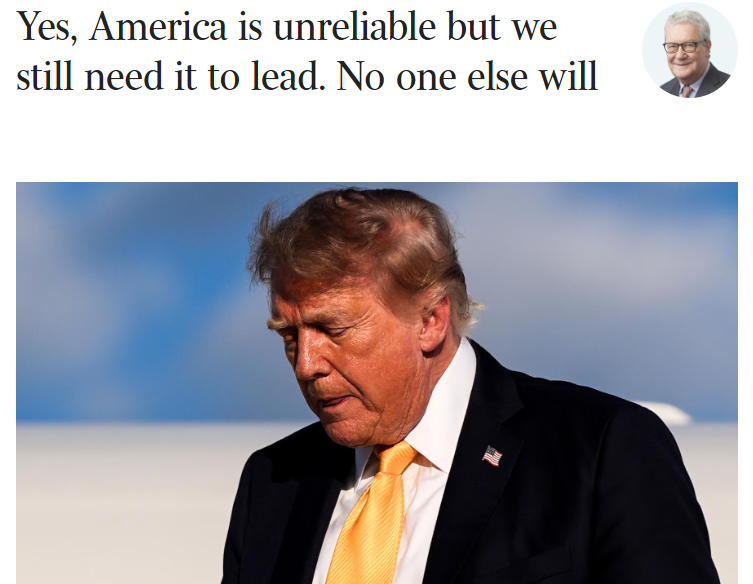
America is indispensable.
America is also unreliable.
Both things are true. Pretending otherwise is how you get blindsided.
Look at the record, not the speeches.
They turned up three years late to the First World War.
Two years late to the Second.
They sided with Nasser against Britain and France over the illegal nationalisation of the Suez Canal.
They left close allies hanging during Confrontation with Indonesia.
They abandoned South Vietnam in 1975.
They threatened to punish Assad if he used chemical weapons, then did nothing when he did.
They did nothing serious about Russia’s seizure of Crimea in 2014.
They fled Afghanistan and handed the country to the Taliban.
Since then they have slapped tariffs on their own allies — particularly vicious towards the Canadians — and even threatened to invade Greenland.
Yes. Unreliable.
Expect it. They have their own political cycles, their own domestic chaos, and a political culture that is starkly different from ours.
But for more than a century the United States has also been the indispensable power.
Since 1941 it has been the main bulwark against extremist totalitarian ideologies. It was central to the defeat of Nazism and fascism in Europe and Japan. More than any other country it held back communism during the Cold War, and it was the Americans, more than anyone else, who helped free Eastern Europe from it.
For all its faults and mistakes, America led the liberal democracies against the worst ideologies of the age.
If America retreats into itself, Russia prevails in Ukraine. Europe has helped, of course. But after the Cold War we pocketed the peace dividend and spent it on welfare and windmills. We still need America to underwrite the effort.
China wants to rewrite the rules and reduce the Indo-Pacific to tribute states. It claims the whole South China Sea and Taiwan. The only thing standing between that ambition and an independent region governed by international law is the balance of power — and that balance requires America.
Go almost anywhere in ASEAN and ask thoughtful people in foreign ministries and think tanks whether the region would benefit from America abandoning its alliances with Japan, Australia and the Philippines and closing its bases. They will tell you they want America to stay.
Much of the current antipathy is just dislike of Donald Trump. That is a serious mistake.
Do not confuse the personality of the current President with the geopolitical necessity of the alliance. Trump is not the cause of a changing America. He is a symptom of it.
Liberal democracy still has enemies. It still requires endurance, patience, courage and perseverance.
We still need America to lead.
No one else will.
Is it more dangerous to depend on an unreliable America — or to pretend we can manage without it?
Far left. Far right.
Same poisonous endgame: Jew-hatred dressed up as principle.
El-Sayed’s campaign was textbook green-red alliance. Left-wing campus radicals and activist America-bashers yoked to an obsessive loathing of Israel and Zionism that flatters a sizeable chunk of Michigan’s Muslims. Classic.
The right does the mirror image. “America First” nativism slides into hostility aimed not at China, Russia or Iran, but at Israel — on the pretext that Israel and “the Jews” drag an innocent, naive Washington into endless wars. Appreciation of Christianity’s role in American history mutates into medieval hatred of Judaism itself, recycling prejudices every decent Christian long repudiated, to fuel a deformed, racist Christian nationalism.
What’s frightening is how wide a following both extremisms now enjoy. Both are deliberately using social media to drag ancient lies and pure hatred into the centre of the public square — turning the crackpot into the mainstream.
Look around. The same social breakdown, the same crisis of meaning, the same surge of extremism among the young (especially young men) that characterised Weimar Germany in the 1920s and 30s. Decadent. Corrupt. Ineffective. Tragic.
Different generations live in different information silos. Young people have grown up where everything is fluid. They distrust the traditions and institutions of their own society. AI and the internet mean many no longer even know what truth is. Weimar’s core weakness was the loss of logos. We’re watching the same thing happen.
Isolated, radicalised young people fall for conspiracies that swarm online. And whether you’re a nutter on the left or a nutter on the right, once you swallow the conspiracies you end up scapegoating Jews — if only because Jews have sat at the centre of conspiracy theories for thousands of years.
That’s why the extremes resemble each other so closely.
How far does this have to go before enough people admit we’re repeating the Weimar pattern in real time?