@Safaricom_Care can someone help me with answers? I went to customer care didn't get satisfactory feedback. I've followed up but not received a call back. It's been almost a week. Can someone support me with a solution?
In 2008, Malcolm Gladwell explained why some people succeed and some don't in a single 1-hour talk.
This will permanently change the way you think about talent, effort, and success.
Bookmark & watch today, no matter what.
I’m in love with this sentence:
“The degree to which a person can grow is directly proportional to the amount of truth they can accept about themselves without running away.”
A reminder from The Subtle Art of Not Giving a F*ck by Mark Manson:
“Happiness comes from solving problems. The keyword here is "solving." If you're avoiding your problems or feel like you don't have any problems, then you're going to make yourself miserable. If you feel like you have problems that you can't solve, you will likewise make yourself miserable. The secret sauce is in the solving of the problems, not in not having problems in the first place. To be happy we need something to solve. Happiness is therefore a form of action; it's an activity.”
To win long term, it requires deep alignment
You have to get your own values and goals in alignment
Otherwise you’re fighting a battle in two fronts, the one of building your business as well as the one of your own competing goals
Alignment gives your goals synergy
I used to open ChatGPT and type whatever came to mind. The results were average. Not bad. Just forgettable.
Then I stopped treating it like a search bar and started treating it like an assistant that needs clarity.
Everything changed.
Here are the prompt frameworks I now use almost daily. They save time. They remove guesswork. And they consistently produce better output.
1. When I need rewriting Instead of saying “make this better,” I write: Rewrite this. Keep the core message. Improve clarity and flow. Adjust the tone to be more professional. Remove weak phrasing and repetition.
The difference is night and day. Clear constraints produce clear results.
2. When I need a summary I ask for three layers: Give me the TLDR in one sentence. Then three key points. Then the one thing I should remember tomorrow.
This forces focus. Not fluff.
3. When I want to understand something deeply Explain this at three levels. Like I’m a beginner. Like I know the basics. Like I’m almost an expert who needs nuance.
4. You stop getting surface level answers.
When I’m stuck I don’t ask for solutions first. I say: I’m trying to achieve X but stuck on Y. Ask me diagnostic questions before giving advice.
Most of the time the real problem isn’t what I thought it was.
5. When making a decision For each option, tell me the best case outcome, worst case outcome, most likely outcome, and who this option suits best.
This removes emotion from the equation.
6. For meetings List the questions they’ll ask me. List the questions I should ask them. Tell me what could go wrong.
Preparation becomes strategic, not reactive.
7. For content ideas Give me 10 ideas. First five practical. Last five unexpected and overlooked. Include a strong angle for each.
It prevents generic content.
The pattern is simple.
Clarity of goal. Defined structure. Specific constraints. Expected format.
Most people blame the tool. Rarely the instruction.
Better prompts are not about being clever. They are about thinking clearly before you type.
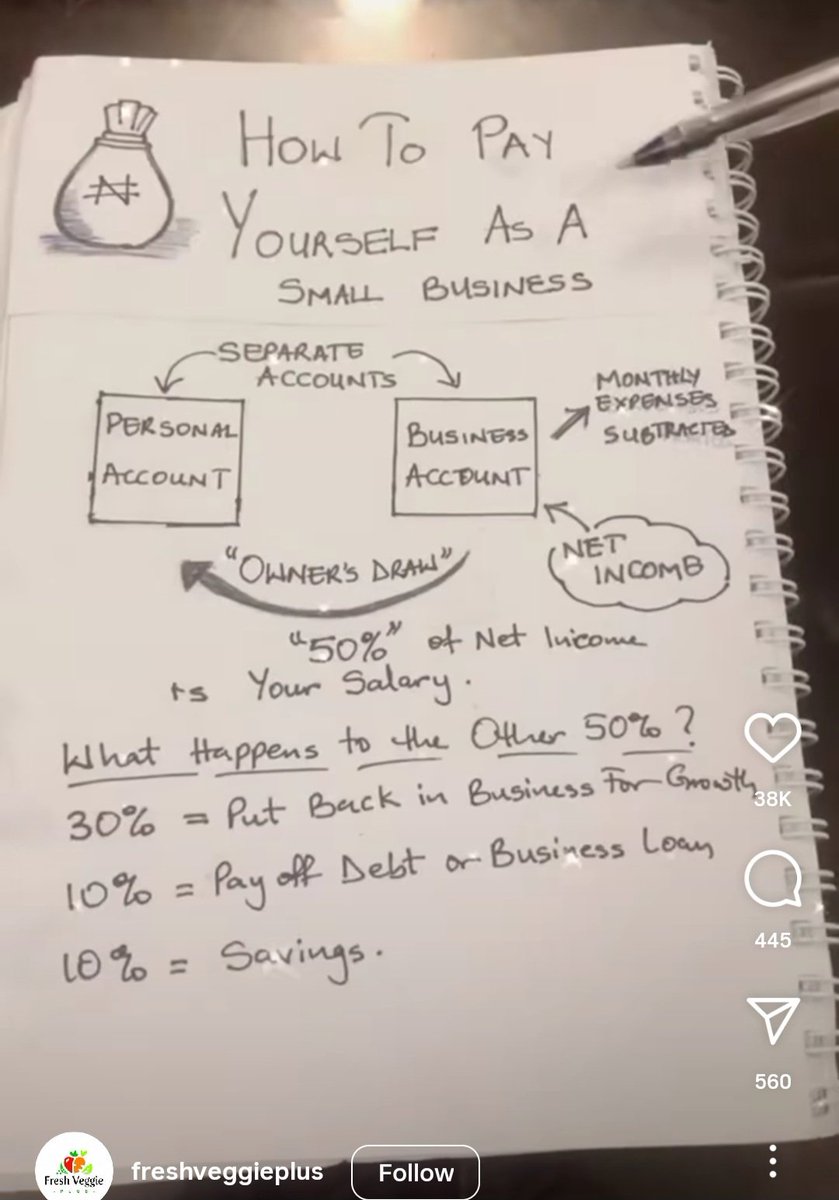
HOW TO PAY YOURSELF AS A SMALL BUSINESS OWNER
I came across this online, and since I’ve tried it myself, I can confidently recommend it to any small business owner (SBO) struggling with cash flow.
One major mistake most SBOs make is running business transactions through their personal accounts. This rookie mistake often leads to overspending and poor financial control. To avoid this, you must have two separate accounts: one for your business and one for personal use.
All business expenses should be paid strictly from the business account. This makes it easier to monitor expenses and accurately determine your profit margin at the end of a given period.
I also recommend using a simple Excel template to record and track your revenue and expenses daily. This way, you can easily assess the financial health of your business at a glance.
At the end of the month, after deducting all expenses, such as staff salaries, raw materials, supplies, staff motivation, transportation, marketing, taxes, miscellaneous costs, etc., from your revenue, whatever remains is your income.
This is where many SBOs become lazy and undisciplined. They start spending the income recklessly because they believe they can always make the money back and don’t answer to anyone. After all, it’s “their money.”
You can not have this mindset if you plan to grow and expand your business.
Instead, do this:
1. Pay yourself 50% of the income as an employee
There is you, and there is your business. Treat your business as a separate entity. When closing your books for the month, pay yourself a salary just as you pay your staff. Transfer this 50% into your personal account. This should cover your personal savings, expenses, and enjoyment.
2. Reinvest 30% of the income back into the business
This does not have to be spent immediately if there’s nothing urgent to purchase. You can set it aside until it’s enough to acquire new equipment or fund business growth. Just ensure the money is strictly reserved for the business.
3. Use 10% to pay off debt or business loans
If your business is debt-free, you can add this percentage to your business savings.
4. Save 10% in an interest-yielding platform
This savings is for your business, not your personal savings. Over time, it helps build financial stability and future expansion capacity.
I hope this helps someone out there. Financial discipline is especially challenging when you run a business that brings in daily income, but it’s also what separates sustainable businesses from struggling ones.