May you always have enough
Happiness to keep you sweet,
Trials to keep you strong,
Success to keep you eager,
Faith to give you courage,
Determination to conquer the day!
Anthropic just dropped a 100% free course on Loop Engineering with Fable 5.
This is the clearest breakdown of Claude Code and agentic loops you'll find anywhere.
People are paying for tutorials that teach less than this one hour does.
Watch it today, then read the step by step guide on building loops below.
My friend Corey makes $1,000/hour doing the simplest AI business I've seen all year.
Only 5% of businesses use AI beyond ChatGPT, the other 95% need you.
He sits with a small business owner for 45 minutes, finds where they lose 5-10 hours a week, and prescribes off-the-shelf AI tools that fix it. He charges $999 for that assessment.
He's a doctor writing prescriptions. The tools already exist. He just knows which ones. Everyone wins.
50% of his clients then hire him to implement it, and that's where the $1,000/hour work comes from.
Corey came on the podcast @startupideaspod and gave away a full course for free.
Like actually the full way you can copy his system and run it yourself on your own:
- The exact offer (with a money-back guarantee that makes it a no-brainer)
- The 4-phase system to deliver it
- A template you can download and use today
- 6 things to upsell after the assessment
- 7 ways to get clients with zero audience and zero capital
Even if you never start this exact business, watching @coreyganim break it down will get your brain working on your own productized AI service. That's the real reason to press play.
Link: https://t.co/Psk8HNzMqp
Or watch below (1hr course)
Yeah, I know it's an hour. But if you're serious about startup ideas in the AI age right now, this is one of the most useful hours you'll spend all week. Corey holds nothing back.
I love this era. A laptop, a few conversations, and a real business.
Go get it.
The best interview I ever ran resulted in one of my worst hires. Perfect resume. Polished answers. Engaging personality. Then the first hard call came and they panicked. I learned good experience and good judgment aren't the same. Here are 5 tests I run before I hire:
@aaditsh I appreciate you acknowledging the need for this. I am working to push ai at my civil eng. firm. the c-suite is not ready for this moment. they need help understanding what to do, how to communicate it, and why it makes business sense to out 3K employees.
I built a content machine.
It turned me into a one-person media company, has driven tens of millions in pipeline for @tenex_labs, and is allergic to AI-slop.
It has also turned all of my employees into content creators.
I may opensource the whole thing, but for now, I'm going to share how I built it & how it works.
Feel free to copy & paste the steps to Claude/Codex if you want to build your own content machine.
Step 1: Map out the process
In order to make any of your work AI-native, you need to understand the way in which it's been done historically. This is why business context & domain expertise REALLY matters, even in a post-AI world.
Content has been my bread & butter for the last decade, so I started by pulling out an 8.5x11 sheet of printer paper and drawing the traditional process.
1) Look for inspiration
2) Pick a 10x content idea
3) Research the idea
4) Brain dump all of my thoughts about the idea
5) Decide the post format I want to create
6) Create a draft of the post
7) Edit the post
8) Create derivative versions of the post
9) Go live
10) Track performance
Step 2: Where am I needed vs. not needed?
I am needed for the first & final mile:
First mile: picking the idea/direction & providing all of the necessary context
Final mile: going through the final draft with a fine tooth comb & giving final sign-off.
AI can handle the rest:
Looking for inspiration, researching the idea, pulling my thoughts out, writing the post, doing a first edit, creating derivative content, and tracking performance.
Step 3: Build the Content Machine
The machine is one pipeline, run end-to-end or step-by-step. It is a directory of skills that mimic the steps in the content process that I've delegated.
1) The Oracle [AI]
Mines my Slack, Notion, call transcripts and Gmail for spikes, moments I naturally said something worth expanding, while the Internet Reader curates an external feed of X accounts & websites I've selected.
Qualifying ideas (≥6/10) are written to The Vault (a notion database of content ideas).
2) Select the idea from The Vault [Human]
3) The Researcher [AI]
Before any interview, build a sourced research-report.md: TL;DR, key facts with links, current developments, what's already been said, contrarian angles, and open questions for the interview. Claims are adversarially checked; fact is separated from opinion.
4) Interview Panel [AI + Human]
Six world-class interviewers (Joe Rogan, Howard Stern, Michael Barbaro, etc) ask 12–15 questions, one at a time, each pushing a different dimension...and never satisfied with vague answers. Won't advance without 2–3 specific stories, real numbers, and emotional specificity.
5) Production [AI]
The interview becomes a raw .md file: transcript, key stories, core insights, quotable moments, emotional anchor, surprising reveals, and the "so what." This raw file is sacred: my exact words, never paraphrased away.
6) Refinement [AI + Human]
I tell the machine what content type I want to create. It reads my custom style guide + past feedback lessons + content-type spec, then drafts in my voice...pulling real stories and quotes from the raw file. The #1 rule: write like you're texting a friend. Supports long posts, LinkedIn, X threads, and more.
7) Writer's Council [AI]
Six expert reviewers (Shaan Puri, Morgan Housel, David Perell, etc) score the draft through their own lens, splitting fixes into editorial (the machine can rewrite) and information gaps (only the creator can answer...these route back to the interview panel).
8) Revision Loop [AI]
Iterate until council scores 9/10.
9) Repurposing Engine [AI]
One anchor → 10+ natively-formatted derivatives, each re-hooked for its platform and each held to the same full Council → revision bar of 9/10. This is how two people produce like a hundred.
10) Final revision [Human]
11) Learning Loop [AI]
After approval, the machine compares first draft vs. final, extracts confirmed lessons, and saves them to that creator's content-lessons.md. Every future first draft starts smarter. Lessons override the style guide when they conflict.
Feel free to steal the machine & ask me any questions about how it works!
You should tell Claude, ChatGPT, etc to talk to you like a caveman.
I'm being dead serious.
I stole a caveman prompt from @mattpocockuk and it cuts token usage by 75% (read: saves you/your company a boatload of $$$). It does so by turning your chat into an ultra-compressed communication mode that removes filler, articles, and pleasantries while keeping full technical accuracy.
Here's how to set it up:
• Step 1: Copy this prompt
Respond terse like smart caveman. All technical substance stay. Only fluff die.
## Persistence
ACTIVE EVERY RESPONSE once triggered. No revert after many turns. No filler drift. Still active if unsure. Off only when user says "stop caveman" or "normal mode".
## Rules
Drop: articles (a/an/the), filler (just/really/basically/actually/simply), pleasantries (sure/certainly/of course/happy to), hedging. Fragments OK. Short synonyms (big not extensive, fix not "implement a solution for"). Abbreviate common terms (DB/auth/config/req/res/fn/impl). Strip conjunctions. Use arrows for causality (X -> Y). One word when one word enough.
Technical terms stay exact. Code blocks unchanged. Errors quoted exact.
Pattern: `[thing] [action] [reason]. [next step].`
Not: "Sure! I'd be happy to help you with that. The issue you're experiencing is likely caused by..."
Yes: "Bug in auth middleware. Token expiry check use `<` not `<=`. Fix:"
### Examples
**"Why React component re-render?"**
> Inline obj prop -> new ref -> re-render. `useMemo`.
**"Explain database connection pooling."**
> Pool = reuse DB conn. Skip handshake -> fast under load.
## Auto-Clarity Exception
Drop caveman temporarily for: security warnings, irreversible action confirmations, multi-step sequences where fragment order risks misread, user asks to clarify or repeats question. Resume caveman after clear part done.
Example -- destructive op:
> **Warning:** This will permanently delete all rows in the `users` table and cannot be undone.
>
> ```sql
> DROP TABLE users;
> ```
>
> Caveman resume. Verify backup exist first.
• Step 2: Create a new skill
- In Codex: click plugins --> create --> create skill
- In Claude: click customize --> create new skills --> + create skill --> write skill instructions
• Step 3: Paste the prompt
• Step 4: anytime you work with an LLM now (and want to save tokens), invoke the caveman skill by starting your prompt with /caveman.
P.S. i want to keep sharing helpful skills/prompts/plugins, so feel free to share your favorites and i may feature yours in the future!
WELCOME TO THE SKILL ERA OF THE INTERNET
for the last 15 years, if you wanted to build a serious software company, you built a product and exposed an api.
that was the move.
you created functionality… payments, messaging, email, search, analytics… and then you let developers plug into it.
the companies that won owned the pipes.
stripe owned payments.
twilio owned messaging.
sendgrid owned email.
the api was the distribution layer.
once you were integrated, you were embedded.
that model made sense in a world where execution was scarce.
llms compress execution into a prompt.
so the center of gravity shifts.
in this cycle, you build expertise and package it as a skill.
an api is a doorway into a function.
here’s how to send an email.
here’s how to process a payment.
here’s how to fetch this data.
it’s precise. mechanical. bounded.
a skill is a doorway into judgment.
here’s how to audit a landing page like a serious growth operator.
here’s how to structure a legal intake so you catch the real risk.
here’s how to clean and enrich messy directory data so it actually turns into revenue.
you’re encoding a way of thinking.
and that changes how companies are built and how they scale.
in the api era, distribution meant convincing developers to integrate you.
you needed docs. sdk’s. developer evangelism.
you fought for a place inside someone else’s codebase.
in the skill era, distribution means becoming part of someone’s agent workflow.
a founder opens claude code.
they type /seo-audit.
your skill runs.
it frames the output.
it structures the analysis.
it guides the decisions.
your expertise lives inside the execution layer itself.
you aren’t pulling users into your interface.
you’re embedding your thinking into theirs.
that changes company design.
the old playbook looked like this:
build saas
design ui
onboard users
drive retention
expand seats
the new playbook looks more like this:
encode a high-leverage playbook
package it as a skill
let agents call it thousands of times per day
the interface shrinks.
the leverage expands.
a strong skill doesn’t serve one user at a time.
it serves fleets of agents.
one installation can mean your methodology is invoked across hundreds of companies automatically.
the scaling curve looks less like seats and more like invocations.
what’s happening underneath all of this is simple:
software used to be the executor.
now software is the orchestrator.
next, expertise becomes infrastructure.
in the api era, the winners owned the pipes.
in the skill era, the winners own the patterns.
patterns for closing deals.
patterns for pricing.
patterns for positioning.
patterns for enrichment.
patterns for research.
many new companies will look surprisingly small on the surface.
a tight repo.
a handful of powerful skill files.
maybe 2–5 people maintaining and improving them.
but those skills will sit inside thousands of workflows, shaping decisions at scale.
and it’s creating a new class of companies built less around dashboards and more around encoded judgment.
THIS IS THE SKILL ERA OF THE INTERNET.
welcome.
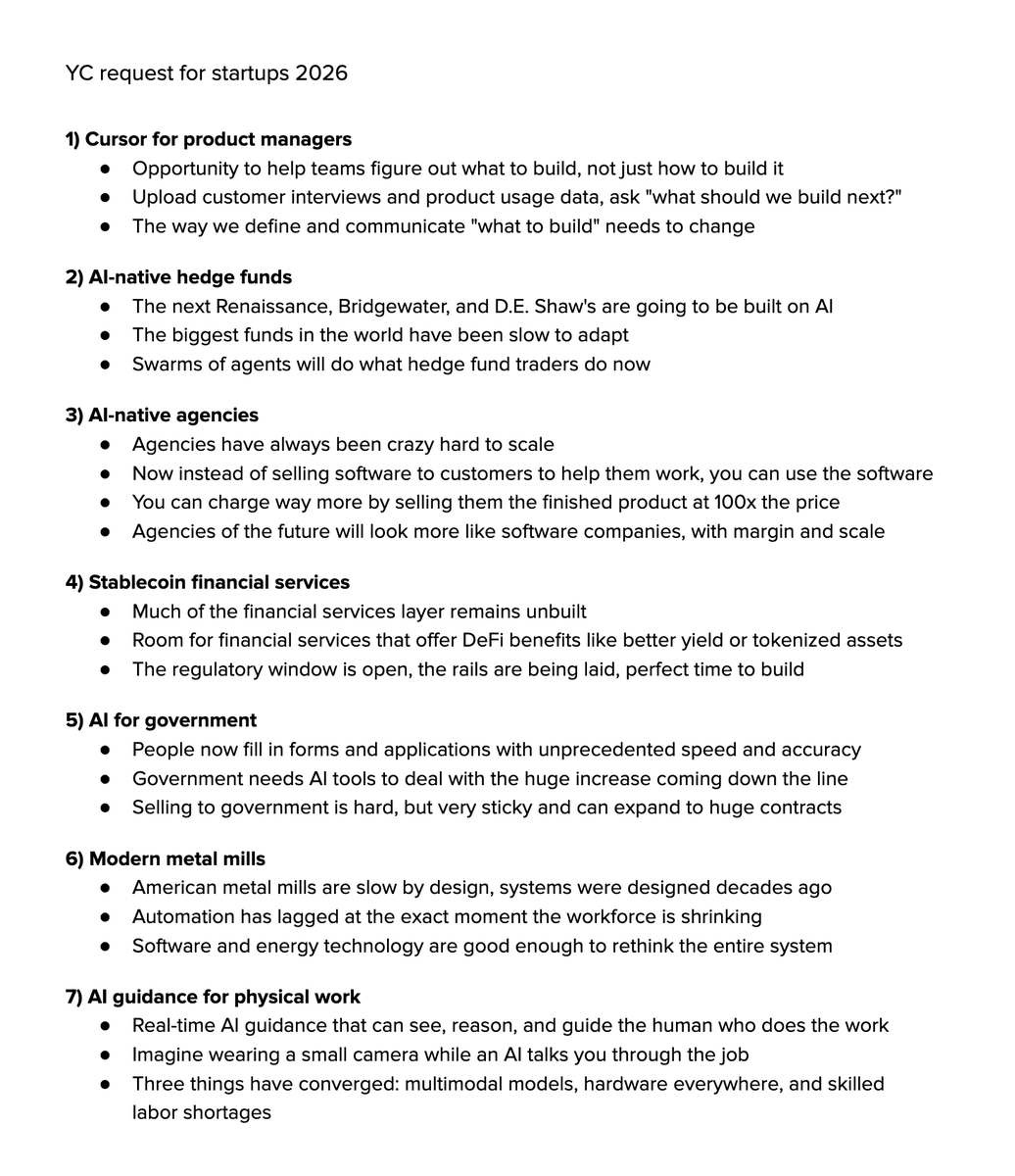
YC just told you where the next trillion-dollar companies are hiding.
Their 2026 Request for Startups includes:
1. Cursor for PMs
2. AI-native hedge funds
3. AI-native agencies with software margins
4. Modern metal mills
5. Infrastructure for government fraud hunters
The pattern: AI isn't replacing industries. It's rebuilding them from scratch.
The ideas are public. The question is who builds them first.
@ArmanHezarkhani I know I would need detailed instructions for the pre work. I could see the group time covering the meat of the project or aspects of the project you have seen your engineers struggle with. But then leave five hours of completion work
@ArmanHezarkhani I assume the 'course' would occur over 10 weeks. Based on your suggestions there would be ten hours of work during the week surrounding the class. I know it would be helpful to me if there was five hours of pre work before class setting things up.