Today we are introducing KaspaDollar, an initiative led by core developer @asaefstroem to build the first decentralized stablecoin on the $KAS network.
The developments around @kccforum and the Toccata hardfork have considerably widened what Kaspa is capable of. Capability alone, however, does not make an ecosystem. Decentralized finance requires a unit of account that holds its value, and until Kaspa has a stablecoin of its own, every application built on it will remain dependent on assets issued elsewhere.
The design we intend to follow is the decentralized, overcollateralized stablecoin: a pattern whose security properties have been examined and tested across the industry for the better part of a decade. With the support of the core team, we consider the conditions right to bring it to Kaspa.
Realizing this requires development, an independent audit, further research, and the operational work of taking a protocol from specification to production. To fund it, we are opening a fundraiser with a target of 5,000,000 KAS.
Contributions are made directly to the fundraising address published on the website. Should the target not be reached by 1 January 2027, every contribution will be returned to the address from which it was sent.
Up until that point, this account will share the plans, details and progress of the work as it develops.
This is a really important milestone because it allows developers to finally start building "composable" apps.
KCC means "Kaspa Calls for Conventions" and it is an effort to define standards that can be shared across the ecosystem.
For apps to be composable, it is not enough that they can call each others functions and observe the results, but they also need to be able to "understand" the data they see.
Instead of having each app manually implement the "proprietary language" of all the other apps, these KCC's establish a "common language" that is understood by everybody.
So while this doesn't introduce new "on-chain" features, it enables developers to write apps that can be composed without the apps having to know about each other.
There will of course be additional standards in the future but these three are arguably the most important ones because they cover the foundations and how tokens / assets are modeled (which is essential for DeFi and anything related to decentralized governance).
Kaspa is growing up so fast! 😱
PS: If you are building on Kaspa, please drop me a DM - I would love to hear about your project!
i’m working with @IzioDev on Argent’s release, though it seems rather usable at the moment as well bcs ppl can audit the generated sil files.
and there’s a lot to do outside the consensus layer to make the whole programmability stack more and more approachable.
i’ll also eventually share a whole lot of work going on with DK
The next evolution of Kaspa will not only be about making money move faster. It will also be about making money intelligent.
Consider a future where economic activity no longer requires humans to initiate every transaction, approve every agreement, or supervise every exchange. Millions of autonomous agents could negotiate contracts, purchase computational resources, provide services, and coordinate entire supply chains. But this creates a fundamental problem: how do machines transact with one another without trusting the machines themselves?
This is where Kaspa's emerging architecture becomes particularly interesting.
Toccata introduced native covenants, transaction introspection, and zero-knowledge verification. KIP-21 provides application-specific sequencing commitments, while vProgs is being developed to execute complex computation outside consensus and prove its correctness on Layer 1.
Individually, these are technical improvements. Collectively, they suggest something considerably more profound: the possibility of a programmable economic environment where trust is increasingly transferred from institutions and software operators to cryptographically enforced rules.
Imagine an AI agent controlling $10,000 in operational capital. Instead of trusting its programming to behave responsibly, a Kaspa covenant could enforce spending limits, restrict destinations, and require specific settlement conditions. Even if the agent malfunctioned or became compromised, its authority would remain bounded by consensus-enforced constraints.
Now multiply that architecture across millions of agents.
An economy begins emerging where participants don't necessarily need to trust one another, share infrastructure, or even operate under the same administrative authority. They simply need compatible settlement rules.
And here's the deeper implication: as artificial intelligence reduces the cost of producing economic decisions, the demand for neutral, automated settlement infrastructure could increase dramatically.
Kaspa's opportunity isn't simply becoming another platform for decentralized applications.
It's becoming the economic coordination layer for autonomous intelligence.
Bitcoin demonstrated that money could exist without centralized issuance. Kaspa will help demonstrate how increasingly autonomous economies can coordinate without centralized permission.
The future of Kaspa will be less about humans using cryptocurrency and more about machines using economic freedom.
Hitler debió haber ganado la guerra. Como eso no ocurrió, ahora Francia es un ex país, donde los negros y los musulmanes, que ya son mayoría, aplican su propia ley y destruyen el país.
(with grok and sol)
---
An interesting design tension in state-carrying covenants that require lineage is how you manage a scarce global resource without forcing every update through a single UTXO.
A compressed design keeps the allocation map behind one Merkle root inside a single covenant UTXO. The covenant checks every transition against the rules. For a name service that means a sparse Merkle tree over the keyspace: registering a name proves the slot is empty, updates the root, and creates a separate ownership UTXO for that point.
U(R₀) → U(R₁) + Point(k)
Later transfers of the name can spend the ownership UTXO without touching the root, so they don’t contend with new registrations. Everything that changes the allocation map itself still has to spend the same root-carrying UTXO. Unrelated names serialize on it.
The other way is to partition the space. A split hands each range to its own covenant UTXO from the same lineage. The split has to preserve the global invariants: ranges don’t overlap, budgets still sum correctly, and it validates the contracts that receive the pieces. After that, each range can evolve independently for operations that stay inside it. Splits, merges, and transfers between partitions still need coordinated checks across the UTXOs involved. Otherwise the range UTXOs are independent, so updates in different ranges can proceed concurrently in the DAG.
Lineage is what keeps the pieces part of the same instance. Covenant IDs make this cheap: consensus already tracks which UTXOs belong to a given covenant, so a script only has to validate the local transition. The live range UTXOs (plus the ownership UTXOs for allocated points) are just the current leaves of that lineage. There’s no separate tree object stored on-chain.
@supertypo_kas’s dotk is a pure-partitioning version of this for names. It keeps the invariant that every key is either inside exactly one gap or is exactly one deed. Claiming a name consumes the gap that contains it and emits the remaining gap(s) plus a deed:
Gap((a,b]) → Gap((a,k)) + Deed(k) + Gap((k,b])
Releasing a name consumes the deed and adjacent gaps and merges them back together. The gaps and deeds have different rules, but every point stays accounted for exactly once.
The cost of the partitioned approach shows up in storage mass. KIP-9 makes creating many small-value outputs expensive, so each new range UTXO needs enough KAS locked in it to keep the mass reasonable. That’s intentional. Growing the live frontier means someone has to put capital behind the extra state. Designs that let users opt in, fund additional range UTXOs while the capacity is useful, and later reclaim the KAS by merging ranges again turn that cost into a controllable design choice. The expand-and-contract frontiers in the kcc20 reference code follow the same principle.
A practical middle ground is to start with a chosen number of range UTXOs and put a Merkle root inside each one. Lineage partitions the keyspace; each partition compresses its own allocation state. While that partition count stays fixed, the L1 footprint for the trackers stays constant, registrations in different ranges still don’t contend, and you avoid creating a new range UTXO for every name. You choose how finely to slice the space, how much KAS to lock behind the frontier, and how much residual contention you accept inside each partition.
Hashing helps distribute keys across ranges, but it doesn’t eliminate hot spots. If most operations land in one range you’re back to serializing on that root. At that point the app can allow further on-demand splits of a hot range, again costing locked KAS that users can later reclaim by merging, or just accept the serialization for that slice
Siempre es bueno recordar lo que le pasó a Vito Quiles cuando pisó hace un año Valencia.
Los falangistas cantando lo que la "izquierda radical" debería de cantar. Fue el mejor video del año pasado a nivel político.
La idea de que los Alemanes simplemente enloquecieron sin ninguna razón es pura propaganda enemiga
Cuando tu País es saqueado y explotado, tu pueblo empobrecido y la degeneración moral se vuelve norma, una reacción se desencadenará.
La Historia se repite y ésta vez es el Mundo
Madurar ideológicamente es dejar de creer que las elecciones cambiarán algo, es alcanzar tal grado de radicalización que te resulte indiferente quién gobierne. No esperas nada de las urnas y permaneces al margen cómo un tigre agazapado esperando el momento de atacar al régimen.
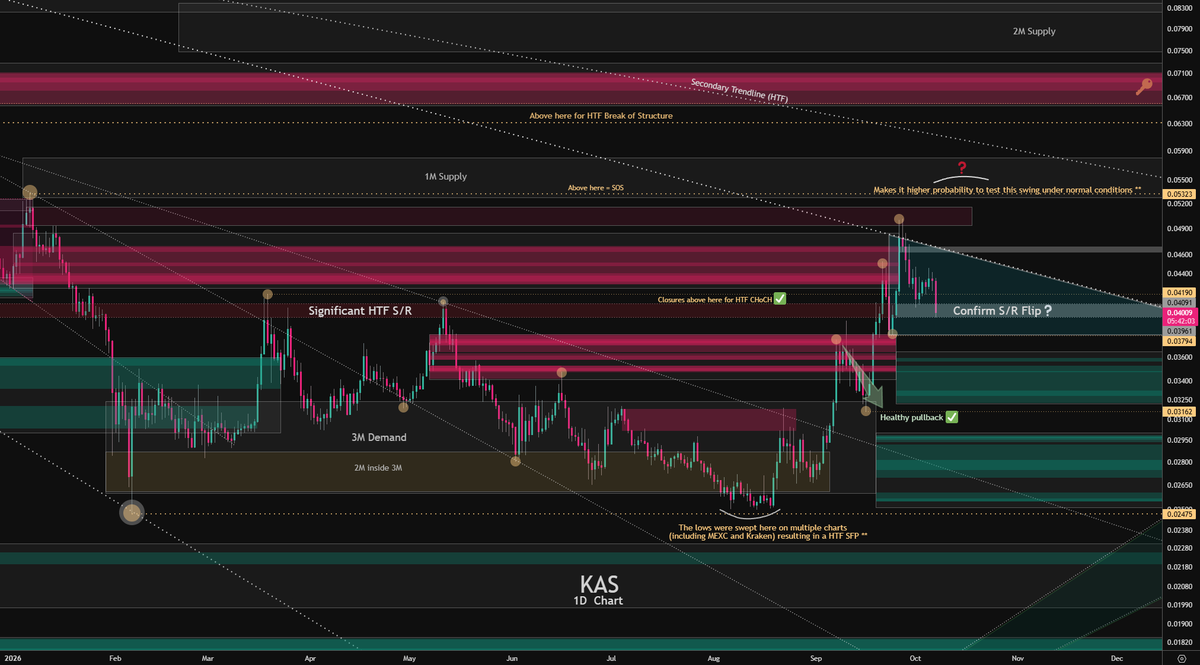
$KAS This will be my last update for a while.
HTF structure is now in a neutral or no-trend - meaning both long and short setups have equal viability. This will be the case until confirming either above 6.3c or below 2.4c.
MTF structure is bullish and will remain so until closures below the 3.8c swing. Some nice areas of support have been built during this drive that could be good areas to look for entries on pullbacks.
Mainly, I'm looking at this now as a big range between 6.3 and 2.4, where pushing past either level will indicate the end of the macro bear trend. Whether that's above 6.3, meaning confirming the bottom at 2.4, or below 2.4 providing the final area for long-term accumulation.
I have no timeframe for any of this, as it's now different enough cyclically that it's not worth factoring in, imo. This just means price could remain in this range for nearly 6 months before it would start to look strange. And on the flip side, price could break out tomorrow and it would look completely natural.
In the short-term, price has rejected from the 2D supply and it's first test of the last MTF trendline before the first HTF (Secondary) TL. Looking at this TL and the 4c S/R as a triangle - reactions here will be the first tip-off of the next move.
The S/R should remain as support. Losing it will be the first sign price will instead look to those lower levels for support. It's still possible to sweep the 5.3c swing before that significant of a pullback as well. Breaking above the TL will be the tip-off this move is coming.
For overhead targets, anything between the 1M and 2M supplies (5.3-8.3c) is on the table before a larger pullback is due. It will be important to monitor HTF closures against the 6.3 swing in the event of a move like this. As I said previously, price can move all the way here and still be favored to make new lows depending on closures.
For lower targets, I believe anything below about 1.3c is now off the table outside of catastrophic circumstances. If the range is broken to the downside, finding a bottom between 2.1 - 1.5c is most likely by a landslide.
Probabilistically, it's now likely the bottom is in. Not drastically - maybe 60/40 - but nonetheless, very close now. Obviously, this will still be swayed but whatever happens with $BTC, which as of now is in the same boat structurally on the HTFs (neutral/no-trend).
That should do it. I'm banking on this info remaining relevant for a while. In the event it does somehow become outdated quicker than expected, I'll do what I can.
GL to everyone and I'll hopefully see you all at new ATHs.
Vi behøves faktisk ikke at skamme os over at sætte Hvide mennesker først.
Eller at mene at den forkerte side tabte WW2.
At Hitler var en stor leder af en smuk ideologi, National Socialisme.
At det bedste der kunne ske var en genopblomstring af Blod, Jord & Ære nationalisme.
Ive given a few days to let dust settle and see what happens to conclude my opinion on $zkas
While I think the idea is good, even great for miners..I will not be going near zkas with a 10 foot pole as an investment
I dont even have an issue with the unlimited supply or tail emissions but..
5% of all zkas mined goes to a dev fund..aka 5% creator tax, first time ever seeing this on a non memecoin
Using KHeavyHash as the mining algo is the best attribute for zkas
For miners, this is great. Merge mine this coin with $kas and dump this kaspa fork for increased profitability
All transactions are private so while the “dev fund” perpetually dumps on people’s heads no one can ever know. How convenient
You have to be mentally ill to think this is a viable long term investment
I will probably use this service to wash my kaspa so there’s no direct link to me
To the early apes in zkas who this strikes a nerve with..try to think critically for a minute, you will get perpetually dumped on by miners and the “dev fund” forever
At 1mm mcap I can’t rule out the possibility it somehow settles a bit higher 2-10 million, I just know if I was a miner I wouldn’t be able to dump this coin fast enough
This reminds me of the dozen or so Bitcoin forks that have died off over the years. One or two of them are still relevant. Would have been better off just holding the big dog only
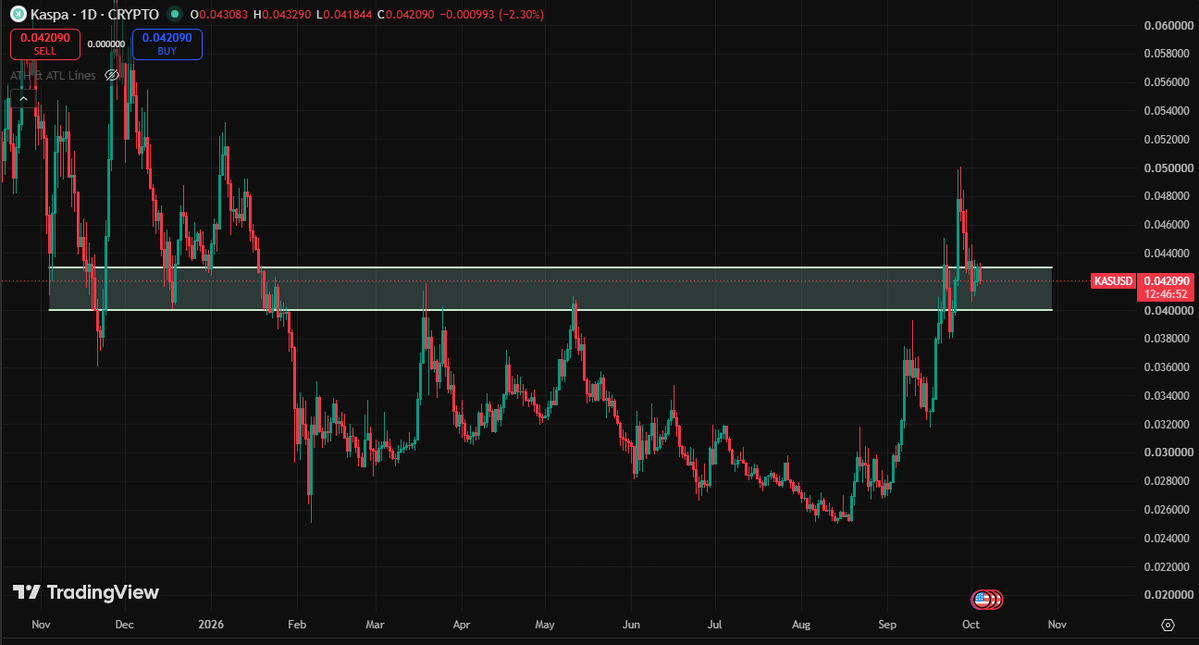
Interesting price area for $KAS 👀
We're in a very tight range between $0.042 and $0.040
If we can bounce over the 4 cents line, we should be able to push back further toward 5 and 6 cents
MUERTO ABURRIDO CANSADO DORMIDO APAGADO
Pero no por mucho tiempo.
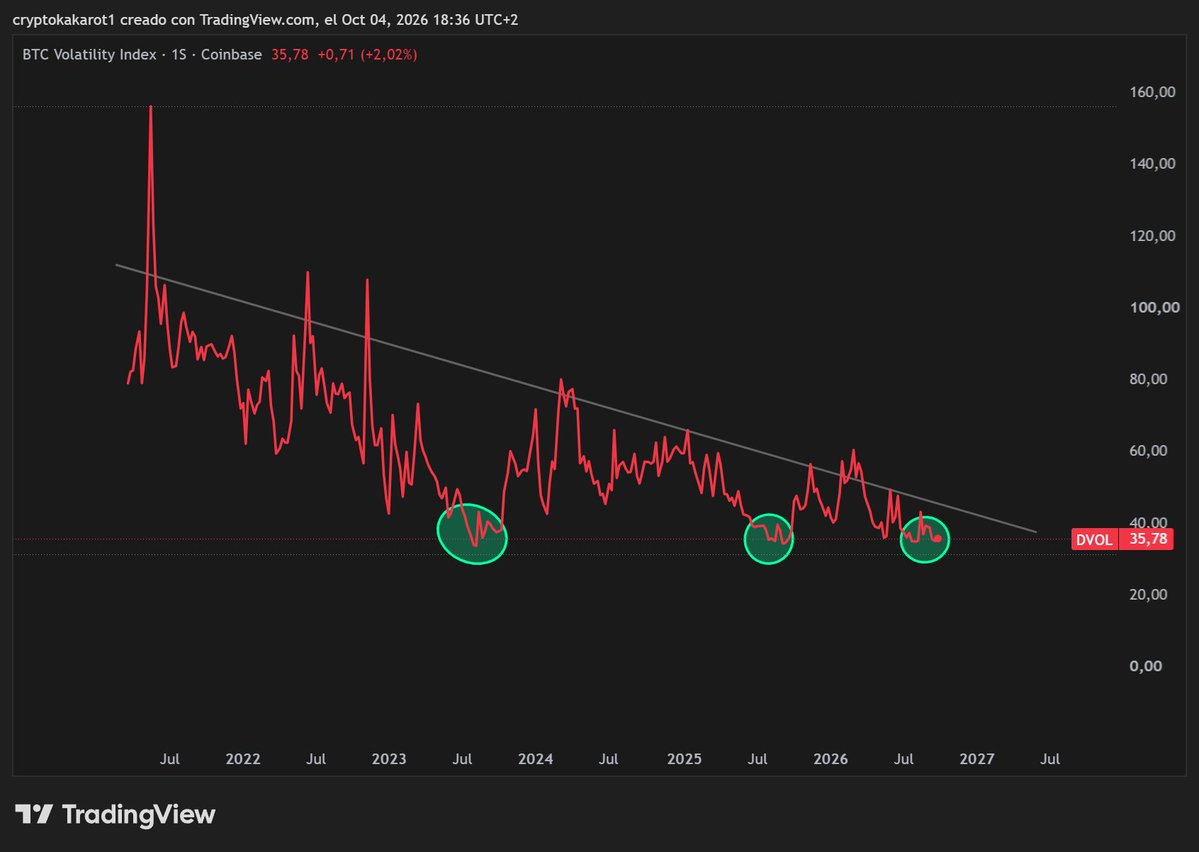
La volatilidad de Bitcoin se encuentra en mínimos históricos.
En los últimos 5 años solo ha estado tan baja en dos ocasiones:
▫️ Verano de 2023, cuando BTC estuvo consolidando en rango durante 6 meses para luego explotar desde los 25K hasta los 72K (+188%) en los 6 meses siguientes.
▫️ Final de verano de 2025, cuando bitcoin:native estuvo haciendo el techo del bull market para luego descalabrarse desde los 126K hasta los 59K (-52%) en los 6 meses siguientes.
En otras palabras, siempre que la volatilidad de Bitcoin ha hecho nuevos mínimos, o los ha tocado, después ha venido un período de al menos 6 meses con movimientos extremadamente violentos y explosivos tanto al alza como a la baja dependiendo de la tendencia de turno.
Pero esta vez está pasando algo bastante raro, anómalo, atípico, y a lo que nadie está prestando atención.
Si nos fijamos en la estructura de la volatilidad se ve claramente que se está comprimiendo durante estos últimos 5 años, con máximos cada vez más bajos, y los mínimos poco a poco se van estrechando...
La volatilidad funciona como un muelle, cuanto más tiempo permanece comprimida, mucho más violenta será la expansión posterior.
Y ya no estamos en bear market, no vamos a caer más, ni a ver nuevos mínimos, la vela semanal salvaje esquizofrénica de agosto en Bitcoin de un +27% fue un aperitivo y un aviso a navegantes.
Este ciclo no será como los anteriores, no creo que vaya a estar Bitcoin subiendo lentamente 3 años, para luego caer durante otro, en mi opinión será mucho más rápido, más efímero, pero mucho más intenso y violento.
Ni siquiera yo estoy preparado para lo que viene.
Aprovecha el silencio antes de que llegue el caos.
No creo que hayamos visto nada igual.
Echaremos de menos estos momentos.