@BullMeechum3 Got it, thanks: decoding done by annealing (QUBO) inside the architecture instead of on a classical machine. Then no impact. The paper bounds what ANY decoder can extract from a region's readout. An annealer solving the QUBO is one such decoder, so it sits inside that bound.
Future quantum computers will split each error-protected qubit’s readout across many decoders and shared wires. If an attacker sees only part of it, how much do they learn? My new paper gives an exact answer, and it’s not what intuition suggests. 🧵
Not shown. Nothing D-Wave has published demonstrates fault-tolerant QEC without decoding. Dual rail flags errors as erasures, which makes decoding easier, not unnecessary. Impact on the findings: none. They don't depend on what does the decoding.
The result is about what a region's measured qubits reveal. At logical readout, whatever decodes (CPU, FPGA, annealer, on-chip analog) receives its region's measured qubits, and the result applies unchanged: if that region misses a column of the code, it learns nothing.
@BullMeechum3 Fair challenge, but the result doesn't assume a classical decoder. It's about what a region's qubits reveal when read out, whoever or whatever decodes them. And yes, decoding is an Ising problem: the paper's threshold is the Nishimori point of one.
For builders: partition decoders and readout lines so no one party’s view spans the code, assemble logical results on trusted hardware, and measure real per-qubit noise. Error correction is not confidentiality. I call this Regional Exposure. Paper: https://t.co/PmJ3FhLFna
Tested on two IBM Heron processors (emulated attacker, not a live hack). The three-row jump showed up in every run. And on real hardware the second row does help: an attacker routes around the worst qubits. Uneven qubit quality explains 90–99% of the gain.
We still need orders of magnitude of improvement for this to impact quantum computing fully, but this Google paper is really showing the potential of AI to improve quantum algorithms. https://t.co/F9zhNgoSPA
Claude says creative things like "gesticulating" or "scheming."
Do you return the favor? Instead of "continue," do you say, "Carry on My Wayward Son" or similar?
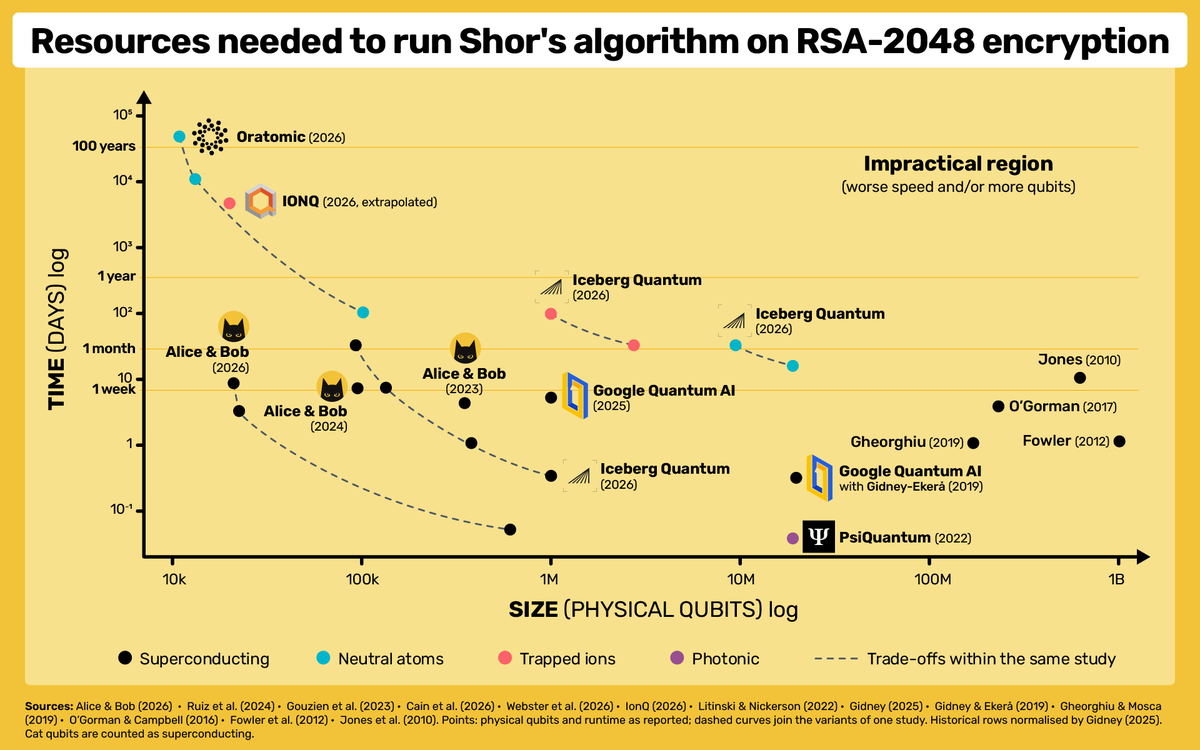
Breaking RSA-2048 with 23,000 cat qubits. 🐈 In 3.14 days
This is the finding of our new paper, the latest resource estimate for Shor’s algorithm, the benchmark the whole field uses to compare quantum hardware 📄
The results are a record low for total quantum resources at this speed of execution, about 40 times fewer physical qubits than @GoogleQuantumAI 's Craig Gidney 2025 estimate. 🏁
RSA-2048 is the lock behind secure websites, banking and software updates 🔐 Shor's algorithm has been able to break it, on paper since 1994. Nobody has built the machine yet, but every year the estimate of how big it needs to be gets a little smaller.
In 2019, the best estimate was 20 million qubits. In 2024, ours was just under 100,000. Now 22,593, in 3.14 days. Yes, pi 🥧
Small isn't enough. Fast isn't enough. The new study optimizes for both. 😼
Bitcoin, Ethereum and most blockchains aren't secure either, about 30,000 qubits would be needed to crack a Bitcoin key in about an hour ₿ ⏳
How we got here, what it means for cryptography, and when it all converges, our CEO Théau Peronnin talks about it in the blog 👇
📝 Blog - https://t.co/K3E5pxTUMv
📄 Paper - https://t.co/kiC9JZz66u
Stay curious, more info coming soon 👀
#QuantumComputing #CatQubits #ShorsAlgorithm #PostQuantumCryptography #Cryptography #FaultTolerance #DeepTech