What's happening in the MLCC market
First off, MLCC as a whole is a $15B market. MLCCs for servers were a $1.3B market in 2025 ($600m for AI servers, $700m for general servers)
The AI server MLCC market is growing at 80%+ CAGR, and the general server MLCC market will also accelerate due to agentic AI increasing CPU demand (around 30%-40% CAGR)
We will see negative growth in the smartphone/mobile MLCC market for at least 2026-27.
Humanoids are another future high-growth market for MLCCs
Book-to-bill ratio for most MLCC suppliers is over 1 now
Reasons for price hikes-
High Nickel & Silver are affecting all segments
There is a supply-demand mismatch in the high-end (high capacitance, high voltage) segment, which is used in autos & servers
High-end MLCC lead time is over 20 weeks
Spot/distributor prices have increased by 20%-40% for low capacitance & consumer device MLCCs due to hoarding and double booking, especially in China
OEM contracts have not seen large price hikes yet
What's happening now:
Rapid capacity expansion happening across the industry
Murata expects blended ASP prices to remain flat (ASP going down in consumer electronics, expansion in AI server market)
Tier 1 players like Murata, Taiyo Yuden, SEMCO building capacity to serve AI server MLCC market
This will create opportunities for Tier 2/3 and Chinese suppliers to expand in the mid to low end market (Macronix effect)
Future:
MLCC production equiment & raw materials suppliers will be the biggest beneficiary of this CAPEX boom
MLCC producer stocks have performed well, and it is finally spilling to raw material/equipment producers
I expect them to outperform MLCC producers now
JP Morgan just raised their Samsung target to ₩480,000.
Samsung is up 143% YTD. Memory peers up 267%. The gap between what CSPs are spending on AI capex and what memory companies are earning is finally closing.
But the bigger story isn’t the price target.
It’s the valuation framework shift.
Memory has always been valued on P/B. Cyclical business, cyclical multiple. Buy low, sell high, repeat.
JP Morgan is now saying: price it on P/E.
Why? Long-Term Agreements.
CSPs and memory makers are negotiating LTAs right now. Once those deals are signed, memory earnings become predictable. Stable. Visible.
That’s not a cyclical business anymore.
That’s a structural growth business.
P/B to P/E is not a small move. It’s a complete re-rating of what memory is worth.
The numbers back it up:
•DRAM price forecast: +293% YoY by end of 2026
•NAND price forecast: +234% YoY by end of 2026
•FY26-27E EPS: 6-18% above consensus
•Shareholder return pool 2024-2026E: ~₩160T
•Special returns expected post Q4 2026
The Samsung strike? JP Morgan flags it as the key near-term catalyst to watch.
A prolonged strike tightens supply.
Tighter supply means higher prices.
The bear case is doing the bull case’s work.
Samsung Electronics (KRX: 005930)
Cyclical no more.
FADU’s Gen5 controller (FC5161) is the highest-performing, lowest-power controller in the industry.
The Gen5 cycle runs from H2 2024 through 2027. During that window, FADU has already locked in 2 hyperscalers and 1 NAND maker as customers.
This isn’t a one-customer story anymore.
Shinhan just initiated coverage on FADU (KOSDAQ: 440110).
Buy. Target price: ₩130,000. That’s 29.5% upside from here.
Key points from the report:
FADU’s Gen5 controller is already beating Marvell on performance. Gen6 is expected to beat Marvell again.
The competitive landscape is narrowing. SanDisk (4% share) and Kioxia (8% share) are estimated to source from third-party fabless controllers — and FADU is the one they’re turning to.
The 2028 NAND controller TAM is projected at 100M+ units annually. FADU’s estimated share: 10%. That’s before hyperscalers start bypassing IDMs entirely and sourcing NAND directly for eSSD production.
The numbers:
•2026F revenue: ₩301.5B(+226% YoY)
•2027F revenue: ₩591.4B
•2028F revenue: ₩863.8B
•Target PER: 40.6x based on 2027-2028 avg EPS of ₩3,262
YTD performance: +372.5%
The “brain” of AI storage infrastructure. Still in early innings.
FADU (KOSDAQ: 440110)
Shinhan just initiated coverage on FADU (KOSDAQ: 440110).
Buy. Target price: ₩130,000. That’s 29.5% upside from here.
Key points from the report:
FADU’s Gen5 controller is already beating Marvell on performance. Gen6 is expected to beat Marvell again.
The competitive landscape is narrowing. SanDisk (4% share) and Kioxia (8% share) are estimated to source from third-party fabless controllers — and FADU is the one they’re turning to.
The 2028 NAND controller TAM is projected at 100M+ units annually. FADU’s estimated share: 10%. That’s before hyperscalers start bypassing IDMs entirely and sourcing NAND directly for eSSD production.
The numbers:
•2026F revenue: ₩301.5B(+226% YoY)
•2027F revenue: ₩591.4B
•2028F revenue: ₩863.8B
•Target PER: 40.6x based on 2027-2028 avg EPS of ₩3,262
YTD performance: +372.5%
The “brain” of AI storage infrastructure. Still in early innings.
FADU (KOSDAQ: 440110)
For everyone saying that IBKR allowing retail to invest in Korean equities will mark the top, there’s very little signal here. Look back to when IBKR enabled Taiwanese equities. Back in July 2023, most of these names traded at truly unjustifiable discounts to their western peers. That discount has gradually narrowed since, and MSCI Taiwan is up about 150% since.
If I'm being ultra bullish, $125 is possible by the end of this year for DRAM, with $250 possible by the end of 2027. Then things likely start to slow down in 2028-2029, maybe reaching a peak of $300-350.
Here's what needs to happen for that $125 to hit IMO: SK Hynix US IPO needs to happen in June or July as planned, Micron needs to announce it's sold out of inventory for 2027 during June earnings call, Samsung employees need to strike this week (can be very short-lived, but this will only increase demand), and the three companies above need to decouple themselves from SNDK, which is not the same thing. HBM is far more bullish than just standard memory alone.
There are a TON of MU calls being bought for the $1100 strike this winter. That's the lowest I see Micron finishing the year. Monitor the call volumes, they've been indicative of every single move during this run.
The “risk” crowd has been wrong for two years straight.
Samsung. SK Hynix. Multi-year rally. Still running.
Getting scared out of generational positions over noise isn’t being careful. It’s being early to regret.
⚠️THIS IS BEYOND ANY COMPREHENSION:
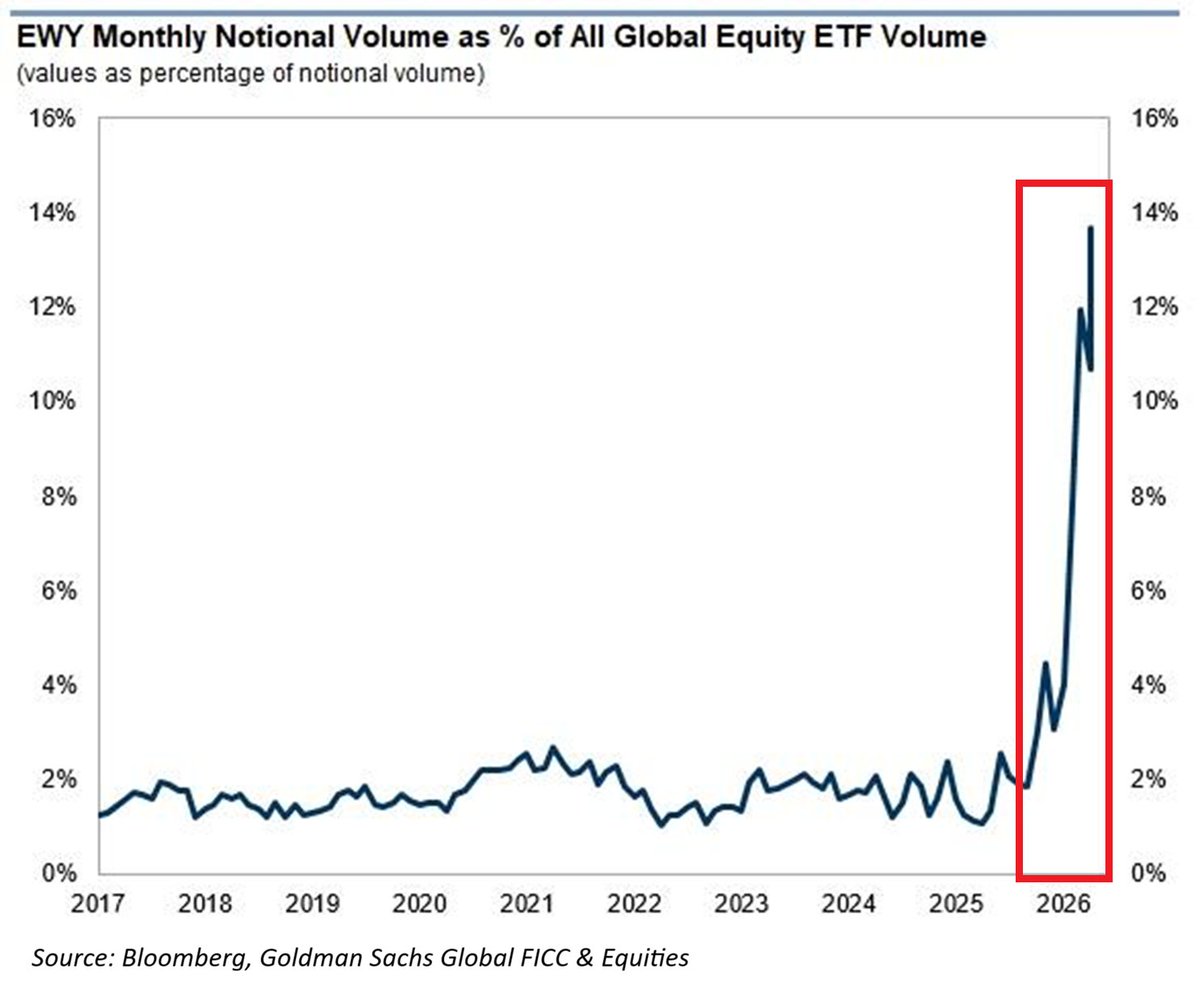
The South Korea ETF, $EWY, now accounts for ~14% of all global equity ETF volume.
This figure is based on a sample of 688 global equity ETFs, per Goldman Sachs.
This percentage has surged by over +500% since 2025.
Over the past year, $EWY has surged +213% and has been the best-performing country ETF in the world.
Modern markets have never seen anything like this.
The market is red today.
But FADU (KOSDAQ: 440110) is up 5%.
That's a signal.
Most people haven't heard of FADU.
Here's why you should.
FADU is a Korean fabless semiconductor company that makes SSD controllers the "brain" of SSD that manage how data flows in and out of storage.
Unglamorous? Sure. Critical? Absolutely.
Every AI datacenter runs on NAND flash storage. Every NAND flash storage needs a controller. FADU makes the best ones.
The customer list tells the story. SK Hynix. SanDisk. And the end customers? Meta. Google. Two of the four major hyperscalers confirmed. Talks ongoing with a third.
The product roadmap is equally aggressive.
•Gen5 controller: shipping now
•Gen6 controller: tape-out complete, revenue expected H2 2026
•Gen7 controller: in development, targeting 100 million IOPS
For reference — Gen6 delivers read speeds of 28.5 GB/s. Double the previous generation.
The company posted losses the last two years due to heavy R&D investment. That cycle is over. Q1 2026 profitable.
Order backlog as of end of last year: ~$70M. Revenue outlook for 2026: already exceeds ₩100B based on disclosed orders alone.
Everyone is talking about HBM.
Nobody is talking about who controls the storage layer of AI infrastructure.
FADU does.
Oh, and FADU is already up 217% this year.
The people who knew really knew already bought it.
The question is whether you're early or late.
FADU (KOSDAQ: 440110)
The market has a recurring delusion.
“The bottleneck is solved.”
It never is. It just moves.
The AI era is no different.
First it was GPUs. NVIDIA became the center of the universe. Every dollar, every conversation, every thesis pointed at one thing: we don’t have enough GPUs.
Then we got more GPUs.
And suddenly not enough power.
Then we solved power.
And suddenly not enough memory.
HBM became the new constraint. The new religion.
Then memory scaled.
And suddenly not enough storage. The speed at which you can read and write data to NAND flash started directly impacting AI inference costs.
Then came the interconnect problem.
Connecting a few servers is easy.
Connecting hundreds of thousands of GPUs into one coherent system? That’s a optical networking problem. A new bottleneck.
And now CPU is making a quiet comeback.
No matter how powerful GPUs get, something has to feed them data and orchestrate the whole system. As AI clusters grow, the CPU’s role doesn’t shrink. It expands.
Here’s the pattern:
GPU → Power → HBM → NAND → Optical → CPU → Cooling → Transformers → Nuclear
The bottleneck doesn’t disappear.
The market’s attention moves. And every time attention moves, multiples get repriced.
This is the game.
Not “what is good.” But: where is the system most constrained right now? And which bottleneck has the market not yet priced in?
The people who answer that question correctly are the ones who capture the big moves.
AI looks like a software story. But the money keeps flowing back to physical infrastructure.
Because compute scales exponentially.
Physics doesn’t.
The bottleneck is still there. It just quietly moved to its next position.
The market is red today.
But FADU (KOSDAQ: 440110) is up 5%.
That's a signal.
Most people haven't heard of FADU.
Here's why you should.
FADU is a Korean fabless semiconductor company that makes SSD controllers the "brain" of SSD that manage how data flows in and out of storage.
Unglamorous? Sure. Critical? Absolutely.
Every AI datacenter runs on NAND flash storage. Every NAND flash storage needs a controller. FADU makes the best ones.
The customer list tells the story. SK Hynix. SanDisk. And the end customers? Meta. Google. Two of the four major hyperscalers confirmed. Talks ongoing with a third.
The product roadmap is equally aggressive.
•Gen5 controller: shipping now
•Gen6 controller: tape-out complete, revenue expected H2 2026
•Gen7 controller: in development, targeting 100 million IOPS
For reference — Gen6 delivers read speeds of 28.5 GB/s. Double the previous generation.
The company posted losses the last two years due to heavy R&D investment. That cycle is over. Q1 2026 profitable.
Order backlog as of end of last year: ~$70M. Revenue outlook for 2026: already exceeds ₩100B based on disclosed orders alone.
Everyone is talking about HBM.
Nobody is talking about who controls the storage layer of AI infrastructure.
FADU does.
Oh, and FADU is already up 217% this year.
The people who knew really knew already bought it.
The question is whether you're early or late.
FADU (KOSDAQ: 440110)
Samsung is quietly making a move in autonomous vehicles.
The weapon: eMRAM �� embedded Magnetic Random Access Memory. A high-performance, ultra-low-power memory designed specifically for self-driving cars.
Samsung just implemented eMRAM on its 8nm process node.
30% better density vs. 14nm. High performance and low power at the same time.
This matters because autonomous vehicles don’t just need fast chips. They need chips that won’t drain the battery or overheat at 120km/h on a highway.
The reference customer? Hyundai.
And the roadmap doesn’t stop at 8nm.
Samsung is targeting 5nm by 2027.
For context — 5nm eMRAM in a self-driving car would be a generational leap. The kind that locks in design wins for years.
Most people are watching Samsung vs. SK Hynix in HBM.
Meanwhile Samsung is building a completely separate moat in automotive semiconductors. Quietly. Methodically.
The automotive chip market is one of the few places where Samsung can win on foundry + memory simultaneously.
And they just got Hyundai on the reference list.
Samsung Electronics (KRX: 005930)
Not just a memory play anymore.
Big Tech is begging SK Hynix for chips.
Not asking. Begging.
According to Reuters, global tech giants are now offering to fund SK Hynix's production lines and even buy ASML EUV machines — worth hundreds of millions of dollars — just to secure memory supply.
Let that sink in.
Your customers offering to buy your equipment for you. That's not a supply chain. That's desperation.
SK Hynix's response? We'll think about it.
Because they can. The company is cash-rich and has zero interest in locking itself into one buyer at discounted prices.
The real signal here isn't the offers. It's what the offers reveal.
SK Hynix and Samsung have both said the same thing: available production capacity is essentially zero. The shortage isn't a 2026 story. It's structural.
So now the industry is negotiating a new contract structure:
•Price floors and ceilings
•30–40% upfront deposits
•Long-term commitments
This is what a seller's market looks like.
The AI boom didn't just create demand for GPUs. It handed the leverage to whoever controls memory.
Right now, that's SK Hynix(000660.KS)
And if you want to own SK Hynix at a discount — there's always SK Square(402340.KS)
https://t.co/xv6jyOOQGF