Mark your calendars: Kpler Pulse Latam Series is back
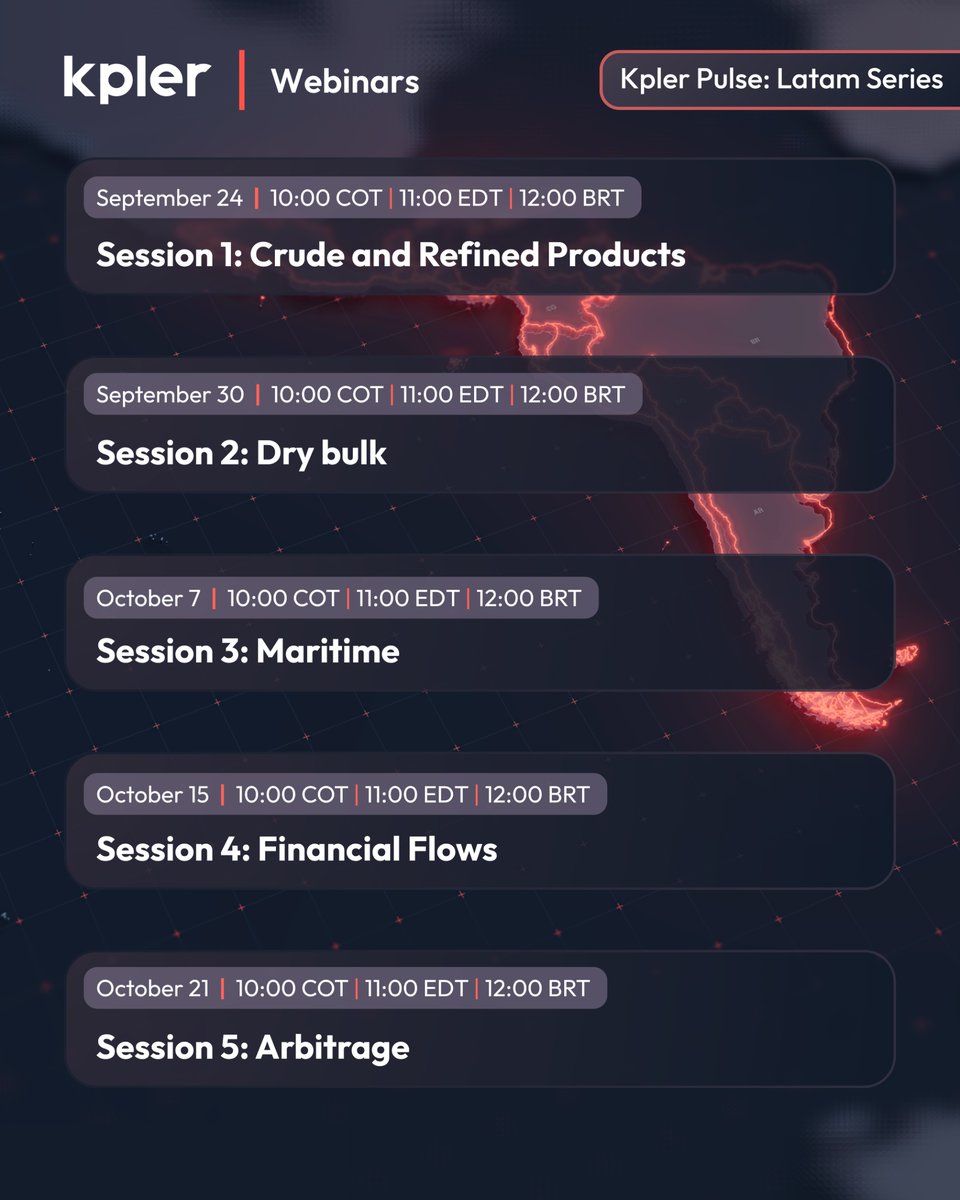
Starting 24 September, we're bringing together Kpler experts for five webinars exploring the forces shaping Latin America's commodity and maritime markets.
📍 24 Sep: Crude & Refined Products
📍 30 Sep: Dry Bulk
📍 7 Oct: Maritime
📍 15 Oct: Financial Flows
📍 21 Oct: Arbitrage
First up: "Latam under pressure: Crude, fuel, and freight in a shifting world."
Join us as we unpack how changing crude flows, fuel markets and freight dynamics are reshaping the region.
🕙 10:00 COT | 11:00 EDT | 12:00 BRT | 16:00 BST
👉 Reserve your spot: https://t.co/WxAk6EO6vE
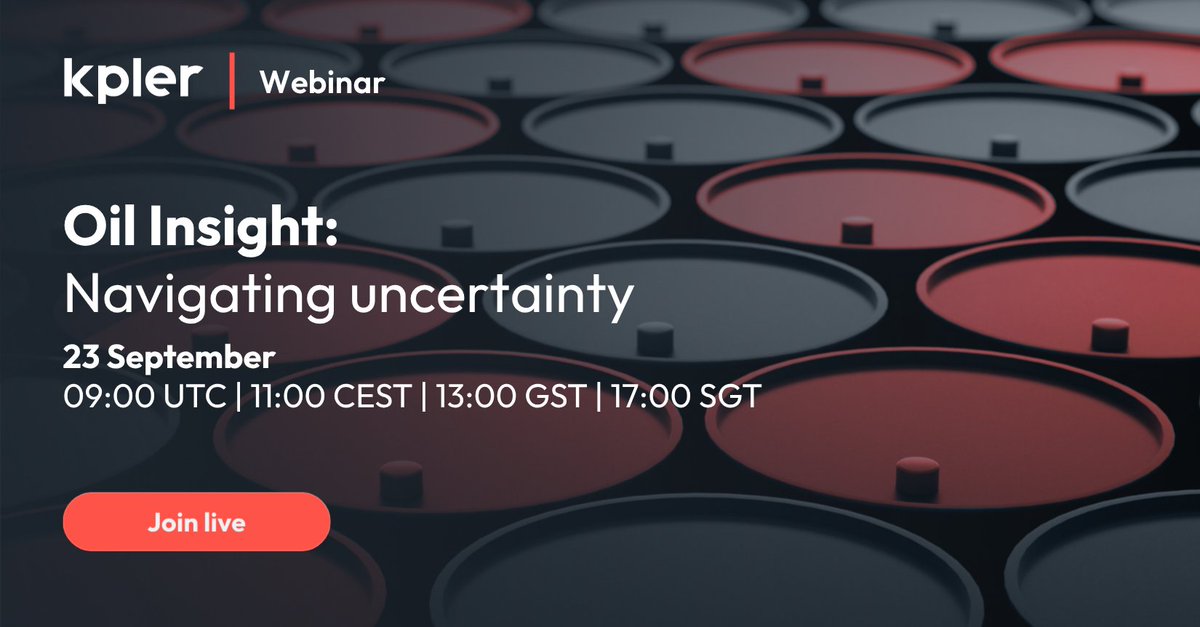
Oil markets are navigating a new wave of uncertainty. Are you prepared for what comes next?
Join Kpler experts Homayoun Falakshahi, Andon Pavlov and Matt Stanley for Oil Insight: Navigating uncertainty, a focused briefing on the latest developments shaping crude and refined products markets.
From Middle East disruption and US–Iran tensions to shifting supply, demand, flows, pricing and margins, our experts will unpack what’s happening now — and the key signals to watch next.
Register now and join us live: https://t.co/xnwJMy9GyO
US copper imports stay elevated as record-value cargo heads for US shores
The CME-LME arbitrage continues to pull copper cathode into the US, with imports running well above year-ago levels through 2026. After record arrivals in July and a softer but still elevated August, Kpler is tracking cargoes scheduled to discharge in September and October.
The question now: can US copper imports hold this pace as tariff uncertainty persists?
Stay ahead of the market with #Kpler Insight: https://t.co/3flst7kAoQ
Red Sea risks tighten gasoil
The Red Sea escalation is moving from crude logistics into gasoil markets. European refinery runs could fall by around 200kbd, while Yanbu gasoil and diesel outflows are already nearly 50% lower year on year. Further aversion to the Bab El Mandeb Strait could delay Indian cargoes and tighten prompt supply in Europe and the Mediterranean. In Asia, concerns over crude feedstock availability could restrain refinery runs and reduce opportunistic diesel exports, including from China. With global refining capacity already a constraint, the latest disruption adds another layer of support to gasoil markets.
Stay ahead of the market with #Kpler Insight: https://t.co/PHkCdnvNKf
Saudi disruption reshapes crude flows
Saudi Arabia’s East-West pipeline disruption has removed a key bypass around Hormuz just as Yanbu inventories are running low. Stronger Dubai structure has reopened west-to-east arbs and intensified competition for Atlantic barrels. Europe remains tight as Forties moves east and Saudi availability falls, while WTI looks increasingly cheap abroad despite tightening US balances.
Real-time tools to enable faster, better decisions: https://t.co/CJaApvVeai
Saudi oil exports pivot east
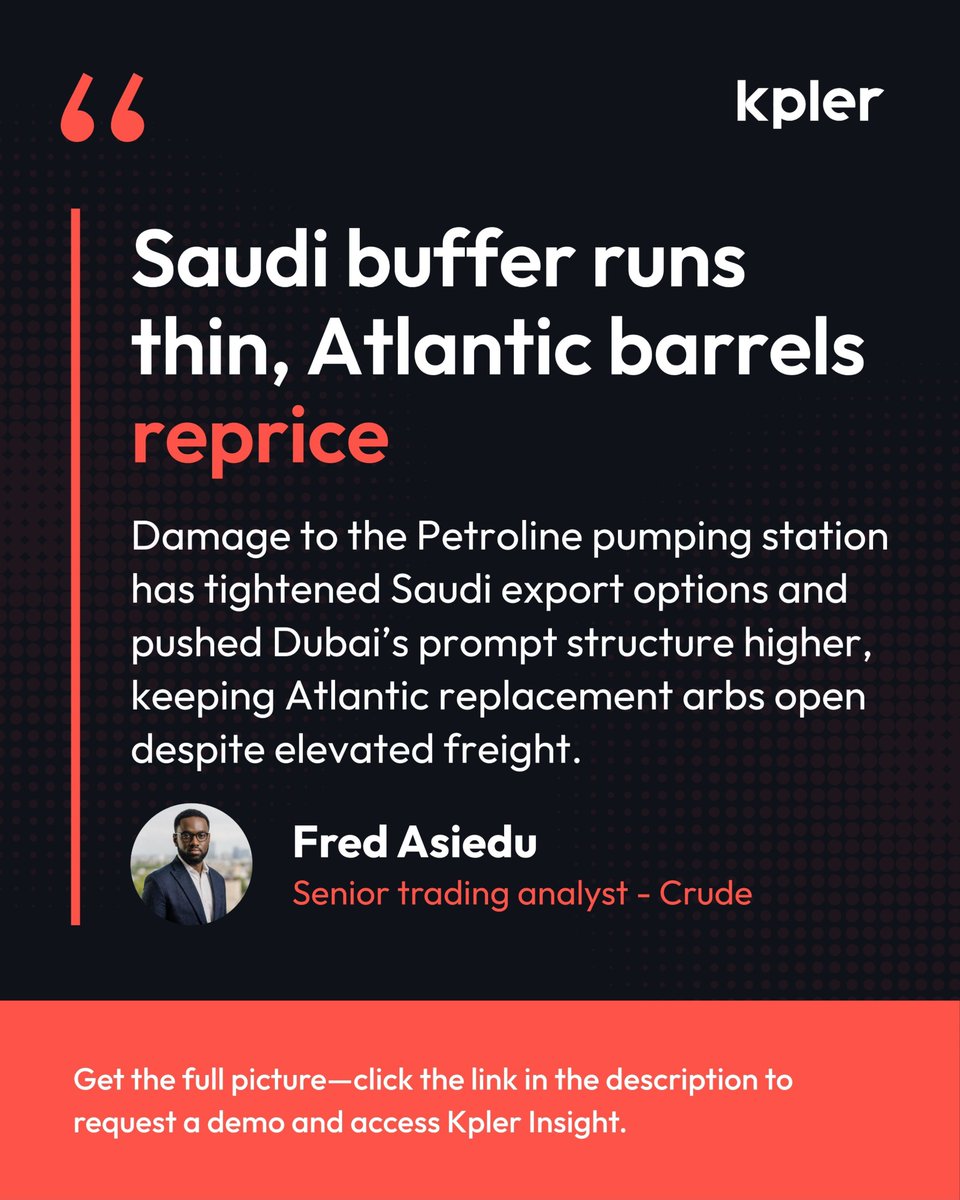
Damage to Saudi Arabia’s East West Pipeline has shifted the #oil market’s focus from pipeline integrity to export logistics. Kpler’s base case assumes Petroline returns at around 50% of its pre-attack throughput after repairs of up to six weeks, potentially cutting Yanbu exports by 2.5 to 2.7 mbd. Saudi Arabia has sufficient tanker capacity to redirect roughly 3 mbd through Ras Tanura, requiring about 25 additional shuttle VLCCs per month. The bigger constraint is geopolitical. Greater reliance on Persian Gulf terminals means greater exposure to the Strait of Hormuz, keeping Dubai differentials supported even as the initial extremes ease.
Stay ahead of the market with #Kpler Insight: https://t.co/bTVcJriN0Z
Washington runs out of levers
US refiners are already running near their limits, yet fuel prices and refining margins remain elevated. Now, Washington is pulling another lever: supply diplomacy. President Trump has urged Ukraine to halt strikes on Russian refineries as disruption to global fuel supply intensifies. But with refining capacity stretched and pressure at the pump persisting, the options are narrowing.
Stay ahead of the market with #Kpler Insight: https://t.co/6pA9B4RD1O
Six months of the Iran war — 45 seconds of market impact.
From ceasefires and disrupted Strait of Hormuz traffic to #tanker attacks and vessels going dark on AIS, the conflict has repeatedly reshaped energy markets and maritime flows. Watch the timeline to see how key events unfolded alongside Brent crude and gasoil prices.
Stay ahead of the market with #Kpler Insight: https://t.co/FiqAXw97Y2
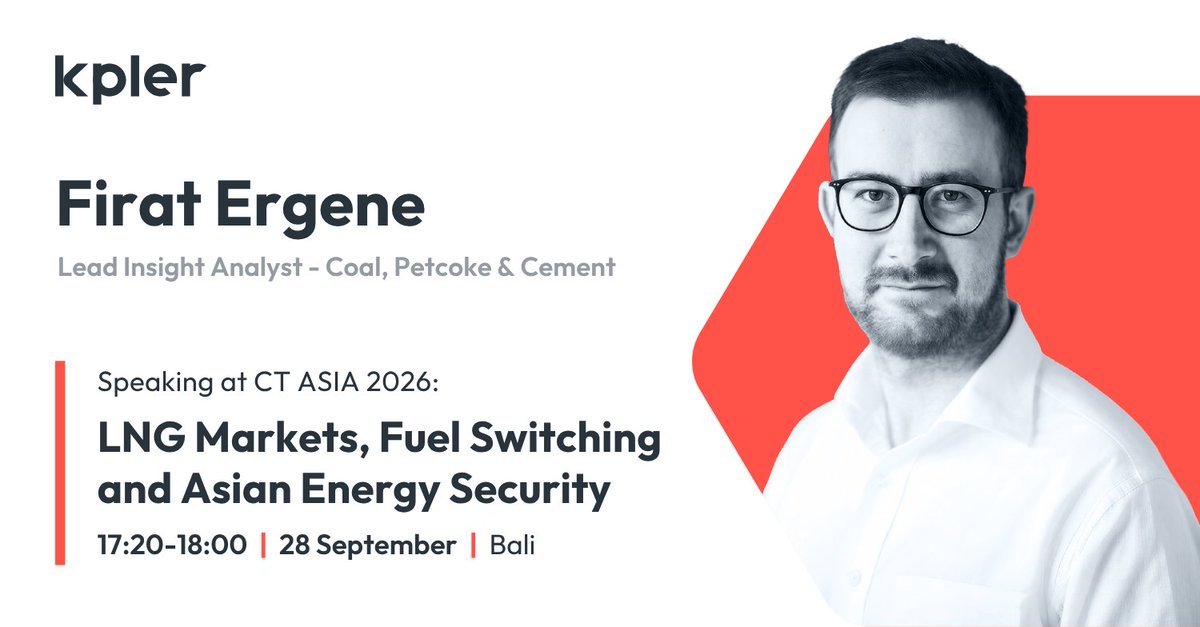
Heading to CT Asia 2026 in Bali?
Join Kpler’s Firat Ergene, Lead Insight Analyst – Coal, Petcoke & Cement, as he takes the stage at CT Asia 2026 on 28 September. Firat will be discussing LNG markets, fuel switching and Asian energy security, looking at how changing fuel economics, shifting trade flows and evolving supply dynamics are influencing energy decisions across the region.
With CT Asia co-located with the International Critical Minerals and Metals Summit for 2026, the event will bring together leaders from across coal, energy, mining and critical minerals to explore the forces shaping Asia’s energy and commodities landscape.
Toronto markets in focus
Commodity markets continue to contend with changing supply dynamics, trade flows and demand signals. On 15 September, Kpler will bring market participants together at SixtyEight at Scotia Plaza in Toronto to examine the forces shaping oil, agriculture and dry bulk.
Eric Nuttall of Ninepoint Partners and Rory Johnston of Commodity Context will join Kpler’s Matt S. for a fireside discussion on the #oil market. Matt Darragh and Alexis Ellender will then share their outlooks for agricultural and dry bulk markets.
The programme runs from 3:00pm to 6:30pm, followed by a networking reception. Limited seats remain. See you there. https://t.co/EyGJRAlZ8Z
We're bringing together decision-makers from across the commercial #shipping market for a briefing in Miami.
The discussion will centre on:
◾ AIS spoofing and dark STS transfers — what defensible vetting looks like in practice
◾ The shadow fleet's role in ton-mile demand and rates
◾ Trade routes reshaping around emerging market disruptions
Reserve your seat: https://t.co/w60l83hgac
What global uncertainty means for LATAM?
Latin America may be geographically distant from many of today’s conflicts, but it is not insulated from their consequences. Changes in #fuel prices, #shipping routes and trade flows are already shaping the region’s economic outlook, yet Latam often receives limited attention in the broader global debate.
Our upcoming series of five webinars will examine how these pressures are reaching the region, what they mean for businesses and economies, and why Latin America deserves a more prominent place in the conversation.
Asia pulls, freight takes the margin
Limited Hormuz flows and falling Iranian floating storage are keeping Asian buyers focused on Atlantic Basin barrels. That demand has helped clear Europe’s prompt length and firm DFL, while relatively cheap WTI keeps Midland competitive into Asia. The arbs remain open, but freight is taking a growing share of the margin.
Real-time tools to enable faster, better decisions: https://t.co/PiT77siFIw
Coal prices rise as supply risks build
Coal markets are strengthening into winter as higher gas prices improve the economics of #coal fired generation across Europe and Asia. Supply uncertainty is reinforcing the move, with Chinese mine safety restrictions, drought disrupting Indonesian logistics and Black Sea shipping risks complicating Russian exports. India is expected to increase seaborne buying from October as utility inventories decline, while tighter fundamentals in China could add further demand later in winter. Together, these factors are keeping thermal coal prices supported despite softer import demand from China and India so far this year.
Stay ahead of the market with #Kpler Insight: https://t.co/QsfIPtpoqq
On plenty of desks, a position update lands on WhatsApp before it lands anywhere else, and it stays there, disconnected from the tonnage list.
We just launched WhatsApp integration for Kpler #Chartering: positions and fixtures shared over WhatsApp flow straight into your terminal. No copy-paste, no missed circulars. Brokers shortlist before the inbox is even open, the edge that gets you there first.
Charterers get a cleaner tonnage picture without waiting on a broker to type it up. Owners and operators see real fleet availability, not a spreadsheet updated after the fact.
If your desk still runs on WhatsApp and email side by side, disconnected from each other, this is what closing that gap looks like.
Book a demo: https://t.co/zxRU0mecE1
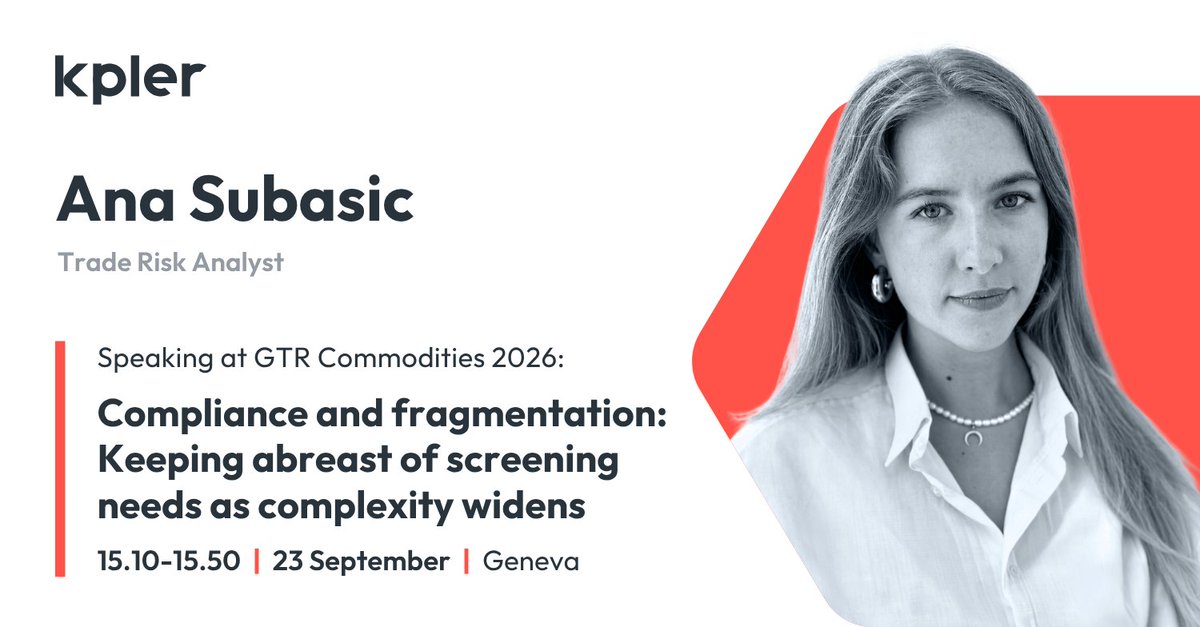
Ana Subasic, Trade Risk Analyst at Kpler, will be speaking at GTR Commodities 2026 in Geneva on 23 September.
She’ll join the session “Compliance and fragmentation: Keeping abreast of screening needs as complexity widens,”looking at how growing complexity across global trade is reshaping compliance and screening requirements.
Bringing together more than 600 senior professionals, GTR Commodities will explore some of the biggest challenges facing commodity trade, from geopolitical disruption and market volatility to risk, compliance and supply chains.
📍 Geneva | 🗓️ 23 September | 🕒 15:10–15:50
Join us in Ontario for the Kpler Market Briefing Toronto, bringing together Kpler experts and industry leaders for an afternoon of insights into the trends shaping global #commodity markets.
Hear from leading voices across oil, agriculture, and dry bulk, including:
◾ Fireside chat: Navigating Today’s #Oil Markets with Eric Nuttall, Partner at Ninepoint Partners, and Rory Johnston, Oil Market Researcher, moderated by Kpler’s Matt Smith. The conversation will explore the forces driving today’s oil markets and what to watch next.
◾ Agricultural Commodity Market Outlook with Matthew Darragh, covering key developments across global supply, demand, and #trade.
◾ Dry Bulk Commodity Outlook with Alexis Ellender, exploring freight markets, shifting trade flows, and emerging risks.
Connect with peers, hear directly from market experts, and leave with a clearer view of what’s ahead across global commodity markets.
📍 SixtyEight Scotia Plaza, Toronto, Ontario
📅 September 15, 2026 from 3:00pm-6:30pm CT
🔗 Register here: https://t.co/uQty4k6PHE
We published our Q2 refinery estimates on July 8. Earnings season just ended. Here's how we did.
Using Kpler's global commodity flow data — vessel tracking, refinery throughput, #crude imports — we modeled Q2 production, runs, revenue, and gross margins for 20 publicly traded refiners before a single company had reported.
The results:
◾ Crude #oil runs: accurate within 2.45% of actuals
◾ Refinery revenue: accurate within 5% of actuals
◾ 93% directional accuracy on revenue YoY signals (13 of 14 tickers)
These numbers were locked in three weeks before earnings.
If your thesis on a refiner depends on getting runs, utilisation, and margin direction right before the print — this is the data infrastructure that makes that possible.
Read more: https://t.co/tBUrHPNPnL
India’s coal imports set to rise
India is likely to step up thermal coal imports from October 2026 as strong power demand and weaker domestic production draw down utility inventories. #Coal generation rose to 114 TWh in August, nearly 14% above last year, while power sector consumption rises to roughly 77 Mt. At the same time, power plant stocks are forecast to fall to around 27 Mt, about half their year earlier level. Domestic production should recover from October, but may not be sufficient to rebuild inventories quickly. With hydro generation weak and #solar output easing into winter, seaborne coal will become increasingly important for maintaining supply security.
Stay ahead of the market with #Kpler Insight: https://t.co/8qUDlNmtsK